
Gustave Courbet was the swaggering father of Realism, the painter who threw out gods and goddesses and put stone breakers, peasants and his own huge ego onto canvases the size of history paintings.
Jailed for his part in a revolution, he died in exile, still paying the bill. In between he founded Realism at the 1855 World’s Fair, built his own pavilion to spite the official Salon, and painted The Origin of the World, the frankest nude of its century.
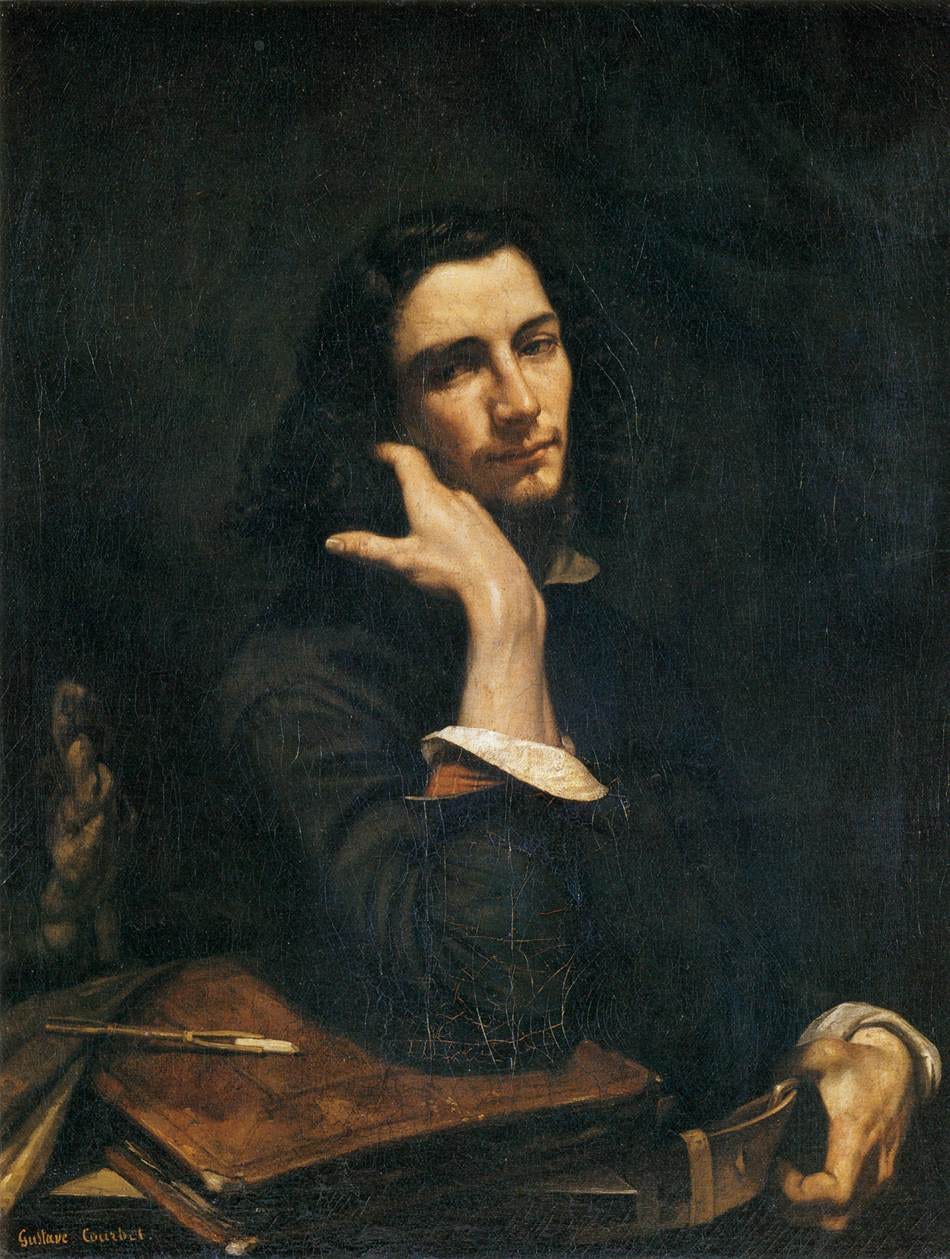
Loud, political and endlessly quotable, Courbet turned his whole career into a running provocation, and it changed the course of art.
More incredible painter stories
If Gustave Courbet pulled you in, you will love these too:


Gustave Courbet at a glance
1819. Born in Ornans, in the Franche-Comté.
1850. A Burial at Ornans scandalized the Salon by giving villagers royal scale.
1855. Built his own pavilion of Realism next to the world’s fair.
1871. Blamed for the fall of the Vendôme column after the Commune.
1877. Died in Swiss exile, days before the first payment on the column came due.
Realism as a weapon
Asked to paint angels, Courbet snapped that he would paint one the day someone showed him one.
Instead he painted Realism: laborers crushing rock in The Stone Breakers, a whole village at a graveside in A Burial at Ornans, plain people made monumental. Critics were appalled that ordinary life filled a frame meant for kings and saints.
The painting that stayed hidden for a century
In 1866 he painted one of the most explicit nudes in the history of art, a close cropped female body he called The Origin of the World.
For more than a hundred years it passed quietly between private owners, too frank to hang in public. Today it is one of the most visited works in the Musee d'Orsay.
His own one man show
When the 1855 World's Fair in Paris rejected his giant canvas The Painter's Studio, Courbet built his own Pavilion of Realism next door and charged admission.
It was one of the first times an artist staged a solo show in open defiance of the official system, a move every independent artist since has echoed.
Courbet's own face turns up in Fantin-Latour's 1864 group portrait Homage to Delacroix, standing alongside Baudelaire, Manet and Whistler.
The column that ruined him
Courbet was a committed radical. During the Paris Commune of 1871 he was held responsible for the toppling of the Vendome Column, a monument to Napoleon's wars.
He was jailed, then ordered to pay for rebuilding it, a crushing sum. He fled to Switzerland and died there in 1877, reportedly the day before the first payment fell due.
How he cleared the way for Manet and the Impressionists
Courbet kicked open the door for modern art. By insisting that the real, the rough and the everyday deserved the grandest treatment, he made the work of Manet, the Impressionists and almost everyone after them possible.
He was his own best advertisement, and he knew it.
The self taught son of Ornans
Courbet was born in 1819 in Ornans, a farming town in eastern France, the son of a prosperous landowner, and he kept that provincial pride all his life. He had almost no formal training.
He taught himself in the Louvre instead, copying the Spanish and Dutch masters he loved, Rembrandt, Frans Hals, Velazquez, Zurbaran and Ribera. Their dark, earthy realism runs right through his own thick, blunt handling of paint.
The Orsay, where his scandals still hang
In New York, the Metropolitan Museum of Art hangs his 1868 nude The Woman in the Waves.
The Musee d'Orsay in Paris holds his great Realist statements, including A Burial at Ornans and The Painter's Studio. His scandalous Origin of the World is there too, no longer hidden away.
Paris, and years spent copying the old masters
Courbet came to Paris around 1839, sent by his father to study law. He dropped it fast.
Instead he worked in the free studios where models posed but no professor corrected you. He taught himself by copying. He spent his days in the Louvre in front of the Spanish and Dutch painters: Velazquez, Zurbaran, Rembrandt, Frans Hals, and the dark, heavy shadows of Ribera.
That copying explains the thick paint and earthy browns he never gave up. He learned the trade from dead men on museum walls, not from a teacher who could hand him a prize. It made him an outsider on purpose, and he stayed one.
A Burial at Ornans, and the scandal of size
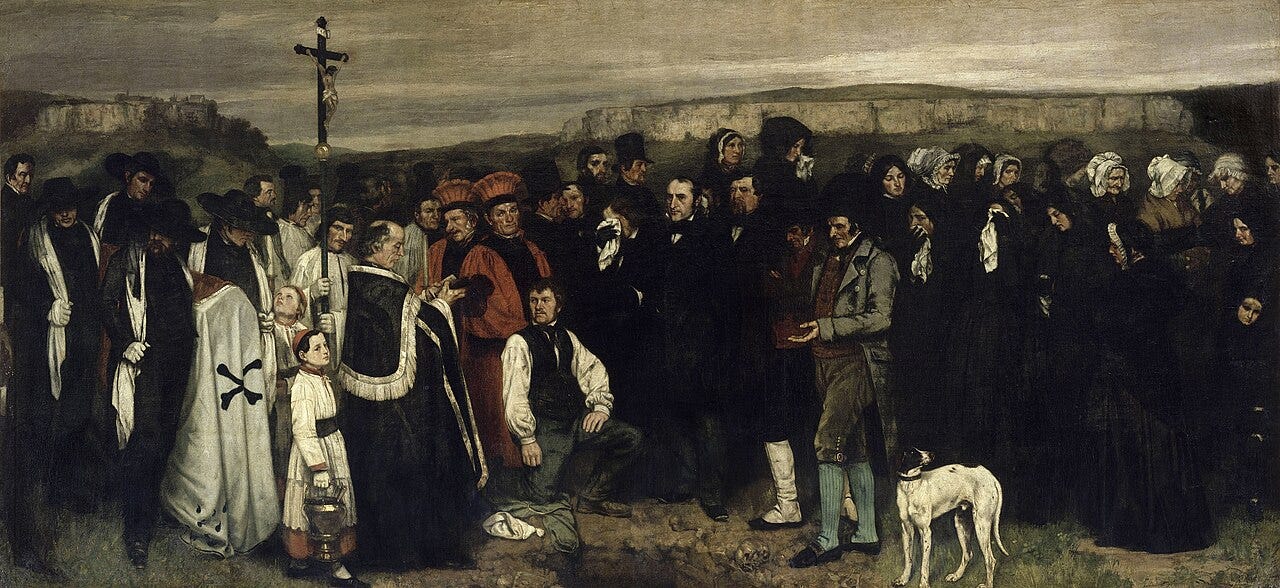
In 1849 and 1850 Courbet painted a funeral in his home village. The canvas runs over 20 feet wide. More than forty villagers stand around an open grave, and Courbet knew most of them.
The shock was the scale. Life size figures were reserved for saints, kings, and scenes from ancient history. Courbet gave that treatment to ordinary country people in their Sunday clothes.
At the Salon of 1850 and 1851, critics called the figures ugly and the whole thing common. They felt he had smuggled peasants into the space meant for heroes.
That was the point. Today it hangs in the Musee d'Orsay and counts as one of the first great Realist paintings.
The Stone Breakers, the painting bombs erased
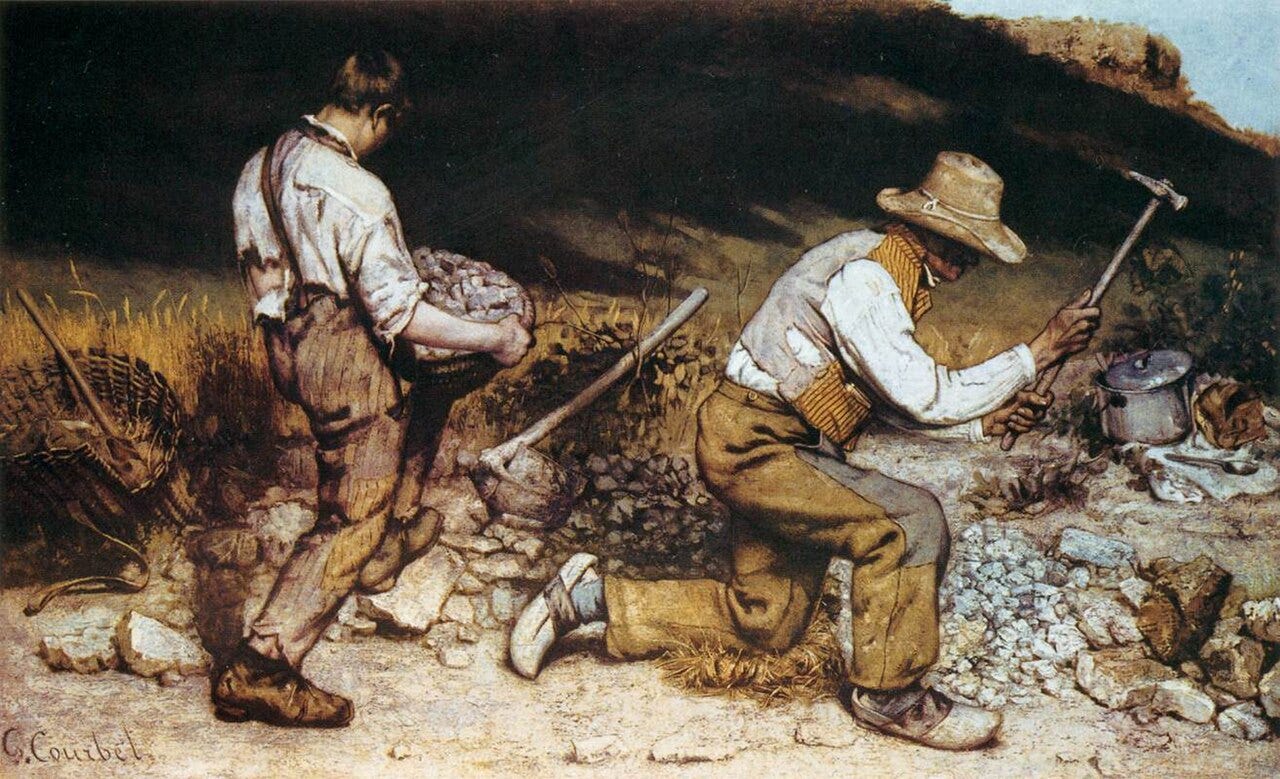
Painted in 1849, this one showed two roadside laborers cracking rocks. An old man and a young boy, backs bent, faces half hidden. Courbet's laborers were part of a much longer tradition, mapped in Blacksmiths and Workers in Painting.
No message, no drama, no lesson. Just hard work rendered plainly, which was itself a kind of protest in 1849. Socialists loved it. Courbet's friend Proudhon read it as a portrait of the class that carried France on its shoulders.
Here is the sad part. You cannot see the real thing anywhere. The painting hung in the gallery in Dresden, and it was lost in February 1945, when Allied bombing destroyed much of the city and the art stored there. Only photographs and copies survive.
The Painter's Studio, a puzzle he never fully explained
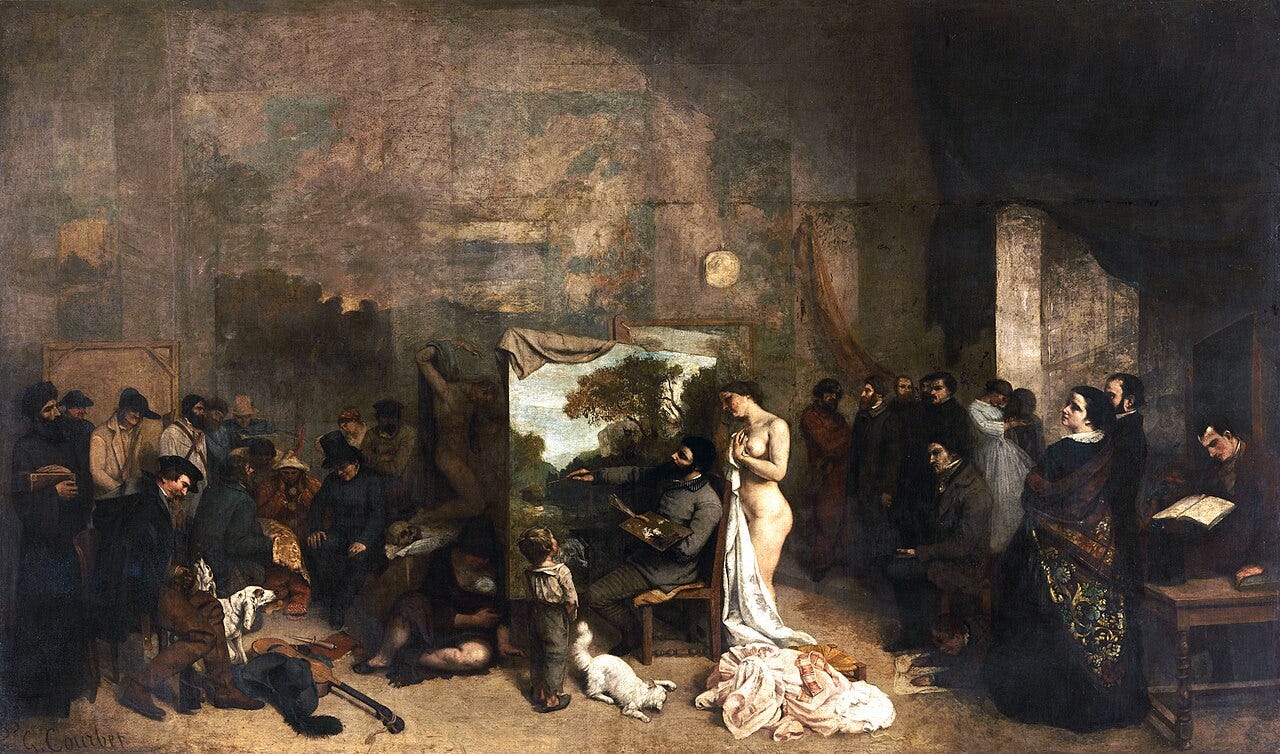
In 1855 Courbet finished a canvas nearly 20 feet across and gave it a strange subtitle: a real allegory summing up seven years of his artistic life.
He sits in the middle, painting a landscape. A nude model stands behind him and a small boy watches. On one side, the types from his own pictures, a hunter, a laborer, a beggar. On the other, his friends and supporters, including the writer Proudhon.
What it all means is still argued over, and Courbet enjoyed that. The jury of the 1855 Exposition Universelle refused it, so he showed it himself nearby. It now belongs to the Musee d'Orsay.
The hunting and landscape pictures that paid the bills
The scandals made his name. The landscapes made his money.
Courbet grew up in the Franche Comte, the wooded country of eastern France, and he hunted there all his life. He knew the limestone cliffs of the Jura, the deep pools of the Loue river, and the deer that moved through the forest.
He painted them again and again, and in 1864 alone he made several versions of the spot where the Loue bursts out of its cave.
He also sold snow scenes, stags at bay, and dead game. These found buyers when the peasant pictures only found insults. The countryside that shaped his eye also kept him fed for years.
Atheist, socialist, and Proudhon's friend
Courbet made no secret of his politics. He called himself a republican by birth and leaned toward socialism his whole life.
His closest thinker was Pierre Joseph Proudhon, the writer famous for the line that property is theft. Courbet painted him in 1865 with his children, seated on a doorstep, and treated him like a hero.
He did not believe in God, and his art shows it. There are no angels, no miracles, no glow from heaven. A burial is just a hole in cold ground.
That plainness was a statement. Courbet wanted paint to show the world as it is, without the comforting stories the church and the Salon liked to tell.
Khalil Bey and the nudes made behind closed doors
In 1866 a wealthy Ottoman diplomat in Paris, Khalil Bey, commissioned private nudes from Courbet. Khalil Bey was a gambler and a collector of erotic pictures.
For him Courbet painted The Sleepers, two women asleep together in a tangled bed. He also painted the explicit close up nude now known as the origin of the world.
These were never meant for a public wall. They were shown to guests in private, which only grew the whispers around them. Khalil Bey soon lost his fortune at the gaming tables and sold everything, and the pictures passed from owner to owner for decades.
The medal he threw back
In 1870 the government of Napoleon III offered Courbet the Legion of Honor, France's highest decoration. Most artists would have bowed and accepted. Courbet turned it down in public.
He wrote an open letter saying the state had no business ranking artists, and that he wanted to stay free of any government. He signed off insisting he would go to his grave with no title but his own name.
It was a calculated insult, and it landed. Within months the empire fell in the war against Prussia. The refusal fit the man. He had spent twenty years telling official France he did not need its approval, and he meant it right to the end.
The Commune, and a myth worth correcting
When the Paris Commune rose in March 1871, Courbet joined in. He was elected head of a federation of artists and put in charge of the city's museums and its yearly Salon.
His real work during those weeks was protection, pushing to guard monuments and the Sevres porcelain works while the city was under fire.
Here is the myth to drop. Many people believe Courbet personally pulled down the Vendome Column, the tall bronze monument to Napoleon's army.
He did not. The Commune voted to topple it, and it fell on 16 May 1871. Courbet had spoken against the monument for years, so he was made the scapegoat, but he took no part in the actual demolition.
Exile, an old inn, and a death timed with cruel irony

After the Commune was crushed, Courbet was arrested, jailed, then hunted for the cost of the fallen column. Rather than pay, he crossed into Switzerland on 23 July 1873.
He drifted through a few towns and settled at La Tour de Peilz, on Lake Geneva, where he bought an old inn.
In 1877 the state fixed his bill for the column at 323,000 francs, to be paid over many years. The first payment fell due on 1 January 1878.
He never made it. Worn out and drinking heavily, Courbet died on 31 December 1877, one day before the first installment was owed. The debt died with him.
More secrets to unlock


Gustave Courbet declared that painting should show only what the eye could see, no gods or allegories; Rosa Bonheur applied that same realist creed to animals, studying carcasses at a Paris slaughterhouse to learn muscle and bone before she painted The Horse Fair.
The Gustave Courbet questions that keep coming up
Who was Gustave Courbet? The French painter who founded Realism.
When was he born? In Ornans, France, in 1819.
How did he die? In exile in Switzerland, in 1877, ruined by a fine.
What is he famous for? The Stone Breakers, A Burial at Ornans, and The Origin of the World.
What movement did he start? Realism.
Where can I see his work? The Musee d'Orsay in Paris holds the key pieces.
Did Courbet go to art school? No. He briefly studied law in Paris, then trained himself in private studios and by copying old masters in the Louvre.
Who paid Courbet to paint his most explicit works? Khalil Bey, a former Ottoman diplomat living in Paris and a private collector of erotic art, commissioned them in 1866. He later lost his fortune gambling and sold everything.
For me Courbet's nerve is the whole point. He took the giant canvas that Europe saved for coronations and crucifixions and filled it with a village funeral, nearly seven meters of ordinary mourners standing at your eye level in the Orsay.