
John William Waterhouse was the English painter of doomed heroines and enchantresses, the last great romantic of the Pre Raphaelite tradition.
The Lady of Shalott drifting to her death, Circe offering a poisoned cup, nymphs luring a young man into a pool. He painted myth and poetry with such dreamy beauty that his pictures are still some of the most reproduced in the world.
Born in Rome in 1849 and working in London until 1917, he gave the Victorian love of legend one last unforgettable face.
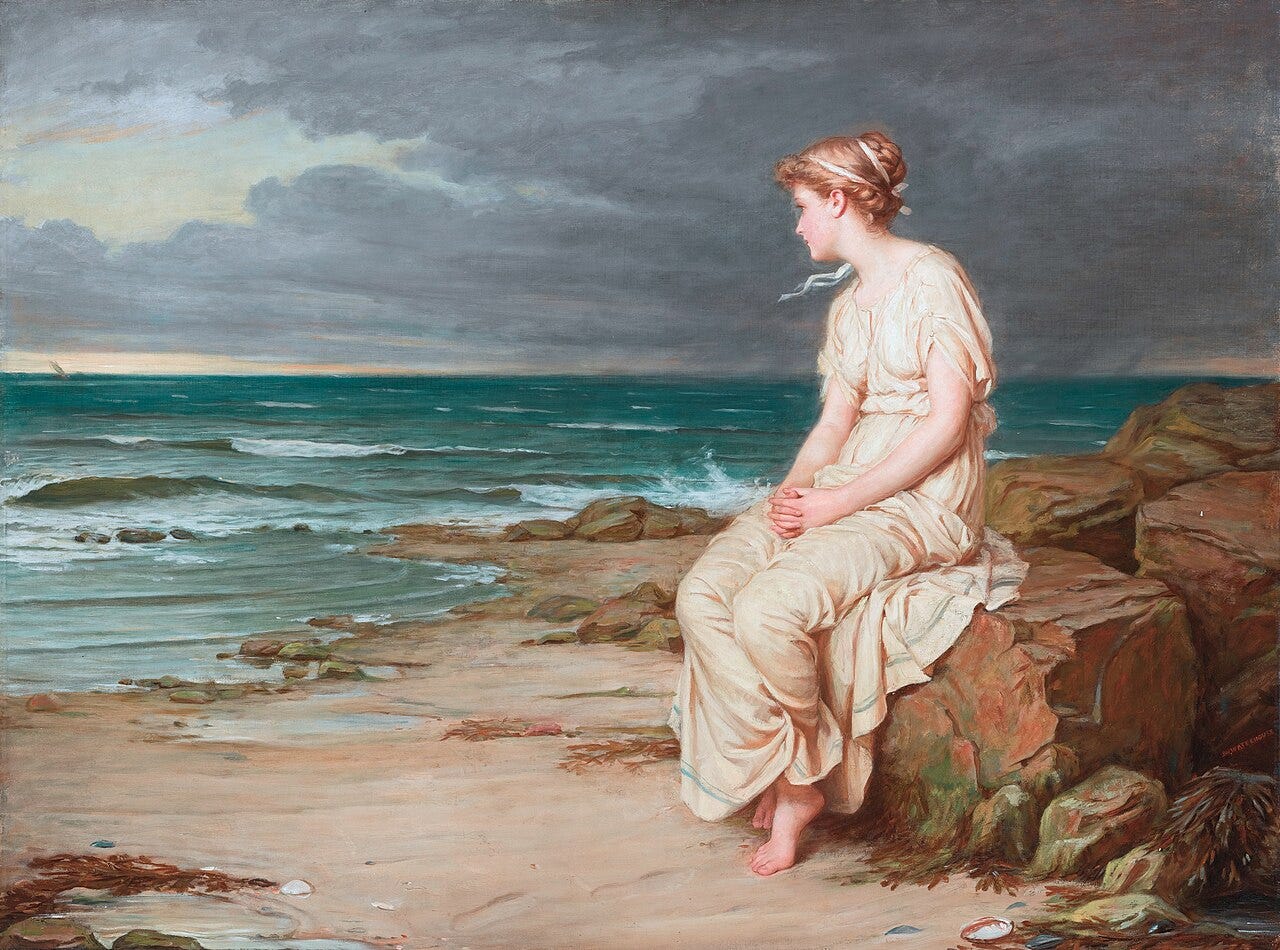
He arrived a generation after the original Pre Raphaelites, and fused their jewel like detail with a softer, moodier touch all his own.
Born: Rome, 1849, to English painters
Known for: literary and mythological women, dreamy romanticism
Died: London, 1917
More incredible painter stories
If John William Waterhouse pulled you in, you will love these too:


The last Pre Raphaelite
The original Pre Raphaelite Brotherhood had formed back in 1848. Waterhouse came later, but carried their love of literature, nature and beautiful melancholy into the new century.
Critics call him a modern Pre Raphaelite. See what is Pre Raphaelite art.
He painted detailed flowers and fabrics like them, but loosened his brush, giving his scenes a soft, atmospheric haze closer to Symbolism.
Women from myth and verse
His great subject was the heroine from poetry and legend, usually at a moment of fate. The Lady of Shalott, from Tennyson, floats down the river to her death. Circe and the Sirens use beauty as a weapon. Ophelia sinks among the flowers.
He returned again and again to the same red haired, faraway eyed woman, a type so recognisable it is simply called the Waterhouse woman.
Hylas, and a modern controversy
His Hylas and the Nymphs shows a young man being pulled into a pond by a circle of beautiful water spirits. In 2018 a Manchester gallery briefly removed it to spark debate about how such images present women, then put it back after public uproar.
The episode showed how alive these century old paintings still are, and how differently each age reads them.
You can see his best known painting, The Lady of Shalott, at Tate Britain.
The boy called Nino, born in a Roman studio
John William Waterhouse was born in Rome in 1849. Both his parents were English painters working in the city, and in the family he was known by the Italian nickname Nino.
The household returned to London in the mid 1850s, and the boy grew up among easels and plaster casts. Before he turned to painting he helped his father in the studio and absorbed the classical world of Rome almost by birthright.
That double inheritance, Victorian London and ancient Italy, runs through everything he later painted. He was an English artist who never quite left the Mediterranean behind.
From the sculpture halls to Sleep and His Half Brother Death
Waterhouse entered the Royal Academy Schools in London in 1870, first meaning to become a sculptor before switching to paint. The training in modelling gave his early figures a carved, solid feel.
His first exhibited pictures were solemn scenes from Greek and Roman life. The quiet Sleep and His Half Brother Death, shown in 1874, took its subject from ancient myth and set the grave, classical tone of his youth.
For a decade he was known as a painter of togas and marble, admired but not yet distinctive. The pictures that made him famous were still to come.
The turn toward story in the 1880s
During the 1880s Waterhouse changed course. He moved away from cool classical scenes toward drama, legend and poetry, and his colour warmed and loosened.
The grim Saint Eulalia of 1885 showed a young martyr dead in the snow. The Magic Circle of 1886, now at Tate, presents a sorceress drawing a ring of fire around herself. The subjects were becoming stranger and more charged.
This is the point at which he is usually called the last Pre Raphaelite, reviving the medieval and literary spirit of an older generation just as it was going out of style.
The Lady of Shalott and Henry Tate
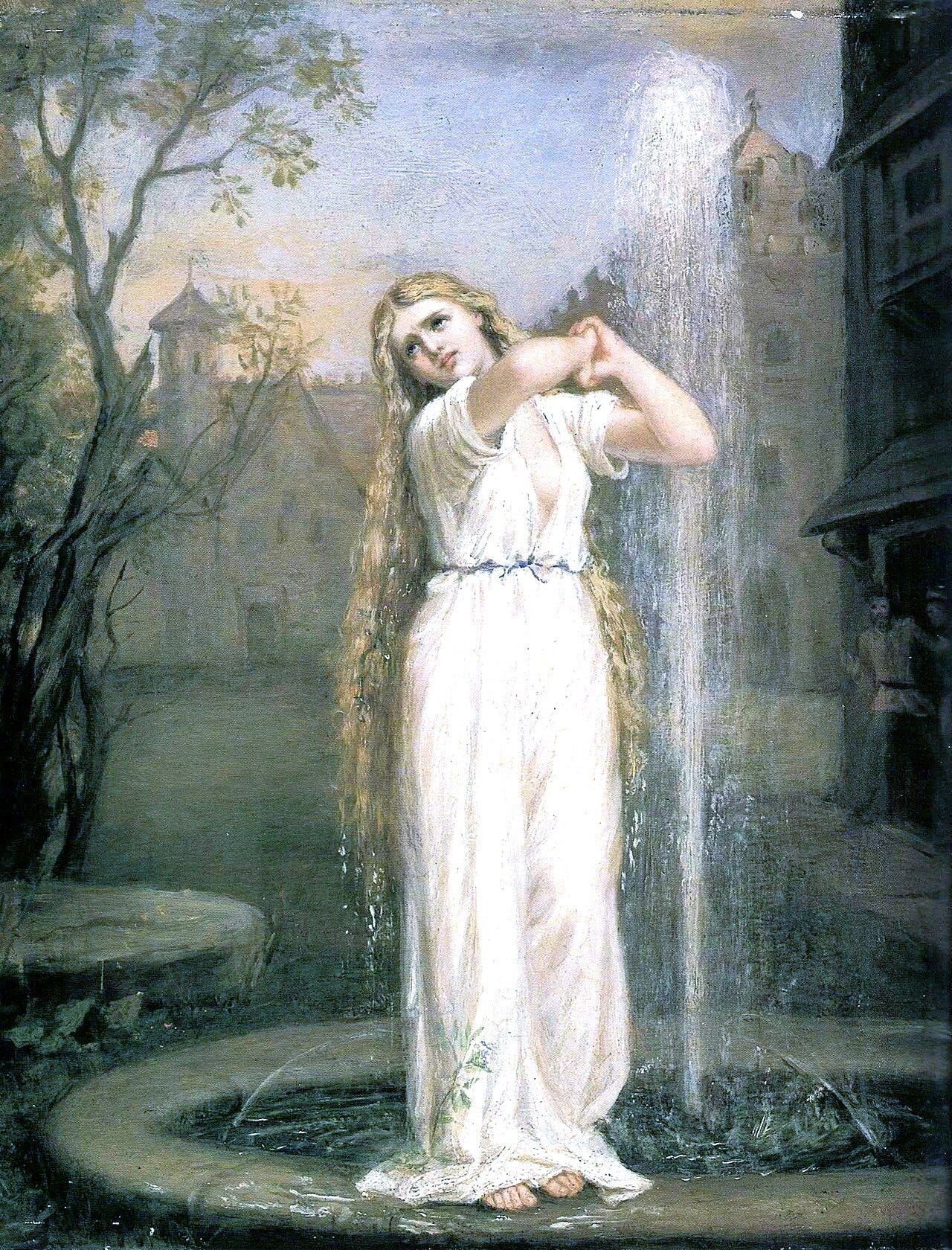
In 1888 Waterhouse painted the picture most people picture first: The Lady of Shalott, from Tennyson's poem. A doomed young woman sits in a boat, loosing the chain, drifting toward Camelot and her death.
The sugar magnate Sir Henry Tate bought it and presented it to the nation, and it entered the collection that became the Tate Gallery. It has been a public favourite ever since.
The subject would not let him go. He returned to the Lady of Shalott more than once, painting her at different moments of the same tragic story across his career.
Three tries at Ophelia
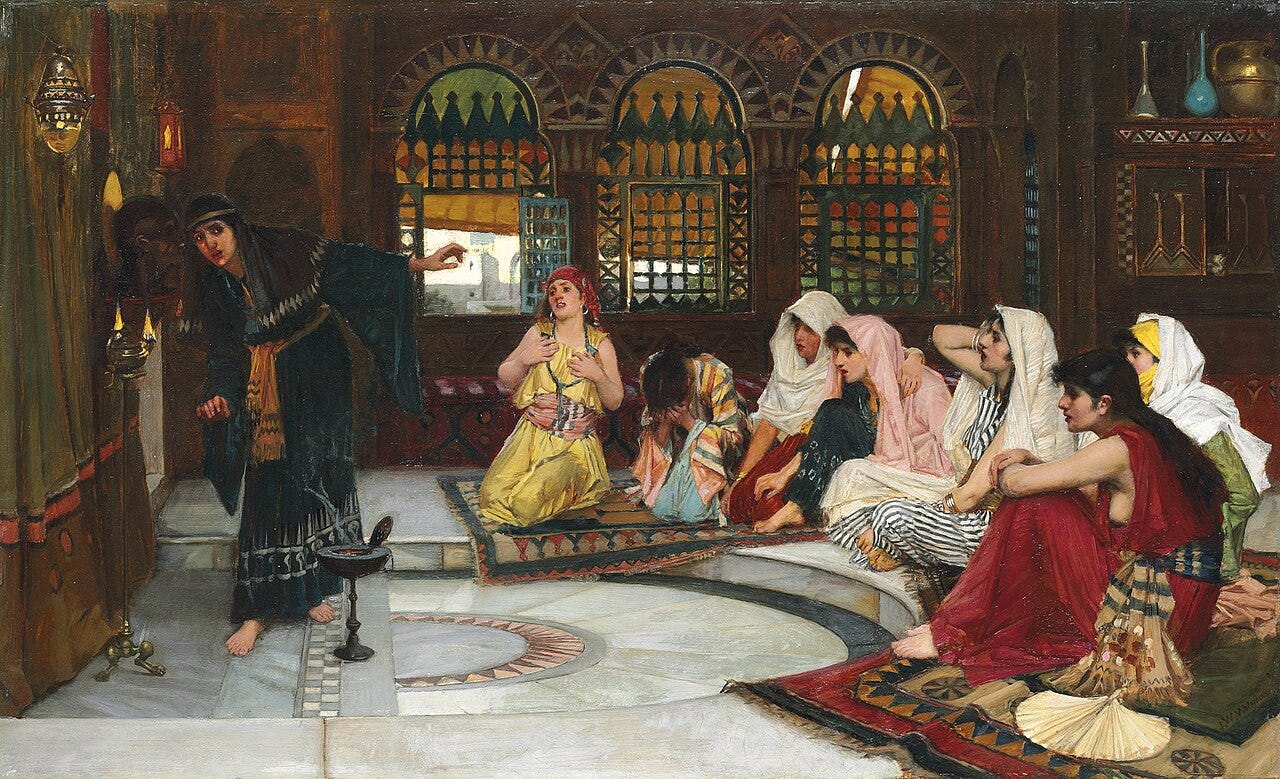
Shakespeare's drowning Ophelia obsessed him as much as Tennyson's Lady. Waterhouse painted her at least three times, in 1889, in 1894 and again around 1910.
Each version finds a different instant: Ophelia lying in the meadow among flowers, perched at the water's edge, or gathering blooms just before she slips under. He was circling the same doomed woman for more than twenty years.
These repeated heroines, lost in myth or verse and usually facing death, became his signature. He painted the moment just before everything falls apart.
Circe, the enchantress with the cup
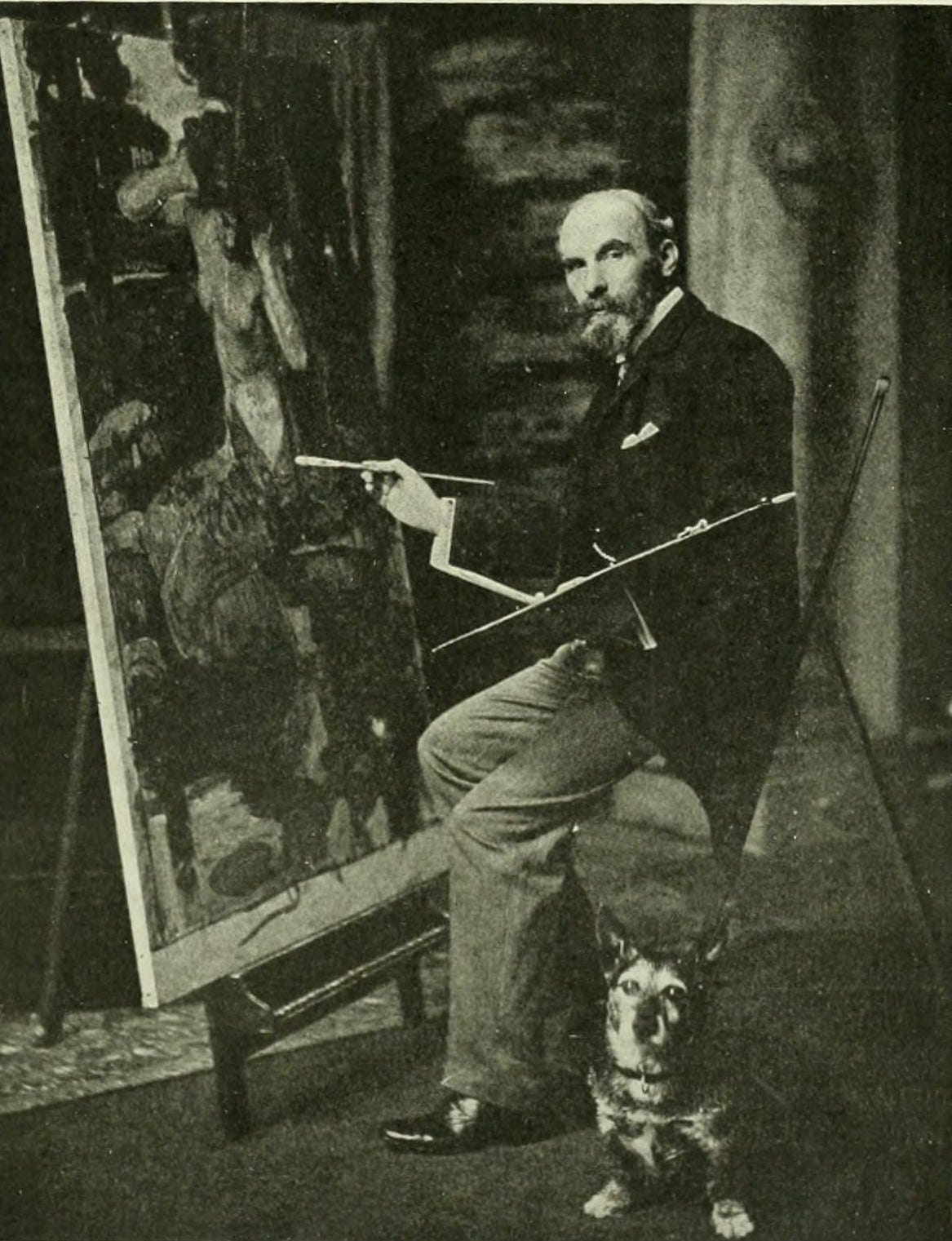
If one figure sums up his fascination with dangerous women it is Circe, the sorceress of the Odyssey who turns men into swine. Waterhouse painted her more than once in the early 1890s.
In Circe Offering the Cup to Ulysses she sits enthroned, holding out the poisoned drink, with the transformed sailors at her feet. In Circe Invidiosa she poisons the water for a rival, pouring green venom with a cold stare.
These are not passive maidens. Waterhouse gave his women power, and often menace, which is part of why the pictures still hold a modern viewer.
Loose paint under the polish
From close up, a Waterhouse is far freer than its dreamy subjects suggest. The flowers, water and drapery are handled with quick, broken strokes that owe something to the plain air painting of his own day.
He built his figures with the firmness of his early sculpture training, then wrapped them in a looser, luminous surface. It is why the pictures read as both solid and softly lit.
That mix, careful drawing under relaxed brushwork, kept him modern enough for the 1890s while his stories stayed rooted in the medieval past.
The poets who gave him his women
Waterhouse rarely invented a story. He read it. His pictures come out of a shelf of poetry and myth, and knowing the source unlocks half of what is on the canvas.
Tennyson gave him the Lady of Shalott. Homer's Odyssey gave him Circe. From Keats he took La Belle Dame sans Merci, painted in 1893, the knight bewitched by a fairy woman in the meadow, and the doomed lovers of other poems.
He was a painter for a literate Victorian public that recognised the lines at a glance. The women are beautiful, but they are also quotations.
A Mermaid, and the diploma at the Academy
When Waterhouse was made a full Academician he had to give the Royal Academy a work to keep, as every new member did. He handed over A Mermaid, finished in 1900, a sea maiden combing her hair on the rocks.
It hangs in the Academy's own collection to this day, his formal entry ticket into the establishment. The subject is pure Waterhouse: a lovely, faintly dangerous woman at the edge of the water.
Even his official duty picture kept to the theme he could not leave alone.
Associate, then Academician
The art establishment took him seriously in his own time. Waterhouse was elected an Associate of the Royal Academy in 1885 and a full Academician in 1895, the highest official honour a British painter could hold.
He taught, sat on juries and exhibited at the Academy almost every year. He was a respected insider, not a rebel, which makes his taste for witches and drowned girls all the more notable.
He kept working steadily until illness slowed him. He died in London in 1917.
Out of fashion, then back from the dead
After his death Waterhouse fell hard out of favour. The rise of modern art made his romantic maidens look sentimental, and for much of the twentieth century he was dismissed as an old fashioned illustrator.
The revival came late. From the 1970s onward, as Victorian painting was reassessed, his reputation climbed back, and a large retrospective toured London, Groningen and Montreal in 2009.
Today his heroines are among the most reproduced images in British art, printed on posters, book covers and postcards the world over. The painter the modernists buried turned out to be very hard to kill.
The John William Waterhouse questions that keep coming up
What is John William Waterhouse famous for?
Dreamy paintings of women from myth and poetry, like The Lady of Shalott and Circe.
Was he a Pre Raphaelite?
Not officially. He worked a generation after the original Brotherhood, but took up their myths and their literature so completely that he is called the modern Pre Raphaelite.
What is the Waterhouse woman?
His recurring red haired, wistful female type, drawn from a favourite model.
More secrets to unlock


Why Waterhouse still casts a spell
Waterhouse turned old stories into images so beautiful they bypass the brain and go straight to the mood. Put The Lady of Shalott on a wall and a whole world of doomed romance comes with it. That is why the posters never stop selling.
A final detail. He exhibited at the Royal Academy for over forty years, yet kept almost no record of his own life, leaving the wistful women on his canvases to speak for a man who stayed in the shadows.