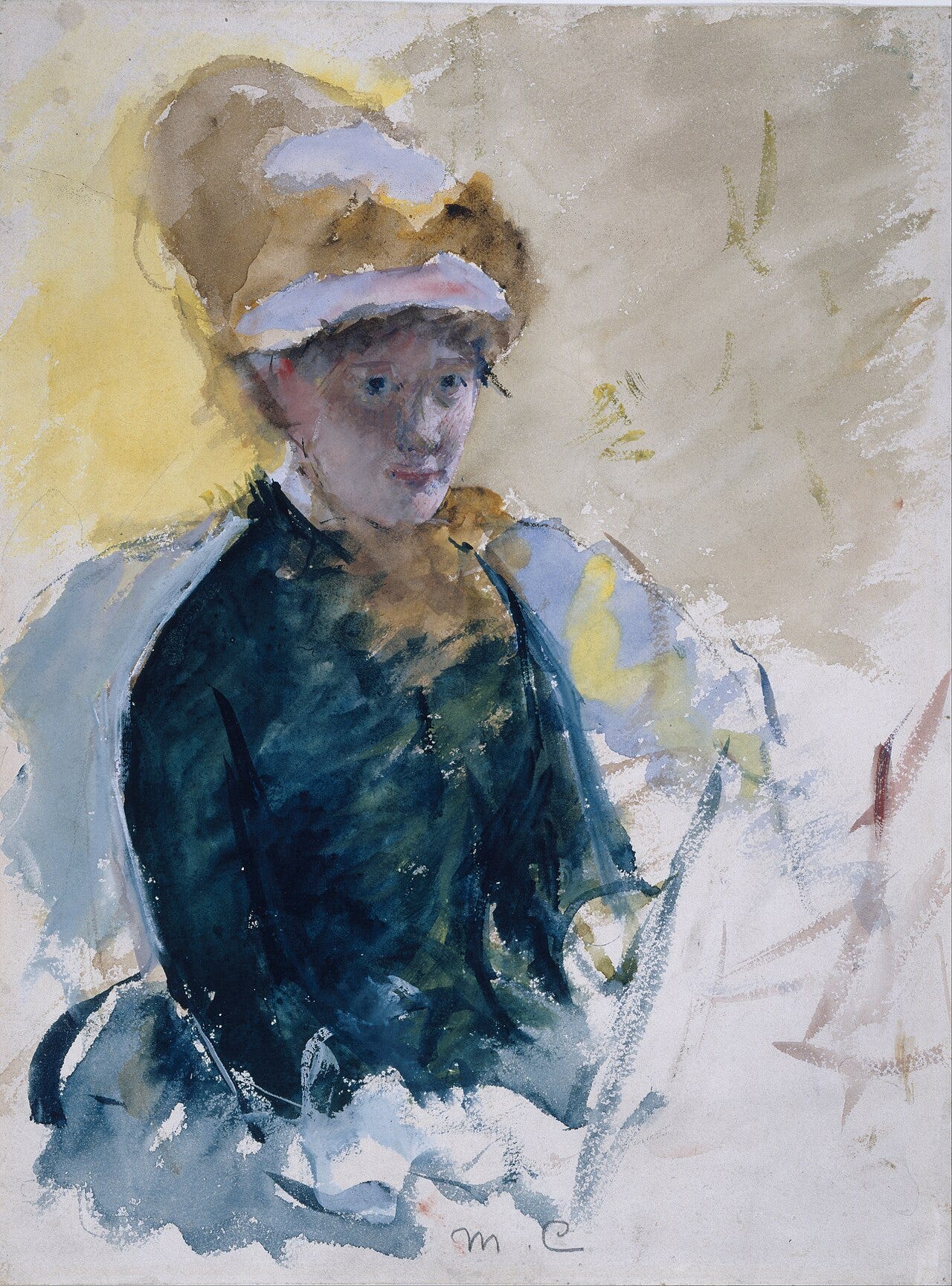
Mary Cassatt was the only American ever invited into the Impressionist exhibitions, made some of the finest color prints since Japan, and spent her spare time telling rich Americans what to buy. Half the Impressionism in US museums traces back to her advice.
Degas said he would not have admitted a woman could draw so well. She kept the compliment and the argument going for forty years.
Mary Cassatt at a glance:
1844: born outside Pittsburgh to a banker's family that considers art an ornament, not a career.
1877: Degas knocks on her Paris studio door with an invitation to exhibit with the Impressionists.
1891: the ten color prints, cut and inked by her own hands, give Japanese method a Parisian accent.
1893: paints Modern Woman, an 18-meter mural for the Chicago World's Fair; it vanishes with the building.
1926: dies at her château near Beauvais, nearly blind, having filled America's museums by advice.
Pittsburgh money, Paris ambition
Cassatt was born in Allegheny City, now part of Pittsburgh, on May 22, 1844, to a banking family that took the children to Europe for years at a time. She enrolled at the Pennsylvania Academy at 15, found it slow, and moved to Paris in 1866, taking private lessons, including with Gerome, and copying daily at the Louvre, since the Ecole des Beaux-Arts barred women.
1877: Degas knocks
After Salon acceptances through the early 1870s, she met Degas, who invited her to show with the Impressionists. She exhibited with them from 1879, the only American ever included, sharing their commitment to modern life seen up close: theatre boxes, tea tables, and above all women and children handled without syrup, painted in the same years she argued for women's independence and never married.
More incredible painter stories
If Mary Cassatt pulled you in, you will love these too:


1891: the ten prints
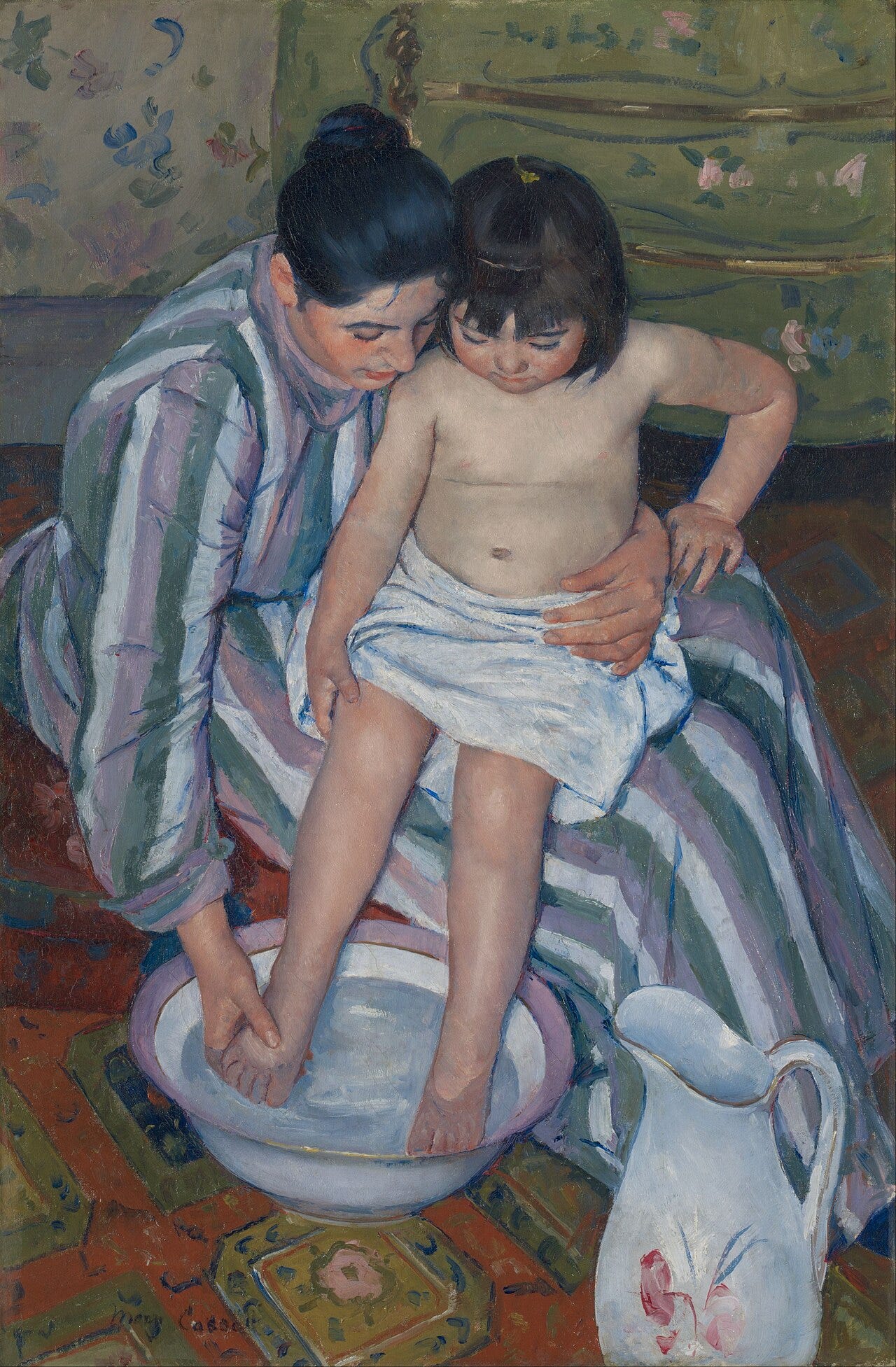
The great japoniste exhibition of 1890 sent Cassatt to the press, and in 1891 she produced a suite of ten color aquatints, The Letter, The Bath, Woman Bathing, that translate Utamaro into modern Paris.
Many printmakers consider them the finest color prints made in Europe in the nineteenth century. Her painting The Child's Bath of 1893, with its plunging Japanese viewpoint, anchors the Art Institute of Chicago.
The myth of the sweet mother painter
Because her subject was often mothers and children, Cassatt gets shelved as sentimental.
The record resists: the drawing is steel, the viewpoints are radical, the woman herself was a sharp-tongued suffragist who lent her pictures to a 1915 exhibition for the vote, and the subject was chosen precisely because modern womanhood was the modern life the men were not painting.
Degas kept her work on his own walls, and the French state gave her the Legion of Honor in 1904.
She stands alongside other women who forced their way into an art world built to exclude them, a group covered in famous female artists who changed art history.
The eye that filled America's museums
Cassatt steered the collecting of her friends Louisine and Harry Havemeyer, whose bequest became the heart of the Met's Impressionist rooms, and advised a generation of American buyers.
Cataracts ended her work around 1914, and she died nearly blind at her Chateau de Beaufresne on June 14, 1926.
The Art Institute of Chicago, the Met, the National Gallery in Washington, and the Philadelphia Museum hold the essentials.
The mural that vanished
For the 1893 Chicago World's Fair she painted Modern Woman for the Woman's Building: women picking the fruit of knowledge, no men anywhere in the field.
Critics grumbled, the fair closed, the building came down, and the mural has never been found.
It remains one of American art's open cases: her largest work, known only from photographs and irritated reviews.
Voting with her walls
In 1915 she lent eighteen works to a New York exhibition benefiting the suffrage campaign, hung beside Degas at Knoedler's.
Part of her Philadelphia family, opposed to suffrage, stayed away. She took note, and later sold pictures they might have inherited.
The painter of mothers and children was never sentimental about power; she wanted the vote, and said so with her walls.
The last decade
Diabetes and cataracts closed in after 1910; the surgeries failed, and by 1914 she had effectively stopped painting.
She spent the last years at Mesnil-Théribus, nearly blind and opinionated as ever, receiving young Americans and telling them precisely what was wrong with modern art.
She died in 1926, having outlived Degas, the quarrels and her own eyesight: everything except the eye itself.
The Mary Cassatt questions that keep coming up
Was Mary Cassatt an Impressionist? Yes, the only American in the group's exhibitions, invited by Degas and showing from 1879 onward.
Why did Cassatt paint mothers and children? As modern life, not sentiment: domestic womanhood was the subject her male colleagues ignored, and she treated it with the rigor they gave cafes and racetracks.
What are Cassatt's ten prints? Her 1891 suite of color aquatints inspired by Japanese woodblocks, widely ranked among the greatest European color prints of the century.
Where can I see Cassatt? The Art Institute of Chicago for The Child's Bath, plus the Met, the National Gallery in Washington, and Philadelphia.
How much does a Cassatt cost? Major oils bring several million and the pastels not much less; the 1891 color prints, once a hard sell, now cost more than her paintings did in 1950.
Did she and Degas fall out? Repeatedly, over money, politics and the Dreyfus affair, and they reconciled every time. She kept his portrait of her all her life, while claiming to dislike it.
Are there more facts like this about Cassatt? She was the only American to exhibit with the Impressionists, never married, and later helped fill American museums with French paintings. A longer list of facts about her is collected here.
More secrets to unlock


Inside Cassatt's taste
When you stand in the Met's Impressionist galleries you are largely inside Cassatt's taste: she guided the Havemeyer collection that fills them, which means America learned Impressionism through the eye of the one American the movement admitted.
Cassatt was one of several Americans who carried Impressionism home from Paris. Childe Hassam did the same for New England and New York, and his story is told in Childe Hassam, The Complete Story.