
Piet Mondrian was the Dutch painter who reduced art to its bones, a white field crossed by black lines and filled with blocks of pure red, blue and yellow.
He believed those few elements could express a hidden universal order, and he chased that idea with almost religious discipline. He did not begin there: it took twenty years of painting Dutch trees, dunes and windmills, the founding of De Stijl with Theo van Doesburg, and a final move to New York, where his last work Broadway Boogie Woogie set that grid dancing to jazz.
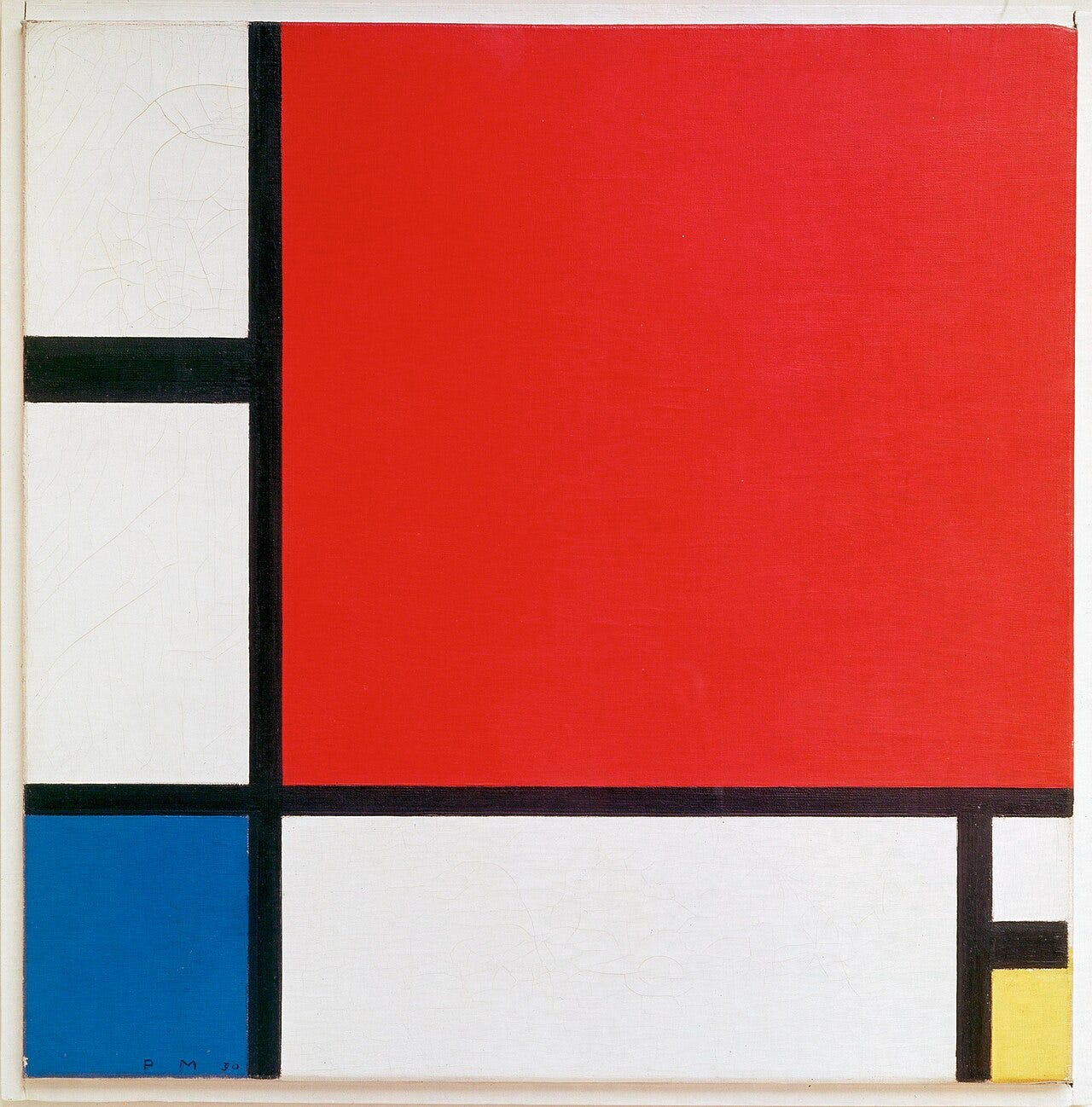
The grids look so simple that people assume he started there. He did not. He spent twenty years painting windmills, dunes and trees, and you can watch reality dissolve into lines across his early work.
Born: Amersfoort, Netherlands, 1872
Known for: De Stijl, grids of primary color, pure abstraction
Died: New York, 1944
More incredible painter stories
If Piet Mondrian pulled you in, you will love these too:


Piet Mondrian at a glance
1872. Born in Amersfoort, son of a strict Calvinist schoolmaster.
1911. Moved to Paris and dropped an a from Mondriaan.
1917. Co-founded De Stijl with Theo van Doesburg.
1940. Reached New York after bombs fell near his London studio.
1944. Died in Manhattan. Broadway Boogie Woogie was already hanging at MoMA.
From trees to grids
Mondrian trained as a traditional landscape painter. Around 1908 he began to simplify, and his famous tree paintings show the process step by step, a real tree breaking down into a web of lines until the branches become a flat pattern.
By about 1920 nothing was left of the tree. Only horizontal and vertical lines, white space, and the three primary colors plus black, white and grey.
Why only straight lines and primary colors
Mondrian was deeply influenced by Theosophy, a spiritual movement that sought the order behind appearances. He thought the vertical and the horizontal, and the purest colors, were the basic building blocks of a universal harmony.
He banned curves, diagonals and green from his mature work. He even fell out with a fellow artist over the use of the diagonal line. For Mondrian this was not decoration, it was a search for truth.
De Stijl and a new name for art
With Theo van Doesburg he founded De Stijl, the Style, a Dutch movement that pushed the same grid logic into architecture, furniture and design. He called his own approach Neo Plasticism.
Their influence ran far beyond painting. Modern graphic design, the look of clean web pages, and countless logos descend from Mondrian's grid.
Boogie woogie in New York
Fleeing war, Mondrian moved to London and then, in 1940, to New York. The city and its jazz transformed him. His last paintings, like Broadway Boogie Woogie, swap the heavy black lines for dancing bands of color that pulse like traffic and music.
He died in New York in 1944, at the peak of this new burst of energy, working to the end.
A strict start in Amersfoort
Pieter Cornelis Mondriaan was born on 7 March 1872 in Amersfoort, a town in the Dutch province of Utrecht. The house was devout and Calvinist, with clear rules about how a life should be lived.
His father was a qualified drawing teacher and a school headmaster who made prints with religious and political messages. Art was allowed, but it was meant to serve a purpose.
There was a working painter in the family too. His uncle, Frits Mondriaan, made his living from landscapes in the Hague School style.
Between the strict father and the professional uncle, the boy grew up with a pencil in his hand from the beginning, and both men gave him his earliest lessons.
The reluctant drawing teacher
His family wanted a steady, respectable path, so Mondrian first trained to teach. He earned the qualifications needed to give drawing lessons in Dutch schools, a safe career with a regular income.
He never really used them. Painting won. From 1892 to 1894 he studied at the Rijksakademie in Amsterdam, then returned part time in 1896 and 1897.
To pay his way he took on copying work and precise scientific drawings, the sort of careful jobs that kept a young artist fed. He painted in the tradition of the Hague School, the muted, weather worn realism that defined serious Dutch art at the time.
For years, nothing about him suggested he would one day reduce painting to lines and squares.
Windmills, farms and the trees on the Gein
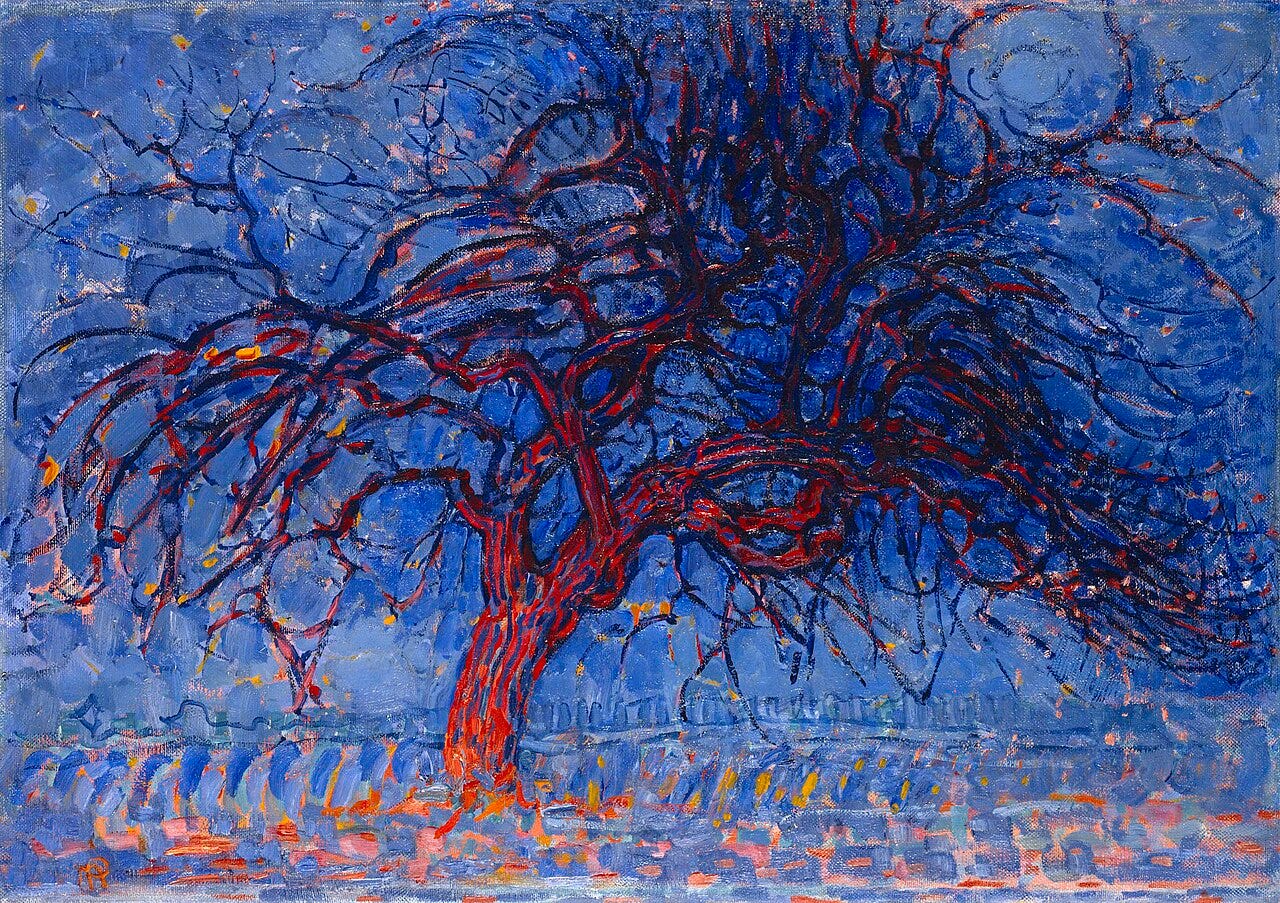
For roughly two decades Mondrian was a landscape painter, and a very Dutch one. He painted windmills, low farmhouses, grazing cattle and still canals under heavy grey skies.
He worked close to home, often along the Gein, a small river near Amsterdam. There he returned again and again to single trees standing in flat fields, and to farm buildings reflected in the water at dusk.
These were real, observed scenes, not yet abstractions. He was learning to look hard at ordinary Dutch country and find quiet order in it.
That patient attention to a handful of subjects, repeated in every light, is the habit that later carried him all the way to pure abstraction.
Theosophy and the search for harmony
Around 1908 his color grew warmer and his brushwork looser, closer to the dotted style of Neo Impressionism. Then in 1909 he joined the Theosophical Society, and this mattered more than any painting lesson.
Theosophy was a spiritual movement that believed a hidden, universal order lay behind everything we see. The visible world was only a surface.
That idea gave Mondrian a mission. If truth was underneath appearances, then a painter should strip away detail to reach it.
His art stopped being about pretty scenery and became a search for universal harmony. This is the key that explains the later grids.
They were never meant as decoration. They were his attempt to paint the calm order he believed held the world together.
Paris, and Cubism pushed further
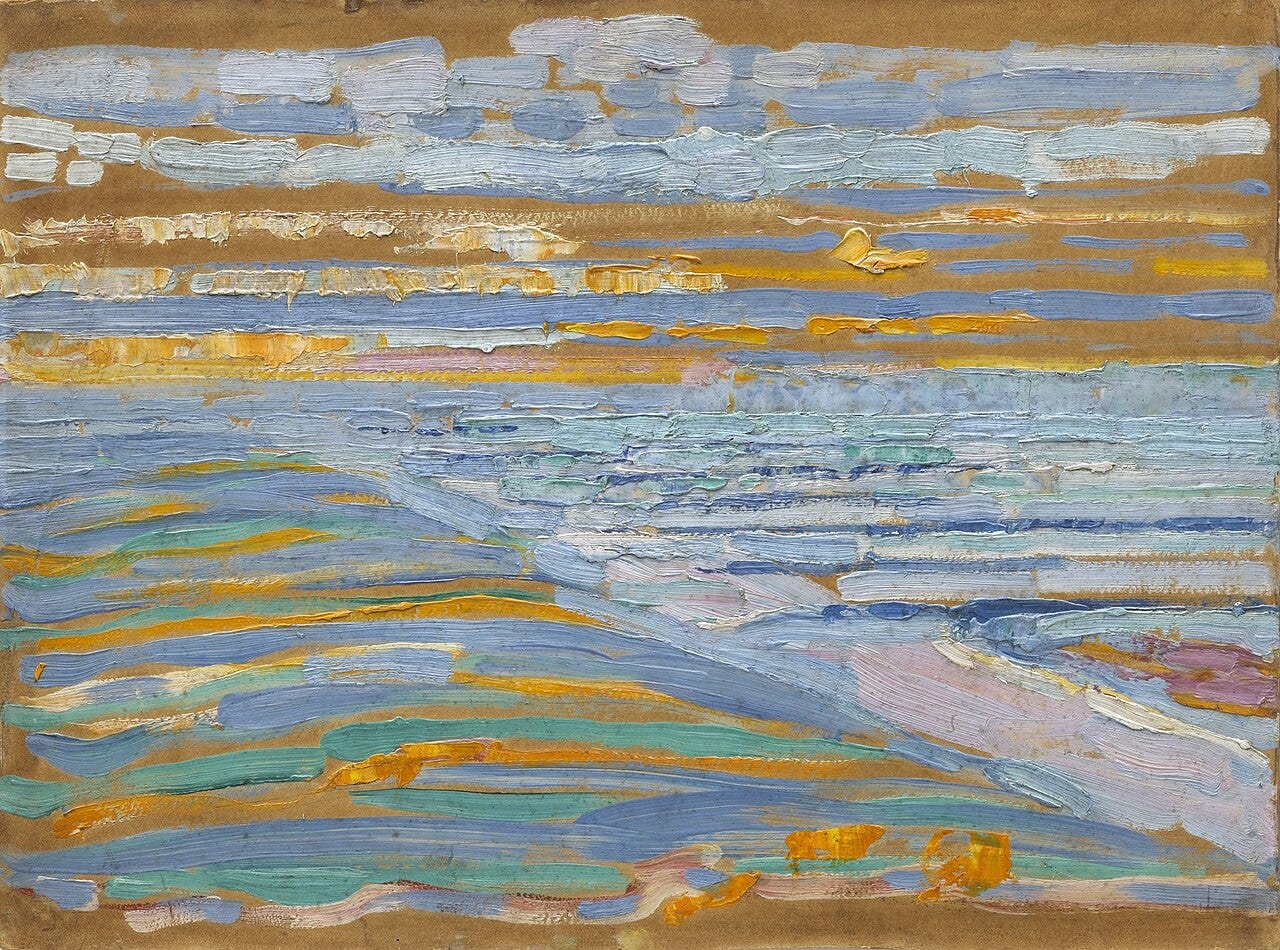
In the winter of 1911 to 1912 Mondrian moved to Paris, then the center of new art. There he saw Cubism, the fractured style of Pablo Picasso and Georges Braque, and it hit him hard.
The Cubists broke objects into planes and angles, but you could still make out a guitar or a face. Mondrian went further than they did. In his hands a tree, a facade or a table dissolved almost completely into a web of short lines and soft color.
He wanted the abstraction the Cubists had started but had stopped short of finishing. It was also in Paris that he trimmed his name, dropping an a from Mondriaan to the crisper Mondrian he signed for the rest of his life.
Trapped by the war, the Laren years
Mondrian was visiting the Netherlands in 1914 when the First World War broke out. The borders closed and he could not get back to Paris.
He spent much of the war in Laren, a village that had become a gathering place for artists and thinkers. There he met the painter Theo van Doesburg, an energetic organizer full of ideas, and fell in with writers exploring Theosophy and geometry.
Talking and arguing in that circle, Mondrian sharpened his theory into words as well as paint. The result appeared in 1917, when he and van Doesburg launched the movement and journal that would carry their ideas across Europe.
The isolation of the war years turned out to be the making of his art.
The quarrel over a diagonal line
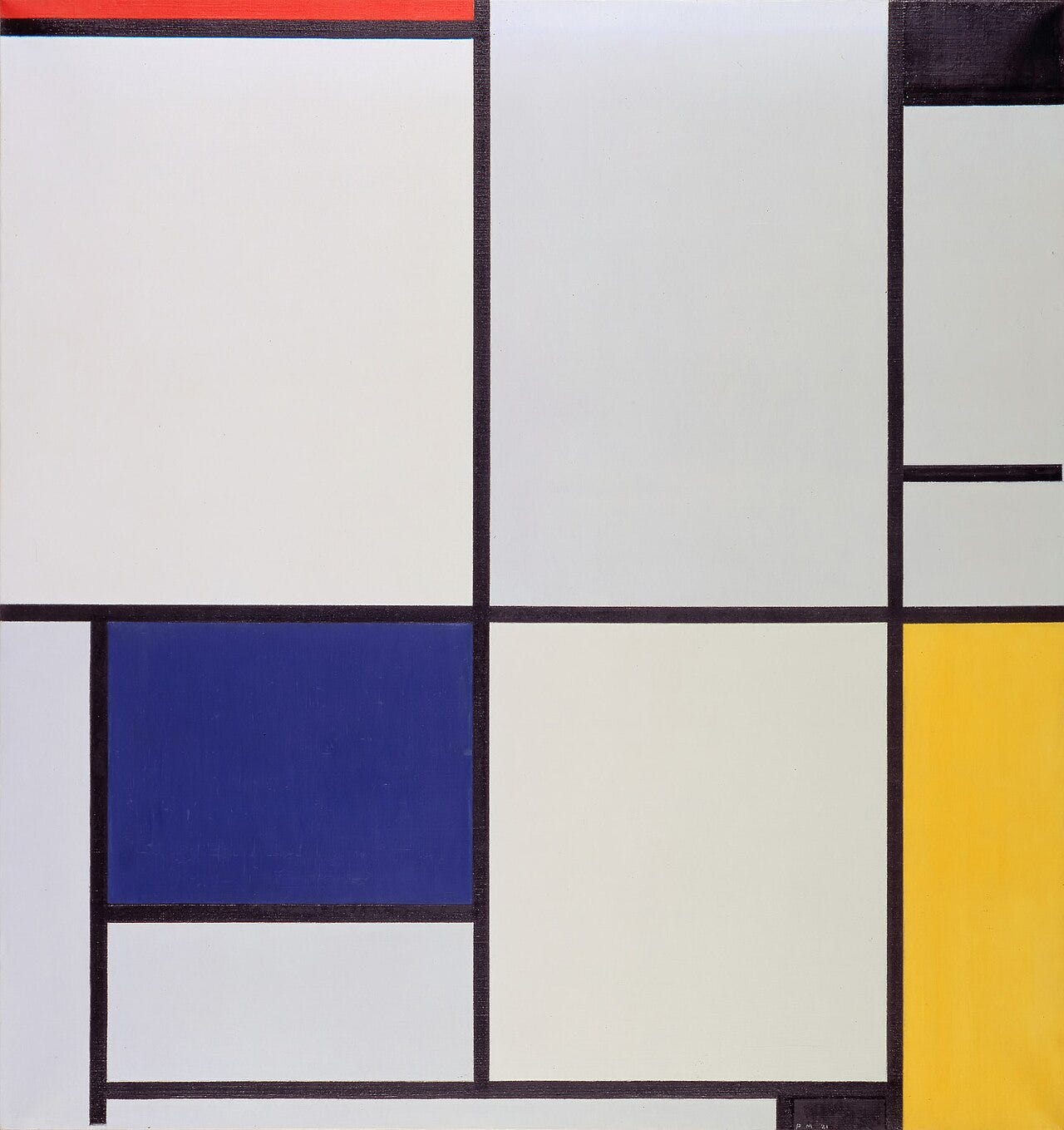
By the early 1920s Mondrian had set himself firm rules. Only horizontal and vertical lines. Only red yellow blue, plus white black and grey. Nothing else was allowed in.
For him the upright and the level were the basic facts of existence, the standing figure and the flat horizon. They were not up for debate.
So around 1924 he broke with his old friend van Doesburg, who had started tilting his lines into diagonals. Mondrian felt the diagonal betrayed the whole idea, and he walked away from the group they had built.
Here is a common myth worth correcting. People assume the grids were worked out with math and a ruler. They were not. Mondrian composed by eye, shifting strips of paper across the canvas and adjusting by hand until the balance felt right.
A studio built like one of his paintings
Mondrian did not stop at the canvas. He treated the room he lived in as a work of art too. In his Paris studio he painted the walls white and pinned up rectangles of red, yellow and blue card.
He moved these colored cards around for years, rearranging them the way he balanced a painting, until the whole space became a slow, three dimensional composition.
Visitors remembered the effect vividly. Stepping inside felt like walking into one of his pictures.
He carried the habit with him. When he later reached New York, he built the same kind of environment there, cards and color planes climbing the walls. For Mondrian, art and daily life were meant to obey the same order, and the studio was proof.
Jazz, the Charleston and a man who loved to dance
The image of Mondrian as a cold theorist misses a lot. He loved to dance. In Paris he threw himself into the new dances of the 1920s, the Charleston and the fox trot, and friends knew him as an eager partner on the floor.
Above all he loved jazz, and especially boogie woogie, the fast piano blues with its hammering, offbeat rhythm.
That music was not a hobby he kept separate from his work. He heard in it the same thing he wanted in paint, a strong pulse built from simple repeated beats.
You can feel it directly in his late pictures, where the calm grid breaks into blocks of color that seem to jump and syncopate like notes.
London, New York, and a last winter

As war returned to Europe, Mondrian moved again to stay ahead of it. In 1938 he left Paris for London, settling near the sculptor Naum Gabo and the painter Ben Nicholson.
When German bombing reached the city in the Blitz, London stopped feeling safe, and in 1940 he crossed the Atlantic to New York. The city thrilled him. Its grid of streets, its lights and its live jazz fed straight into his work.
He was still going when he fell ill. Mondrian died of pneumonia in New York on 1 February 1944, at the age of 71. On the easel he left Victory Boogie Woogie, a large diamond shaped canvas he never finished, buzzing with the rhythm of the city that gave him his last home.
The Piet Mondrian questions that keep coming up
What is Piet Mondrian famous for?
Pure abstract grids of black lines and primary colors, and co founding De Stijl. See what is abstract art.
Did he always paint grids?
No. He began as a landscape painter and arrived at abstraction slowly.
Why no green or curves?
He believed straight lines and primary colors expressed a deeper universal order.
More secrets to unlock


From canvas to phone screen: the grid that escaped
Mondrian's grid escaped the gallery and became the visual grammar of modern design, from fashion to phone screens. Few painters shaped daily life so widely with so little. See where his purity sits in what is abstract art.
One last fact. In 1965 Yves Saint Laurent turned his grids into a set of shift dresses, and the Mondrian look has cycled through fashion ever since, usually with no idea who he was.
You can explore works by Piet Mondrian in the collection of the Metropolitan Museum of Art.