
Raphael was the Italian painter of the High Renaissance, the third of its great trio with Leonardo da Vinci and Michelangelo. In a short life he became the most admired painter in Europe.
Where Leonardo was mysterious and Michelangelo was stormy, Raphael was grace itself. His art makes harmony and balance look effortless, and for centuries he was held up as the model every painter should follow.
More incredible painter stories
If Raphael pulled you in, you will love these too:


He ran a huge workshop, charmed popes and princes, and died on his 37th birthday at the height of his powers. Here is the whole story.
Raphael at a glance
1483. Born in Urbino, son of the court painter Giovanni Santi.
1504. Arrived in Florence to study Leonardo and Michelangelo at work.
1508. Called to Rome by Julius II to paint the papal apartments.
1514. Named architect of Saint Peter’s after Bramante’s death.
1520. Died on Good Friday at 37 and was buried, at his request, in the Pantheon.
The High Renaissance trio
Raphael arrived in Rome when Italian art was at its peak. Leonardo was the older genius, Michelangelo the rival titan, and Raphael the brilliant young newcomer who learned from both.
The High Renaissance prized balance, idealized beauty and calm grandeur, and Raphael became its purest voice. He absorbed Leonardo’s soft modeling and Michelangelo’s powerful bodies, then made them gentler.
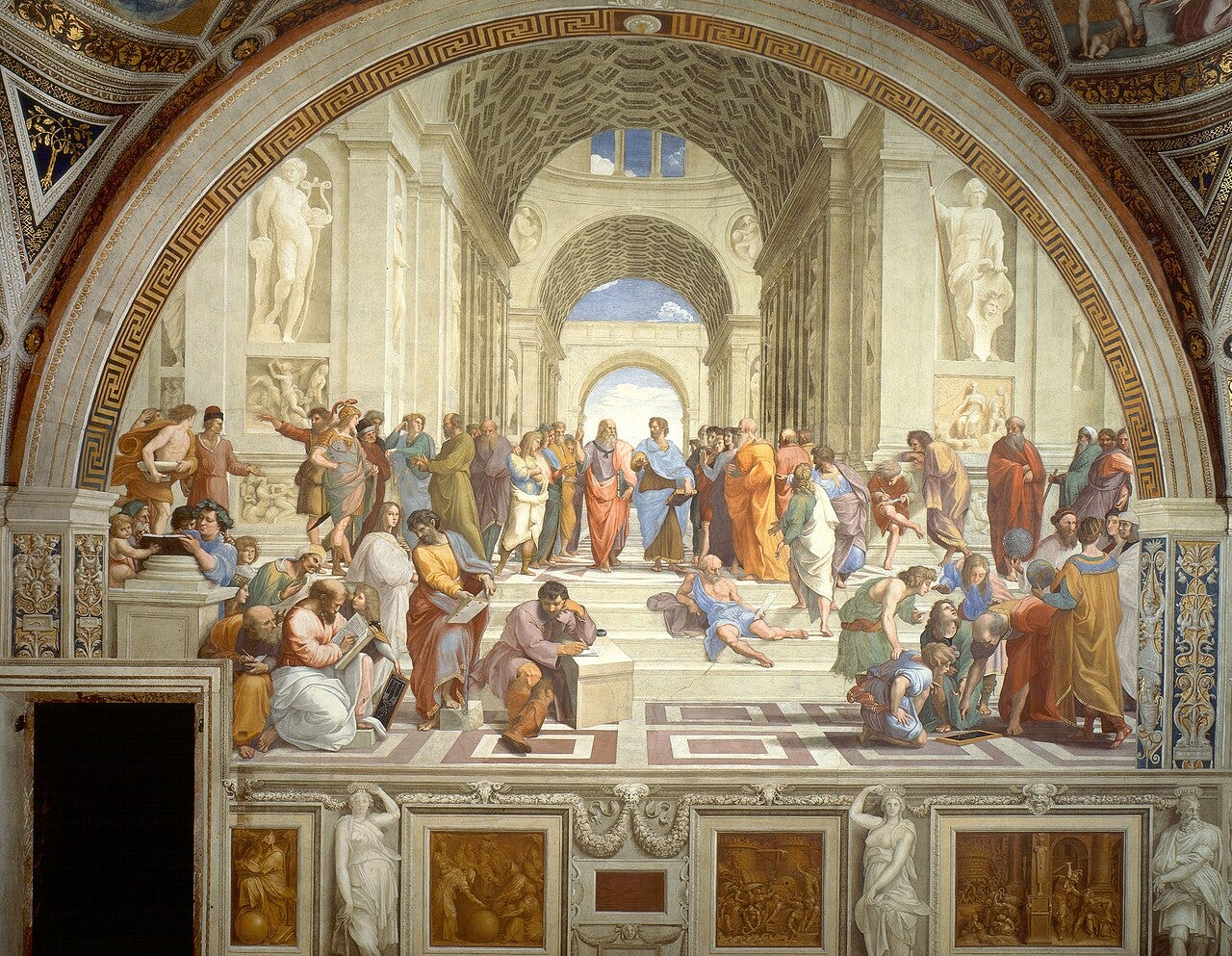
The Madonnas and The School of Athens
Raphael is famous for his tender Madonnas and for his greatest work, The School of Athens.
Painted on a Vatican wall for the pope, in fresco, it gathers the great philosophers of antiquity into one grand hall, with Plato and Aristotle at the center. It is the textbook image of Renaissance harmony.
The ease that took the most work
A Raphael is recognizable by its sense of ease. For me that ease is the hardest thing in all of art to fake.
Balance. Figures arranged in calm, stable, almost musical compositions.
Sweet faces. Soft, idealized features, especially in his gentle Madonnas.
Clear space. Deep, ordered settings where everything has its place.
Grace over drama. Even crowded scenes feel serene rather than violent.
What Perugino, Leonardo and Michelangelo taught him
Raphael was the great absorber of his age. He trained under the Umbrian master Perugino, whose sweetness and clarity stayed with him for life.
In Florence and Rome he studied Leonardo da Vinci, learning soft sfumato and pyramid compositions, and Michelangelo, learning muscular, powerful figures. He took the best of both and made it his own.
The workshop empire
Raphael was not just a painter but the head of a large, busy studio, with as many as 50 assistants helping fill his flood of commissions.
He was also one of the first artists to spread his designs through prints, made with the engraver Marcantonio Raimondi. In effect he built an early image brand, his style copied across Europe.
The rivalry with Michelangelo
While Raphael painted his rooms in the Vatican, Michelangelo was nearby painting the Sistine Chapel ceiling, and the two did not get along.
The older Michelangelo was suspicious and solitary, and accused the charming, popular Raphael of borrowing his ideas. Raphael did quietly slip a portrait of a brooding Michelangelo into The School of Athens, as the lone thinker on the steps.
From Urbino to the papal court
Raphael was born in 1483 in Urbino, a refined little court city, the son of a painter who died when Raphael was a boy. He rose fast, from Umbria to Florence to Rome, where popes showered him with work.
He lived in style, was made the Vatican’s overseer of antiquities, and was engaged to a cardinal’s niece, though gossip linked him to a Roman woman known as La Fornarina, said to be the love of his life.
How Raphael died
Raphael died young and suddenly, in 1520, after a short fever. He was just 37. The tradition that it fell on his own birthday comes from Vasari and cannot be proven.
All of Rome mourned. He was honored with burial in the Pantheon, the ancient temple, where his tomb still draws visitors today.
Rome, above all
Rome and a few great museums hold the best of him.
The Vatican Museums, Rome. Home of The School of Athens and the Raphael Rooms.
The Uffizi and the Prado. Rich in his portraits and Madonnas.
The Pantheon, Rome. Where he is buried.
Outside Rome, the Metropolitan Museum of Art in New York and the National Gallery in London hold his panels and drawings.
The orphan from Urbino
Raphael was born in Urbino in 1483, a small but cultured court city in central Italy. His father, Giovanni Santi, was court painter to the Duke of Urbino and ran a busy workshop. That is almost certainly where Raphael first learned to hold a brush.
His mother, Magia, died in 1491, when he was about eight. His father died in 1494, when Raphael was eleven. By his early teens he was an orphan.
Yet he was already trained enough to help keep the family workshop going. Documents from around 1500, when he was seventeen, call him magister, the Latin word for master.
He was leading commissions at an age when most painters were still grinding pigment for someone else.
The painting that announced him
One early work shows how fast he was moving. The Marriage of the Virgin, finished in 1504, hangs today in the Brera gallery in Milan.
It shows Mary and Joseph being wed in front of a domed temple that seems full of calm and open air. Raphael signed it and dated it plainly on the building, a young painter putting his name where everyone could read it.
He borrowed the format from his teacher Perugino, who had painted a similar scene, then quietly made his own version lighter and more graceful. He was around twenty one. It is the picture where you can watch the student step past the teacher.
Four years in Florence
In 1504 Raphael moved to Florence, then the busiest art city in Italy. He stayed, on and off, until 1508.
He arrived as an outsider from a provincial court and set about learning everything the city could teach. He filled sheets with drawings and studied how the local painters built their figures.
Florence also gave him a business. Wealthy families wanted small devotional pictures of the Virgin and Child for their homes, and Raphael turned out a steady run of them, each one a little different.
Collectors call them his Florentine Madonnas. Portraits followed. By the time he left, he was no longer a promising newcomer but a painter with a name.
The rooms he painted for Pope Julius II
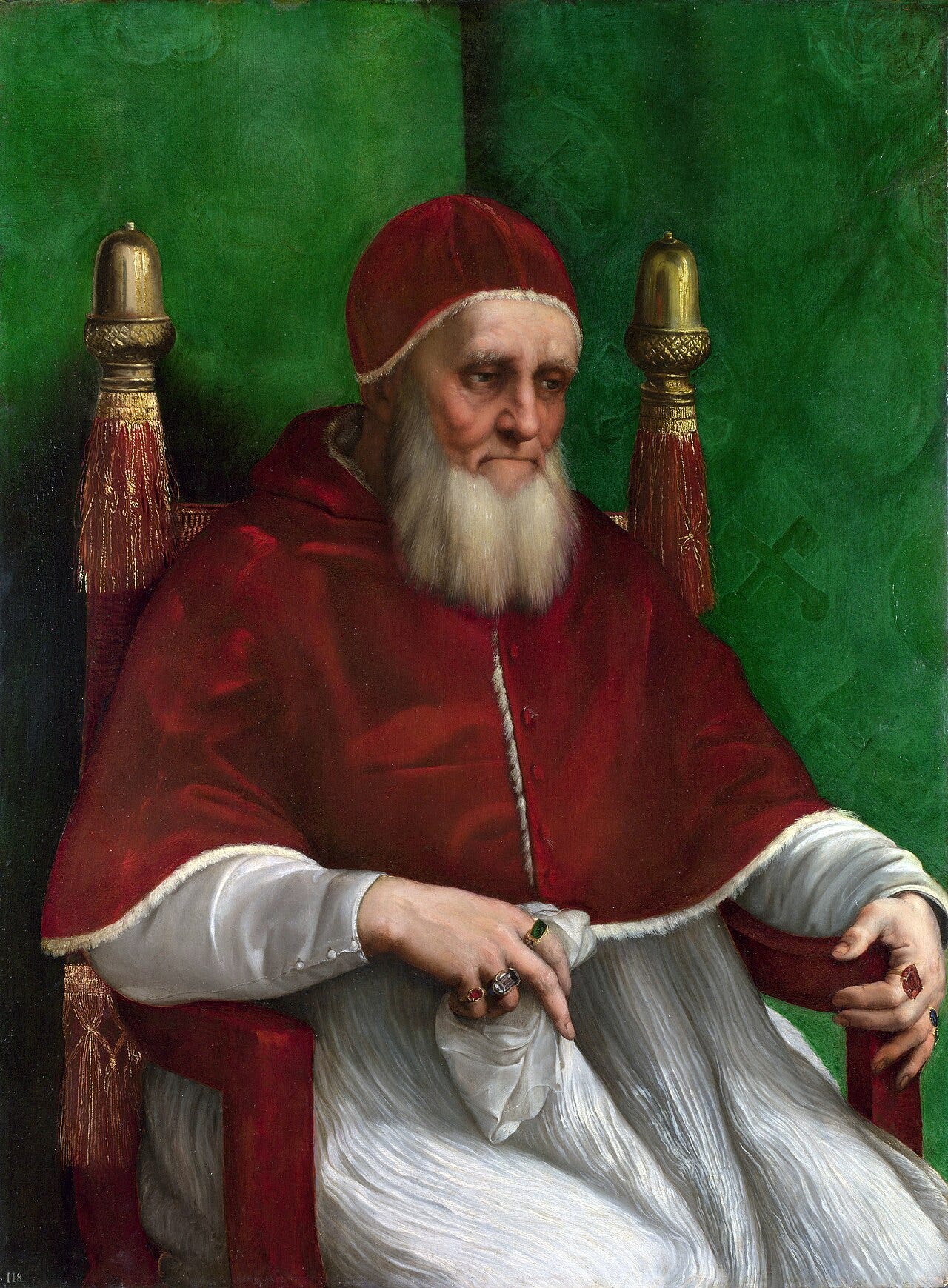
In 1508, at twenty five, Raphael was called to Rome by Pope Julius II. The job was enormous. Julius wanted the private apartments of the papal palace redecorated, and he handed several rooms to this young painter from Urbino.
These rooms are known today as the Stanze, Italian for chambers. Raphael began with the room called the Stanza della Segnatura, the pope's library and study.
He would work on the apartments for the rest of his life, finishing some rooms and leaving others to his assistants. Just down the corridor, Michelangelo was on his back painting the Sistine Chapel ceiling.
Two of the greatest painters in history were at work in the same building at the same time.
The faces hidden in his frescoes
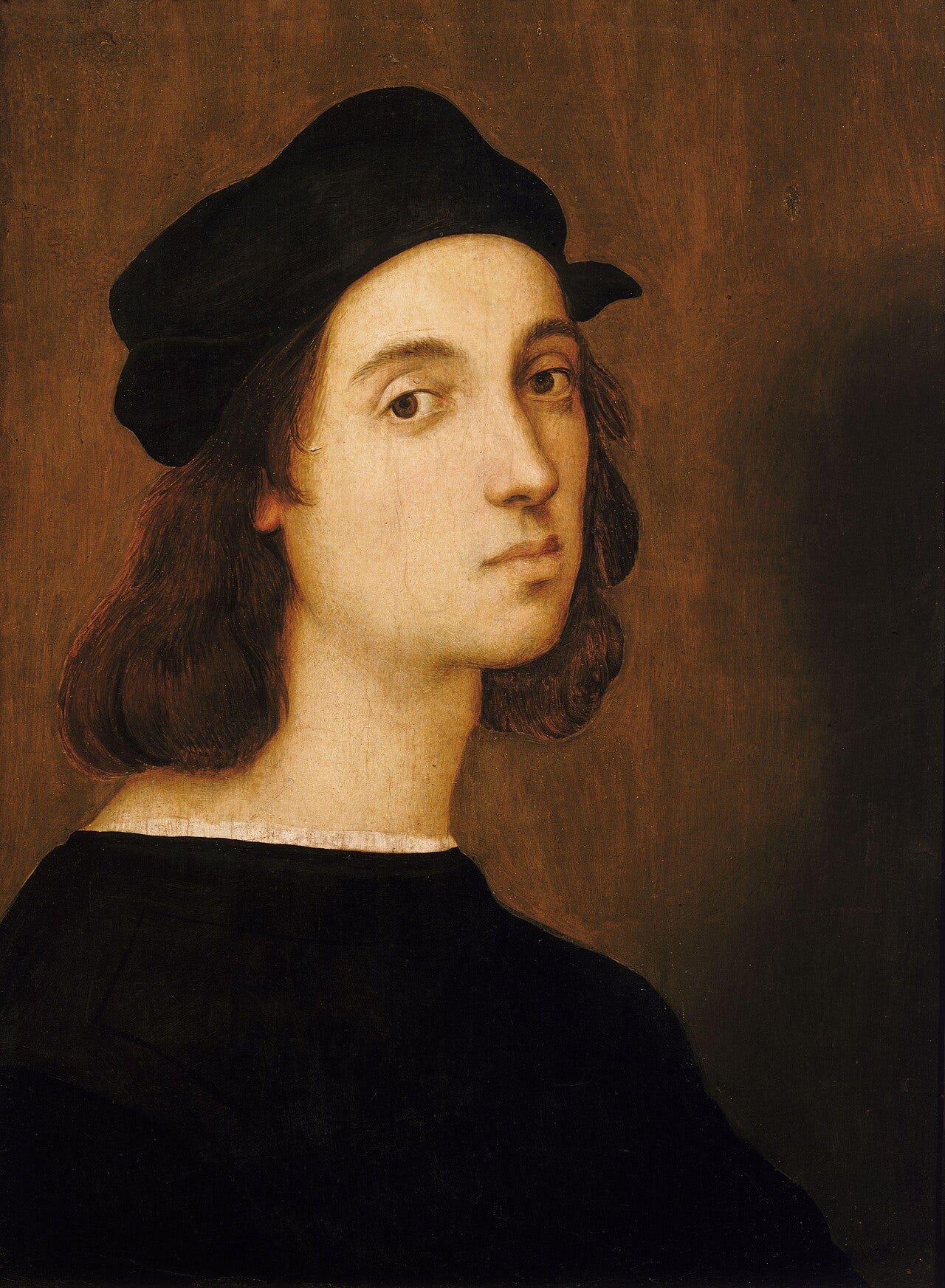
Raphael liked to smuggle real people into his sacred and classical scenes. In his Vatican frescoes, the crowds of saints, poets and philosophers are dotted with the faces of his own contemporaries.
The thoughtful figure of Plato, at the center of the philosophers, has long been said to wear the features of Leonardo da Vinci. That identification has been repeated for centuries, though Raphael never labeled it, so treat it as tradition rather than proven fact.
In a lower corner, a young man in a dark cap looks straight out at us. That is Raphael himself, a quiet self portrait slipped in among the great thinkers. He signed the wall not with his name but with his face.
The tapestry cartoons for the Sistine Chapel
In 1515 Pope Leo X gave Raphael one of the largest jobs of his career. He was to design ten enormous tapestries showing the lives of Saint Peter and Saint Paul, meant to hang in the Sistine Chapel on feast days.
Raphael and his workshop painted the full size designs, called cartoons, in glue based color on paper. The cartoons were shipped north to Brussels, where the weaver Pieter van Aelst turned them into tapestries threaded with silk and gold.
Seven of the ten cartoons still survive. They have been in Britain since the seventeenth century, brought over by the future King Charles I, and they hang today in the Victoria and Albert Museum in London.
Architect of Saint Peter's and guardian of ancient Rome
Painting was only part of Raphael's Roman workload. In 1514 the older architect Bramante died, and Leo X put Raphael in charge of building the new Saint Peter's, the largest church project in Christendom. He was a painter running a building site.
The next year, in 1515, the pope also made him guardian of ancient Rome's marbles and inscriptions.
Raphael took it seriously. He began drawing up a map of the ancient city and worried openly about how fast the old ruins were being torn apart for stone.
For a man in his early thirties, it was a remarkable amount of power over how Rome looked, past and future.
The Sistine Madonna and its two bored cherubs
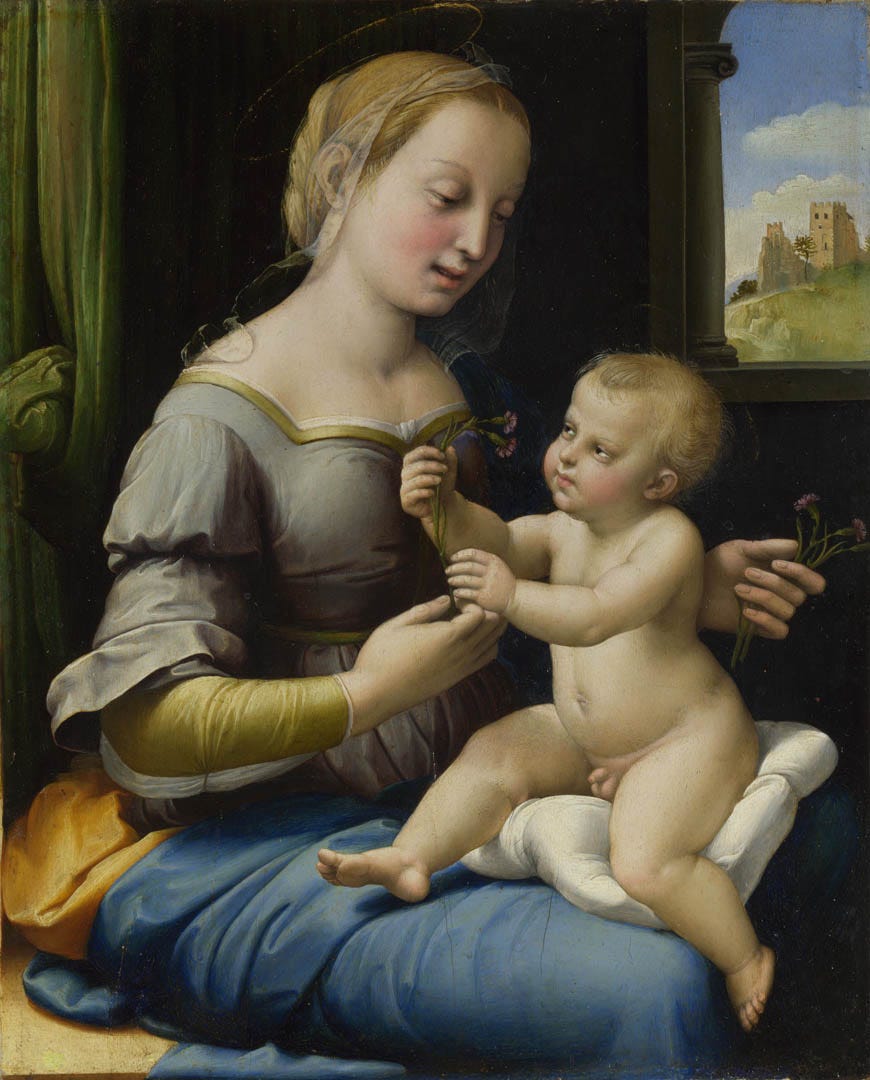
Around 1512 to 1513 Raphael painted the Sistine Madonna for the church of San Sisto in Piacenza. It shows the Virgin walking toward us through parted curtains, carrying the Christ Child. Around the same years he also painted the Madonna della Sedia, a circular panel now in the Pitti Palace and one of the best known examples of what is a tondo in Renaissance painting.
For centuries the painting was admired mostly for her. Then people noticed the two small winged children leaning on a ledge along the bottom, chins propped on their hands, gazing off with the look of bored schoolboys.
Those two cherubs became famous on their own. They now turn up on mugs, cards and posters all over the world, often with no hint that they come from a Raphael altarpiece. The painting itself hangs in Dresden.
His portraits of Castiglione and Pope Leo X
Raphael was one of the finest portrait painters of his age. His portrait of the writer and diplomat Baldassare Castiglione, painted around 1514 to 1515 and now in the Louvre, shows a calm man in soft grays and black, so alive that later painters copied the pose for centuries.
His group portrait of Pope Leo X with two cardinals, from about 1518 and now in the Uffizi in Florence, is almost cruelly honest. Leo is heavy and short sighted, holding a magnifying glass over an illuminated book.
Raphael did not flatter him into a saint. He painted a powerful, watchful man exactly as he was, down to the sheen on the silk.
His fortune, La Fornarina, and the engagement he never kept
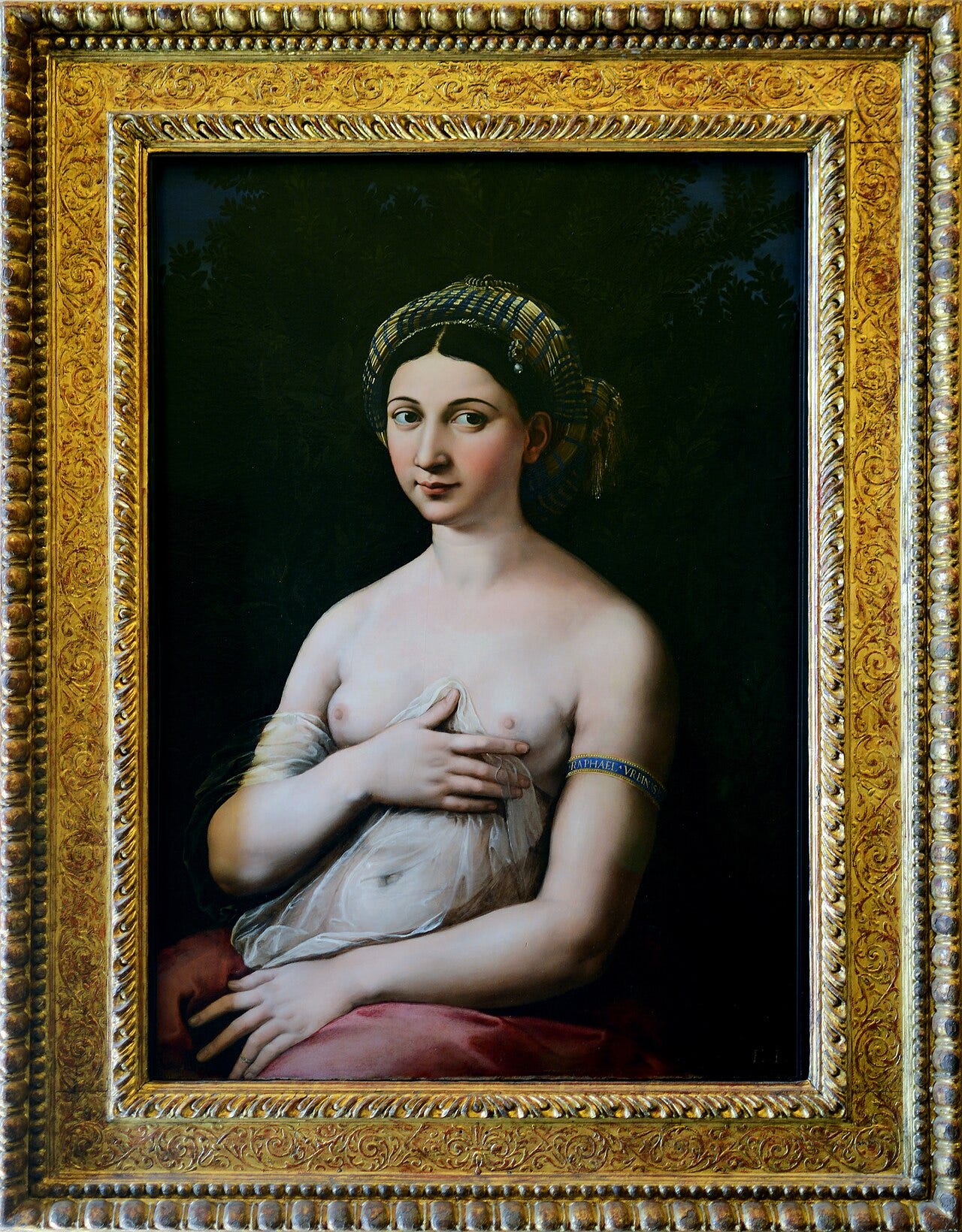
Success made Raphael rich. He lived almost like a nobleman in Rome, kept a large house, and moved easily among cardinals and princes.
His personal life was tangled. Tradition says his great love was a woman known as La Fornarina, the baker's daughter, later named as Margherita Luti, though no document proves the identity.
At the same time he had agreed to marry Maria Bibbiena, the niece of a powerful cardinal and friend. He kept putting the wedding off for years.
Maria died before it ever happened. Raphael never married, and both his fortune and his unfinished promises passed into legend after his early death.
More short, verifiable details of this kind, from his birthplace to the exact circumstances of his death, are gathered in interesting facts about Raphael.
The Raphael questions that keep coming up
What is he known for? Madonnas, portraits, and the fresco The School of Athens.
When did he live? Born in 1483, died in 1520, aged 37.
Where was he from? Urbino, in Italy.
Who taught him? The painter Perugino, then the example of Leonardo and Michelangelo.
How young was Raphael when he became a master painter? Very young. By around 1500, when he was about seventeen, documents already call him magister, or master, and he was taking on commissions of his own. His father, the court painter Giovanni Santi, had died in 1494 when Raphael was eleven, so he came up fast and largely on his own.
Where is Raphael buried? In the Pantheon in Rome, the ancient domed temple that was turned into a church. Raphael asked to be buried there, and after his death in 1520 his wish was honored. His tomb still sits inside, marked by a Latin inscription praising him.
More secrets to unlock


One last fact
Doubt about where he lay lasted three centuries, until 1833, when Pope Gregory XVI had the Pantheon tomb opened before witnesses.
The skeleton was there, measured and sketched by the artists present, then sealed again beneath the epitaph that says Nature feared to be outdone. Rome has known exactly where perfection rests ever since.
Raphael died in 1520, at just 37 years old, one name among a wider guide to famous Italian paintings.