
Thomas Gainsborough was the English painter behind The Blue Boy, one of the most famous portraits in the world. He was the most elegant portraitist of Georgian Britain, with a light, feathery touch, yet he spent his career wishing he could give up the rich and paint landscapes instead.
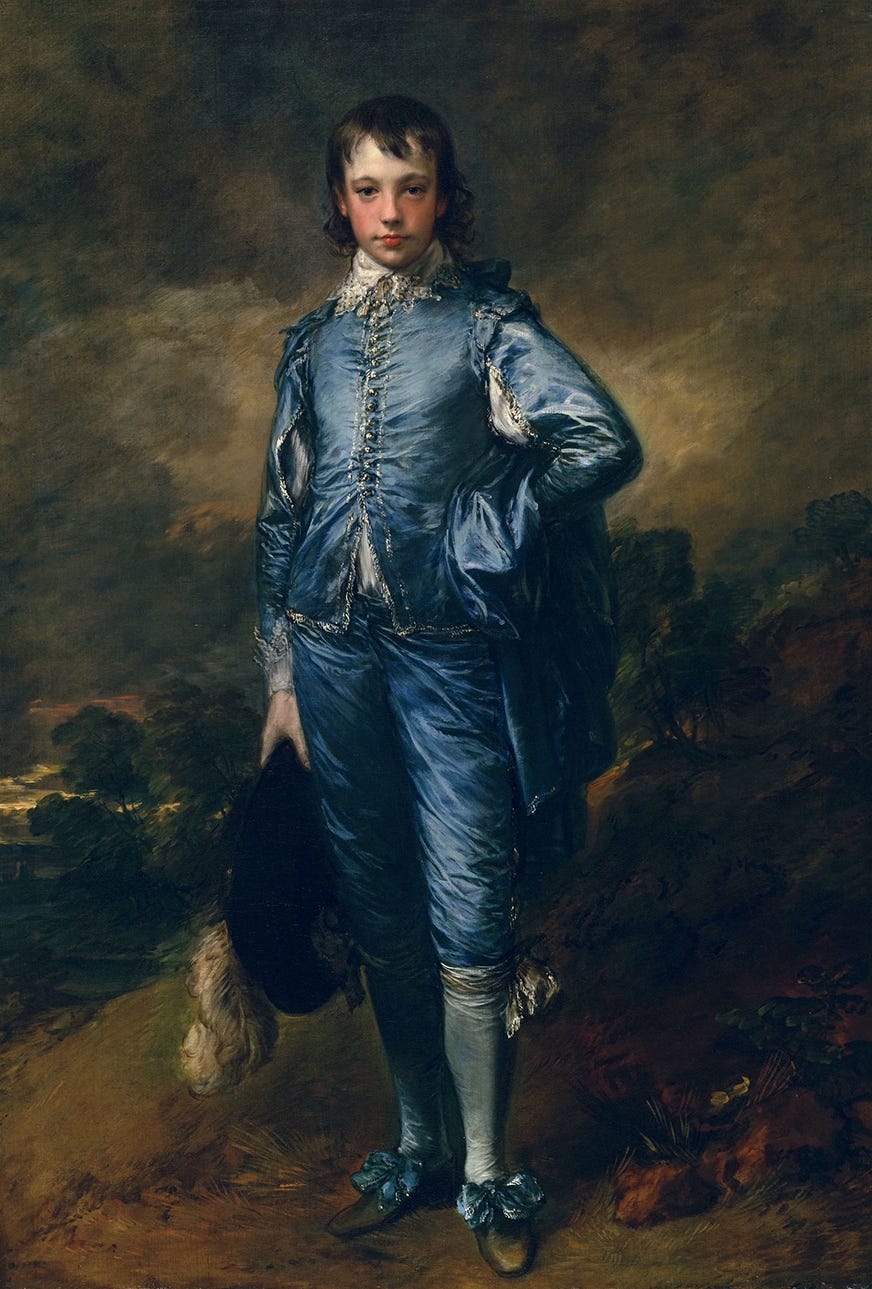
That tension, society's favorite face painter who longed to escape into the countryside, runs through everything he made.
Born: Sudbury, Suffolk, 1727
Known for: The Blue Boy, glamorous portraits, English landscapes
Died: London, 1788
More incredible painter stories
If Thomas Gainsborough pulled you in, you will love these too:


Thomas Gainsborough at a glance
1727. Born in Sudbury, Suffolk, a clothier’s son.
1746. Married Margaret Burr, whose annuity steadied the young household.
1768. A founding member of the Royal Academy.
1770. The Blue Boy, painted in Van Dyck dress.
1788. Died in London after a deathbed truce with Reynolds, invoking Van Dyck as company for the road.
The man who would rather paint trees
Gainsborough loved the landscape of his native Suffolk and taught himself to paint it as a young man. But portraits paid, and he was brilliant at them, so he built his career on faces while smuggling glorious skies and woods into the backgrounds.
He once wrote that he was sick of portraits and wished he could walk off to a quiet village and paint landscapes in peace. The market never let him.
The Blue Boy
His most famous work shows a young man in gleaming blue satin, painted in homage to the old master Anthony van Dyck. The blue costume was partly a technical gamble, since teachers of the day warned against using cold blue as the dominant color.
It worked so well that the picture became a global icon. It now lives in California, the prize of a famous American collection.
Bath, then London
Gainsborough made his name in Bath, the fashionable spa town, where he moved in 1759 and the wealthy queued to sit for him. In 1768 he became a founding member of the Royal Academy.
He moved to London in 1774, and although Reynolds ran the Academy, it was Gainsborough whom King George III preferred, calling him to paint the royal family.
Fancy pictures
Late in life Gainsborough painted what he called fancy pictures, tender scenes of country children that he loved more than any commission.
Up close his late work melts into thin, flickering strokes, so loose that viewers had to step back across the room before a face swam into focus.
Suffolk skies at the National Gallery, satin at the Huntington
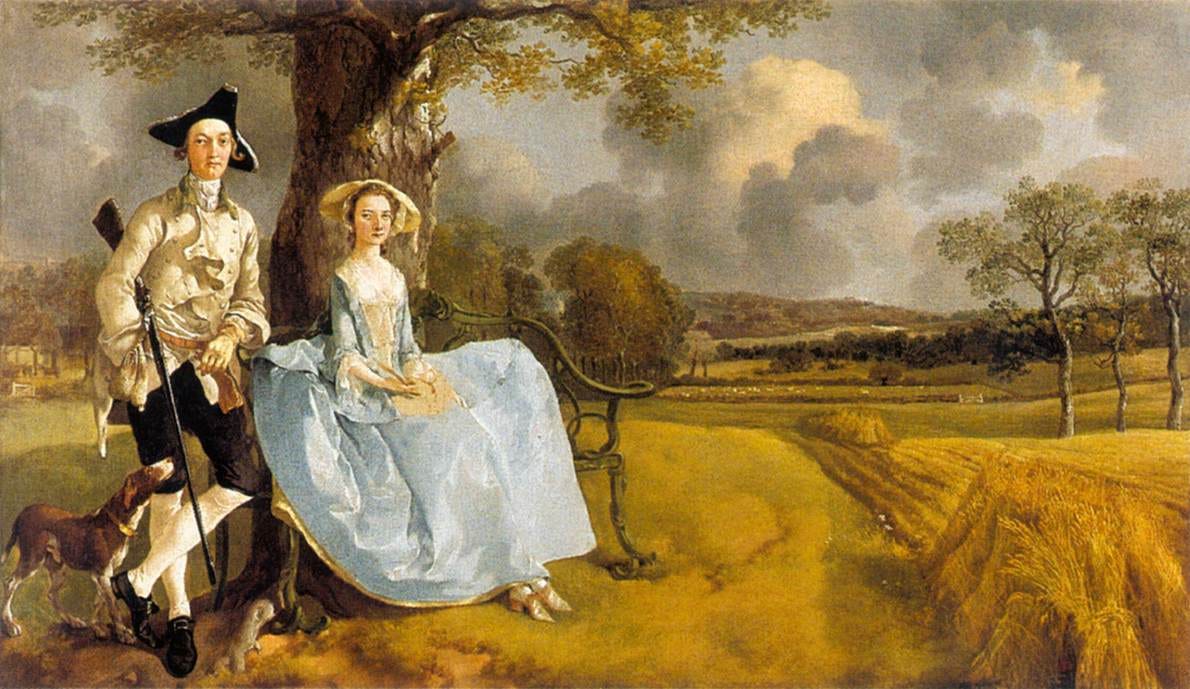
The National Gallery in London holds Mr and Mrs Andrews, his early triple portrait of a couple and their land. The Blue Boy lives at the Huntington in California, which bought it in 1921 for 728,000 dollars, then the highest price ever paid for a painting.
Born in Sudbury in 1727, a clothier's son
Thomas Gainsborough was born in Sudbury, Suffolk, and baptised on 14 May 1727. He was the youngest son of a Sudbury cloth merchant, one of nine children in a busy trading household.
As a boy he was happiest outdoors. He filled sheets with drawings of the woods, lanes and fields around the town. That early habit set the course of his whole life.
Long before he painted a single duchess, he was studying Suffolk light, hedgerows and skies.
The countryside he sketched as a child never left his work. Even his grand London portraits usually place the sitter in front of trees and open ground. It is a rare thing to see a painter's childhood so plainly in his mature pictures.
London at thirteen, trained by Gravelot
Around 1740, aged about thirteen, Gainsborough was sent to London to train. His teacher was the French draughtsman and engraver Hubert Francois Gravelot, who had settled in the city.
Through Gravelot he entered the world of the St Martin's Lane Academy, the main gathering point for London artists before the Royal Academy existed. William Hogarth had helped found that same academy a generation earlier.
Gravelot brought French Rococo taste with him, and the light, elegant manner of Watteau. You can feel it in the easy poses of Gainsborough's later couples.
A second influence arrived when he studied the portraits of Anthony Van Dyck. Their silvery elegance shaped how he dressed and posed his own sitters.
He never took the customary trip to Italy. His schooling was London, French drawing and the old masters he could see at home.
Marriage to Margaret Burr and a private income
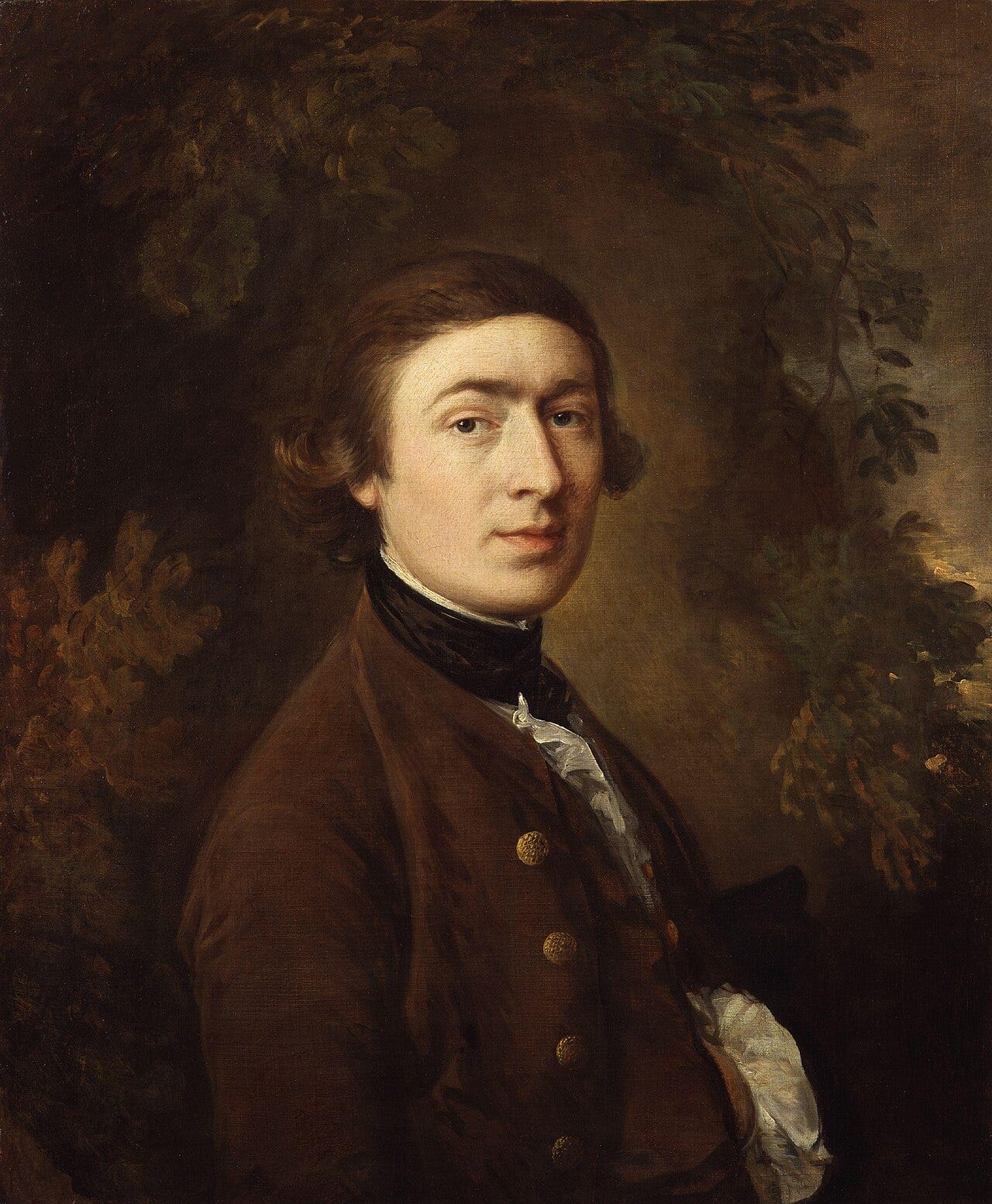
In 1746 Gainsborough married Margaret Burr, who was about eighteen. She was the illegitimate daughter of the Duke of Beaufort, and she came into the marriage with an annuity, a fixed yearly income.
That money mattered. It gave the young couple a cushion of security while Gainsborough was still building a name. The marriage lasted the rest of his life, and they had two daughters who survived childhood, Mary and Margaret, whom he painted again and again.
Margaret outlived him by ten years, and the two are buried side by side in Kew churchyard in London. For a painter who often grumbled about chasing wealthy clients, that steady private income was a quiet advantage few of his rivals had.
Mr and Mrs Andrews, a couple and their land
Back in Suffolk, Gainsborough painted the double portrait now known as Mr and Mrs Andrews, around 1750. It shows the newly married Robert and Frances Andrews at the edge of their own estate near Sudbury.
People sometimes assume the golden fields behind them are an invented backdrop. They are not. The National Gallery describes the picture as a portrait of the couple and their land, a real view looking east over the valley, down to the sheaves of corn and the grazing sheep.
That mix of exact likeness and real countryside is the young Gainsborough in one frame. He wanted to paint landscape, and portraits paid the bills. Here he found a way to do both at once.
A founder of the Royal Academy, then a public quarrel
In 1768 Gainsborough became a founding member of the Royal Academy, the new official body for British art. He moved to London in 1774 and showed his pictures at the Academy's crowded annual exhibitions.
The relationship soured over something very practical: how his work was hung. In 1784 the Academy insisted on placing his portrait of the three eldest princesses at the standard height, high on the wall.
Gainsborough argued that his light, delicate touch could only be read close up.
When they refused to lower it, he withdrew every picture he had entered. He never exhibited at the Royal Academy again, and from then on he showed new work to the public in his own studio at Schomberg House in Pall Mall.
The feathery brush and the sitter in the landscape
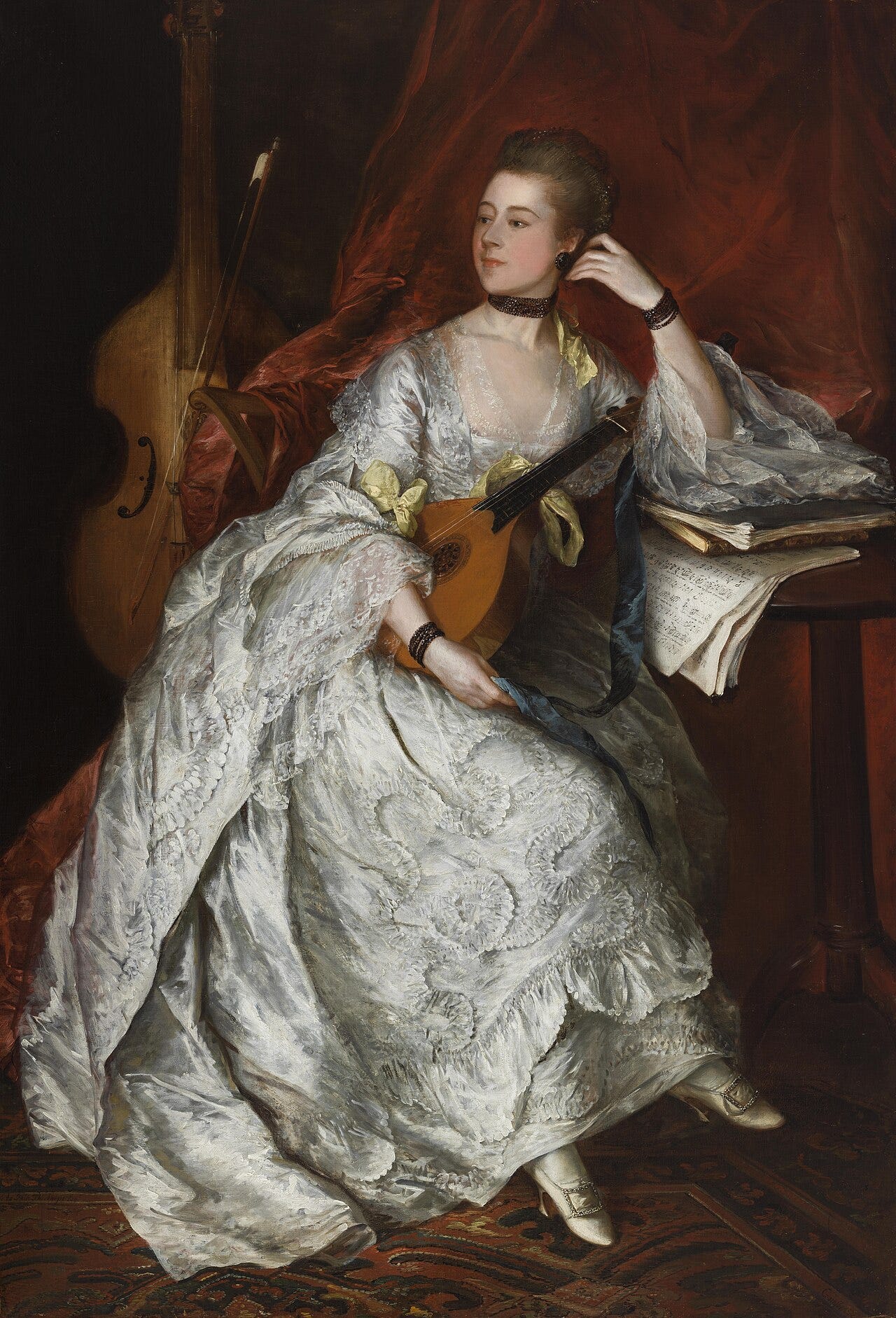
Gainsborough's late portraits are easy to know by their touch. He worked with thin paint and long, feathery strokes, so that lace, silk and hair seem to dissolve up close and pull together at a distance.
Most fashionable painters of the day handed off the clothes and backgrounds to specialist drapery painters. Gainsborough did not. He painted the whole picture himself.
He also liked to set his sitters outdoors, against trees, sky and open ground rather than a plain studio wall. That was his way of smuggling landscape into a portrait commission.
The result is a kind of portrait where the person and the countryside share the canvas.
The candlelit show box
Gainsborough was restless with materials and methods all his life. In his later years he built a viewing device now called Gainsborough's show box.
Inside it he set painted glass slides of landscapes. A candle behind the glass lit them from within, and the viewer looked through a lens that magnified the scene.
The effect turned a small painting on glass into a glowing, backlit picture of moonlight, sunsets and cottage doors.
It was part entertainment, part experiment in how light behaves in a landscape. The box and several of its glass transparencies still survive in the collection of the Victoria and Albert Museum in London, one of the most unusual objects any great painter left behind.
A painter among musicians, close to Garrick and Bach
Gainsborough loved music almost as much as painting. He played several instruments and kept close company with performers.
Two friendships stand out. One was with David Garrick, the most celebrated actor of the age, whom Gainsborough met at Bath and painted more than once.
The other was with Johann Christian Bach, the composer son of Johann Sebastian Bach, then living and working in London.
Bach thought so highly of Gainsborough that he chose him to paint his portrait for a gallery of famous musicians in Bologna. His circle also took in the viol player Carl Friedrich Abel and the oboist Johann Christian Fischer, who married Gainsborough's daughter Mary.
Music ran right through his social world.
Royal favour, and a deathbed truce with Reynolds
By the 1780s Gainsborough was a favourite of the royal family. In 1781 he was asked to paint King George III and Queen Charlotte, and the king was said to prefer him to the Academy's president, Joshua Reynolds.
He died in London in 1788, aged sixty one, of cancer, and was buried in Kew churchyard. His long rivalry with Reynolds is famous, but the two men are reported to have made peace at the very end.
Reynolds is said to have visited the dying Gainsborough, who is remembered for a last line about the painters he loved most: we are all going to Heaven, and Van Dyck is of the company.
The reconciliation comes down to us as tradition rather than hard record, but it is the story his friends passed on.
Thomas Gainsborough and his rival Joshua Reynolds both sat on the founding committee of London's Royal Academy in 1768, and reportedly could barely stand to be in the same room by the end of their careers.
The Thomas Gainsborough questions that keep coming up
What is Gainsborough famous for? The Blue Boy, Mr and Mrs Andrews, and portraits that dissolve into feathery landscape.
Where can I see his work? The National Gallery in London and his birthplace museum in Sudbury; The Blue Boy hangs at the Huntington in California.
Did he prefer landscape to portraits? Yes. He complained that faces paid the bills while the trees were what he loved.
How did he die? Of cancer in August 1788, at 61, after, tradition says, a deathbed reconciliation with his rival Reynolds.
More secrets to unlock


The trees he finally got to paint
Gainsborough proved English painting could be as graceful as anything in Europe, and he slipped real landscape into an age obsessed with status, a peak of the Rococo century.
To me the freewheeling late landscapes, the pictures nobody commissioned, are where he is most himself.
One last fact. On his deathbed he is said to have made peace with Reynolds, and his final words were that they were all going to heaven, with Van Dyck in the company.