
Leonardo da Vinci wrote most of his private notes in mirror script, from right to left, with every letter reversed, so that the page reads as ordinary Italian only when it is held up to a mirror.
The usual explanation is his left hand: writing leftward kept it out of the wet ink, and the practice, taken up young, never left him. Yet a drawing from his youth shows that he could also write the ordinary way.

On one of his pages, each line starts at the right edge and travels toward the left, and a b looks like a d. Nothing about it was hidden. Writers described Leonardo's reversed handwriting in print in the sixteenth century, and every account of his life has repeated it since.
Cool Stories About Art is a newsletter to learn art the fun way.
Join 200,000+ readers and get:
10 new art stories / month
The entire archive of content (140+ articles)
Comment, ask questions, and chat with other readers
The left-hand explanation rests on ink. In Leonardo's day, a line written with a quill pen stayed wet for a moment after it was traced.
A left-hander who writes from left to right drags the side of his hand over the words he has just set down, and they smear. Moving the other way, the hand travels ahead of the words, always on clean paper.
The explanation is reasonable, and a drawing kept in Florence, in the Uffizi Galleries, puts it to the test. Leonardo made it at twenty-one, and it shows what each of his hands could do.
The drawing of 1473 and Leonardo's right hand
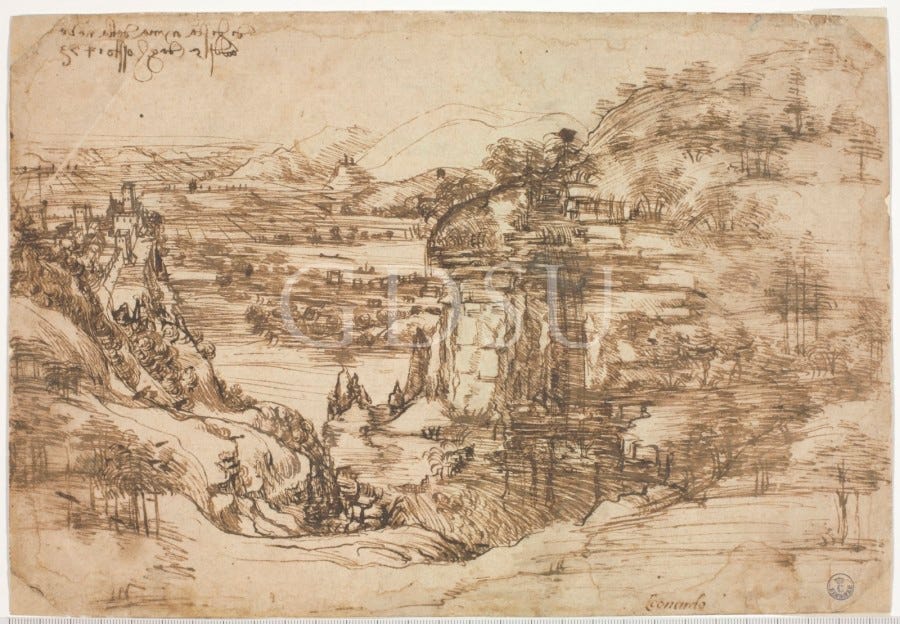
The sheet is a pen-and-ink landscape, the valley of the Arno River seen from a height, drawn in the summer of 1473. It is the earliest dated drawing by Leonardo that survives. He wrote on its front and on its back, and the two lines do not run the same way…
What You'll Discover
Who else could read his notes.
What scholars still cannot settle.
What he filled those pages with.