
Amedeo Modigliani was the Italian painter of long necks and almond eyes, a beautiful, doomed figure of bohemian Paris who burned through a short life and died at thirty five.
His nudes once had a show shut down by the police, and the day after he died, his pregnant lover stepped out of a window. His legend is almost as famous as his faces.
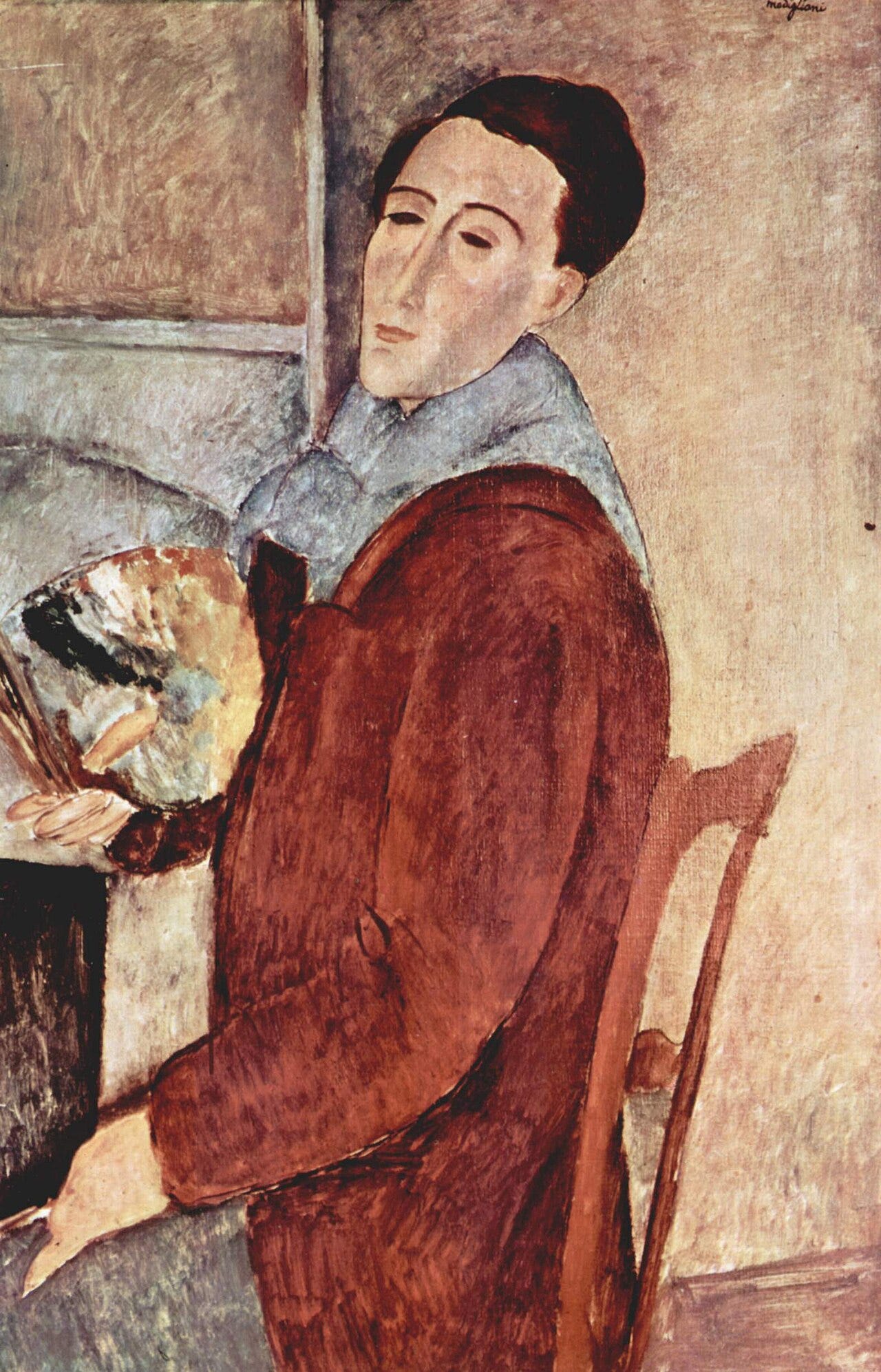
You can spot a Modigliani across a crowded room. That instantly readable style cost him a life of poverty and ended in tragedy.
More incredible painter stories
If Amedeo Modigliani pulled you in, you will love these too:


Amedeo Modigliani at a glance
1884. Born in Livorno into a Sephardic family in financial ruin.
1906. Arrived in Paris at 21, headed for Montmartre, then Montparnasse.
1909. Met Brancusi and gave three years to carving stone heads.
1917. His only solo show was ordered shut by the police over the nudes in the window.
1920. Died of tubercular meningitis at 35. Jeanne Hébuterne died the next day.
The face you know instantly
Long oval faces, tilted heads, swan necks, and eyes often left blank like almonds: a Modigliani portrait is unmistakable. He fused the calm of early Italian painting with the stark simplicity of African masks into a look that was entirely his own.
The nudes that shocked Paris
In 1917 he had his only solo show. The nudes in the window pulled such a crowd that the police ordered them taken down for indecency, and the show closed almost as soon as it opened.
Those same nudes are now among the most valuable paintings on earth.
The doomed charmer of Montparnasse
Handsome, magnetic and always broke, Modigliani lived hard in Montparnasse alongside Picasso, Soutine and Brancusi. He drank, used hashish, and hid the tuberculosis that was slowly killing him, playing the role of the doomed artist almost too well.
Why the eyes are often blank
People always ask about the empty almond eyes. Modigliani left many of them blank on purpose. When his lover Jeanne asked why, he is said to have answered that he would paint her eyes once he truly knew her soul.
The blankness turns each face into a mask and a question at the same time, calm on the surface and unreadable beneath. It is the one quiet trick that makes a Modigliani feel haunted rather than merely elegant.
He wanted to be a sculptor
Before the paintings, Modigliani dreamed of carving. He cut a series of long, serene stone heads, but the dust attacked his weak lungs and he could not afford the materials.
He turned back to paint, carrying the carved, simplified forms with him onto the canvas.
Jeanne Hébuterne
His great love was the young painter Jeanne Hébuterne. When he died of tubercular meningitis in January 1920, she was pregnant with their second child.
The next day, in grief, she fell to her death from a high window. The double tragedy turned a poor painter into a legend overnight.
Four faces that made his name
A few works carry his fame: the long Reclining Nude, the portraits of Jeanne, the portrait of his friend Soutine, and his carved stone heads. Each face is a mood more than a likeness.
Born in Livorno in 1884
Amedeo Modigliani was born on 12 July 1884, in the port city of Livorno, on the coast of Tuscany. He was the fourth child of a cultured Sephardic Jewish family.
The Modiglianis had been prosperous, but his father Flaminio came from a line of businessmen whose fortune collapsed, and the family declared bankruptcy shortly before Amedeo arrived.
Family legend says the bailiffs came the day he was born. Under an old law, a debtor's bed could not be seized if a woman was giving birth in it, so relatives are said to have piled their most valuable goods on top of his laboring mother.
Whether or not that story is exact, Modigliani grew up in a household that had lost money but kept its books, its languages and its pride.
The mother who turned illness into a calling
His mother, Eugenia Garsin, came from an intellectual Jewish family, and she handed her son her love of culture and learning. She taught him at home, ran a small school, and later kept diaries that recorded his fragile health.
Modigliani was sick for much of his childhood. He suffered pleurisy and a bout of typhoid fever, and around 1900 he contracted the tuberculosis that would follow him for the rest of his life.
Illness kept pulling him out of ordinary schooling. During one fevered stretch as a teenager, he told his mother he wanted to paint. She took him seriously. In 1898, when he was fourteen, she arranged for him to study art, and his path was set.
Learning to paint in Livorno, Florence and Venice
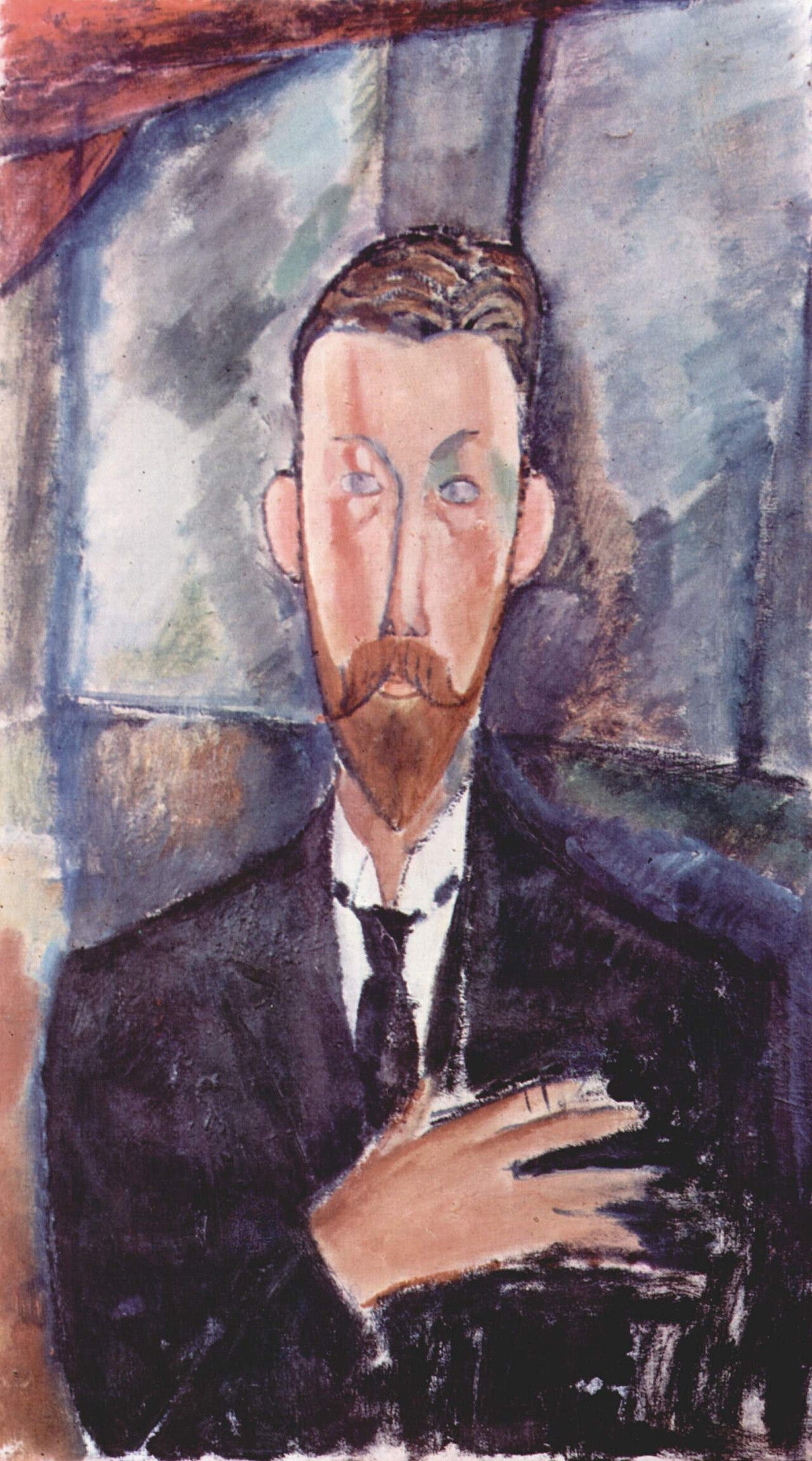
His first teacher, from 1898, was the Livorno painter Guglielmo Micheli, who worked outdoors and pushed his students to paint directly from nature.
From there Modigliani traveled through Italy and soaked up its older art. He took formal training in Florence and in Venice, drawing from the human figure and studying the Renaissance masters he admired all his life.
Venice mattered for another reason. Around 1903, in the city, he met the Chilean painter Manuel Ortiz de Zarate, who filled his head with stories of Paris and its bohemian quarter.
That conversation planted the idea. Modigliani decided he had to see Paris for himself, and within a few years he went.
Paris in 1906, and the shadow of Cezanne
Modigliani reached Paris in 1906, aged twenty two. He settled first in Montmartre, the hilltop district crowded with cheap studios and cabarets, then in 1909 moved across the river to Montparnasse, which was becoming the new home of the avant garde.
He arrived just as the city was rediscovering Paul Cezanne, who had died in 1906. Cezanne's way of building a face or a body out of simple, weighted planes stayed with Modigliani for good.
You can feel it in his portraits. The long necks and tilted heads are not just style. They are figures constructed like small monuments, calm and solid, stripped of fuss.
Paris also gave him the company of Picasso, Brancusi and a floating crowd of poets.
Brancusi, African masks, and the years he chose stone
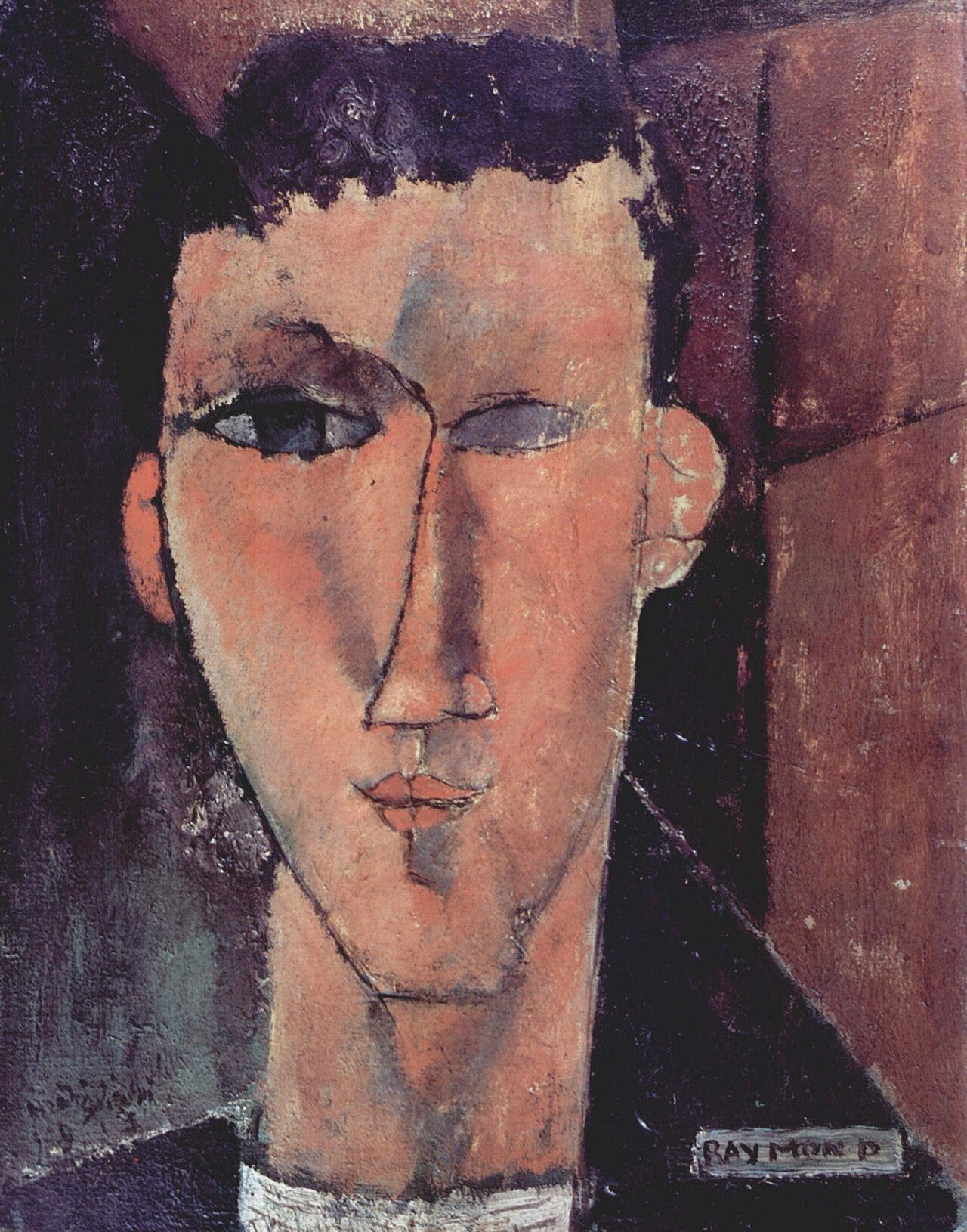
Between roughly 1909 and 1914, Modigliani nearly abandoned painting for sculpture. The push came from two directions.
At the old ethnographic museum in the Trocadero he studied African carvings and Khmer sculpture, drawn to their calm, abstracted faces.
The other push was a person. His neighbor, the Romanian sculptor Constantin Brancusi, carved directly into stone rather than modeling in clay, and Modigliani followed him.
He produced around twenty five carved stone heads, most of them long, narrow faces. At the Salon d'Automne of 1912 he showed seven of them together as a single decorative group.
Why he put down the chisel
The stone heads were the great gamble of his life, and around 1914 he gave them up. The reason was his body. Carving threw off clouds of stone dust, and dust was the last thing weak, tubercular lungs could take.
Coughing over the limestone was slowly poisoning him.
There was also money. Stone was expensive, and Modigliani was poor. Biographers have long wondered how he even paid for his materials, and suspect he sometimes took limestone left lying at Montparnasse building sites.
So he turned back to paint and pencil. The sculptor did not vanish, though. Everything he learned cutting faces out of rock went straight into the portraits that made his name.
Broke in Montparnasse, trading drawings for meals
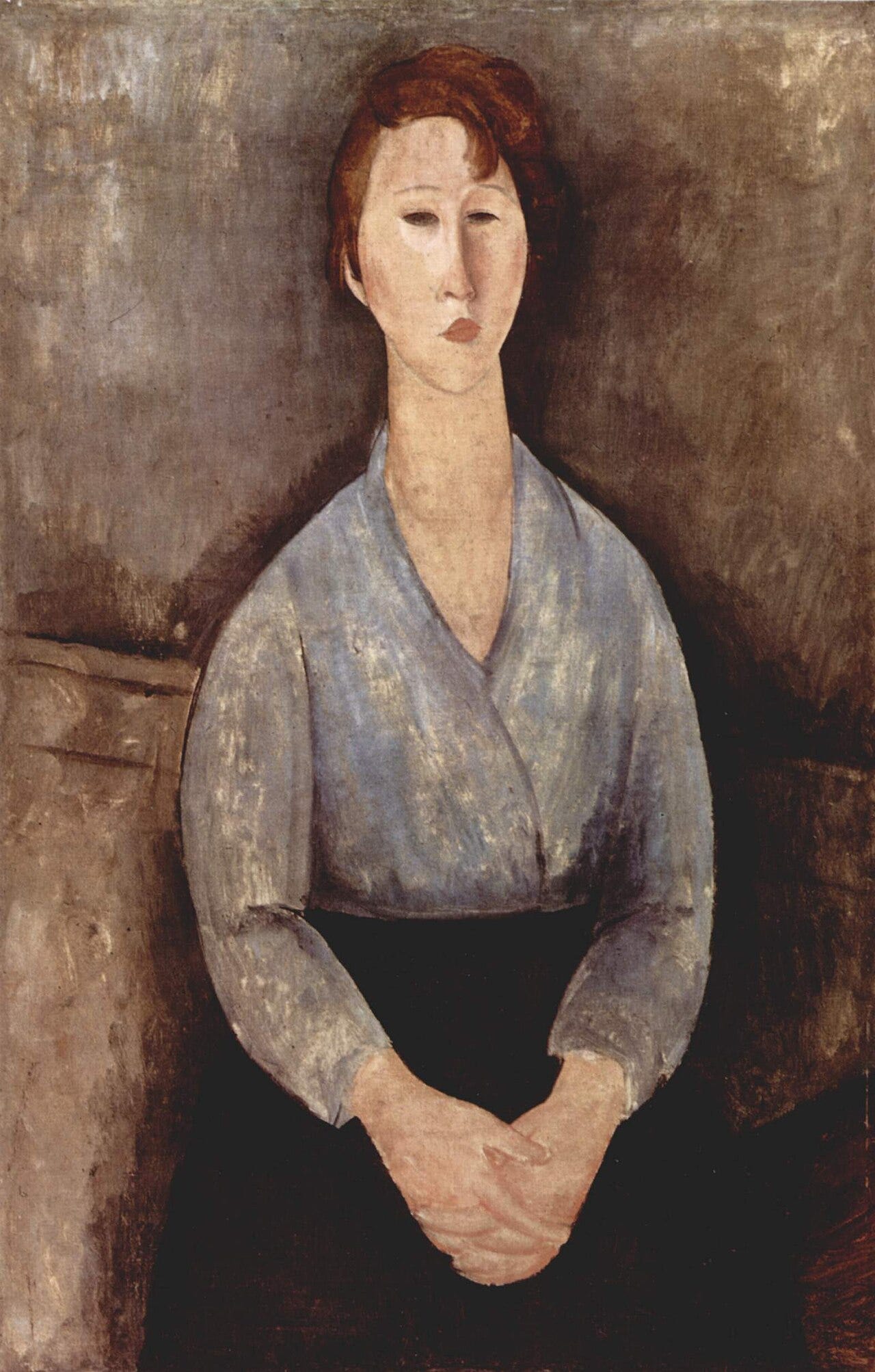
For most of his Paris years Modigliani had almost no money. He drew constantly, in cafes and on the street, pulling out paper and pencil the moment a face interested him.
Many of those drawings were not made to sell in a gallery. They were currency. He handed them across cafe tables in exchange for a drink, a meal, or a night's lodging.
The going rate was humiliating. One friend sold a Modigliani portrait when he was short of cash for a few dozen francs. A portrait of the writer Jean Cocteau, painted in 1916, was later passed to a cafe owner to settle an unpaid bill.
Decades on, that same canvas changed hands in America for a fortune.
Modi, Beatrice Hastings, and the illness he hid
His friends called him Modi, a shortening of his name that also sounds like maudit, the French word for cursed. The nickname stuck to the drinking, the hashish, and the scenes he made in public.
That is where the myth needs correcting. The easy story is a doomed genius drowning in wine for the drama of it. The plainer truth is that tuberculosis carried heavy social stigma at the time, and a visible case could get a man shut out of rooms and beds.
Drink and drugs helped him mask the coughing and hide how sick he was.
Before Jeanne Hébuterne, his great companion was the British writer and poet Beatrice Hastings. Their relationship, from about 1914 to 1916, was close, competitive and often stormy.
The dealer and the show the police shut
Around 1916 a Polish poet named Leopold Zborowski became his dealer and his lifeline. Zborowski paid him a small allowance, supplied canvases and models, and even sent him south to Nice for a spell of sun and quiet.
Zborowski also arranged the one solo exhibition of Modigliani's life, at the Galerie Berthe Weill in December 1917.
To pull in a crowd, a reclining nude was hung in the gallery window. It worked too well. A crowd gathered, a police commissioner objected, and the nudes were ordered down, the offense being their frank pubic hair.
The scandal made noise but little money, and Modigliani stayed as broke as ever.
Two deaths in January 1920, and the millions after

Modigliani died in Paris on 24 January 1920, of tubercular meningitis, a complication of the disease he had carried for twenty years. He was thirty five, and he died in poverty in a charity hospital.
The grief that followed was terrible. His companion Jeanne Hébuterne, nearly nine months pregnant with their second child, went to her parents' home and, two days later, jumped from a window. She was twenty one.
Then came the reversal. Prices for the paintings he could barely give away began to climb, and they have never stopped climbing since.
More secrets to unlock


The Amedeo Modigliani questions that keep coming up
Why do Modigliani's figures have blank eyes? He told a sitter he would paint her eyes when he knew her soul. The empty almonds keep the portraits at a devotional distance, closer to icons than likenesses.
How did Modigliani die? Of tubercular meningitis on January 24, 1920, at 35. Jeanne Hébuterne, nine months pregnant with their second child, took her own life two days later.
Was Modigliani really a doomed bohemian? The legend hides the strategy: he had concealed tuberculosis since youth, and drinking loudly let him disguise the coughing fits of a disease that would have gotten him quarantined.
Did Modigliani make sculpture? About 25 surviving limestone heads, carved between 1911 and 1913 beside Brancusi, before dust and poverty drove him back to painting. They now sell for tens of millions.
How much does a Modigliani cost? Nu couché sold for 170.4 million dollars in 2015, then the second-highest auction price ever paid for any artwork.
Where can I see Modigliani? The Barnes Foundation in Philadelphia, Tate Modern, the Met, and the LaM at Villeneuve-d'Ascq near Lille.
Who was Amedeo Modigliani? An Italian painter and sculptor of the School of Paris.
When was he born? In Livorno, Italy, in 1884.
What is he famous for? His elongated portraits and his nudes.
Who was Jeanne Hébuterne? His young lover, who died the day after he did.
Where can I see his work? Major modern collections worldwide, from the Met to the Centre Pompidou.
Did Modigliani sell much during his lifetime? Very little. He spent most of his Paris years in poverty, trading drawings for meals and drinks, and his only solo show, at the Galerie Berthe Weill in December 1917, sold poorly even after the police scandal. The huge prices came only after his death.
What did Modigliani die of, and how old was he? He died of tubercular meningitis, a complication of the tuberculosis he had lived with since around 1900. He died in Paris on 24 January 1920, aged thirty five, in a charity hospital.
In 2015 his Reclining Nude sold for over one hundred and seventy million dollars, among the highest prices ever paid for a painting. A century earlier, the police had shut down the show where nudes like it first hung.
You can explore works by Amedeo Modigliani in the collection of the Metropolitan Museum of Art. His Girl in a Sailor’s Blouse hangs there today.
Modigliani and Chaim Soutine were close friends in Montparnasse, both represented by the same dealer, Léopold Zborowski. Soutine's own story is told in Chaim Soutine, The Complete Story.