
Andrei Rublev was a medieval Russian monk and the greatest icon painter in Russian history. His greatest work, The Trinity, painted in the early 1400s, is still seen as the high point of Russian religious art, and he himself was later made a saint.
Working in egg tempera and gold leaf, he brought a human warmth to a fixed, sacred art form, and his fame faded for centuries before a 1904 cleaning and a 1966 film revived it.
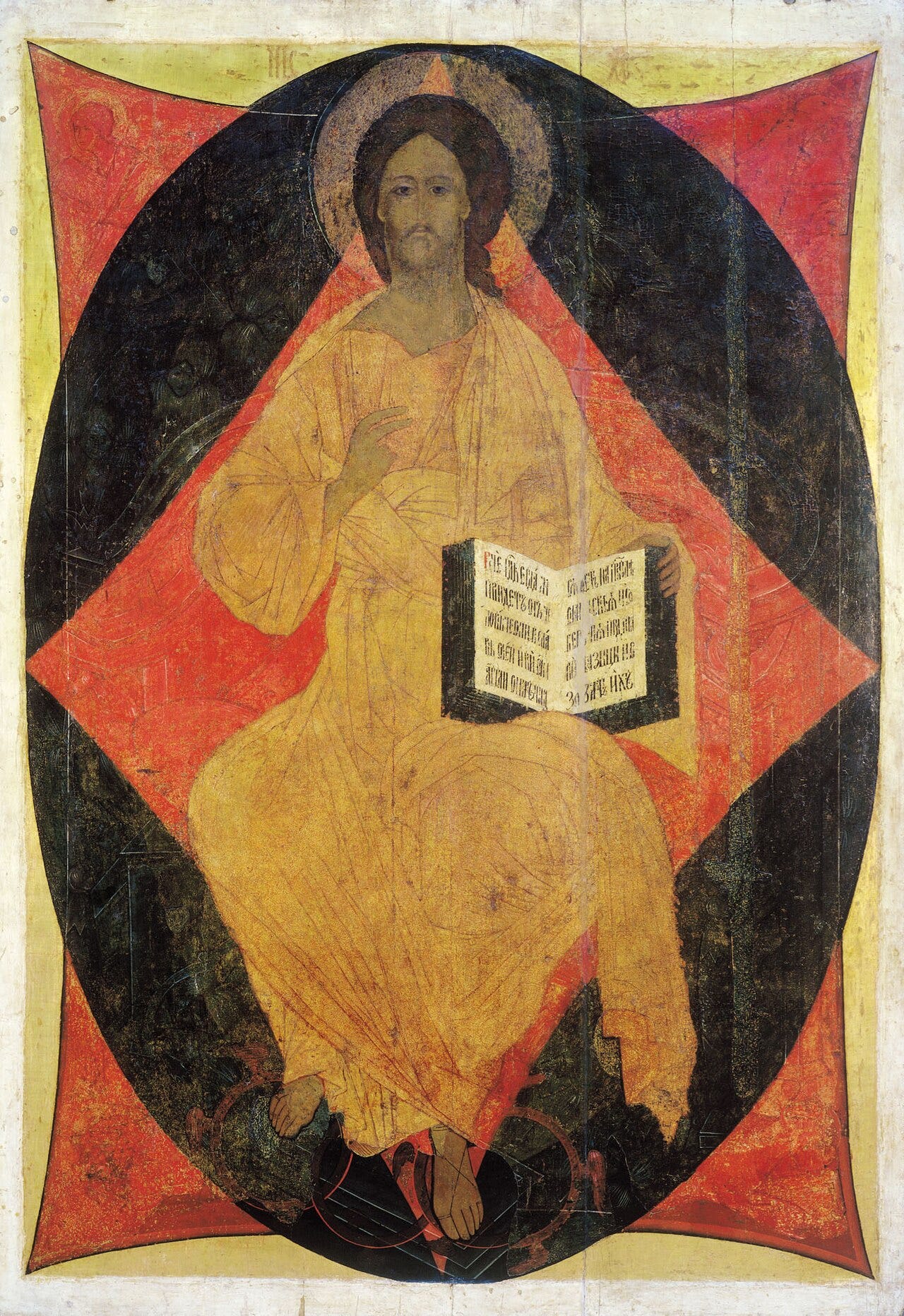
Icons are sacred images, made to be prayed before, not just admired. Rublev gave them a tenderness and calm that set him apart from the sterner Byzantine style he inherited, a gentleness that still feels startling six hundred years later.
Cool Stories About Art is a newsletter to learn art the fun way.
Join 170,000+ readers and get:
10 new art stories / month
The entire archive of content (1,000+ articles)
Comment, ask questions, and chat with other readers
More incredible painter stories
If Andrei Rublev pulled you in, you will love these too:


His life is mostly lost to history, his fame partly revived by a famous film. Here is the whole story.
Andrei Rublev at a glance
1360. Born around this decade in the Moscow lands. Nothing of his youth survives.
1405. Documented painting the Kremlin’s Annunciation Cathedral beside Theophanes the Greek.
1408. Frescoed the Dormition Cathedral at Vladimir with Daniil Chorny.
1425. Painted the Trinity for the Trinity Lavra around this time.
1428. Died of plague at the Andronikov monastery around this year. Canonized in 1988.
What an icon actually is
To understand Rublev, you first have to understand the icon. An icon is a holy image of Christ, the Virgin or the saints, used in Orthodox Christian worship.
It follows strict rules of iconography, the fixed visual language that tells you exactly who is shown and what it means. Icons are not meant to look like real people in a real room.
They are windows onto the divine, flat, calm and outside time on purpose.
The painter was not supposed to show off or invent. That is what makes Rublev's quiet originality so remarkable: he moved people while staying inside the rules.
The Trinity, his most famous icon
Rublev's Trinity shows three angels seated around a table, standing for the Father, Son and Holy Spirit. It illustrates a moment from the Bible when three mysterious visitors come to Abraham.
He painted it for the monastery of the Trinity founded by Saint Sergius of Radonezh, the most revered monk in Russian history.
What makes it unforgettable is the gentleness. The three figures bow toward one another in a soft, almost unbroken circle, painted in tender blues and golds.
Set against a gold ground, it feels less like a rule book and more like a hush. Many consider it the most perfect icon ever painted.
For me it is the one icon I cannot walk past quickly. Three figures, no drama, and the whole of love and grief held in the tilt of their heads.
How the icons were made
Rublev worked the way icon painters had for centuries, with painstaking craft.
He painted in egg tempera on wooden panels, building up thin, glowing layers, over grounds of real gold leaf. Icon painters also used a kind of reverse perspective, where lines open outward toward the viewer rather than shrinking into the distance, as if the holy figures were reaching into our world rather than sitting back in theirs.
A life mostly lost to history
We know very little for certain about Rublev. He was a monk, probably born around 1360, who lived in monasteries in and around Moscow.
He worked alongside the older master Theophanes the Greek and his close companion Daniil, painting churches including cathedrals in the Moscow Kremlin and in Vladimir.
Most of what survives is debated by scholars. The Trinity is the one work they firmly agree is his, which means it carries the weight of his entire reputation.
The cleaning that brought him back
For centuries Rublev's work was almost invisible. Icons darkened over time under candle smoke, grime and layers of later overpainting, until the bright colors vanished into a brown haze.
Only in 1904 did restorers carefully clean The Trinity, and Rublev's luminous blues and golds reappeared from under centuries of soot and overpaint.
It reshaped how the world saw early Russian art, and the icon, kept for a century at the Tretyakov Gallery in Moscow, was returned to the Russian Orthodox Church in 2023.
From monk to saint, and to film
Rublev died around 1428 and was buried at the Andronikov monastery in Moscow.
He also reached a global audience through Andrei Tarkovsky's celebrated 1966 film named after him, a long, intense meditation on faith, violence and the life of an artist. For many people outside Russia, that film is how they first meet his name.
The Trinity stays in Moscow
His greatest work stays in Moscow.
The Tretyakov Gallery, Moscow. The traditional home of The Trinity and other works linked to him.
The Andrei Rublev Museum, Moscow. Set in the Andronikov Monastery, dedicated to early Russian icon art.
On screen. Tarkovsky's 1966 film remains the most seen tribute to him.
The workshop of Theophanes the Greek
The first firm record of Rublev comes in 1405, when he helped decorate the Annunciation Cathedral inside the Moscow Kremlin. He did not work alone.
Beside him stood Theophanes the Greek, a Byzantine master newly arrived from Constantinople, and a painter called Prokhor of Gorodets.
Theophanes brought the dark, shadowed manner of late Byzantine art. Rublev absorbed it and softened it, trading drama for a gentle calm that became his own.
That meeting matters. Through Theophanes, the long tradition of Constantinople passed into Russian hands, and in Rublev it found a quieter, more tender voice.
Painting the Kremlin and Vladimir cathedrals
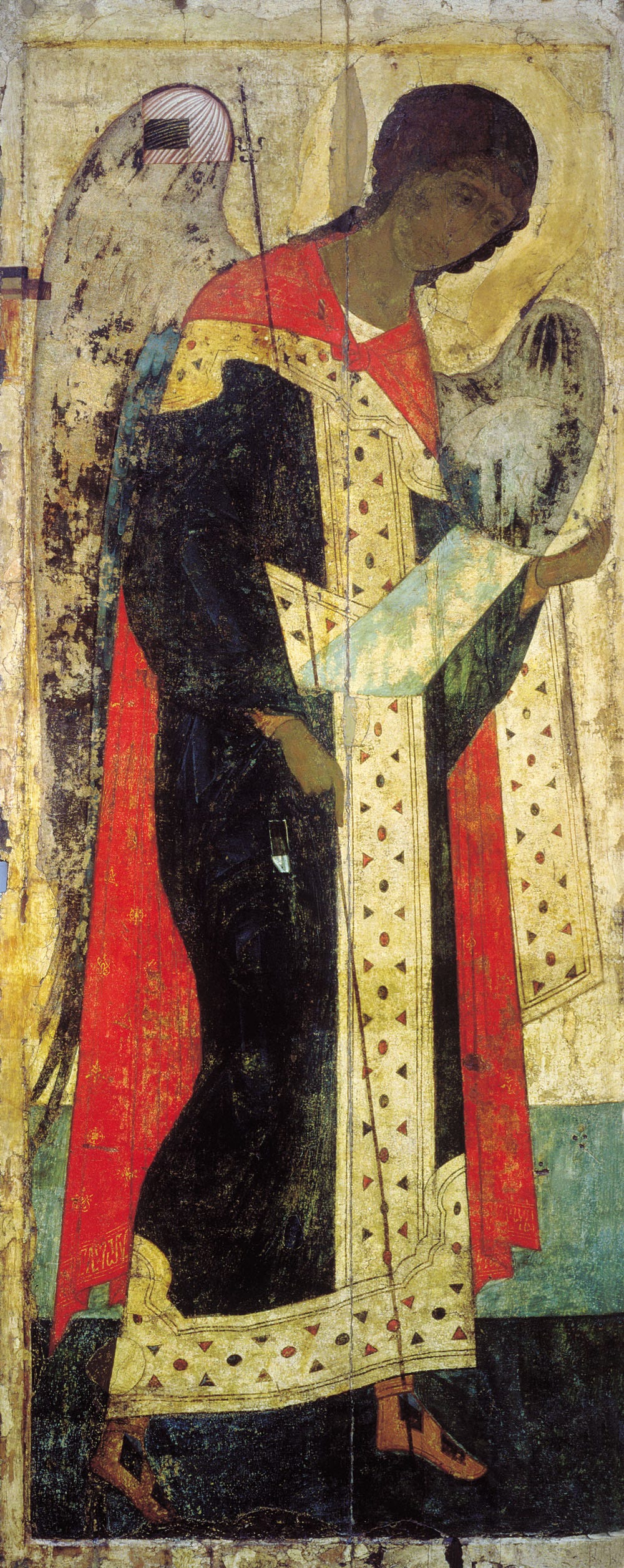
Rublev spent his life decorating churches, not easel pictures. In 1408 he and a fellow monk, Daniil Chorny, painted frescoes in the Dormition Cathedral at Vladimir, an ancient center of Russian faith.
Fragments of that work survive on the walls, including parts of a Last Judgment rendered without terror, full instead of a serene hope. It is one of the few large fresco schemes we can still tie to his hand.
These were state and church commissions at the highest level. To be sent to paint the great cathedrals of Moscow and Vladimir marked Rublev as the leading painter of his day, even if his name meant little to the wider public then.
The three faces found in a woodshed
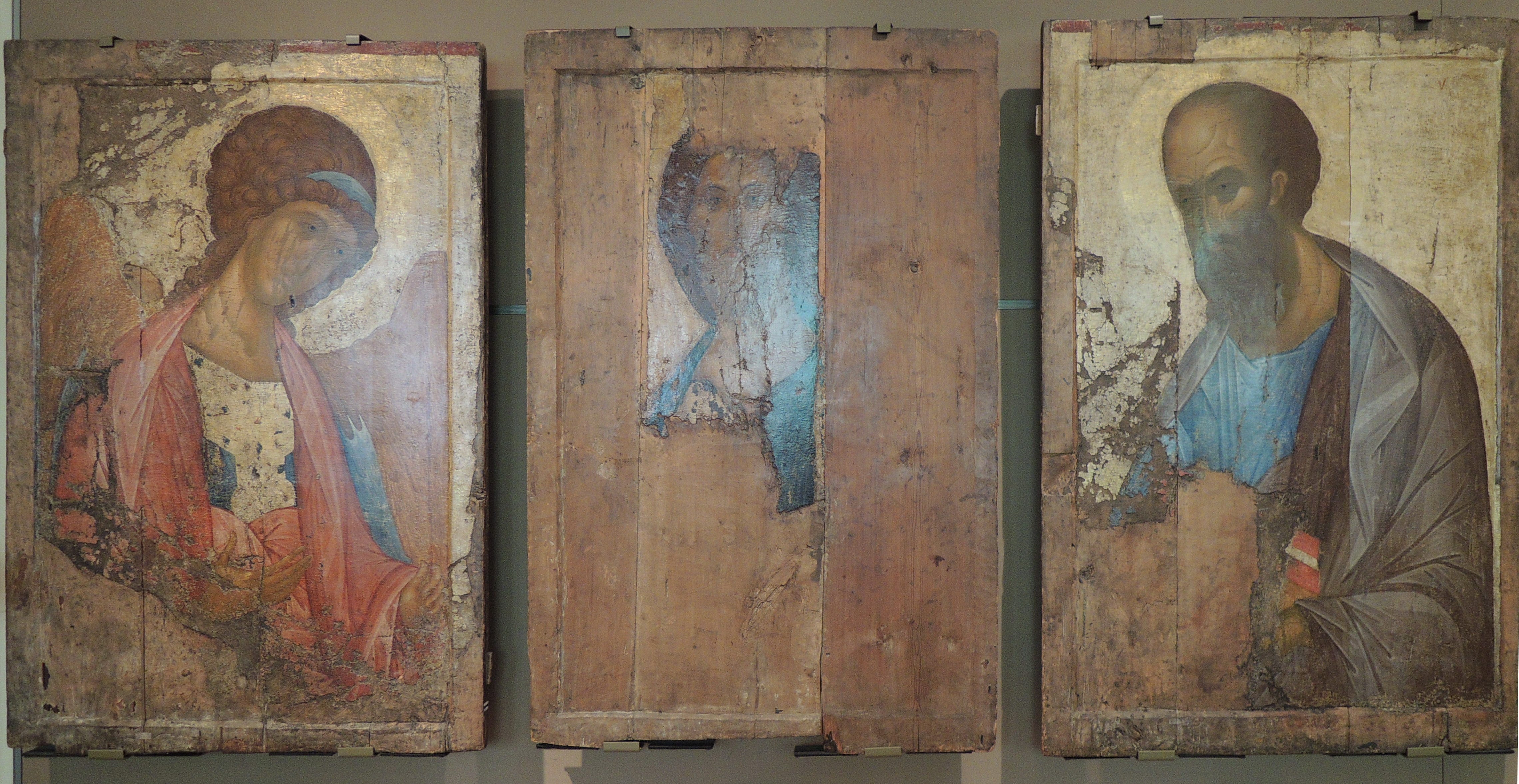
In 1918, during the upheavals in Russia, restorers made a discovery near the Assumption Cathedral in Zvenigorod. Stacked in a woodshed, used almost as building scrap, lay three old icon panels.
They showed Christ, the Archangel Michael and the Apostle Paul, and their quiet beauty pointed straight to Rublev. The group is now called the Zvenigorod Deesis.
The story is a reminder of how close his work came to being lost. Centuries of dark varnish and neglect had hidden it, and only luck and careful hands brought these faces back.
The council that made him the standard
Long after his death, the Russian church settled an argument about how icons should be painted by pointing to Rublev. At the Stoglav Council of 1551, gathered in Moscow, his icons were named as the model that painters should follow.
It was a rare honor, to have one artist's work fixed as the official rule for a whole tradition. It also shows how completely his gentle manner had come to define the Russian icon.
For generations afterward, painters copied his compositions and his soft, harmonious color. Much of what the world now pictures as a Russian icon flows from him.
A monk's death, and centuries of silence
Rublev lived his last years as a monk at the Andronikov Monastery in Moscow, and he died there around 1428, probably during an outbreak of plague. He was buried within the monastery walls.
For a long time his fame faded. Icons were rarely signed, layers of oil and soot darkened them, and his name slipped toward legend rather than history.
Only in the twentieth century, through cleaning, scholarship and a famous film, did he return as a named artist. In 1988 the Russian Orthodox Church declared the humble monk a saint.
The colors of paradise
Part of what sets Rublev apart is his color. Where earlier Byzantine icons could feel dark and severe, his glow with soft blues, warm gold and gentle rose.
The blue in particular became famous, a clear sky tone that later Russians linked to his name. In the icon it was never mere decoration. Gold stood for the light of heaven, and each hue carried a spiritual meaning.
Rublev tuned these colors into quiet harmony, so that a panel feels calm and whole. The peace people sense in front of his work is built, in part, out of that careful balance of color.
So little, so certain
Here is the strange truth about Rublev. Almost nothing can be proved to be by his hand. Icons went unsigned, records are thin, and centuries of grime hid the paint.
Only one work, the Trinity, is accepted by nearly everyone as his. Everything else, from the Zvenigorod panels to the Vladimir frescoes, rests on careful judgment and old chronicles rather than a signature.
That is why scholars still argue over his catalogue. A single sure picture carries the weight of his whole reputation, which is rare for an artist so widely loved.
More secrets to unlock


The Andrei Rublev questions that keep coming up
Who was Andrei Rublev? A monk and icon painter active around 1400 to 1430 in and near Moscow, canonized by the Russian Orthodox Church in 1988, and the standard by which all icons are measured.
What is the Trinity icon? His panel of three angels at Abraham's table, painted around 1425 for the Trinity Lavra. Long the treasure of the Tretyakov Gallery, it was recently returned to church custody, a move conservators publicly opposed.
Why do we know so little about Rublev? A handful of chronicle lines and attributions is all that survives. Tarkovsky's 1966 film Andrei Rublev filled the silence with fiction, and shaped how the world imagines him.
Why are icons said to be written, not painted? The Greek and Russian words for icon-making mean writing: the image is treated as scripture in color, copied within a canon rather than invented.
What makes Rublev's style unique? Against the stern Byzantine manner of his teacher Theophanes the Greek, Rublev painted gentleness: bowed heads, circular harmony, colors like exhaled light.
Where can I see Rublev? The Tretyakov Gallery in Moscow, his frescoes in the Assumption Cathedral at Vladimir, and the Andrei Rublev Museum in Moscow's Andronikov monastery, where he died around 1430.
What is he known for? The Trinity, the most famous Russian icon.
What is an icon? A sacred Orthodox image used in worship.
What did he paint with? Egg tempera and gold leaf on wooden panels.
Is he a saint? Yes, canonized by the Russian Church in 1988.
When did he live? Born around 1360, died around 1428.