
Eugene Delacroix was the leader of French Romanticism, the painter of storms, lions, massacres and revolt. Where the Neoclassicists worshipped clean line, he set the canvas on fire with color and motion.
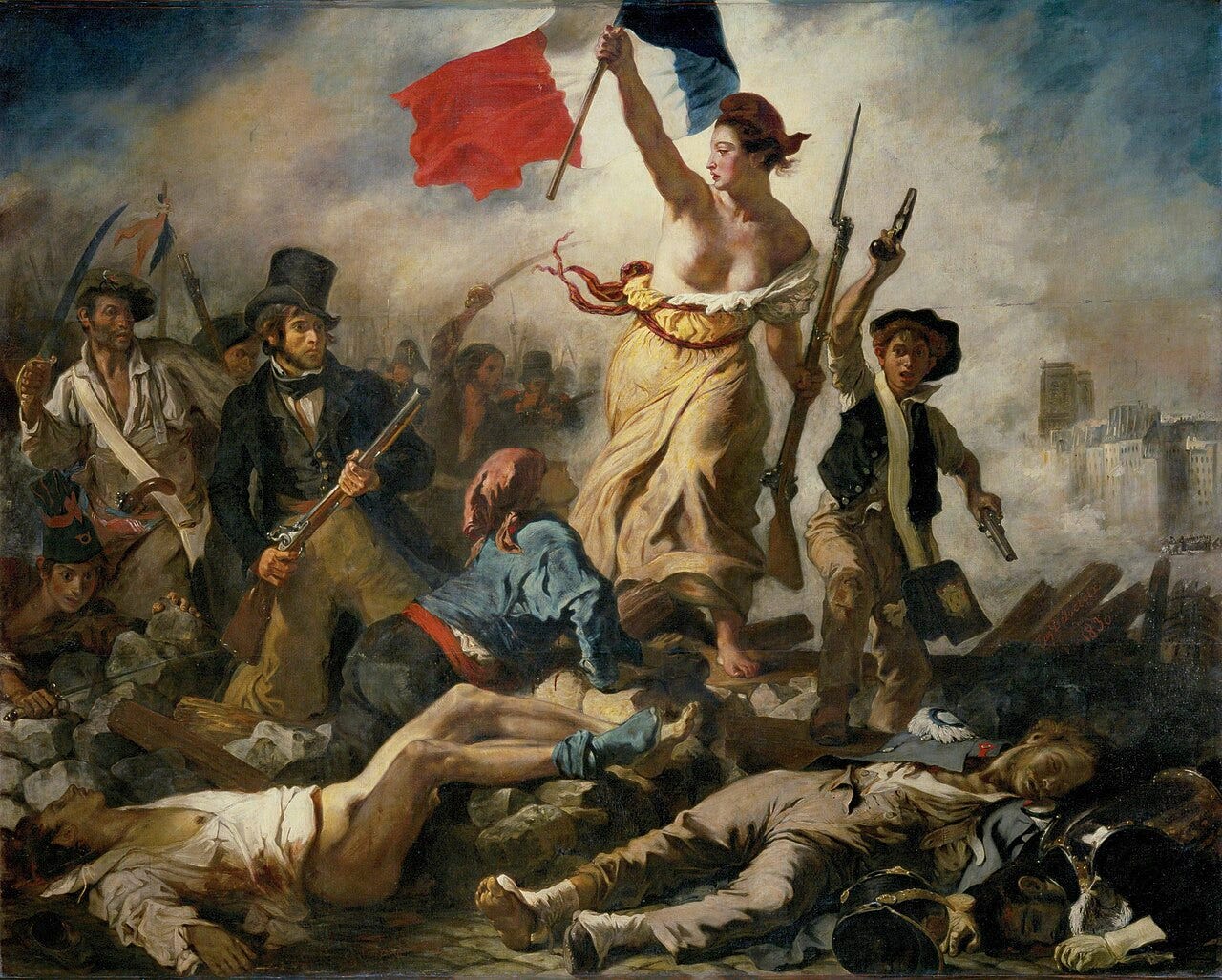
Liberty Leading the People made him the painter of the barricade, and his private journal made him one of the great writers of art.
Born near Paris in 1798 and dead there in 1863, he left roughly 850 paintings plus the Louvre ceilings and the walls of Saint Sulpice, all charged with the same heat he brought to the barricade.
He turned painting from a lesson into a fever, and half of modern color owes him a debt.
More incredible painter stories
If Eugène Delacroix pulled you in, you will love these too:


Eugène Delacroix at a glance
1798. Born at Charenton-Saint-Maurice, near Paris.
1822. Salon debut at 24 with The Barque of Dante.
1830. Liberty Leading the People, painted within months of the July Revolution.
1832. Six months in Morocco that recolored the rest of his career.
1863. Died in Paris, a member of the Institut for only six years after seven failed candidacies.
Color against line
The great fight of 1820s Paris was line against color. On one side stood the followers of Jacques Louis David, led by Ingres, who believed drawing was everything.
On the other stood Delacroix, who believed color carried feeling. He became the face of Romanticism, and the future took his side.
Liberty Leading the People
In 1830 he painted Liberty as a bare breasted woman striding over a barricade, tricolor in one hand, musket in the other, the dead at her feet. It became an instant symbol of France itself, the kind of image that outgrows its painter.
Massacre and melodrama
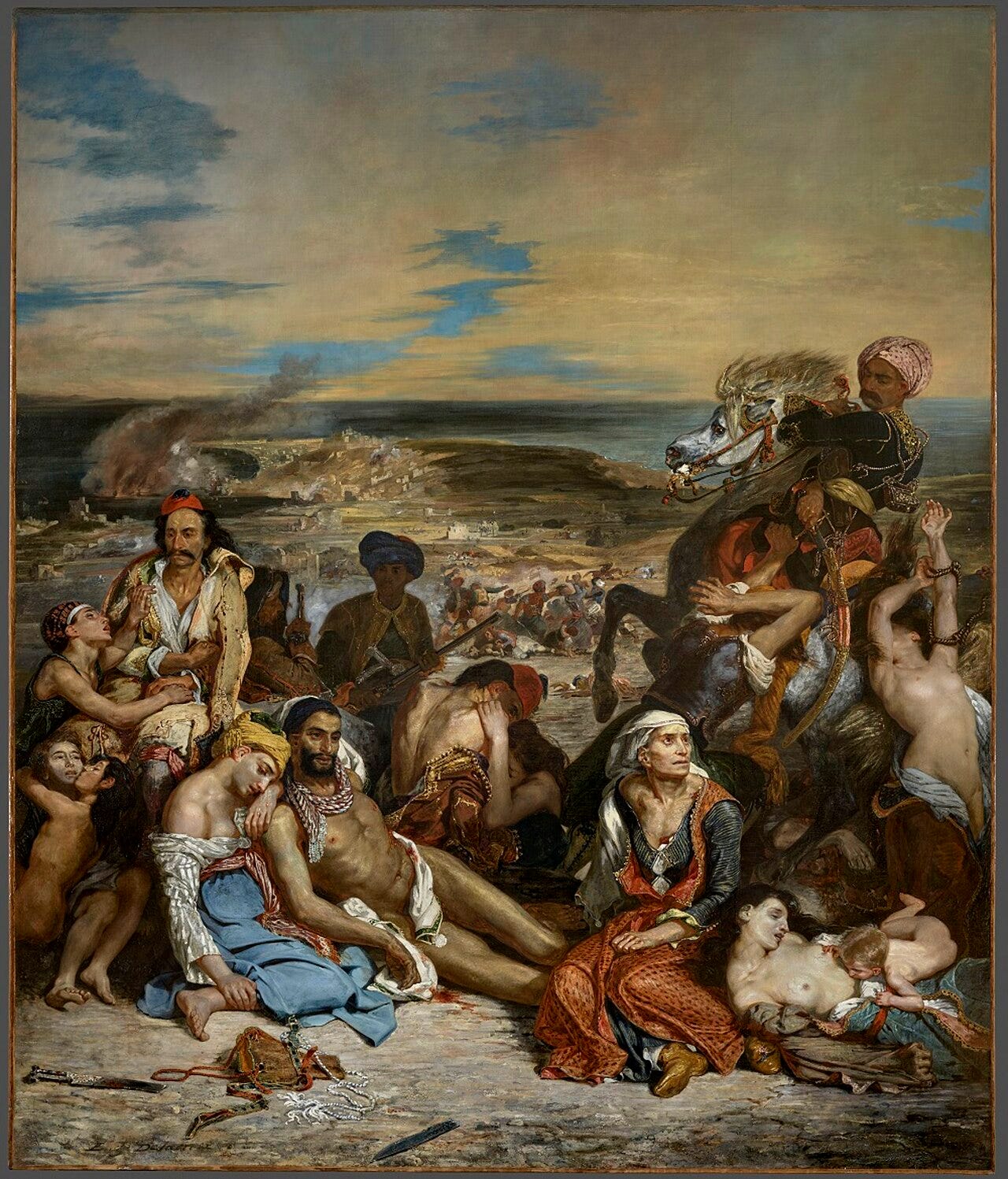
Delacroix loved extremes: the burning chaos of the Death of Sardanapalus, the despair of the Massacre at Chios, lions and tigers locked in struggle.
He wanted the viewer's pulse to rise, not their reason. The Salon called his canvases unfinished and savage, and he wore the insult with pride: it meant he had left the cold academy of David behind for good.
The journey that changed him
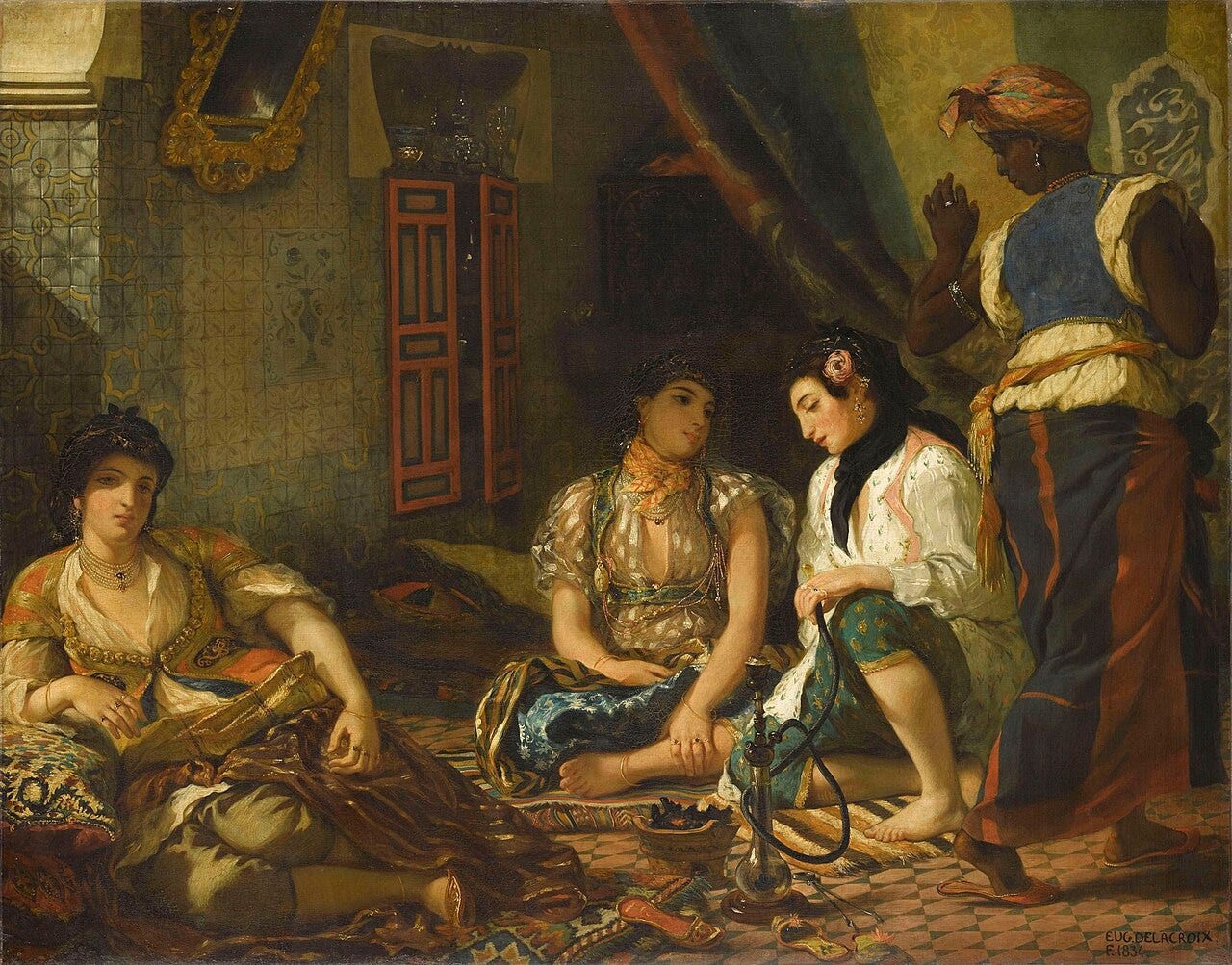
A trip to Morocco and Algeria in 1832 hit him like a revelation: the light, the robes, the horses, the crowds. He filled notebooks and spent the rest of his life mining them, becoming a founder of Orientalism in painting.
The painter who wrote
Delacroix kept a journal for decades, sharp and honest about art, friends and his own doubts. It is one of the most read documents any painter has left, and it shows a restless, brilliant mind behind the drama on the walls.
The walls of Paris
Delacroix spent his last decades on enormous public murals that most visitors walk straight past. He painted the ceiling of the Galerie d'Apollon at the Louvre, the library of the Palais Bourbon, and a side chapel at the church of Saint Sulpice, where his Jacob Wrestling with the Angel still burns on the wall.
He kept climbing the scaffold there until he was too ill to go on. His final studio, beside the church, is now the small Musée Delacroix.
What he gave modern art
His real legacy was color. He set bright tones side by side and let the eye blend them, an idea the Impressionists seized a generation later.
Van Gogh copied his religious scenes, Seurat studied his touch, and a straight line of influence runs from his canvases to Claude Monet and the painters who broke with the past.
The four canvases that carry his fame
A few paintings carry his fame: Liberty Leading the People, the Death of Sardanapalus, the Massacre at Chios, and Women of Algiers. Each one trades polish for raw feeling.
Born near Paris in 1798
Eugene Delacroix was born on 26 April 1798, at Charenton Saint Maurice, a town just outside Paris. He was the youngest of four children in a family tied to public life.
His father, Charles Delacroix, was a senior official who had served as foreign minister and then as ambassador. His mother, Victoire, came from the Oeben family of royal cabinetmakers, whose furniture had graced the court of Louis XV.
So Eugene grew up surrounded by fine craft and government at once. He was often sickly as a boy, yet he read widely and drew constantly, and music and theatre filled the household.
Losing both parents young
Delacroix was orphaned before he reached adulthood. His father died in 1805, while serving as prefect of Bordeaux, when Eugene was only six.
He and his mother then moved to Paris, where he attended the Lycee Imperial, known today as the Lycee Louis le Grand, and formed friendships that lasted his whole life.
His mother died in 1814, leaving the teenager feeling lost even with older siblings nearby.
His brother Charles and his sister Henriette helped raise him. It was his uncle, the painter Henri Riesener, who steered him toward art.
In 1815 that guidance carried Eugene into a Paris studio. Loss came early, but it pushed him deeper into the drawing and reading that already absorbed him.
The rumor about Talleyrand
One rumor has trailed Delacroix for two centuries. Some have argued that his real father was not Charles Delacroix but Charles Maurice de Talleyrand, the powerful French statesman and diplomat.
The claim has never been proven. It leans on two clues: a reported physical resemblance between the painter and Talleyrand, and the steady flow of government commissions Delacroix won throughout his life, even when his work defied academic taste.
Both clues are circumstantial, and no document settles the matter. Whatever the truth, Delacroix always spoke of Charles Delacroix with affection and thought of him as his father.
It makes a good story, and it may even be right, but for now it stays a theory rather than an established fact.
Guerin's studio and the pull of Gericault
In 1815 Delacroix entered the studio of Pierre Narcisse Guerin, one of the largest teaching studios in Paris. Guerin was a respected history painter, though he never quite saw what the quiet young student could do.
The deeper influence came from an older studio mate, Theodore Gericault, who was already winning attention at the Salon. Gericault became the young painter's closest friend, and he also gave Delacroix an odd brush with fame.
Delacroix posed as one of the figures in Gericault's huge canvas The Raft of the Medusa, finished in 1819 and now in the Louvre.
Look closely at that raft and you are partly looking at Delacroix. Gericault died suddenly in 1824, at 32, a loss the younger man felt for years afterward.
A Salon debut at twenty four
Delacroix was only 24 when he made his entrance. For the Salon of 1822 he submitted Dante and Virgil in Hell, often called The Barque of Dante, drawn from Dante's Inferno. It shows the two poets crossing a dark river crowded with the damned.
Critics noticed at once. The tragic mood, the heavy modelling of the bodies, and the rich color announced a new kind of painter. The figures recalled Michelangelo, while the color owed a clear debt to Rubens, whom Delacroix studied for hours at the Louvre.
The state bought the picture, an early sign of the official favor that would follow him. With one canvas, the sickly boy from Charenton had set himself at the head of a young generation soon labeled Romantic.
The scandal of Sardanapalus
Five years later Delacroix pushed his luck. At the Salon of 1827 he showed The Death of Sardanapalus, a violent scene taken from a tragedy by the English poet Lord Byron.
The Assyrian king, defeated and condemned, reclines on a great pyre and orders everything he owns destroyed with him: his wives, his horses, his treasure. Bodies and jewels tumble across the canvas in a storm of red.
Victor Hugo and Alexandre Dumas admired it. Most critics were appalled. They attacked the whirling, off balance composition and the way color seemed to overrun drawing and order.
The picture nearly cost him his official support. Today it hangs in the Louvre and reads as one of the biggest gambles of his youth.
Chopin, George Sand and a life among artists
Delacroix moved easily among writers and musicians. His friends included the Polish composer Frederic Chopin and the French novelist George Sand, who were a couple for years.
Delacroix admired Chopin above almost any living artist and often spoke of music as a model for painting. In 1838 he painted portraits of both friends, among them a now famous likeness of Chopin at the piano, intense and inward.
That double portrait of the pair was later cut in two, and the Chopin fragment now hangs in the Louvre.
He also knew the English painter Richard Parkes Bonington and stayed close to the literary world of Hugo and Dumas. For Delacroix, company meant conversation about art, and he kept that company his whole life.
Jenny Le Guillou and the guarded late years
In his later years Delacroix grew private and often unwell. Fragile health had shadowed him since childhood, and long stretches of illness slowed his work.
He kept a country house at Champrosay, near the forest of Senart, where he walked alone and studied the woods. One person stood between him and the noise of daily life: his housekeeper, Jenny Le Guillou, who entered his service around 1835 and ran his household for the rest of his years.
She guarded his privacy and his time.
In 1857 he moved to a quiet apartment on Rue de Furstemberg, chosen partly for its garden and its nearness to his ongoing work at the church of Saint Sulpice. That apartment is now the Musee national Eugene Delacroix.
Elected at last, and death in 1863
Recognition came slowly. Delacroix wanted a seat at the Institut de France, the body that crowned an artist's career, but the academy turned him down again and again.
He was finally elected to its Academy of Fine Arts in January 1857, on his seventh attempt, close to the end of his life.
Other honors had already warmed toward him. At the 1855 World Fair in Paris he was given a room of more than thirty works he chose himself.
He went on painting through his final years, weaker but steady. Delacroix died in his Rue de Furstemberg apartment on 13 August 1863, at the age of 65.
Jenny Le Guillou stayed at his side to the end, and he left behind more than 6,000 drawings, watercolors and prints.
More secrets to unlock


The Eugène Delacroix questions that keep coming up
What is Delacroix's most famous painting? Liberty Leading the People of 1830, the bare-breasted allegory on the barricade, in the Louvre and on everything from banknotes to album covers.
Why is Delacroix called the father of modern color? He built form from vibrating adjacent tones instead of line, and the Impressionists studied him openly; Cézanne said we all paint in Delacroix's language.
What did the 1832 Morocco journey change? Six months in Morocco and Algiers gave him a lifetime of subjects and the conviction that antiquity was alive in North African light: over 80 paintings came from seven notebooks.
Was Delacroix friends with Chopin? Deeply. He painted the composer's most famous portrait in 1838, and his Journal mourns Chopin's death in some of its most moving pages.
Why does his Journal matter? Kept from 1822 to his death in 1863, it is the best painter's diary ever written, on color, music, ambition, and the boredom of dinners, still in print in every major language.
Where can I see Delacroix? The Louvre for Liberty and Sardanapalus, the murals at Saint-Sulpice, and the Musée Delacroix in his last apartment on Place de Furstenberg.
Who was Eugene Delacroix? The leading painter of French Romanticism.
When was he born? In 1798, near Paris.
How did he die? In Paris, in 1863.
What is he famous for? Liberty Leading the People.
What movement did he belong to? Romanticism, which he led.
Where can I see his work? The Louvre, and the Musée Delacroix in his last studio in Paris.
Was Delacroix really the son of Talleyrand? No one has ever proven it. The idea that the statesman Charles Maurice de Talleyrand was Delacroix's true father is an old rumor, built on a claimed family resemblance and on the run of government commissions the painter kept receiving. There is no document that confirms it, and Delacroix always treated Charles Delacroix as his father.
How did Eugene Delacroix die? Delacroix died on 13 August 1863, in his Paris apartment on Rue de Furstemberg, at the age of 65. He had been in fragile health for much of his life, and illness wore him down in his final years. His devoted housekeeper, Jenny Le Guillou, cared for him to his last hours.
Liberty Leading the People was so charged that after the French state bought it, officials kept it hidden from public view for years, judging it too likely to stir up another revolt. A painting that powerful was treated like a loaded gun.
You can explore works by Eugene Delacroix in the collection of the Metropolitan Museum of Art.