
Fra Angelico was the Dominican friar who painted like an angel, and was later made one of the blessed for it. An early Renaissance master in Florence, he joined the new science of perspective and light to a deep religious calm, above all in the frescoes he painted on the walls of his own convent of San Marco.
, whose panels also hang at the National Gallery in London
His name means the Angelic Brother, a nickname that stuck because the work itself seems to glow with faith. For him, painting was a form of prayer. His own painted angels earn a place alongside other artists' in Famous Angel Paintings.
Born: near Florence, around 1395
Known for: the San Marco frescoes, luminous early Renaissance devotion
Died: Rome, 1455
More incredible painter stories
If Fra Angelico pulled you in, you will love these too:


Fra Angelico at a glance
1395. Born Guido di Pietro around this year in the Mugello, north of Florence.
1423. Documented by now as Fra Giovanni, a Dominican friar who painted.
1433. The Linaiuoli Altarpiece, his first great public commission, contracted to the day.
1440. Began the San Marco frescoes around this time, one for each friar's cell.
1455. Died in Rome. He is buried in Santa Maria sopra Minerva, and was beatified in 1982.
A painter in a friar's robes
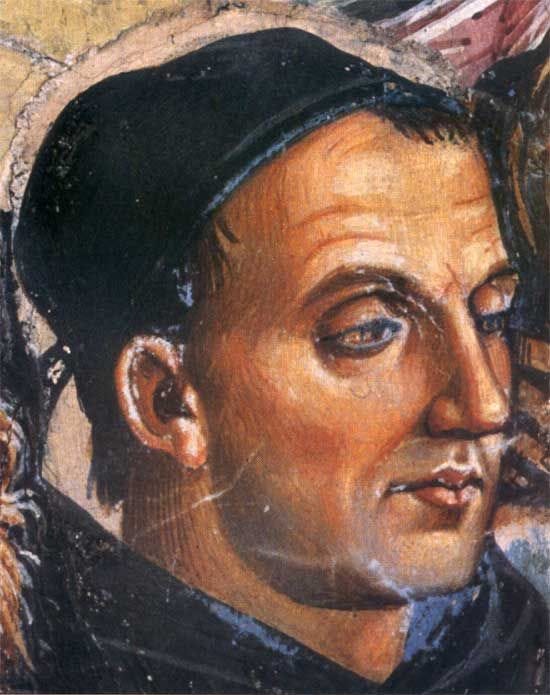
Fra Angelico was a friar first and a painter second, or rather both at once. He took his vows young and painted for his order, refusing, the stories say, ever to alter a sacred figure once he had set it down, and praying before he began.
Yet he was no naive craftsman. He embraced the cutting edge of his day, the new perspective and natural light of the early Renaissance, and used it to make heaven feel real. See what is fresco painting.
The cells of San Marco
His major work is the convent of San Marco in Florence. He and his assistants painted a fresco in each friar's small cell, simple, quiet scenes meant for private prayer, not public display.
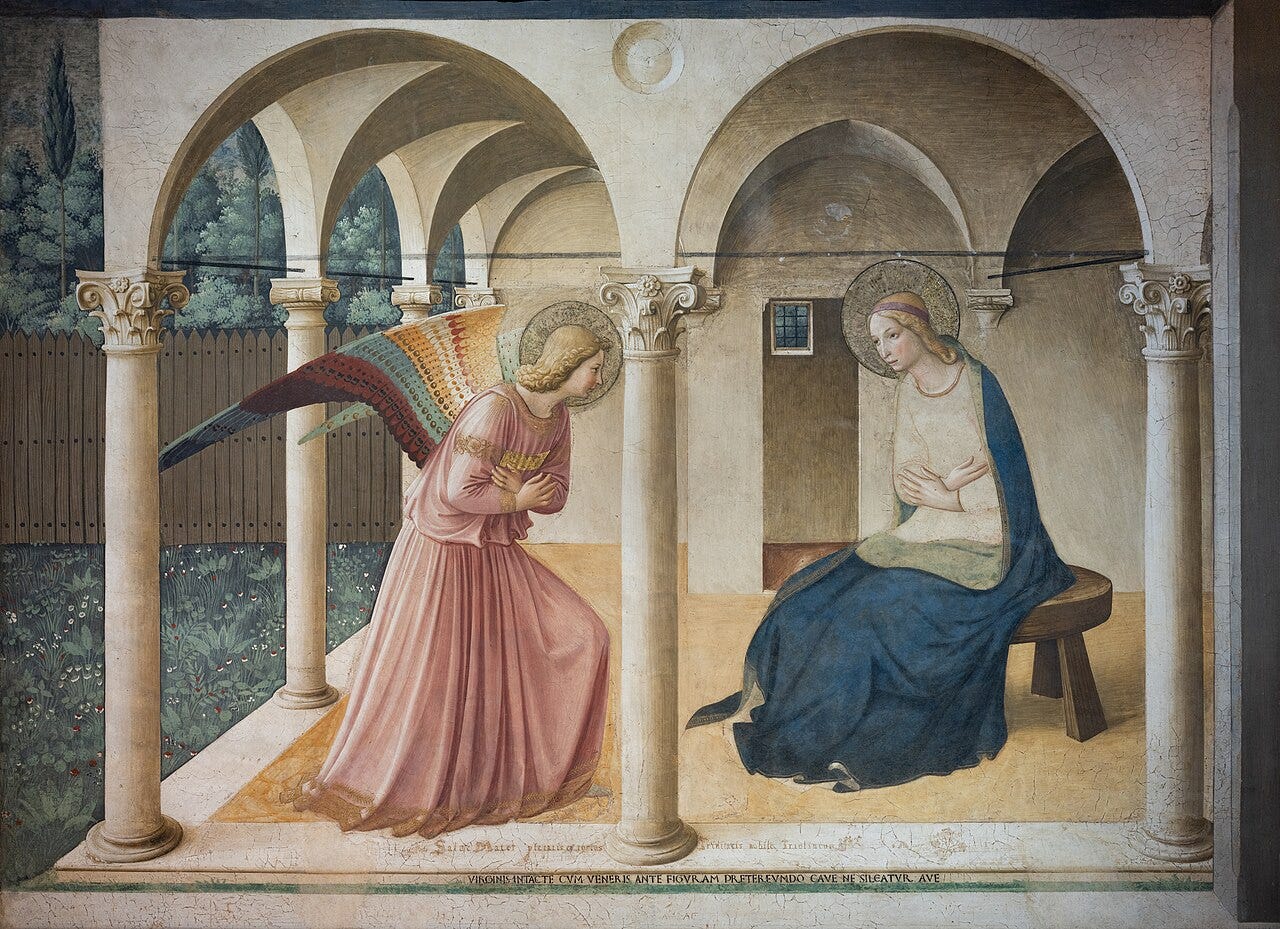
At the top of the stairs he placed his famous Annunciation, the angel Gabriel meeting the Virgin in a plain, sunlit loggia. Calm, tender and perfectly composed, it is one of the most beloved images in Christian art. See what is iconography.
Gold, light and devotion
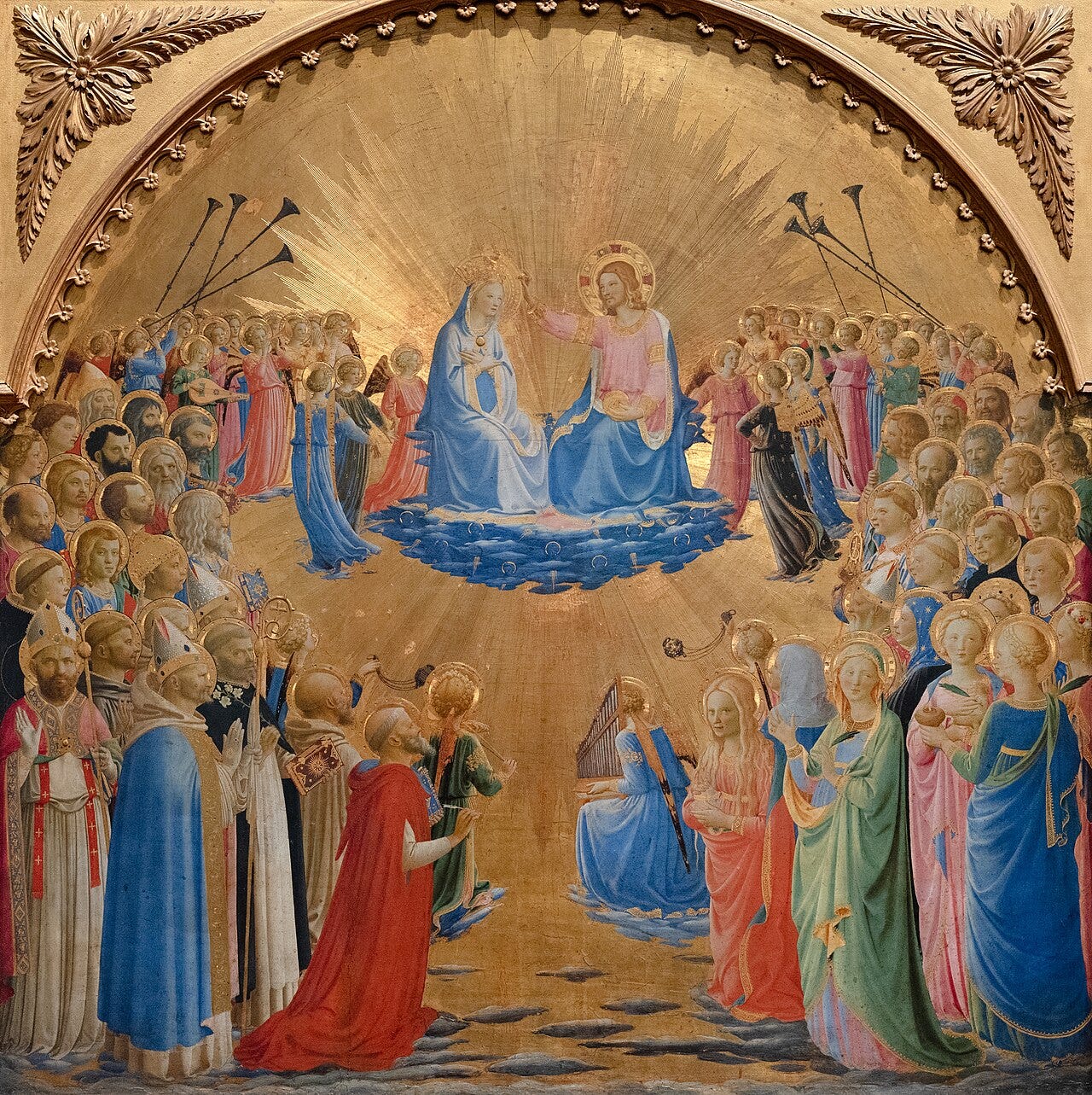
Fra Angelico bridged two worlds. He still loved the radiant gold backgrounds of medieval painting, but he set within them figures with real weight, space and gentle human feeling, often working in luminous tempera.
He worked in Rome for the Pope late in life and was so respected that, legend says, he turned down the chance to become an archbishop, preferring his brushes. He also turned down the Prato Cathedral choir commission, which went instead to Filippo Lippi.
You can explore works by Fra Angelico in the collection of the Metropolitan Museum of Art.
The boy from the Mugello named Guido
He was born around 1395 in the hills of the Mugello, northeast of Florence. His parents named him Guido di Pietro.
He first appears in the records in 1417, listed simply as a lay painter working in Florence. People often place his birth in Fiesole, the hill town where he later lived as a friar, and that is where the confusion starts.
Fiesole shaped the man, but Vicchio, out in the Mugello countryside, is where the boy actually came from. We know almost nothing about his childhood.
What we do know is that by his early twenties he was already earning money with a brush. The friar came later. The painter came first.
Taking the name Fra Giovanni
Sometime between 1420 and 1422, Guido did something that changed his whole life. He joined the Dominican order.
He entered the priory of San Domenico, just outside Florence at Fiesole, and took a new name: Fra Giovanni da Fiesole. Fra means brother. From then on he lived under a strict daily rule of prayer, study and work. Painting was his work.
The Dominicans were a preaching order, built to teach the faith, and Fra Giovanni turned that mission into pictures. He kept rising inside the order too.
By the end of his life he had served as prior of his own community, and he never stopped painting while he did it.
Why we call him the angelic friar
Nobody called him Fra Angelico while he was alive. The nickname came after his death.
People began calling him angelico, Italian for angelic, because of how he lived. Later they added beato, meaning blessed, and put together you get Beato Angelico.
The painter Giorgio Vasari, writing about a century later, pushed the legend further. Vasari claimed Fra Angelico prayed before he picked up a brush, and wept while he painted the Crucifixion.
Treat those stories with care, since Vasari wrote long after the friar died and loved a good tale. Still, the core rings true. Every account from his own time describes a quiet, devout man.
Painting in the margins first
Before the giant altarpieces, Fra Angelico worked small. Much of his early income came from illuminating manuscripts, painting tiny scenes and letters by hand onto the pages of choir books.
This was patient, close work, done with a fine brush under good light.
Vasari said his teacher was Lorenzo Monaco, a monk and one of the finest painters of the older Gothic style in Florence.
You can see that training in the delicacy of his early panels. The lesson of the miniaturist never left him. Even on a large panel he kept that precision, every face and fold set down with care.
He thought like a man who once painted inside the curl of a letter.
The Linaiuoli Altarpiece, dated to the day
Most medieval paintings float free of any firm date. This one does not.
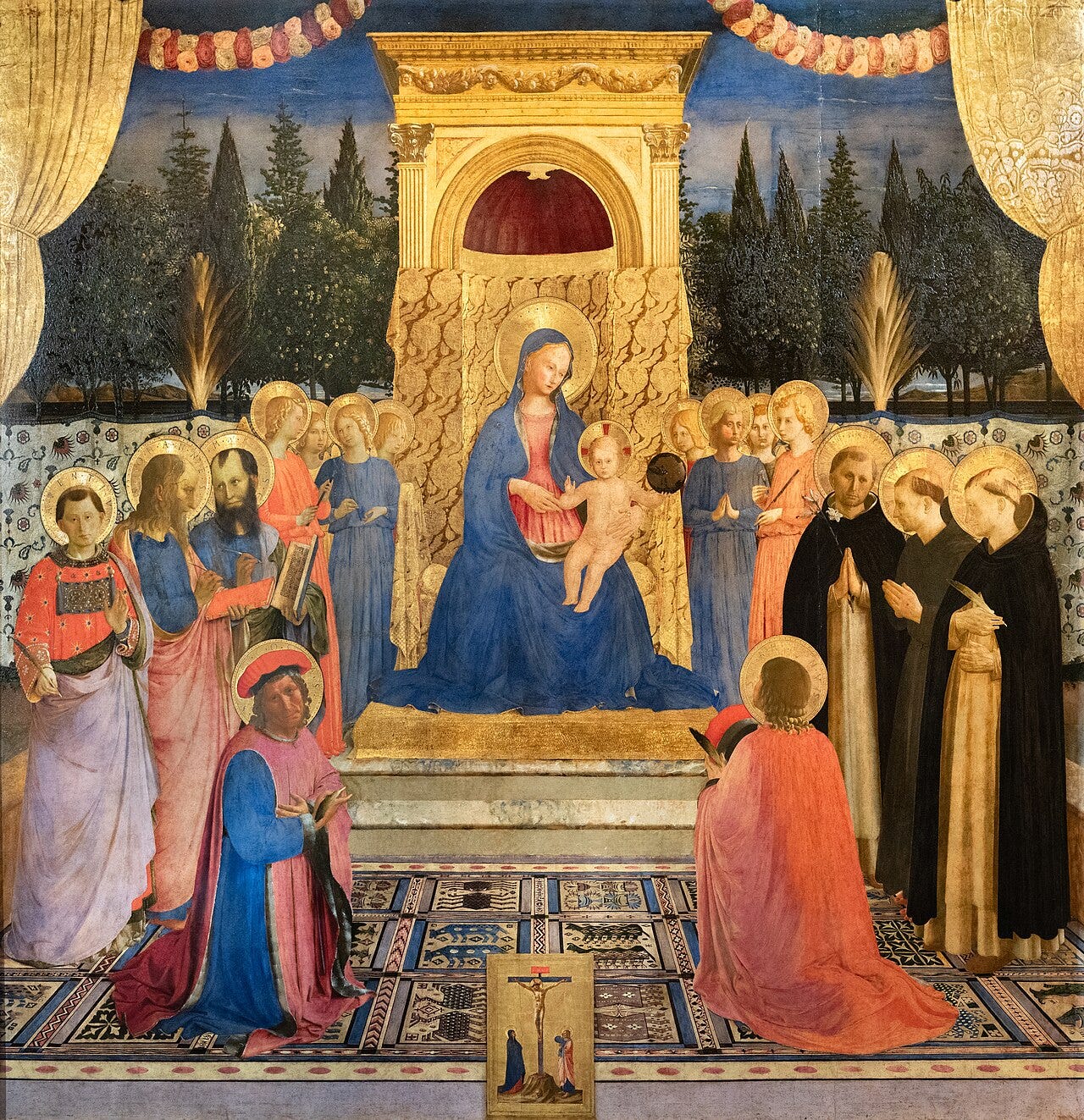
The Linaiuoli Altarpiece, made for the Florentine linen merchants' guild, carries the date 11 July 1433. That makes it the earliest work we can pin to Fra Angelico with certainty.
It is huge, built to hold a monumental Virgin and Child flanked by small singing angels.
The marble frame around it was designed by Lorenzo Ghiberti, the sculptor famous for the bronze doors of the Florence Baptistery.
Along the bottom runs a predella, a strip of small narrative scenes. Here you catch the shift happening. The figures sit in real, measured space, as the old flat gold world gave way to something you could walk into.
The Annunciation he painted more than once
Fra Angelico returned to one scene again and again: the angel Gabriel telling Mary she will bear Christ. He painted it as a full altarpiece at least three times.
The earliest, made around 1426 for his own convent of San Domenico at Fiesole, now hangs in the Prado in Madrid. A second version went to Cortona, a town where he also worked.
The third, and most famous, is the fresco he later painted inside San Marco.
Each one sets the meeting under a row of slim columns, in a calm garden or portico. The Prado panel adds a predella below, telling the life of the Virgin. He clearly loved this subject and kept finding new ways to stage the same quiet moment.
Old gold and new space
Fra Angelico stood on a fault line in art. Behind him lay the medieval habit of setting holy figures against flat sheets of gold, the gold ground, a sign of heaven with no real depth.
Ahead of him lay the new Florentine idea of perspective, drawing a room so it seems to recede into the distance.
He took both. He studied Masaccio, the young painter who first made one point perspective feel solid and human, and he borrowed that sense of weight and space.
Yet when a patron wanted old fashioned gold behind a Madonna, he gave them gold too. That balance is what makes his work unusual. The bodies stand in believable rooms, and the setting still glows like a prayer.
Cosimo's convent and a young assistant
In the 1430s the Dominicans took over a rundown convent in Florence called San Marco. The money to rebuild it came from Cosimo de Medici, the banker who effectively ran the city.
Cosimo poured a fortune into the project and even kept a private cell there for his own retreats.
From about 1436 Fra Angelico led the painting of the whole convent. It was far too big for one man, so he ran a workshop, and among his assistants was a young painter named Benozzo Gozzoli, who would later win fame of his own.
Together they covered the walls and the small sleeping cells with frescoes. The pictures were not decoration. They were tools, placed where each friar would see them and be pulled back toward prayer.
The call to Rome and the Pope's chapel
Fra Angelico's fame reached far beyond Florence. Around 1445 the Pope called him to Rome, and he spent much of his last decade working for the papal court.
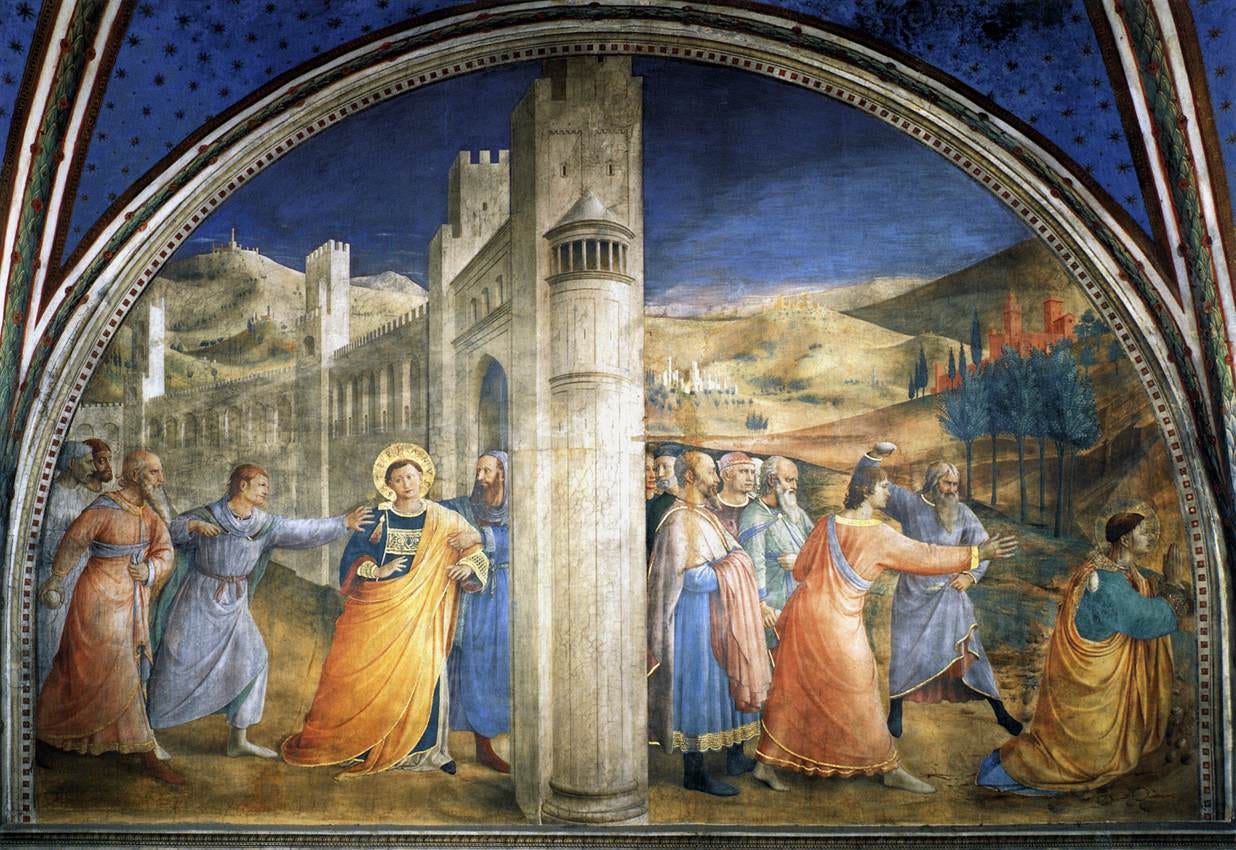
His main task there was the private chapel of Pope Nicholas V, known today as the Niccoline Chapel, which he painted roughly between 1447 and 1449.
On its walls he told the lives of two early martyrs, Saint Stephen and Saint Lawrence, in warm bands of colour.
This was a long way from a quiet friar's cell. He was now decorating rooms for the most powerful man in the Church. The Niccoline Chapel survives inside the Vatican, one of the few rooms he covered from floor to ceiling that you can still stand in.
The archbishop who said no, and a death in Rome
Here is a fact that says everything about the man. Fra Angelico was offered the post of archbishop of Florence, and he turned it down.
The job went instead to his fellow friar Antoninus Pierozzi, later made a saint. Fra Angelico wanted to paint, not to govern.
He died in Rome on 18 February 1455, while still working for the papal court. They buried him in the Dominican church of Santa Maria sopra Minerva, near the Pantheon, where his tomb slab remains today.
The story did not end there. In 1982 Pope John Paul II declared him blessed, confirming the old nickname beato. Two years later the same Pope named him patron of artists. The angelic friar had become, officially, the Church's painter.
The Fra Angelico questions that keep coming up
What is Fra Angelico famous for?
His luminous, devout early Renaissance frescoes, above all the San Marco Annunciation.
Was he really a monk?
Yes, a Dominican friar. He was beatified by the Church in 1982 and is a patron of artists.
Where can you see his work?
The convent of San Marco in Florence, now a museum dedicated to him.
Where did Fra Angelico die?
In Rome, in 1455, while working for the Pope. He is buried in the church of Santa Maria sopra Minerva there.
Why is he called Fra Angelico? His name was Fra Giovanni da Fiesole; the angelic nickname spread after his death, and Vasari sealed it. The Church made it near-official when John Paul II beatified him in 1982 and named him patron of artists.
What is special about the San Marco frescoes? He painted them in the 1440s directly in the friars' cells, one scene per cell, as aids to prayer rather than public display, the most intimate fresco cycle of the Renaissance, still in place in Florence.
More secrets to unlock


Why the Annunciation still stops you
Fra Angelico proved that the newest techniques could serve the oldest faith, and made devotion look effortless. His quiet Annunciation still stops visitors in their tracks at the top of the stairs.
More than five centuries after his death, Pope John Paul II declared him Blessed and named him the patron of artists, making the painter nicknamed the Angelic Brother an official heavenly advocate for everyone who paints.