
Giorgione was the Venetian painter who filled art with mood and mystery, then vanished almost without trace. In a short life he invented the poetic landscape, pictures where atmosphere matters more than story, and a hush of soft light and weather hangs over everything.
We know so little about him that even his greatest painting has no agreed meaning.
Plague killed him around the age of thirty three, and a handful of canvases is all we have.
Born: Castelfranco Veneto, around 1477
Known for: The Tempest, the Sleeping Venus, poetic mood landscapes
Died: Venice, around 1510
More incredible painter stories
If Giorgione pulled you in, you will love these too:


Giorgione at a glance
1477. Born around this year in Castelfranco Veneto, on the Venetian mainland.
1504. Painted the Castelfranco altarpiece, his one securely documented commission, around this year.
1508. Frescoed the Fondaco dei Tedeschi with the young Titian. Salt air later washed the walls almost blank.
1510. Died of plague in Venice at about 33. A letter to Isabella d’Este is the closest thing to a death notice.
1530. The Tempest turns up in a Venetian collector’s inventory, already described as a mystery.
The painting no one can explain
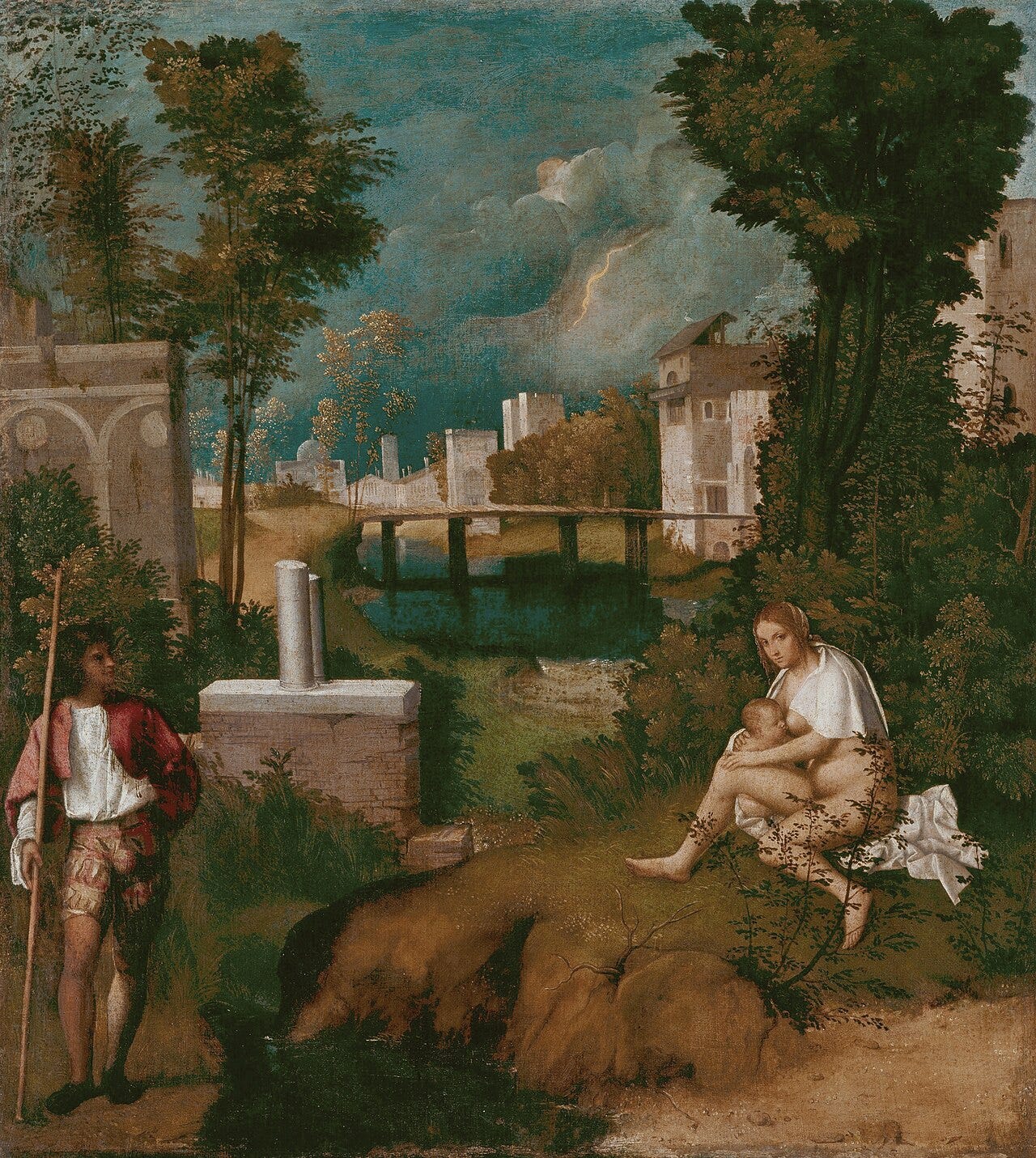
His most famous work, The Tempest, shows a soldier, a nursing mother, a broken column and a storm breaking over a town. For five hundred years scholars have argued about what it means, and no answer has stuck.
That is the Giorgione effect. The feeling is unmistakable, the subject impossible to pin down. He made the atmosphere itself the story. See what is landscape painting.
Soft light, sleeping bodies
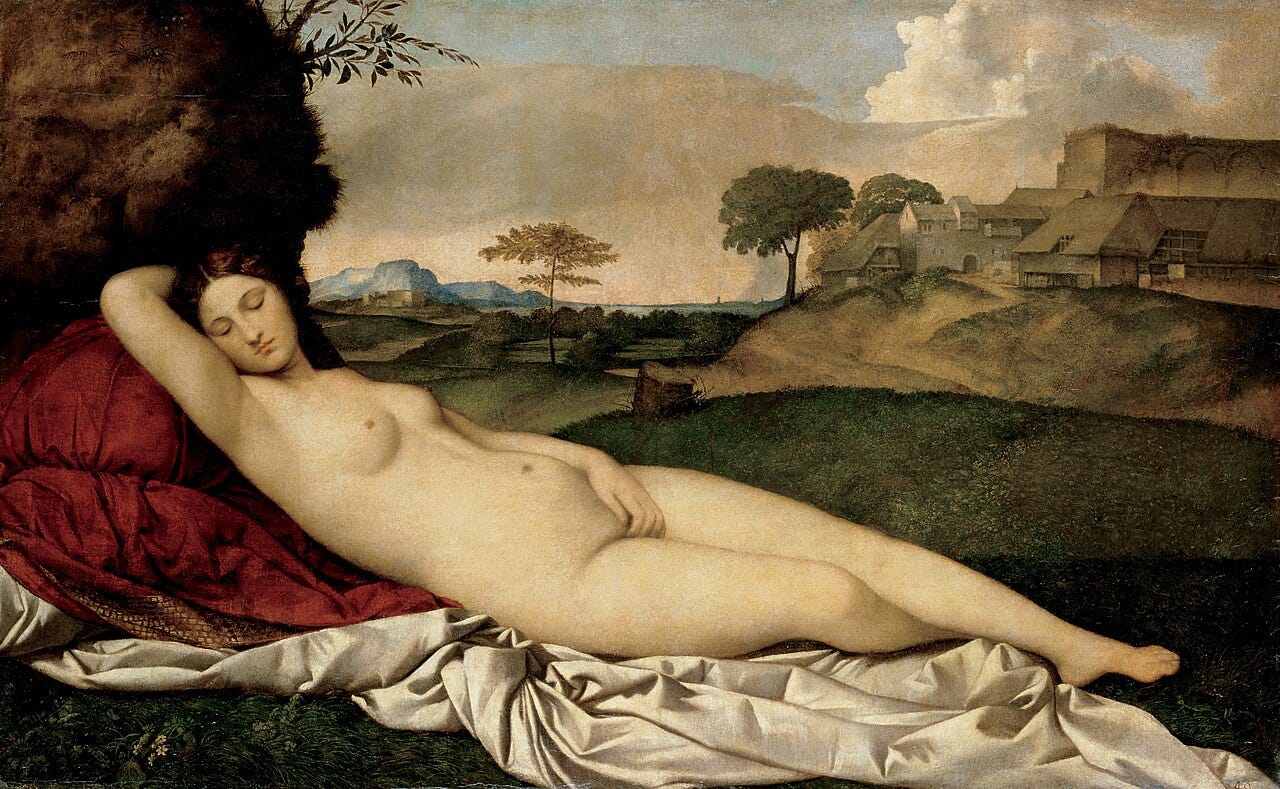
In the Sleeping Venus he laid a nude woman in a landscape, eyes closed, calm as the hills behind her. It set the template for reclining nudes for centuries, and his friend Titian later painted his own version. See what is the nude in art.
Giorgione worked in the Venetian way, building form from colour and glowing oil glazes rather than hard line. See what is oil painting.
A life in the dark
Almost nothing about him is documented. We are unsure which paintings are fully his, and how many were finished by others after he died.
Titian, who knew him and may have shared a studio, completed some of his unfinished works, which only deepens the confusion over who painted what.
What the X rays found
Modern scanning has looked beneath The Tempest, and it changed the story. Under the standing soldier, Giorgione first painted a seated nude woman, then covered her over.
He composed by feel, shifting figures as he worked rather than following a fixed plan. That improvising, mood first method is exactly what makes his pictures so hard to decode and so easy to feel.
The paper trail almost no one left
He was born at Castelfranco Veneto, a walled town on the mainland north of Venice, around 1477 or 1478. His name was Giorgio, which in Venetian dialect becomes Zorzi. Giorgione simply means big George.
The documents that name him fit on a single page. A 1506 inscription calls him maistro Zorzi da Castelfranco. In 1508 he painted frescoes on the outside of the Fondaco dei Tedeschi, the German merchants warehouse in Venice, now surviving only as ruined fragments.
Much of what we think we know comes from a Venetian collector named Marcantonio Michiel, who jotted notes on local pictures in the 1520s and 1530s. Those private notes are among the earliest records of the man we have.
His one documented job, the Castelfranco altarpiece
The Castelfranco Madonna is the only altarpiece securely tied to him, and it still stands in the cathedral of his home town. It is a calm, upright image of the Virgin and Child, and it is the closest thing he left to a fixed point in his career.
The story behind it is grim. The Cypriot mercenary commander Tuzio Costanzo buried his son Matteo in the church at Castelfranco in 1504, and ordered the altarpiece as a memorial to the dead young man.
Giorgione's own family later helped keep the picture safe over the centuries.
The Three Philosophers and three men no one can name
In Vienna's Kunsthistorisches Museum hangs The Three Philosophers, painted around 1508 or 1509. Three men occupy a rocky landscape, one seated and gazing toward the light, two standing, one holding a sheet covered in calculations.
A note written in 1525, when the picture belonged to the Venetian Taddeo Contarini, calls them simply philosophers. The museum now reads them as Pythagoras with his teachers, the men the Renaissance treated as the first thinkers of the West.
Others have seen the three ages of man, or the three Magi waiting for a star. No single reading has won, and the canvas has been cut down on its left side, so we are not even seeing the whole scene Giorgione planned.
Venus asleep, and the hand that finished her
The Sleeping Venus in Dresden gave Western art its first great reclining nude, a woman asleep in the open air with a landscape rolling out behind her. Titian would later borrow the pose for his own reclining Venus.
The picture is not all Giorgione. The landscape and sky are generally credited to Titian, thought to have finished the canvas after Giorgione died.
Some scholars now go further and give even the figure largely to Titian, which leaves Giorgione's exact share uncertain.
An X ray added another twist. At Venus's feet Giorgione had painted a small seated Cupid. The area was damaged, and in the nineteenth century a restorer simply painted the boy out, so for most viewers today he has gone from the scene.
Colour before line
Giorgione helped make oil paint on canvas the standard of Venetian art, and he used it in a way that put colour ahead of drawing. He built figures and weather out of deep, saturated tone and soft light rather than a firm outline.
He seems to have worked with little or no fixed underdrawing, composing straight onto the canvas and changing his mind as he went. That is why the X rays of his pictures keep turning up figures that were moved, added or painted out.
The result is a body of work with a mood no earlier painter had reached, and a habit of leaving things open. It also made his pictures easy to imitate and hard to attribute, a problem that has never closed.
When a Giorgione is mostly someone else
The best warning about trusting a Giorgione is the National Gallery's Il Tramonto, or The Sunset. It surfaced in a villa near Venice in 1933, badly damaged, and passed through a chain of dealers and restorers before London bought it in 1961.
Much of what you now see is not his. The mounted Saint George and the dragon, the monster in the lake and parts of the hermit were added by restorers to cover holes and losses.
Only the sunset, the foreground pebbles, the two front figures and the far landscape are accepted as Giorgione. A single small canvas shows how blurred the line between him, his followers and later repair can become.
The portraits that invented a mood
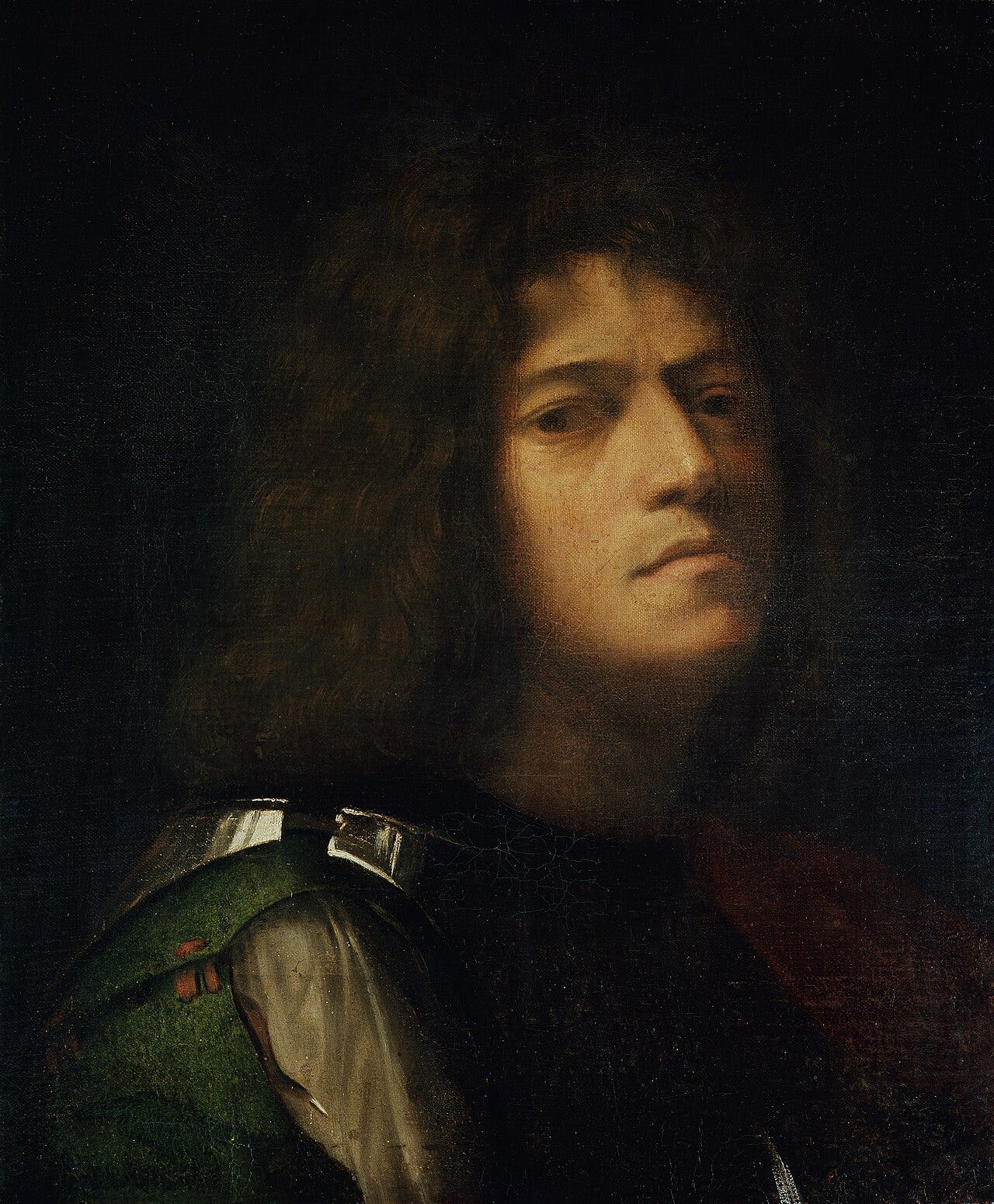
Giorgione also changed the Venetian portrait. In Laura, dated 1506 and now in Vienna, a woman turns from a screen of laurel, one breast bared, the meaning left open between marriage picture and poetry.
His Boy with an Arrow and the so called Young Man in Berlin drop the stiff profile of earlier portraits and catch a sitter mid thought, softly lit, half turned.
That quiet, inward mood is the thing later Venetians took from him more than any single subject.
The letter that tells us he was gone
We can date his death almost to the week because a customer was chasing his work. In the autumn of 1510 Isabella d'Este, the marchioness of Mantua and a relentless collector, wrote to Venice trying to acquire a painting by him.
The reply told her he had died of the plague. Those letters, from late 1510, are how we know. He was probably still in his early thirties.
Few works, a long shadow
For a painter with so few certain pictures, his reach was large. His closest heir was Titian, who worked beside him, finished canvases he left incomplete and carried the soft Venetian light forward for decades after.
Within a generation, painters across Venice were copying his moody landscapes and quiet, dreaming figures, so many of them that a whole class of pictures came to be called Giorgionesque.
He changed how a city painted, then disappeared before he was forty.
The frescoes that Venice let wash away
In 1508 Giorgione was given a public commission of the first rank. He painted frescoes across the outside of the Fondaco dei Tedeschi, the great warehouse and lodging of the German merchants beside the Rialto bridge.
A younger painter worked on another face of the same building. That painter was Titian, and the shared job is one of the few times the two are documented side by side.
Venetian salt air was cruel to outdoor paint. The frescoes faded over the following centuries until almost nothing was left, and only a battered fragment of a female nude survives today.
One of Giorgione's largest public works exists now mostly as a rumor.
A mood that outlived the man
Giorgione died young, but the feeling he had invented did not die with him. A soft, dreaming quality, figures lost in thought in a warm landscape, spread through Venetian painting.
Younger artists such as Sebastiano del Piombo, Palma Vecchio and Giovanni Cariani carried the manner forward, so much so that scholars group them loosely as the giorgioneschi, the followers of Giorgione.
This is part of why his catalogue is so hard to pin down. So many painters absorbed his mood that telling a true Giorgione from a close follower has kept experts arguing for centuries.
The Giorgione questions that keep coming up
What is Giorgione famous for?
Inventing the poetic mood landscape, and for The Tempest and the Sleeping Venus.
What does The Tempest mean?
Nobody knows for certain. Its subject has resisted every explanation for centuries.
How did he die?
Of plague in Venice around 1510, aged only about 33.
How is he linked to Titian?
They worked closely, and Titian finished some paintings Giorgione left incomplete.
More secrets to unlock


Why the mystery keeps pulling
Most painters are remembered for answers. Giorgione is remembered for a question that will not close. Stand before The Tempest in Venice and the storm still has not told anyone what it is about.
One last detail. So few works are securely his that experts can list them almost on one hand, which makes every firm Giorgione one of the rarest things in Renaissance art.