
HR Giger was the Swiss artist who painted nightmares where human flesh and cold machinery fuse into one. He designed the monster in Ridley Scott's 1979 film Alien, and won an Oscar for it.
Working in cold grey and a flawless airbrush finish, he called his fused world of flesh and machine biomechanical, and it went on to shape decades of horror film, album art and tattoo design.
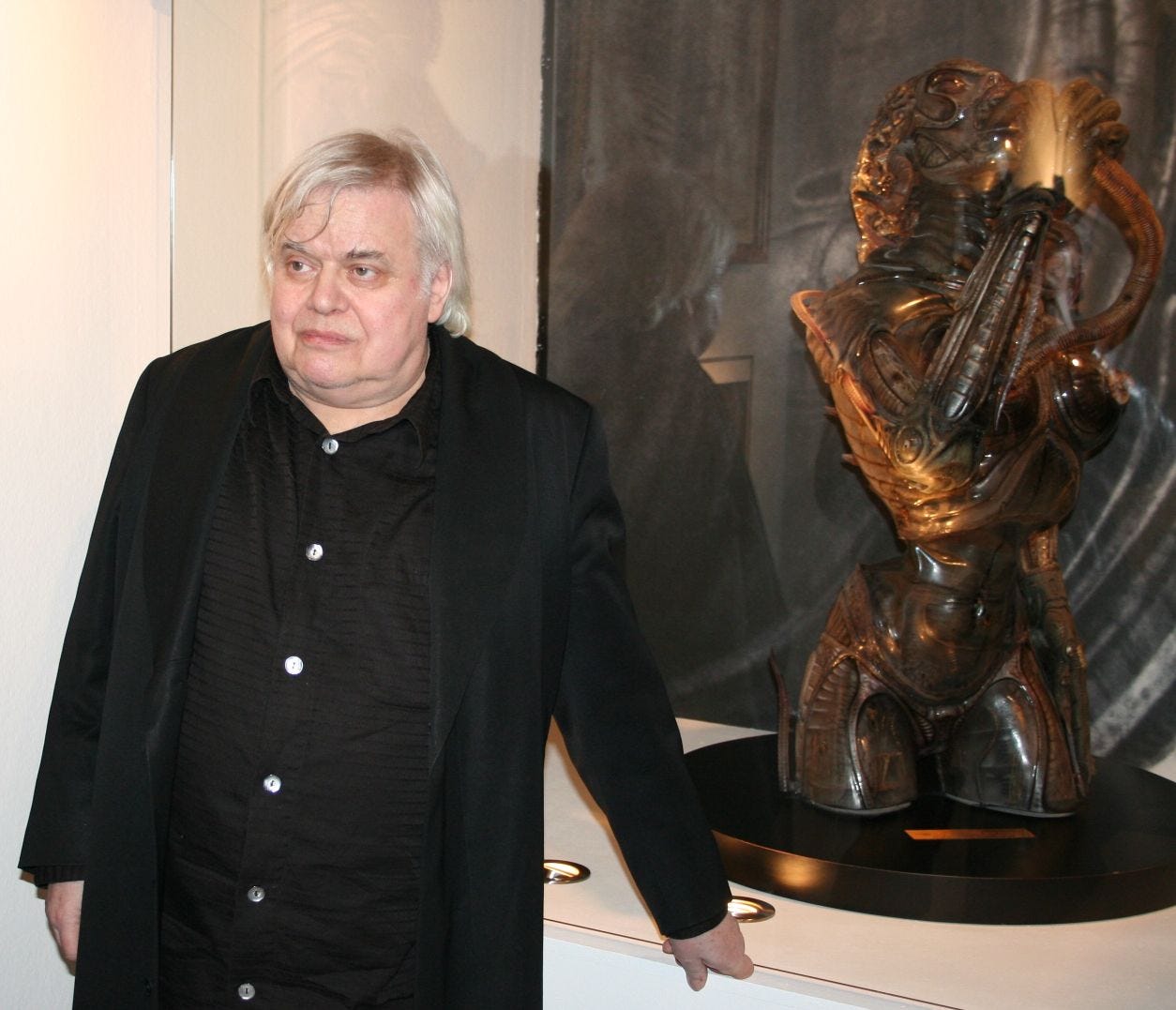
His world has a name, biomechanical: bodies wired into tubes and pistons, bone melting into metal, sex and death tangled with engines.
It is beautiful and deeply disturbing at the same time, and once you have seen it you can recognize a Giger anywhere.
More incredible painter stories
If HR Giger pulled you in, you will love these too:


He turned his own night terrors into one of the most influential dark visions of the 20th century. For me no one else has fused beauty and dread quite like him. Here is the whole story.
HR Giger at a glance
1940. Born in Chur, Switzerland, a pharmacist's son.
1977. Published the Necronomicon, the book that landed on Ridley Scott's desk.
1980. Won the Oscar for the visual effects of Alien.
1998. Opened his museum in the medieval castle of Gruyères.
2014. Died in Zurich at 74 after a fall.
The artist who built the Alien
Giger trained in architecture and industrial design before turning to dark, dreamlike images. In 1977 he gathered his paintings into a book called Necronomicon.
The director Ridley Scott saw it and hired him to design the creature for Alien. Giger built the whole life cycle of the monster, the egg, the face hugger and the dripping adult, plus the eerie derelict spaceship.
The team won the 1980 Academy Award for visual effects. Few artists have ever created a single image so widely feared.
What biomechanical means
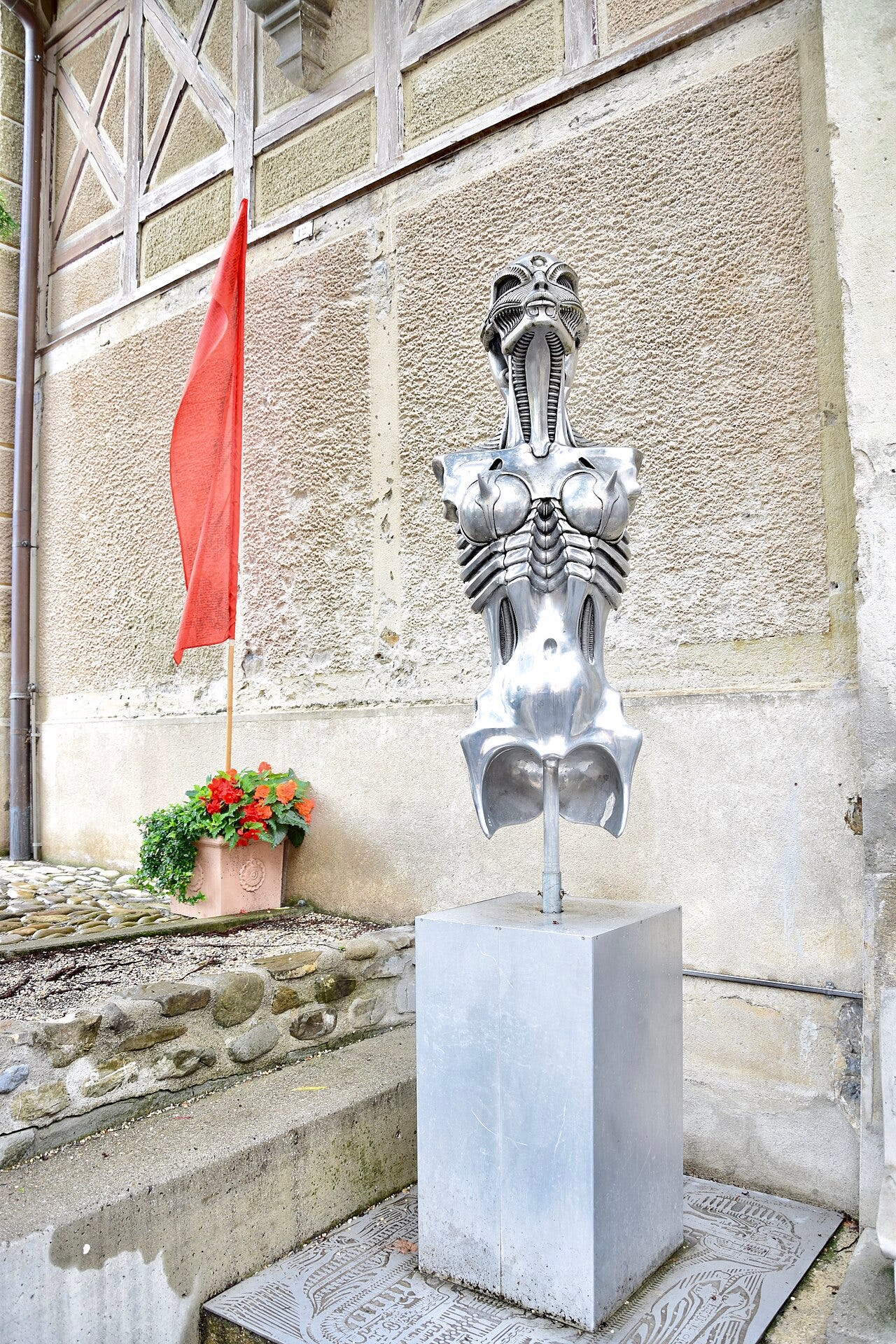
Biomechanical is Giger's own word, his fusion of biology and machine. Skeletons sprout tubes. Skin hardens into armor plating. Birth, sex and death share the frame with gears and pipes.
It sits close to dark Surrealism, the art of dreams and the unconscious, but pushed all the way toward horror. Its roots also reach back to Symbolism, which painted fear, desire and death as visions rather than facts.
How to spot a Giger
His look is unmistakable, and there is real method behind it.
The fusion. Human figures merge with tubes, bones, skulls and mechanical parts until you cannot tell where the body ends.
The grey. Most of his major work is in cold grey monochrome, like wet stone or metal.
The smooth surface. No visible brushmarks. Everything looks airbrushed, polished, almost photographic.
The unease. Beauty and dread held together, never one without the other.
He was a master of the airbrush, which is why his surfaces feel so eerily seamless.
The nightmares he borrowed and the ones he made
Giger's nightmares had ancestors. He drank in the horror writer H.P. Lovecraft, with his vision of vast, indifferent cosmic monsters.
He learned dream logic from the Surrealists Salvador Dali and Max Ernst, and the swarming hells of the old master Hieronymus Bosch. Most of all he drew on his own sleep, he suffered from night terrors, and painted them partly to get them out of his head.
Beyond the Alien
Giger's reach went well past one film. He designed for movies like Species, created unused designs for an early attempt at Dune, and made album covers for rock and metal bands, from Emerson, Lake and Palmer to Danzig and Korn.
He also built physical worlds. There are Giger Bars in Switzerland where the seats, arches and ceilings are shaped like his biomechanical bones, so you can sit inside his imagination.
The Giger Museum
In 1998 he opened the HR Giger Museum in the medieval town of Gruyeres, Switzerland, in an old castle.
It shows the artist's own personal art collection beside his work, and remains the place to see the full sweep of his vision in one spot.
Chur, Zurich and the love he lost
Hansruedi Giger was born in 1940 in Chur, Switzerland, the son of a pharmacist who wanted him to take a safer path. He studied design in Zurich before committing to art.
His life carried real darkness. His great early love, the actress Li Tobler, died by suicide in 1975, a loss that haunted his work for years. Out of that pain came some of his most powerful and personal images.
If this raises difficult feelings, it is a sensitive subject, and support is available if you or someone you know is struggling.
How HR Giger died
Giger kept working and overseeing his museum into his seventies.
He died in 2014, at 74, from injuries after a fall at home in Zurich. By then his crossover of fine art, film and music had made him one of the most copied dark artists alive.
Where to stand inside Giger's world
He is a museum unto himself.
The HR Giger Museum, Gruyeres. The essential stop, a castle filled with his work in Switzerland.
The Giger Bars. Step inside a biomechanical room in Switzerland.
On screen. The Alien films remain the most seen Giger of all.
The Dune that was never made
Before Alien there was a film that collapsed. In the mid 1970s the director Alejandro Jodorowsky set out to film the science fiction novel Dune, and he gathered a wild team of artists to imagine its worlds.
Giger was among them, designing the dark castle of the villainous Harkonnen family. The project ran out of money and fell apart around 1976 without a frame being shot.
It was not wasted. Several people from that failed Dune, Giger included, carried their ideas into other films. The strange machinery he had dreamed up for a movie no one would ever see was about to find a home.
The book that led to Alien
In 1977 Giger gathered his paintings into an art book called Necronomicon. It laid out his whole dark world in one place, part machine, part body, part bad dream.
The writer Dan O'Bannon, who had worked on the doomed Dune, showed the book to the director Ridley Scott. Scott took one look and knew he had found the creature for his new horror film.
That film was Alien, released in 1979. For his designs Giger shared an Academy Award the following year. A private book of nightmares had turned into one of the most famous monsters in cinema.
The airbrush and the monochrome world
Giger worked in a way few fine artists did. His main tool was the airbrush, a device that sprays a fine mist of paint, letting him build smooth, seamless surfaces with no visible stroke.
He worked mostly in grey and black, large canvases drained of color, so that metal and flesh seem to melt into a single cold substance. The lack of color is part of the dread. Everything looks lit by a dead light.
This method gave his pictures their odd, photographic smoothness. They feel less painted than grown, which is exactly the unsettling effect he wanted.
The record covers he designed
Giger's images did not stay inside galleries and cinemas. They also turned up on the covers of rock albums, where his machinery matched the mood of the music.
He created the sleeve for the band Emerson, Lake and Palmer and their record Brain Salad Surgery in the 1970s, and later worked with the singer Debbie Harry and with heavy metal acts. His art gave a whole strain of dark music its visual face.
For many young fans, a record sleeve was their first meeting with Giger, long before they saw Alien. The cover became a doorway into his world.
The bars he built to walk inside
Giger did not just paint his world. He built it. In Switzerland he designed two Giger Bars, one in his home city of Chur and one in the town of Gruyeres, where the walls, seats and vaulted ceilings become his biomechanical shapes.
Visitors sit inside skeletal arches, drinking coffee among ribs and spines of cast material. It is one of the few places on earth where you can step bodily into an artist's imagination.
Nearby stands the HR Giger Museum, opened in 1998 in a medieval castle at Gruyeres, which holds the largest collection of his work. Together the bar and the museum let the public live for an hour inside the mind that made the monster.
The furniture, the microphone and the guitar
Giger kept pushing his shapes off the wall and into three dimensions. From his Dune designs he built the Harkonnen chair, a heavy throne of bone like forms that looks grown rather than made.
He designed objects for musicians too, including a twisting microphone stand and a guitar whose body carries his machinery. Fans could hold a piece of his world in their hands.
It all fit one lifelong aim. Giger did not want to illustrate a nightmare from a safe distance. He wanted you to sit in it, play it, and walk around inside it, until the line between his imagination and the real room went blurry.
More secrets to unlock


The HR Giger questions that keep coming up
What is he known for? Designing the creature in the film Alien.
What is biomechanical art? His fusion of human bodies with machine parts.
Did he win an Oscar? Yes, for the visual effects of Alien in 1980.
What inspired him? Lovecraft, the Surrealists, Bosch, and his own nightmares.
How did he die? From a fall at home in 2014, aged 74.