
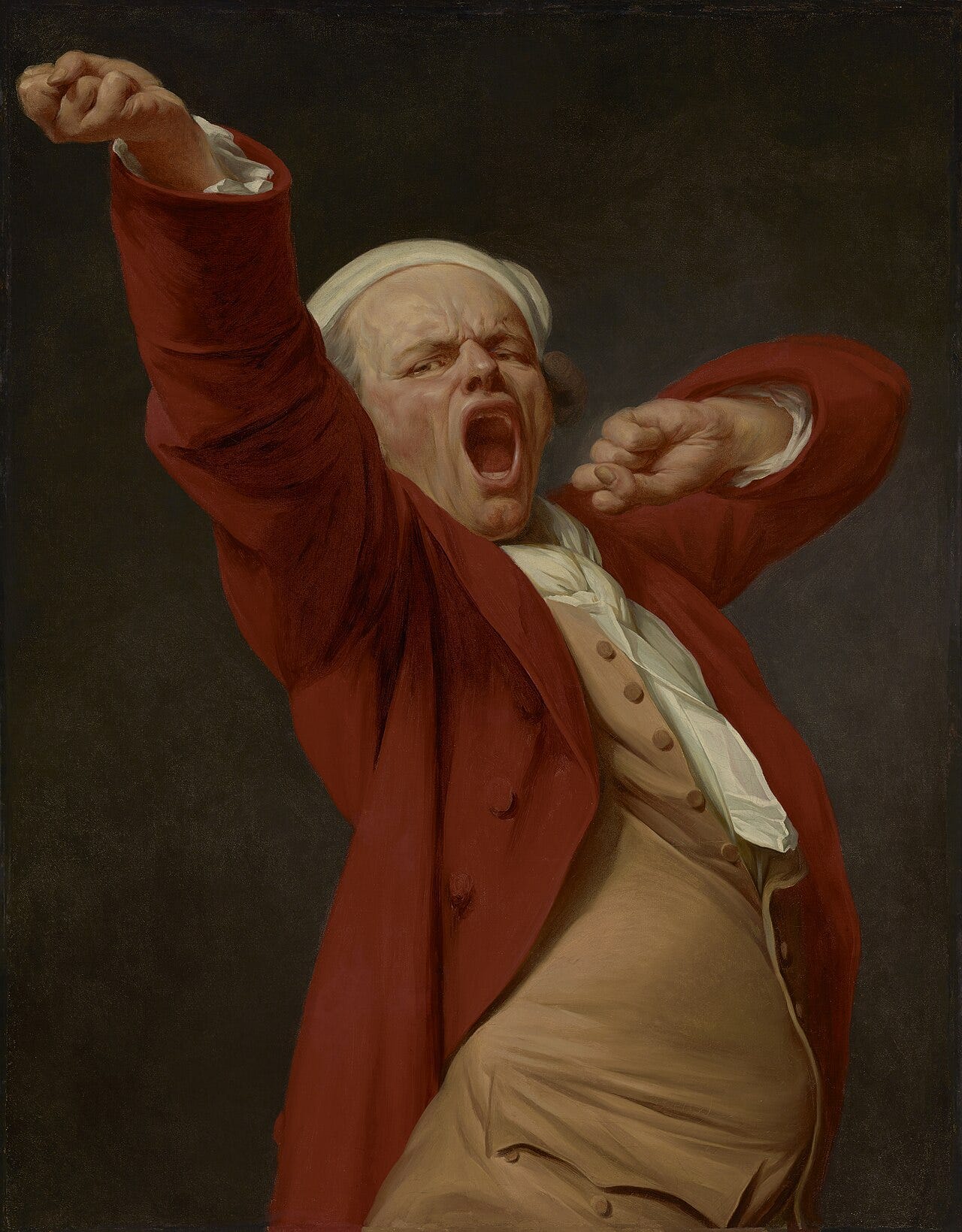
Joseph Ducreux was a French portrait painter, born in 1735, who painted Marie Antoinette and drew Louis XVI in his prison cell. Today he is famous for something stranger: his grinning, pointing self portraits became one of the internet's favorite meme templates.
Trained in pastel by Maurice Quentin de La Tour, he rose to baron and court painter to the queen before the Revolution swept away his royal patrons.
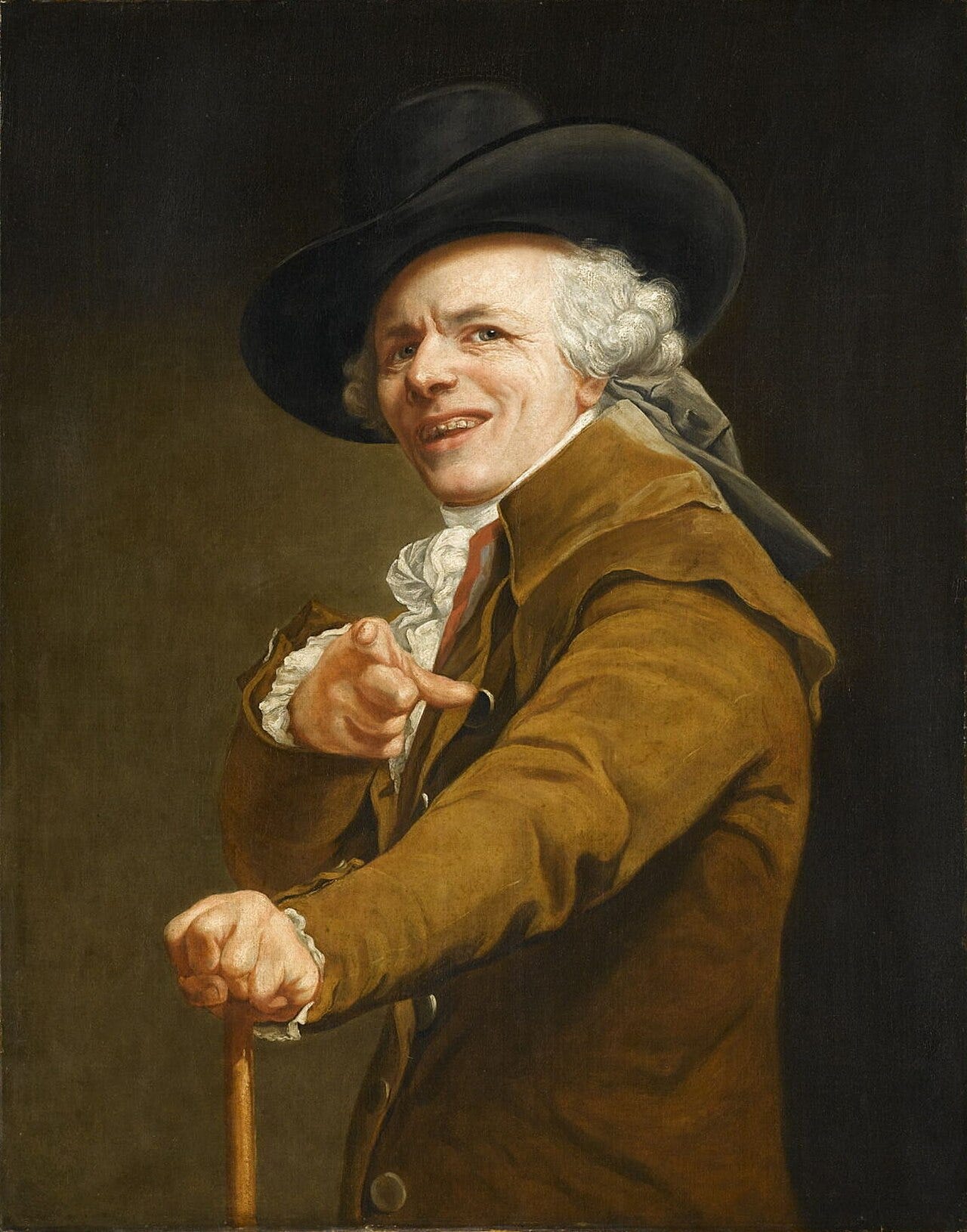
So the same man captured a doomed queen and now carries captions like “Disregard the haters, acquire knowledge.” Here is who he really was.
Cool Stories About Art is a newsletter to learn art the fun way.
Join 170,000+ readers and get:
10 new art stories / month
The entire archive of content (1,000+ articles)
Comment, ask questions, and chat with other readers
More incredible painter stories
If Joseph Ducreux pulled you in, you will love these too:


Joseph Ducreux at a glance
1735. Born in Nancy, then capital of an independent Lorraine.
1769. Sent to Vienna to portray Marie-Antoinette before her marriage to the future king.
1783. Named first painter to the queen, with a barony attached.
1793. Drew the last portrait of Louis XVI before the guillotine.
1802. Died near Paris. Two centuries later his grinning self portrait became an internet meme.
The court painter behind the meme
Ducreux trained as a portraitist and rose fast. In 1769 he was sent to Vienna to paint the teenage Marie Antoinette before she came to France to marry the future Louis XVI.
He was named a baron and a court painter to the queen. For a portraitist in the 1700s, that was the top of the ladder.
The meme hides all of this. The man behind the grinning macro was, in his day, a trusted painter of kings and queens.
What he learned from La Tour, and the circle he kept
He learned the delicate art of pastel from Maurice Quentin de La Tour, the great pastellist of the French court. That training gave his faces their soft, living surface.
He moved in the circle of Jacques Louis David, the painter who would define the Revolution. Ducreux outlived the regime that destroyed many of his royal patrons.
Why his self portraits feel so alive
Most portrait painting of his time was stiff and formal. Sitters posed like statues. Ducreux did the opposite.
He was fascinated by physiognomy, the old idea that a face reveals character. So he turned the self portrait into a study of pure expression.
He painted himself yawning, laughing, pointing straight at the viewer. Almost no one in 1790s France was breaking the fourth wall like that.
A one man catalogue of human expression
Ducreux wanted a complete set of faces showing every mood: surprise, mockery, silence, discretion. He used his own face as the model, again and again.
He named some by the feeling they showed, like Le Discret, the discreet man with a finger to his lips. The famous grin and yawn belong to that same project.
The last face of a condemned king
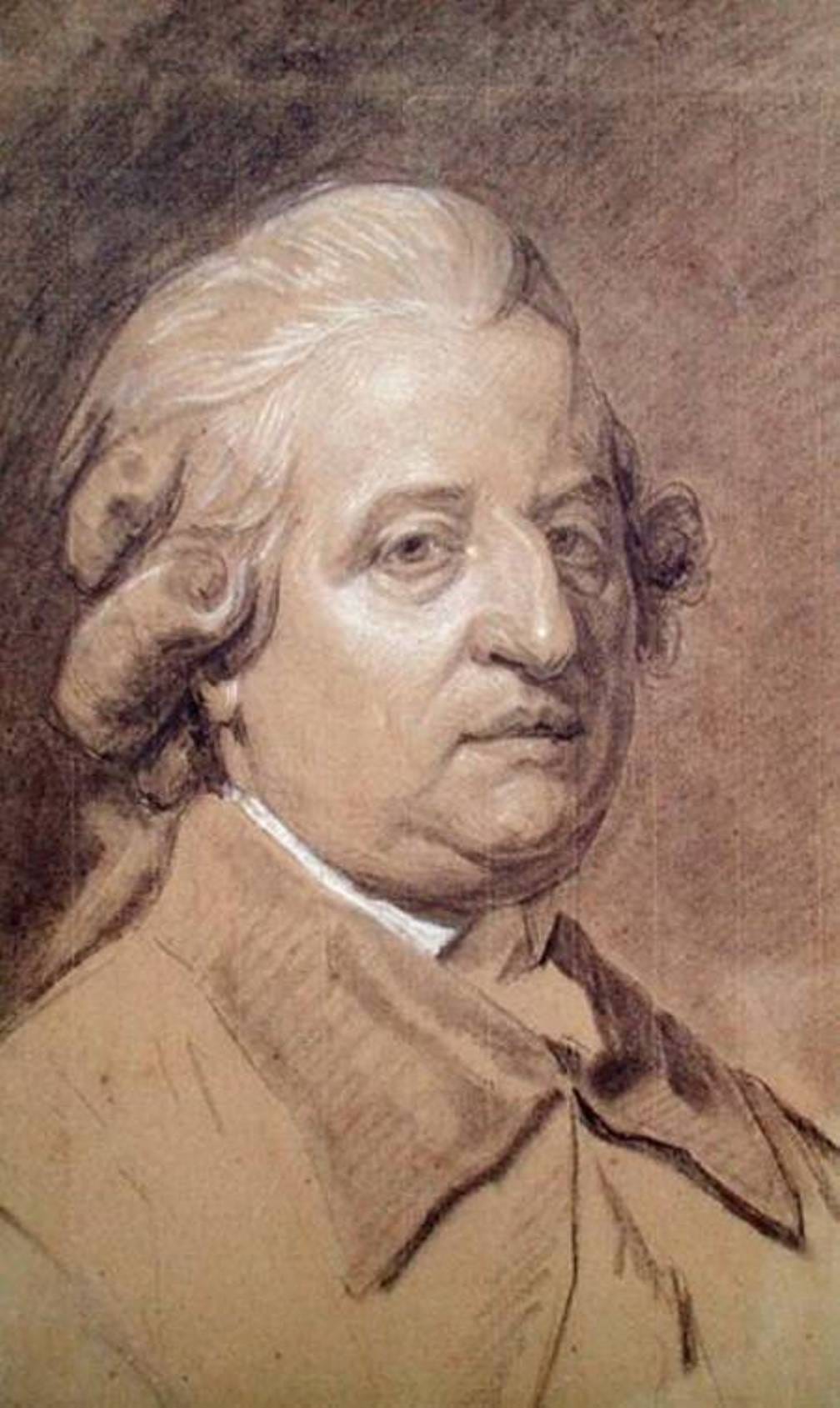
In 1793, Ducreux was allowed into the Temple prison to draw Louis XVI before his execution. That small sketch is one of the last images of the king alive.
When royal ties turned dangerous, Ducreux fled to London for a time, then returned to Paris under the new regime and kept working until his death in 1802.
Three faces to know him by
Start with the self portrait at the Getty in Los Angeles, where he points and grins with his mouth open. It is the image the internet adopted.
Then its companion, the self portrait mid yawn, arms stretched, painted around 1783. Almost no painter dared look that informal.
Last, the prison drawing of Louis XVI from 1793. The same hand that made the jokes recorded a king's final days.
From Versailles to the meme template
In the late 2000s, internet users paired his grinning faces with mock old captions, turning modern slang into stiff 18th century English. The format spread as “Archaic Rap.”
It is a strange afterlife. A serious court painter became famous two centuries later for looking like he is about to land a punchline.
Where his faces hang today
The Louvre in Paris holds several of his portraits. The Getty in Los Angeles owns the grinning self portrait that launched the meme.
From Nancy to the court of Louis XV
Joseph Ducreux was born in 1735 in Nancy, in eastern France, into a family of painters. His father gave him his first lessons, and the boy grew up with pastels and portraits as the family trade.
As a young man he made his way to Paris, the only place a portraitist could truly build a career. There he studied with Maurice Quentin de La Tour, the great pastellist whose lively likenesses of the court set the standard of the day.
From that base Ducreux climbed toward the royal circle. He learned to flatter without lying, and to catch the flicker of life in a sitter's face, skills that would carry him to the very top of French society.
The portrait that crossed a border
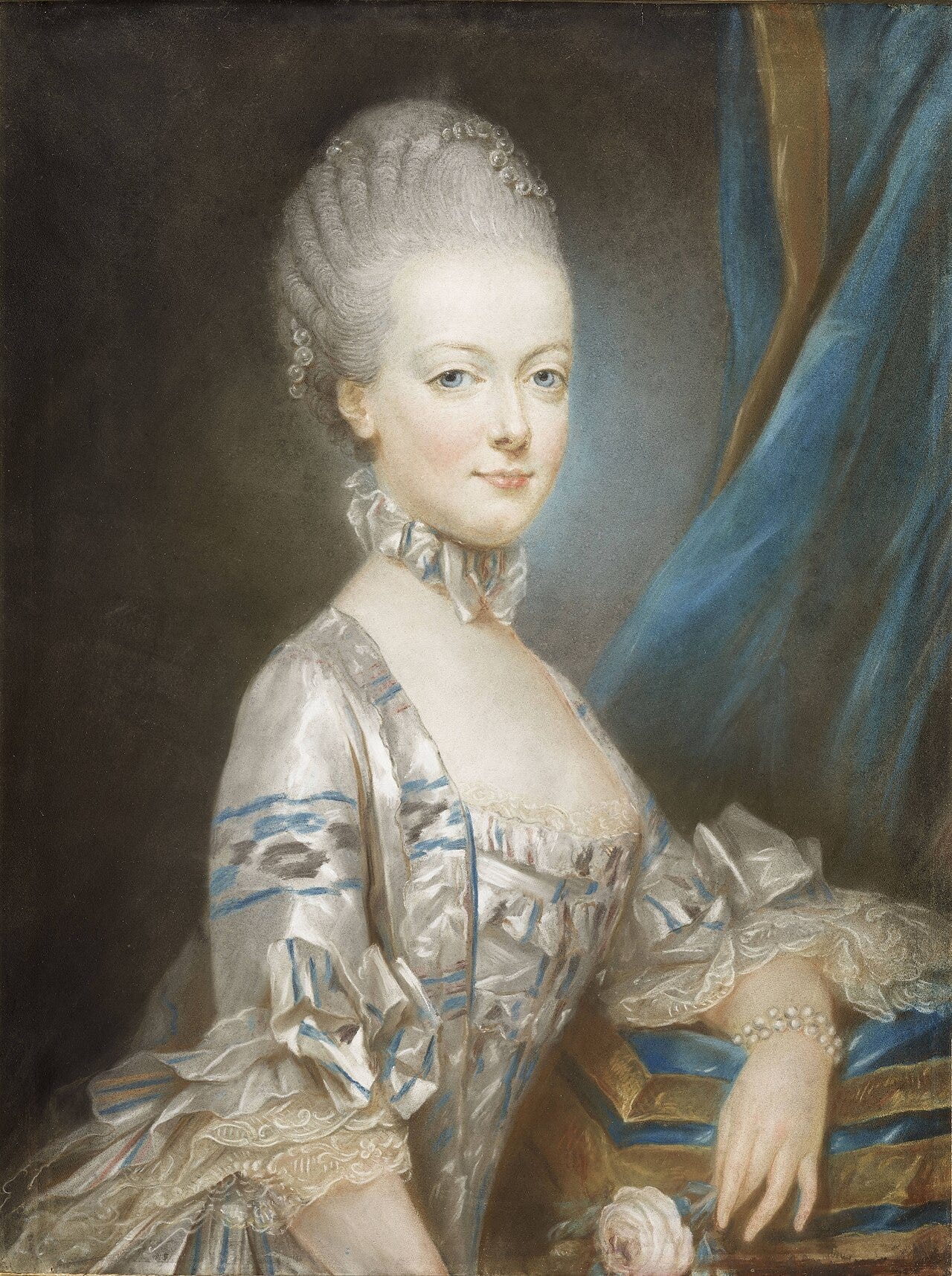
In 1769 Ducreux was handed a delicate royal errand. The French court wanted to see the young Austrian archduchess who was to marry the future Louis the Sixteenth, so Ducreux was sent to Vienna to paint her.
The bride was Marie Antoinette, then about fourteen. His portrait let the French royal family study their future queen before she ever set foot in France, a common diplomatic use of painting in an age before photography.
The mission paid off handsomely. Ducreux was made a baron and named first painter to the queen, a title that placed him among the most favored artists of the crown.
The science of reading a face
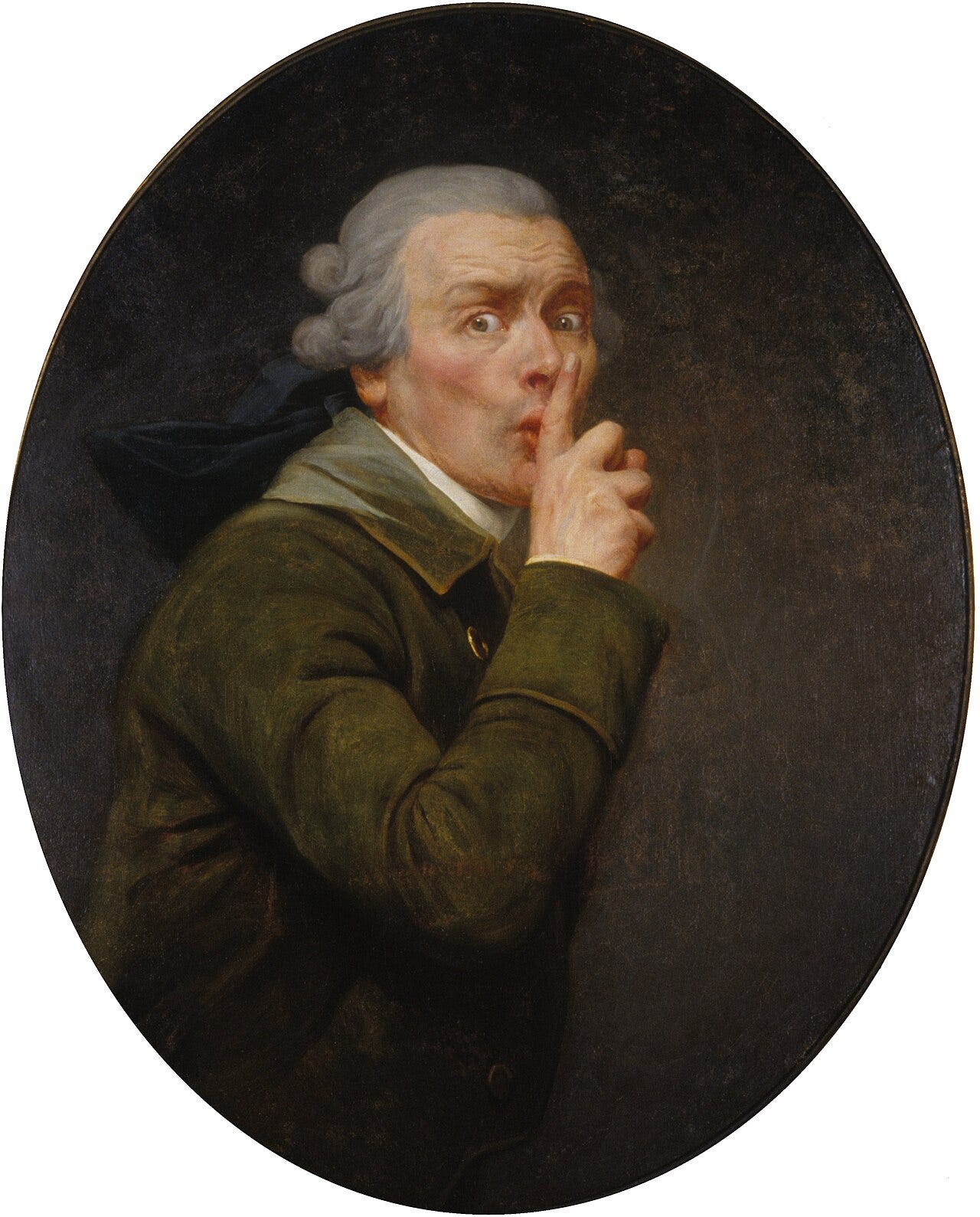
Ducreux lived in an age fascinated by the idea that a face could reveal the soul. The Swiss writer Lavater was busy claiming that character could be read in features, and educated Europe was gripped by the notion.
Ducreux turned this into art. He made studies of himself pulling faces, yawning, mocking, gaping in surprise, treating his own head as a laboratory of human expression.
These were not vanity portraits. They were experiments in how far a painted face could carry feeling, and they are exactly the images that centuries later turned him into an internet joke.
The outsider who never joined the Academy
For all his royal rank, Ducreux stood apart from the official art world. He was never a full member of the Royal Academy of Painting, the body that controlled the prestigious Salon.
So he showed his work at alternative venues and leaned on his court title instead. It made him something of an outsider among the grand painters of Paris, admired at the palace yet kept at the edge of the academic establishment.
That position may have freed him. A man with no Academy reputation to protect could afford to paint himself gurning and yawning, in ways a cautious academician never would.
Surviving the Terror
The Revolution put Ducreux in danger. As first painter to the queen he was tied to a court that the new order wanted gone, and for a time he left France for the safety of London.
He returned to Paris during the upheaval, and in January 1793 he is said to have drawn one of the last portraits of Louis the Sixteenth, made in the king's final days before the guillotine.
Ducreux lived through the Terror when many of his patrons did not. He died in Paris in 1802, an old court painter who had outlasted the world that made him.
The daughter who painted too
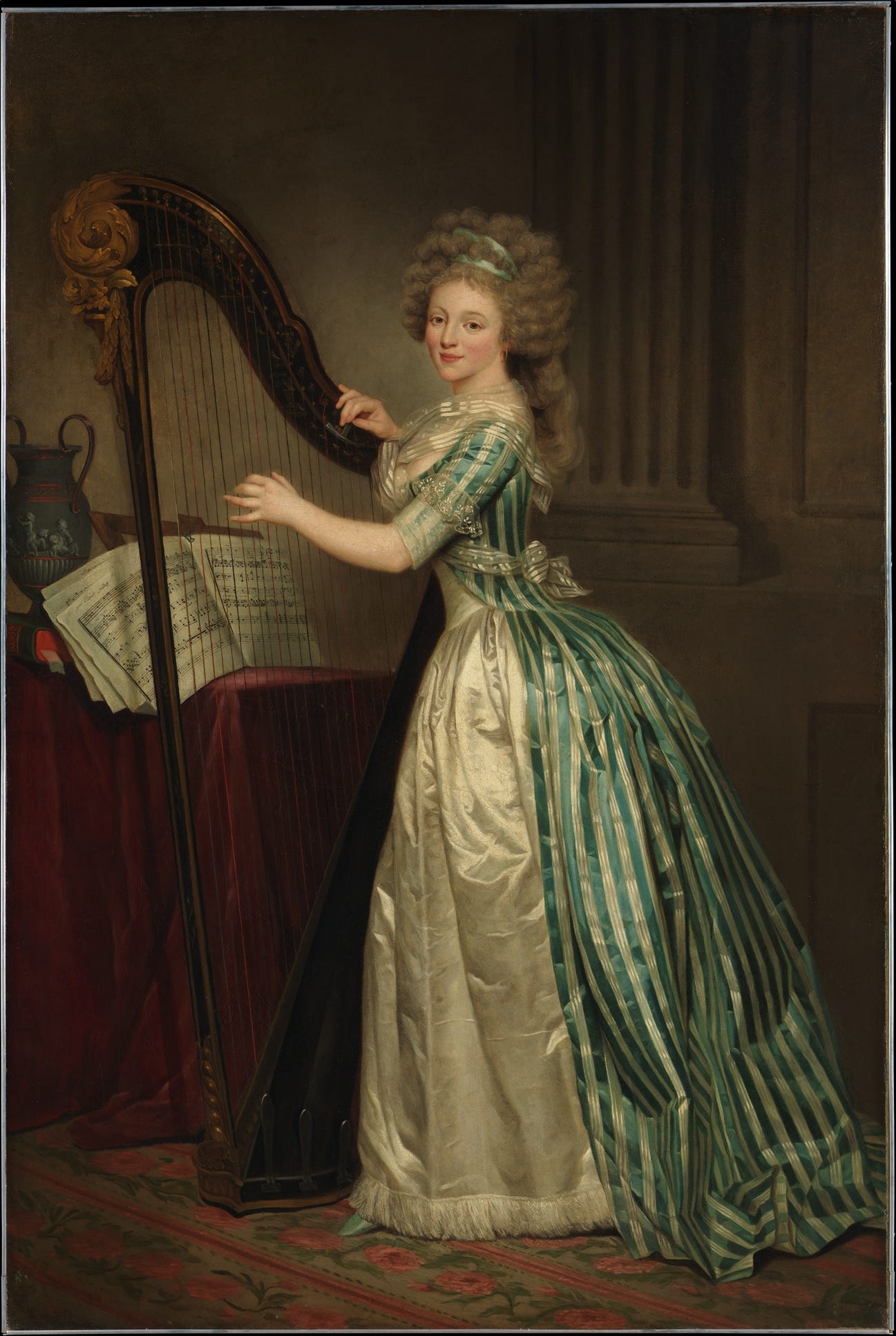
Ducreux passed his gift to his children. His daughter Rose Adelaide Ducreux, born in 1761, became a painter and a musician in her own right.
Her finest known work is a self portrait seated at a harp, calm and assured, painted around the time of the Revolution. For years it was credited to the far more famous Jacques Louis David, until scholars recognized the hand as hers.
Father and daughter died in the same year, 1802. Her small but real body of work is now studied as part of the wave of talented women painters who emerged in France in those years.
Pastel, oil and the miniature
Ducreux was at home in more than one medium. From La Tour he took the art of pastel, the powdery chalk that could catch skin and silk with a soft glow. He also painted in oil and worked at the tiny scale of the miniature.
That range served his career. The likeness of Marie Antoinette he carried back from Vienna was a small portable image, exactly the kind of thing a court needed to send across borders.
His famous expression studies show the same flexibility. He could finish a formal court oil and, in the same years, dash off a self portrait pulling a face, moving between grand and playful with ease.
More secrets to unlock


The Joseph Ducreux questions that keep coming up
When was Joseph Ducreux born? In 1735 in Nancy, France. He died in Paris in 1802.
What did he paint, and in what medium? Portraits, in both oil and pastel, with a focus on expressive faces.
Where did he work? At the French court, in Vienna for Marie Antoinette, then London and Paris.
Why is he remembered today? For his meme self portraits, and for drawing Louis XVI before the king died.
Where are his paintings? Mainly the Louvre and the Getty, plus several French regional museums.
The physiognomy framing of these self portraits is doing some retrospective work. Lavater's theories explain why Ducreux found expression a serious subject, but the internet did not revive him for his science of facial character. It revived him because the pose is absurd and endlessly recaptionable, which is a different kind of afterlife than the science angle implies.
Rose Adelaide Ducreux's harp self portrait being credited to David for so long is not just a quirky footnote. Misattributing a woman's work to a famous man was routine practice in how collections and scholarship got built, and treating her case as an isolated correction understates how common that pattern was.
Framing his exclusion from the Royal Academy as the freedom that let him paint himself yawning gives him a lot of credit for what may have simply been a snub. Pastel portraitists were often looked down on by the Academy's history painters, and there is no real evidence Ducreux experienced the exclusion as liberating rather than as a professional setback he worked around.