
KAWS is Brian Donnelly, the American artist who turned a cartoon with crossed out eyes into one of the most recognizable, and most expensive, images alive.
He started spraying graffiti and now sells sculptures for millions. That drooping Companion figure, all X eyes and slumped shoulders, is now the heart of an art brand whose paintings have hit 14.
8 million dollars at auction while his toys sell for the price of a shirt.

His signature is everywhere: a soft, Mickey Mouse style figure called Companion, with X marks for eyes and a glum, almost grieving pose.
You have probably seen it on a toy, a hoodie, a phone case or a giant balloon, without knowing the artist behind it.
More incredible painter stories
If KAWS pulled you in, you will love these too:


KAWS sits right on the line between fine art and product, between the museum and the gift shop, and for me that tension is exactly the point. Here is the whole story.
KAWS at a glance
1974. Born Brian Donnelly in Jersey City.
1996. Began repainting bus shelter and phone booth ads, then putting them back in place.
1999. Tokyo produced the first Companion figure, and the toy became a door into art.
2019. A giant Companion floated in Hong Kong harbour, and The Kaws Album sold for 14.8 million dollars.
2021. The Brooklyn Museum retrospective, What Party, brought the street kid fully inside.
What does KAWS actually mean?
Here is the first surprise. KAWS does not stand for anything.
As a teenage graffiti writer, Brian Donnelly just liked how the letters K, A, W and S looked together when sprayed. There is no hidden acronym. The name is pure style, chosen for shape, not meaning, which tells you a lot about the artist.
From hijacked bus ads to the gallery
His real origin story is the best part. In the 1990s, working in New York, KAWS did something risky and illegal.
He would quietly open the glass cases at bus shelters and phone booths, slide out the fashion and movie ads inside, take them home, and paint his own cartoon characters over the models. Then he put the altered ads back on the street.
People started stealing them. Calvin Klein and DKNY posters reworked by KAWS became collectors' items pulled straight off the street. An act of vandalism became his portfolio.
The movement: Pop art's street smart heir
To place him, think of Pop art. Andy Warhol took soup cans and celebrities and called them art. KAWS does the same with cartoons, branding and toys.
He belongs to a generation that grew up on Saturday morning television and streetwear, and treats Mickey Mouse, The Simpsons and SpongeBob as the old masters of its visual world.
He paints them in crisp, flat acrylic, in the tradition of acrylic painting, then twists them into something melancholy.
The crossed out eyes that give him away
Once you know the code, you cannot unsee it. A KAWS gives itself away fast.
The XX eyes. Every character has crossed out eyes, like a cartoon that has fainted. It is his signature, almost a logo.
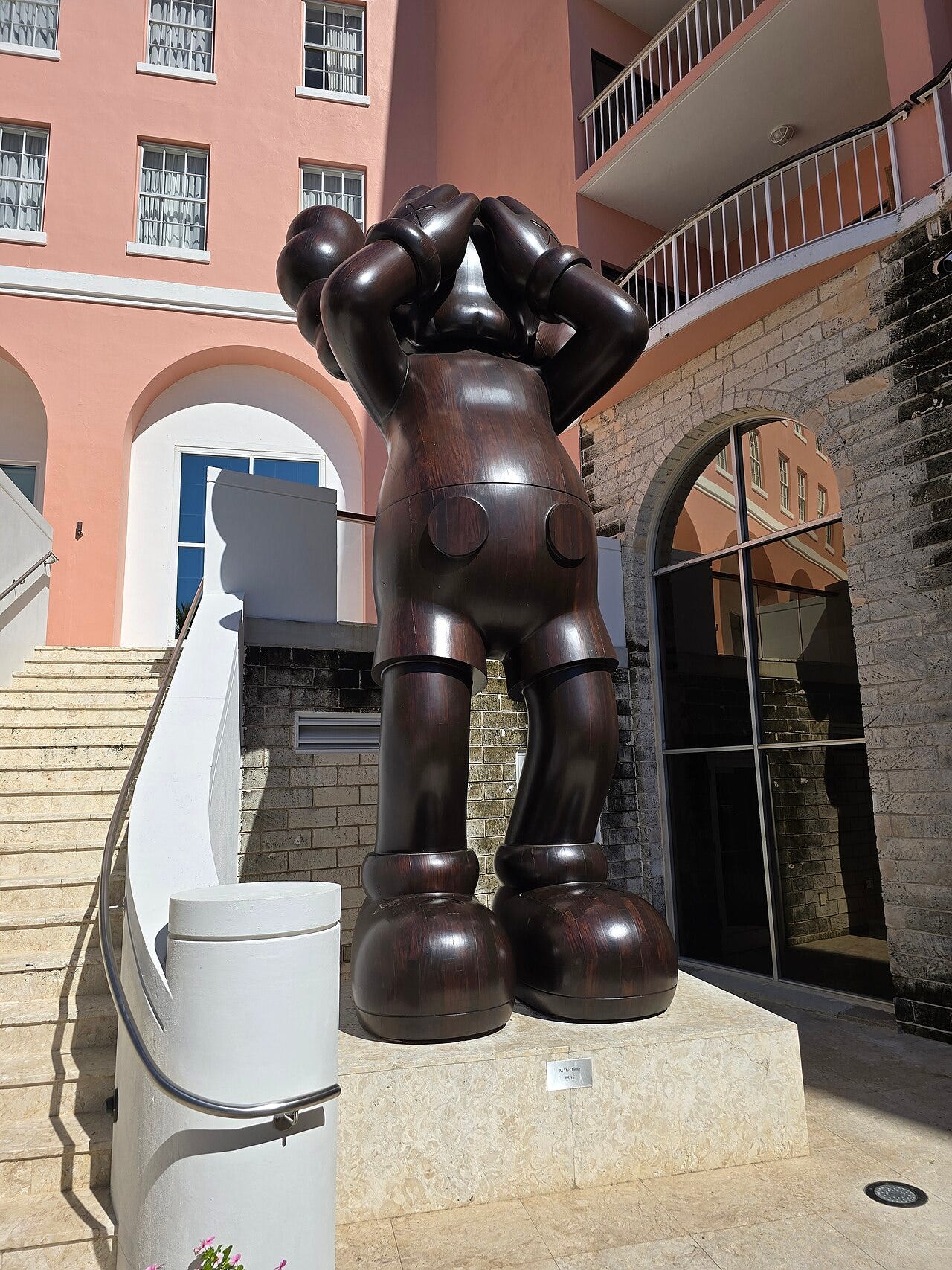
Companion. A glove handed, round eared figure based on Mickey Mouse, often slumped, covering its face, or curled up sad.
The cast. A family of characters with names like Chum, Accomplice and BFF, all sharing the same crossed eyes.
The finish. Clean flat color and smooth surfaces, whether in paint, vinyl or giant sculpture.
What Warhol, Disney and Murakami handed him
KAWS is open about where he comes from.
Warhol gave him the idea that commerce and art are the same game. Walt Disney and classic American cartoons gave him his cast of rounded, friendly shapes.
The Japanese artist Takashi Murakami showed him how to move between toys, fashion and museums without apology, and the Pop sculptor Claes Oldenburg pointed the way to making everyday things huge.
He took childhood imagery the art world looked down on and made it the center of the conversation.
Why KAWS is everywhere
Most artists guard the line between art and product. KAWS erased it on purpose, and that is the whole trick.
He has made cheap vinyl toys and limited Uniqlo shirts that sell out in minutes, and also one off paintings worth millions. He designed album covers for Kanye West and Travis Scott, collaborated with Dior, Nike and Sesame Street, and built a brand that a teenager and a billionaire collector can both buy into.
That double life, mass and exclusive at once, is why his crossed eyes turn up on a child's plush toy and in a major auction house in the same week.
Why KAWS is so expensive
The prices shock people, so it is worth explaining. In 2019 a single painting, The KAWS Album, a remake of a famous Beatles cover using Simpsons characters, sold for about 14.8 million dollars in Hong Kong.
The logic is scarcity plus hype. He releases work in limited drops, the way sneaker brands do, so demand always outruns supply. Add celebrity collectors, a global fan base from the streetwear world, and instantly readable images, and you get blue chip prices.
The giant floating Companion
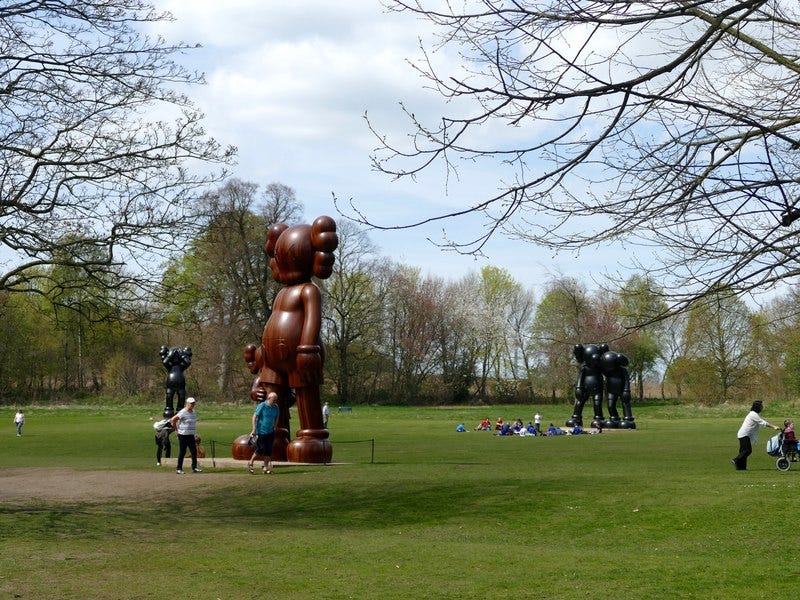
If you have seen a vast KAWS figure lying in a public square or floating in a harbor, that is his HOLIDAY series.
He has sent enormous inflatable and sculpted Companions around the world, floating one in Hong Kong's harbor, laying one across a Seoul plaza, even placing one near Mount Fuji.
The works turn his sad little character into a shared public event, free to see for anyone walking by.
The life behind the brand
Brian Donnelly was born in Jersey City in 1974 and came up through graffiti as a teenager. He studied illustration at the School of Visual Arts in New York.
Early on he worked as a freelance animator, painting backgrounds for cartoons, before his street work and his vinyl Companion toys, first produced with collaborators in Japan around 1999, made his name.
Today he works from a large studio in Brooklyn with a team, running what is effectively an art brand.
No home museum, so where do you find him
He is young, alive and collected worldwide, so he has no single home museum. A few routes get you closest.
Major museum shows. Institutions like the Brooklyn Museum and the Modern Art Museum of Fort Worth have given him large retrospectives that tour.
Public sculptures. His HOLIDAY figures and permanent Companions appear in cities around the world.
The accessible route. His toys, prints and clothing collaborations put a real KAWS within reach of almost any budget.
The Jersey City kid who tagged his way out
KAWS is the working name of Brian Donnelly, born in 1974 and raised in Jersey City, New Jersey. As a teenager he started writing graffiti around the city and across the river in New York.
He picked the letters K, A, W and S because he liked how they looked together. The name never stood for anything.
He was not an outsider with no training, though. In 1996 he finished a degree in illustration at the School of Visual Arts in Manhattan, then took freelance animation work in the late 1990s.
Painting walls by night and drawing cartoons by day set the pattern for everything after: a foot in street culture, a foot in the studio.
The ads he borrowed, repainted, and put back
In the mid 1990s KAWS found his real breakthrough on the street, not the wall. Bus shelters and phone booths in New York held their posters behind glass on removable panels.
He learned to open them, slide the advertisement out, take it home, and paint over it.
Onto fashion and phone company campaigns he added his own cast: cartoon skulls, crossed out eyes, and cushiony gloved hands. Then he returned the reworked poster to the same frame, so commuters found a Calvin Klein or DKNY ad quietly hijacked.
Collectors began prying the panels loose to keep them.
A cartoon with crosses for eyes
The figure that carried his name into museums is Companion, a rounded character with the silhouette of an old cartoon mouse and two X shapes where the eyes should be.
Those crossed out eyes, along with a recurring skull and crossbones, became his signature marks. Draw an X over anything and it reads as blank, switched off, gone.
Companion arrived as an object before it arrived as a painting. In 1999 KAWS released it as a small vinyl figure, roughly eight inches tall, in an edition of 500.
It sold out fast. From the start he treated the toy and the sculpture as the same idea at different sizes.
How Tokyo turned him into a brand
That first Companion was made with Bounty Hunter, a streetwear label in Japan. The timing mattered. Tokyo in the late 1990s had a hungry market for limited toys and designer clothing, and KAWS landed right inside it.
He grew close to Nigo, the founder of the streetwear brand A Bathing Ape, and produced figures through the Japanese company Medicom Toy.
Japan gave him a business model the American art world did not yet offer: small runs, fast sellouts, and a devoted audience who lined up for drops.
For years he was arguably bigger in Tokyo than in New York.
From a phone booth to the auction podium
The market caught up in 2019. A 2005 painting called The KAWS Album, a parody of the Beatles Sgt Pepper cover redrawn with characters from The Simpsons, went up for sale at Sotheby's in Hong Kong. It had been commissioned years earlier by Nigo.
Sotheby's expected around one million US dollars. It sold for about 14.8 million, a record for the artist and nearly fifteen times the high estimate.
A man who once smuggled posters out of bus shelters now set prices at the same salesroom level as blue chip painters, inside a single decade.
The signature everyone wanted to wear
KAWS built a second career out of collaborations. His Uniqlo shirts sold in the millions and emptied shelves on release day. He worked with Dior on its Spring 2019 menswear show under Kim Jones, where a giant Companion sat on the runway covered in flowers.
He designed an Air Jordan 4 sneaker with Nike in 2017.
Here is a fact people get wrong. Many assume KAWS made the cover for Kanye West's 2007 album Graduation. He did not. That cover was by the Japanese artist Takashi Murakami.
KAWS designed the artwork for the following record, 808s and Heartbreak, in 2008.
The giant that floated in Hong Kong harbour
By the late 2010s KAWS was working at the scale of a city. The touring project KAWS HOLIDAY placed enormous reclining Companion figures in public spaces across Asia, including Seoul, Taipei, and later near Mount Fuji.
The most talked about stop came in March 2019, when a floating Companion roughly 37 metres long lay on its back in Hong Kong's Victoria Harbour, organized by AllRightsReserved.
Its crossed out eyes stared up at the skyline, and the artist framed the piece as a nudge to a fast moving city to stop and rest.
Crowds queued along the water for a photograph.
The collector museums finally put on the wall
In 2021 the Brooklyn Museum gave KAWS his first large survey in New York, titled KAWS WHAT PARTY. It opened early that year and ran through September, tracing about 25 years of work across paintings, sculpture, graffiti drawings, furniture, and small collectibles.
An earlier survey had toured from the Modern Art Museum of Fort Worth in 2016.
What the shows also revealed is that KAWS is a serious collector himself. He owns a deep trove of paintings, design objects, and vintage toys, including work by other artists, and pieces of that collection have shaped how his exhibitions are presented.
Fine art dressed up as a plaything
Starting in 2020, KAWS extended Companion into augmented reality with Acute Art, a London based company. Through a phone app, people could place virtual Companion figures in their own streets and rooms, in a project released while much of the world was shut indoors.
Across all of it runs one stubborn idea: make fine art that looks like a toy, and make a toy you would treat like fine art. His vinyl figures sit in glass cases beside oil paintings.
That flattening of high and low, gallery and gift shop, is the whole argument of his career, and it is why some critics resist him and millions of others line up.
More secrets to unlock


The KAWS questions that keep coming up
What does KAWS stand for? Nothing. They are letters he liked to tag as a graffiti writer.
Who is KAWS? The American artist Brian Donnelly, born in 1974.
What are KAWS figures? Collectible sculptures and toys of his characters, especially Companion.
Why is KAWS so popular? He blends street art, cartoons and fashion into images anyone can recognize.
Why is KAWS so expensive? Limited drops, hype and celebrity collectors push demand far past supply.
What is KAWS's real name, and does KAWS mean anything? KAWS is the American artist Brian Donnelly, born in Jersey City, New Jersey, in 1974. He adopted the name as a graffiti tag as a teenager. The letters K, A, W and S do not stand for any words. He chose them simply because he liked the way the shapes looked painted together.
What is the most expensive KAWS work ever sold? The record is The KAWS Album, a 2005 painting that reworks the Beatles Sgt Pepper cover using characters from The Simpsons. It sold at Sotheby's in Hong Kong in April 2019 for about 14.8 million US dollars, far above its estimate of roughly one million. The work had originally been commissioned by Nigo, founder of A Bathing Ape.