
Kazimir Malevich was the Russian artist who reduced painting to a black square and called it a beginning, not an end. He founded Suprematism, an art of pure geometric shapes floating in space, and declared his famous Black Square the zero point of painting, the place where art could start over.
Few images in modern art are more radical or more argued over.
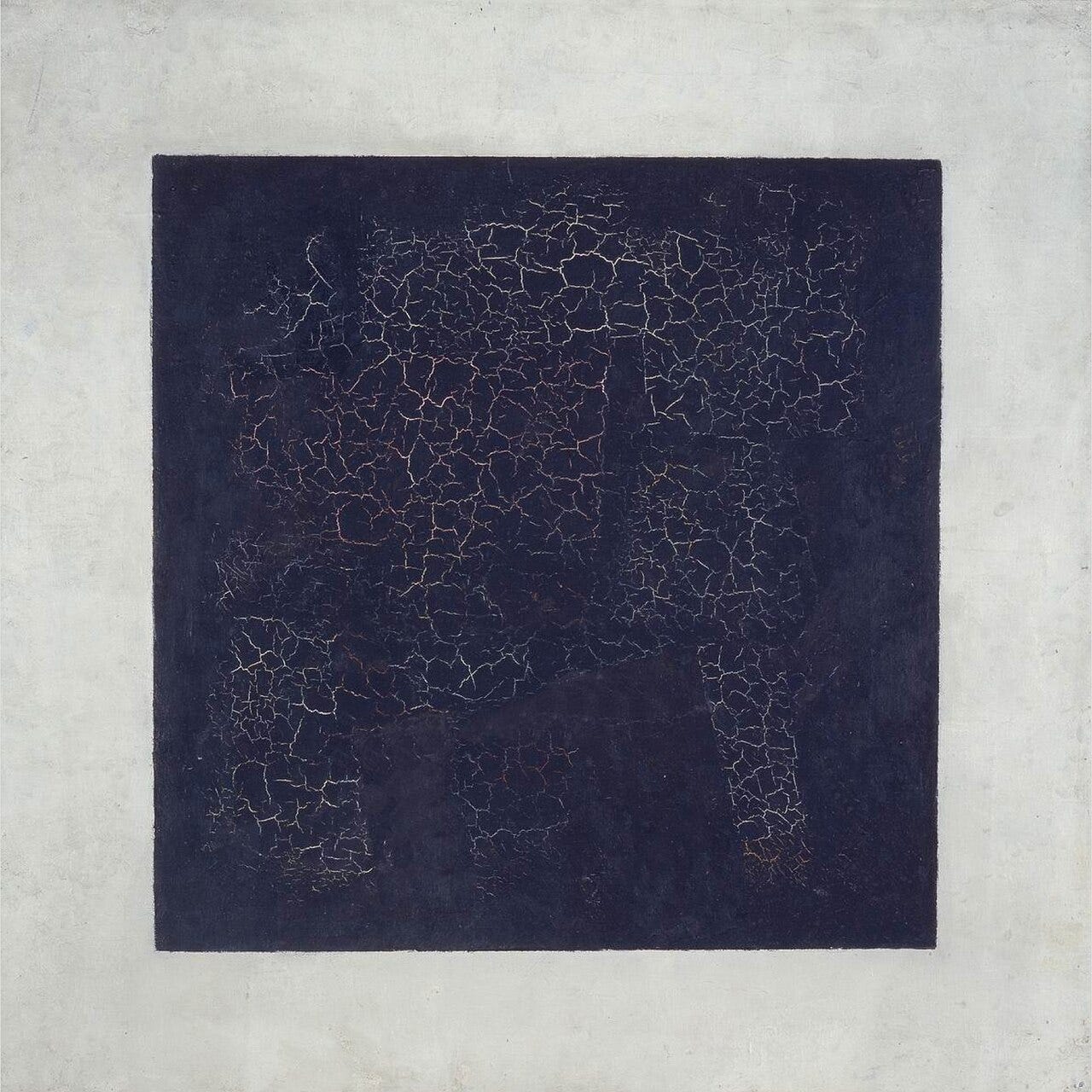
He first hung that black square high in a corner, where Russian homes place a holy icon.
Born: near Kyiv, 1879
Known for: Suprematism, Black Square, pure geometric abstraction
Died: Leningrad, 1935
More incredible painter stories
If Kazimir Malevich pulled you in, you will love these too:


Kazimir Malevich at a glance
1879. Born near Kyiv to a family of Polish descent.
1913. Designed the opera Victory over the Sun, where a black square first appeared on a curtain.
1915. Black Square hung across a corner, icon style, at the 0.10 exhibition in Petrograd.
1927. His Berlin exhibition left dozens of works in the West when he was called home.
1935. Died in Leningrad. Mourners followed a coffin marked with a black square.
The square that meant to start again
In 1915 Malevich showed Black Square, a black shape on a white ground, nothing more. To him it was not empty but full, the zero of form, painting wiped clean of objects so pure feeling could take their place. See what is abstract art.
At its first show he placed it across the top corner of the room, the spot reserved in Russian homes for a sacred icon. He was claiming abstraction as a new kind of faith.
Suprematism, art of pure feeling
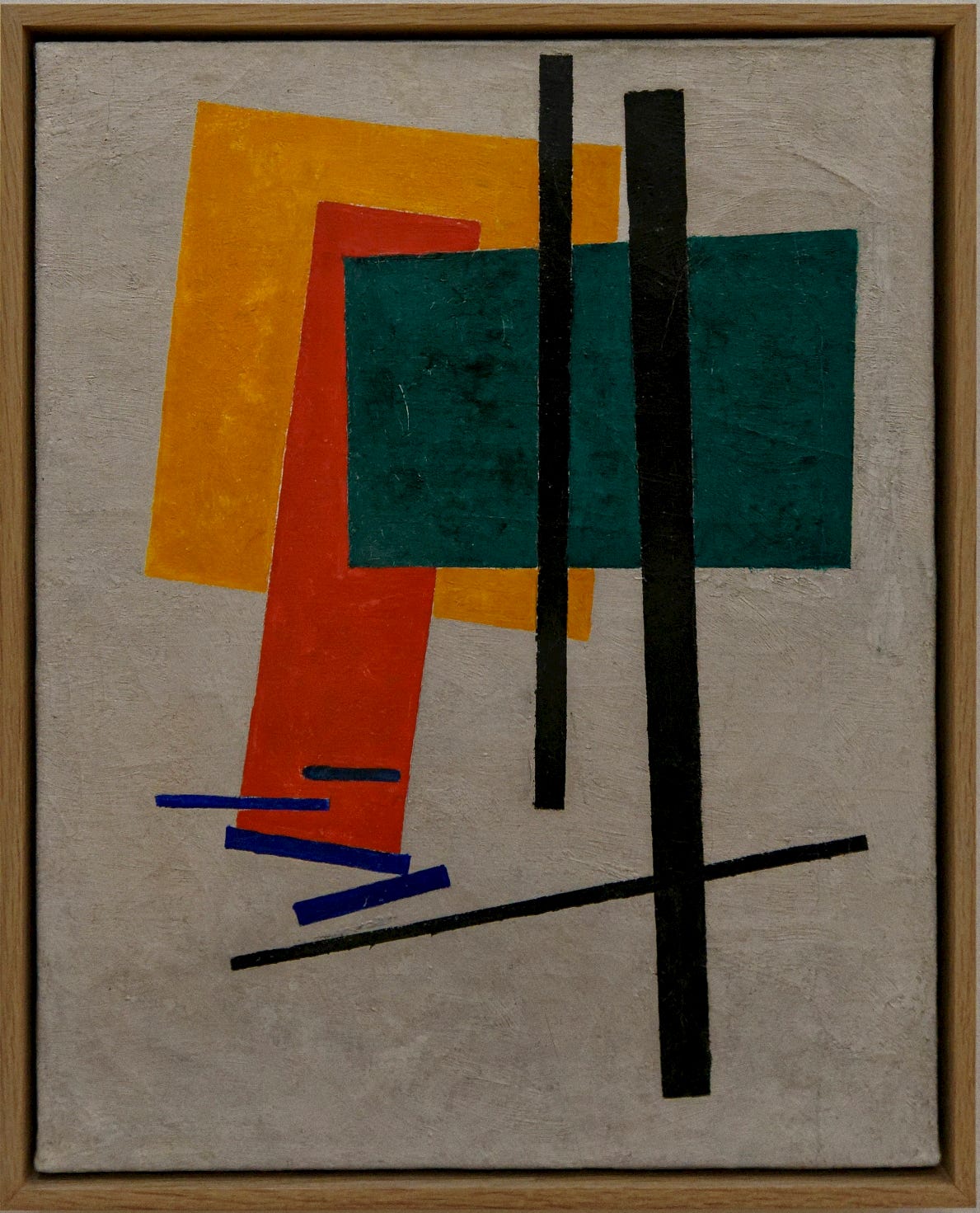
Malevich called his movement Suprematism, the supremacy of pure feeling over the depiction of things. Coloured rectangles, crosses and circles drift across white space as if in zero gravity.
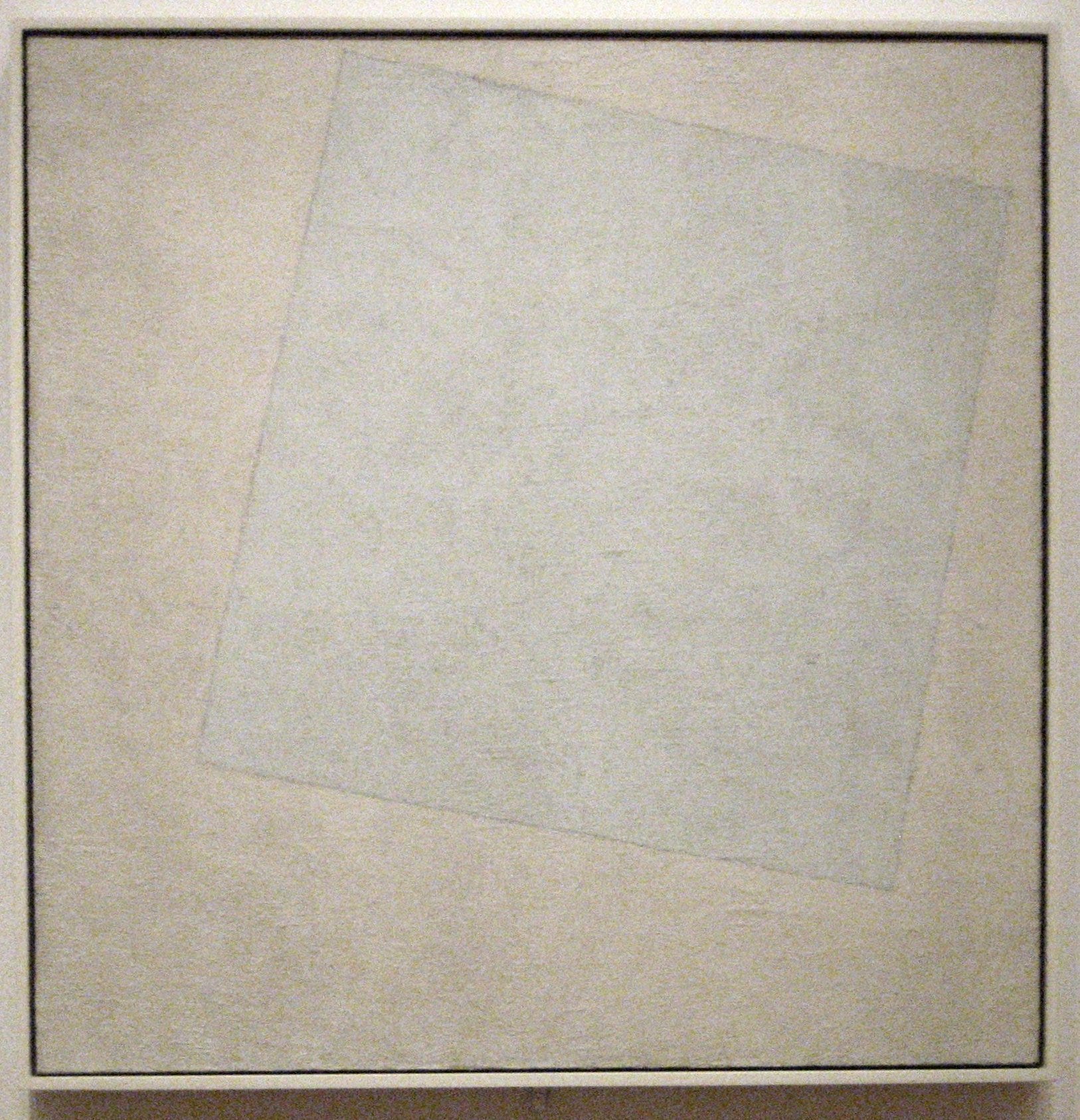
He pushed it to the limit with White on White, a pale square barely visible on a paler ground, abstraction approaching pure light.
From Cubo Futurism to the edge
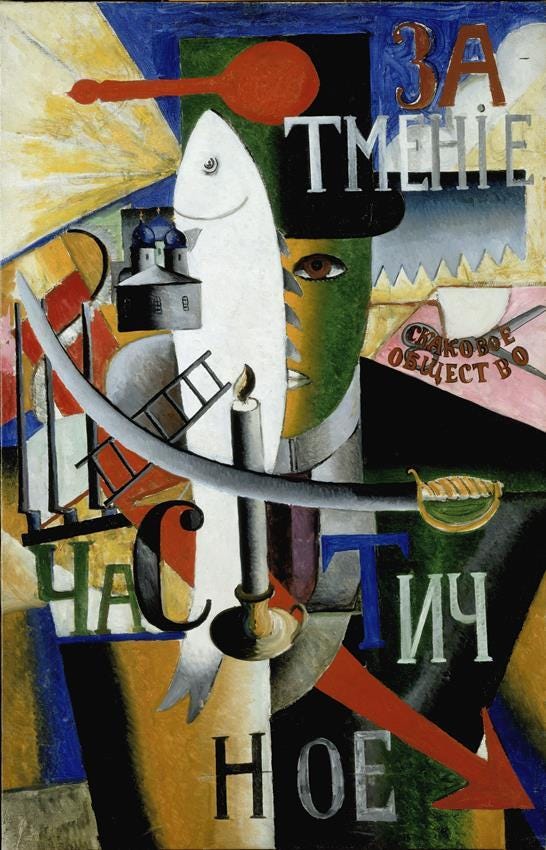
He arrived there fast. His early work ran through Cubo Futurism, mixing the broken planes of Cubism with the speed of Futurism, peasants and machines built from tubes and shards. See what is cubism.
Then he jumped past objects entirely. Within a few years he had gone from painting villagers to painting nothing but shape, colour and space.
You can explore works by Kazimir Malevich in the collection of the Metropolitan Museum of Art.
From Kyiv to the Moscow academies
Malevich was born near Kyiv in 1879 to parents of Polish origin. He first studied drawing in Kyiv, then moved to Moscow and enrolled at the Stroganov School and the Moscow School of Painting, Sculpture and Architecture, the academies that trained much of the Russian avant garde.
He reached abstraction slowly. For years he tried on one manner after another, a painter who kept changing his mind rather than a prodigy who arrived fully formed.
The styles he wore out before Suprematism
His early canvases ran through Impressionism, then Symbolism, then a Russian answer to Fauvism. After a trip to Paris in 1912 he took in the lessons of Picasso and Cubism.
As a member of the Jack of Diamonds group he became a leader of the Russian Cubist circle, and by 1912 and 1913 he was folding Cubism into the speed of Futurism, the phase now called Cubo Futurism.
Each phase lasted only a few years. He used styles like tools, then set them down.
0.10, the show where abstraction went public
In December 1915, at an exhibition in Petrograd called 0.10, the Last Futurist Exhibition of Paintings, Malevich showed his geometric abstraction for the first time.
The Black Square headed the list of his works in the catalogue and hung high across a corner of the room, the place a Russian home kept its holy icon. In a leaflet handed out at the show he wrote that he had transformed himself into the zero of form.
Tate counts thirty five abstract paintings by Malevich in that room. The Black Square that opened the door now hangs in the State Tretyakov Gallery in Moscow.
Why he called abstraction a kind of realism
Malevich did not present Suprematism as a flight from reality. He called it a new painterly realism and argued that a picture of pure planes was more honest than an illusion of the world.
Its real subject, he said, was the language of painting itself, colour and line and the plane, stretched and rotated and overlapped. The white grounds behind the shapes stood for a boundless, ideal space.
White on White and the pull of flight
In 1918 Malevich carried the idea to its edge with Suprematist Composition, White on White, a pale square tilted on a paler ground, now held by the Museum of Modern Art in New York.
He was taken with aviation and studied aerial photography, and he wanted the picture to feel like floating. White, he believed, was the colour of infinity.
A year later he published a short manifesto with the series. I have overcome the lining of the coloured sky, he wrote. Swim in the white free abyss, infinity is before you.
White on White pushed the single color canvas about as far as it can go, a format with its own long history, explained in what is monochrome painting.
A Russian answer to the West
Malevich meant Suprematism as a claim of originality, a Russian invention that owed nothing to Paris. At 0.10 his abstractions hung against Vladimir Tatlin's counter reliefs, the opening of a rivalry that split the avant garde.
After the revolution of 1917 he wrote for an anarchist newspaper and called himself the chairman of space. He argued that painters should keep control of their own workspaces, and he preferred public collections to private owners.
In 1919, at the Tenth State Exhibition in Moscow, his White on White paintings hung beside Aleksandr Rodchenko's Black on Black, the two limits of an argument about how far abstraction could go.
The teacher and the book that crossed the border
Malevich became a founder of UNOVIS, a collective of students devoted to the new art, and he took several teaching posts. From 1928 to 1930 he taught at the Kyiv Art Institute, until repression against the Ukrainian intelligentsia pushed him back to Leningrad.
His theories reached the West through his book The Nonobjective World. On a 1927 visit to the Bauhaus in Dessau he met Wassily Kandinsky and arranged for the German edition.
The opera that hid the first black square
Two years before the famous painting, Malevich helped stage a strange Futurist opera in St Petersburg. Victory over the Sun, put on in 1913 with the writer Aleksei Kruchenykh and the musician Mikhail Matyushin, was about heroes capturing the sun and abolishing the old order.
Malevich designed the sets and costumes. For one backdrop he drew a square divided into a black half and a white half, the earliest seed of the pure black square to come.
He later pointed back to that stage design as the true birth of Suprematism. The idea arrived in the theatre before it reached the canvas.
The last self portrait, signed with a square
In 1933, forced away from abstraction and near the end of his life, Malevich painted a self portrait that looks back to the old masters. He shows himself in the guise of a Renaissance man, in a heavy costume, one hand raised in a formal gesture.
It was his answer to a state that wanted recognisable figures. He would give them a face, but on his own terms, dressed as a European master of centuries past.
In the corner, where a signature belongs, he painted a small black square instead of his name. Even cornered, he signed with the sign he had invented.
The Stalin years, from confiscation to blank faces
By the start of the 1930s modern art had fallen out of favour with Stalin's government. Malevich lost his teaching position, his paintings and manuscripts were confiscated, and he was barred from making art.
In 1930 he was held in prison for two months, under suspicion raised by his trips to Poland and Germany. Pushed away from abstraction, he returned to painting figures, among them peasants with blank, faceless heads.
Those late workers, with their empty features, are hard to read as any celebration of Soviet life, and he refused to treat the change as repentance.
How his paintings scattered, and slowly came back
In 1927 Malevich carried about seventy works to Berlin for a large exhibition and left them behind when he went home. He never returned for them.
The cache was hidden to keep it from the Nazis after 1933. In 1935 Alfred Barr bought two paintings and two drawings for the Museum of Modern Art, and much of the rest reached the Stedelijk Museum in Amsterdam, which holds a large body of his work.
Malevich died in Leningrad in 1935, buried in a coffin marked with a black square. His work was hidden inside Russia for decades, and only in the 1990s did his heirs begin to contest who owned the scattered paintings.
Malevich, briefly answered
What is Kazimir Malevich famous for?
Founding Suprematism and painting the radical Black Square, a landmark of pure abstraction.
What is Suprematism?
His art of pure geometric shapes and feeling, free of any depiction of real objects.
Why is the Black Square important?
He called it the zero of form, a fresh start for painting, and showed it like a sacred icon.
When did he die?
In 1935, in Leningrad, after Soviet pressure pushed him back toward figurative work.
More secrets to unlock


The black square Stalin could not erase
Under Stalin, abstraction was condemned and Malevich was forced back to painting figures, sometimes signing them with a tiny black square, a quiet flag of where his heart still lay.
His square remains one of the most extreme gambles any painter ever made.
One last detail. When he died, his followers laid him out beneath the Black Square and marked his grave with one, treating a simple black shape as the symbol of an entire life. The icon he invented became his own.