
Pierre Bonnard was the French painter who turned ordinary domestic life into a blaze of colour. A breakfast table, a sunlit garden, a woman in the bath, all glow under his orange, violet and gold.
He worked from memory and notes rather than from life, building scenes from feeling, and one model, his wife Marthe, appears in his work hundreds of times.
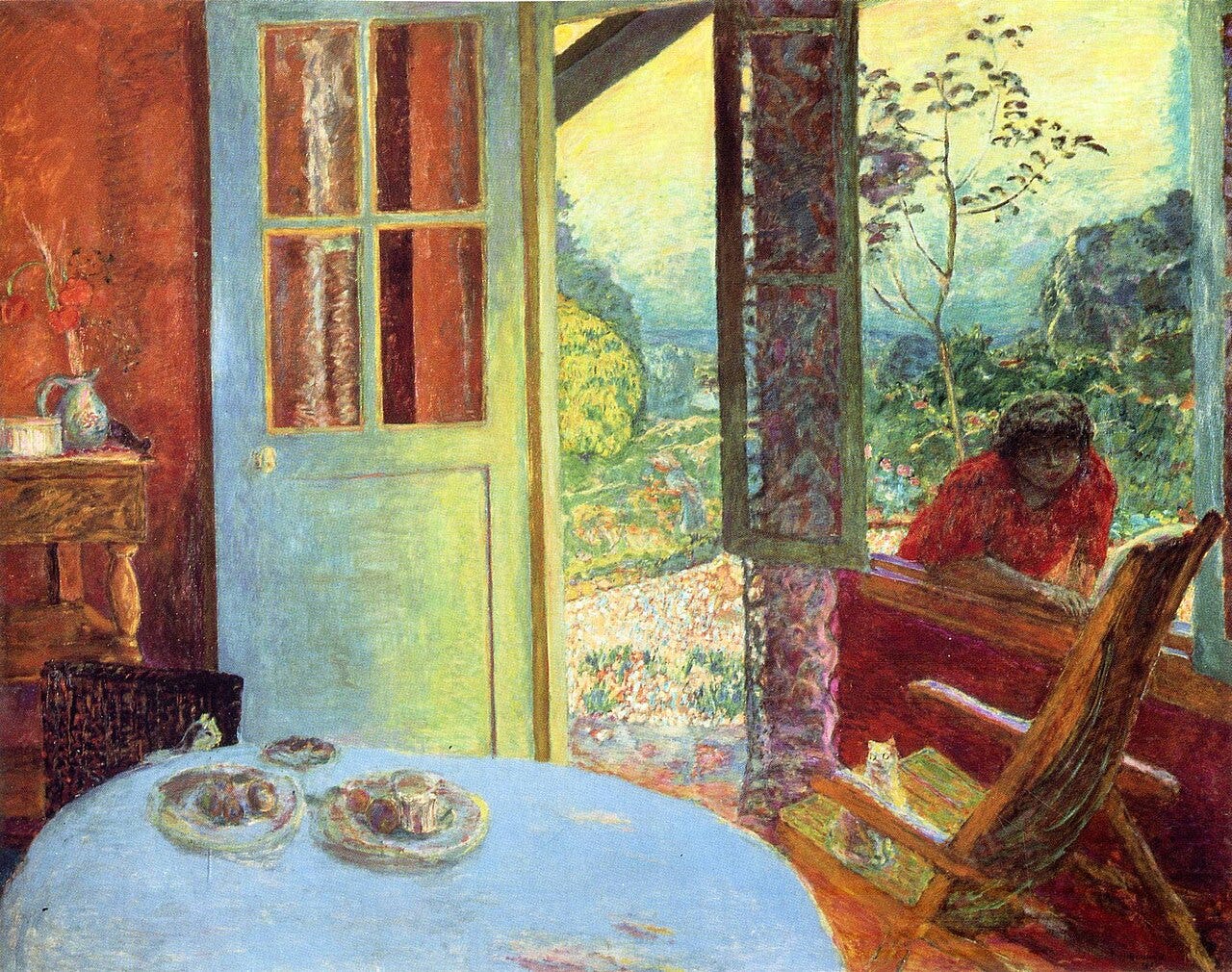
He loved his finished paintings so little that he once sneaked into a museum to keep retouching one.
Born: Fontenay aux Roses, France, 1867
Known for: intimate domestic scenes, intense colour, the Nabis
Died: Le Cannet, France, 1947
More incredible painter stories
If Pierre Bonnard pulled you in, you will love these too:


Pierre Bonnard at a glance
1867. Born at Fontenay-aux-Roses, trained first as a lawyer.
1891. His poster France-Champagne made his name before his paintings did.
1893. Met Marthe, who would appear in his work for the next fifty years.
1926. Bought Le Bosquet, the small house at Le Cannet where the late color caught fire.
1947. Died at Le Cannet, days after having a final patch of yellow added to his last painting.
The everyday set on fire
Bonnard painted what was around him: meals, rooms, gardens, pets, his wife. Nothing dramatic happens, yet the colour is almost overwhelming, warm light pouring across a tablecloth or a tiled floor until the scene glows.
See what is post impressionism.
He is often called an intimiste, a painter of intimate private life. The subjects are humble, the colour anything but.
The Nabis and the flat bright world
As a young man Bonnard joined the Nabis, a group inspired by Gauguin who treated a painting as a flat surface covered in colours in a certain order. They loved pattern, decoration and strong flat shapes. See what is oil painting.
Bonnard kept that love of pattern all his life. Wallpaper, tablecloths and tiles dissolve into glowing fields of colour, so the whole canvas vibrates at once.
Painting from memory
Unlike the Impressionists racing to catch a passing moment outdoors, Bonnard worked slowly in the studio from small sketches and memory. He wanted the remembered feeling of a scene, not a snapshot of it.
He pinned unstretched canvas straight to the wall and worked on several at once, adding touches over months. The freshness is built, not caught.
Marthe, painted for forty years
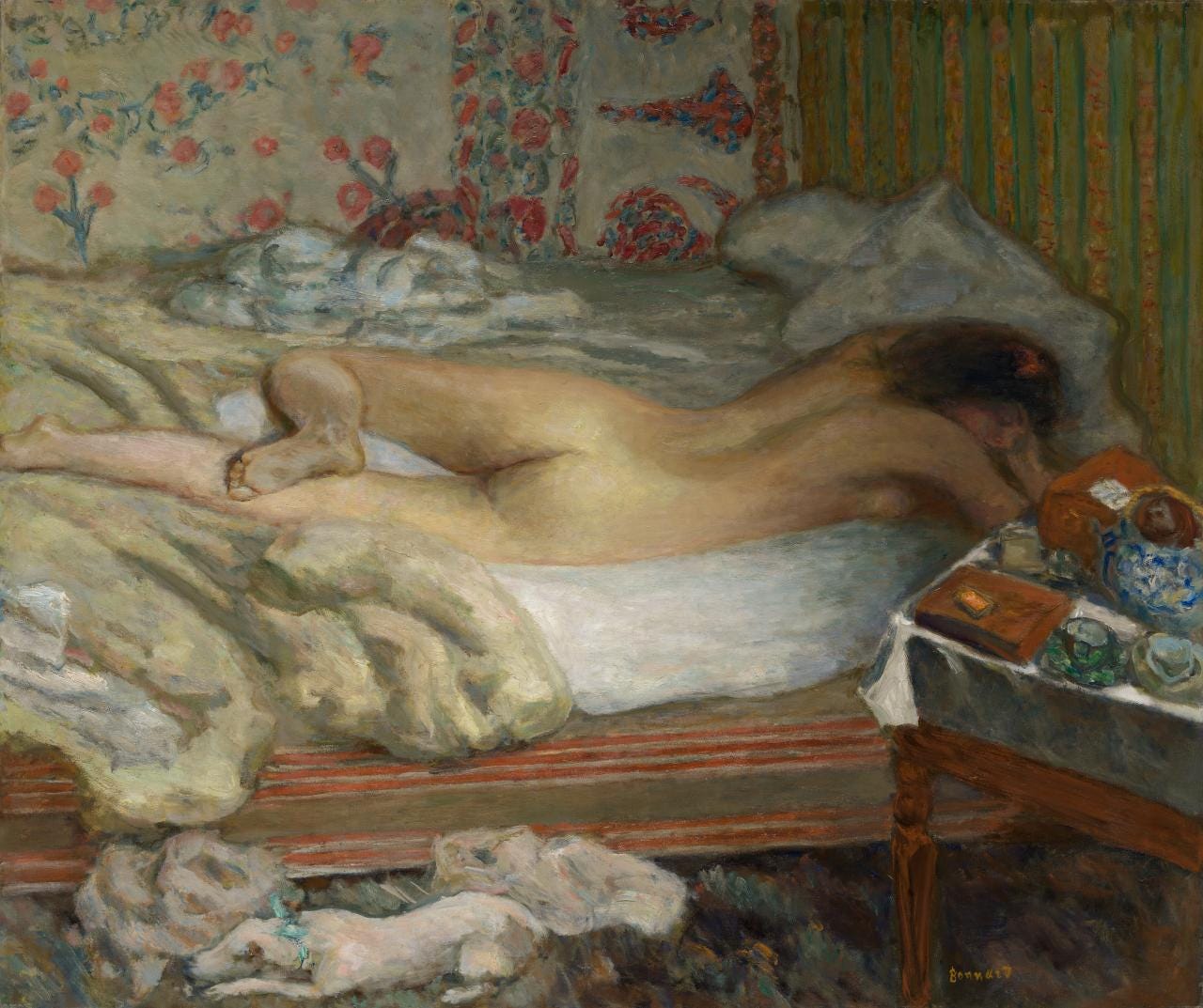
His wife Marthe is the constant of his art, painted again and again, very often in the bath. Over the decades she appears hundreds of times, ageless, as if frozen at the moment they met.
She was reclusive and unwell, and their life together was private and strange. The bathtub paintings, glowing and tender, are among the most haunting images of married love in modern art.
You can explore works by Pierre Bonnard in the collection of the Metropolitan Museum of Art and the Art Institute of Chicago.
The law student who chose paint
Pierre Bonnard was born on 3 October 1867, at Fontenay aux Roses, just outside Paris, into a comfortable middle class family. His father held a senior post at the War Ministry.
He was a strong pupil and took his baccalaureate with distinction in the classics. To please his father, he studied law, and in 1888 he even worked briefly in a government office, training far enough to qualify as a lawyer.
But he had been drawing all along. He sat the entrance competitions for the Ecole des Beaux Arts, failed to win the Prix de Rome that would have sent him to study in Rome, and quietly moved his life toward art instead.
The safe career his father wanted never happened.
Meeting the prophets at the Academie Julian
The turn came at the Academie Julian, the busy private art school where Bonnard enrolled after the Beaux Arts. There, around 1888, he fell in with a circle of ambitious young painters: Paul Serusier, Maurice Denis, Ker Xavier Roussel, Edouard Vuillard, and later Paul Ranson and Felix Vallotton.
Vallotton was the group's outsider, a Swiss recruit the others nicknamed le Nabi etranger.
They gave themselves a secret name, the Nabis, from the Hebrew word for prophets, and their own private slang.
Their spark was a small panel Serusier had painted at Pont Aven under Gauguin's direct guidance, using flat, unmixed colour. They treated it almost as a sacred object.
In 1890, after military service, Bonnard shared a Montmartre studio with Denis and Vuillard, and the friendships lasted for life.
The very Japanese Nabi
Bonnard loved Japanese woodblock prints, and it showed so plainly that his friends nicknamed him le Nabi tres japonard, roughly the very Japanese Nabi.
A large exhibition of Japanese prints at the Ecole des Beaux Arts in 1890 hit him hard. He collected prints himself and hung cheap ones around his room.
You can see the debt in his four tall, narrow panels called Women in the Garden, painted in 1890 and 1891 and now in the Musee d'Orsay.
Their shape copies the kakemono, the vertical Japanese hanging scroll. Flat pattern, cropped figures, a high viewpoint: these Japanese habits stayed in his work for the rest of his life.
France Champagne, the poster that made him
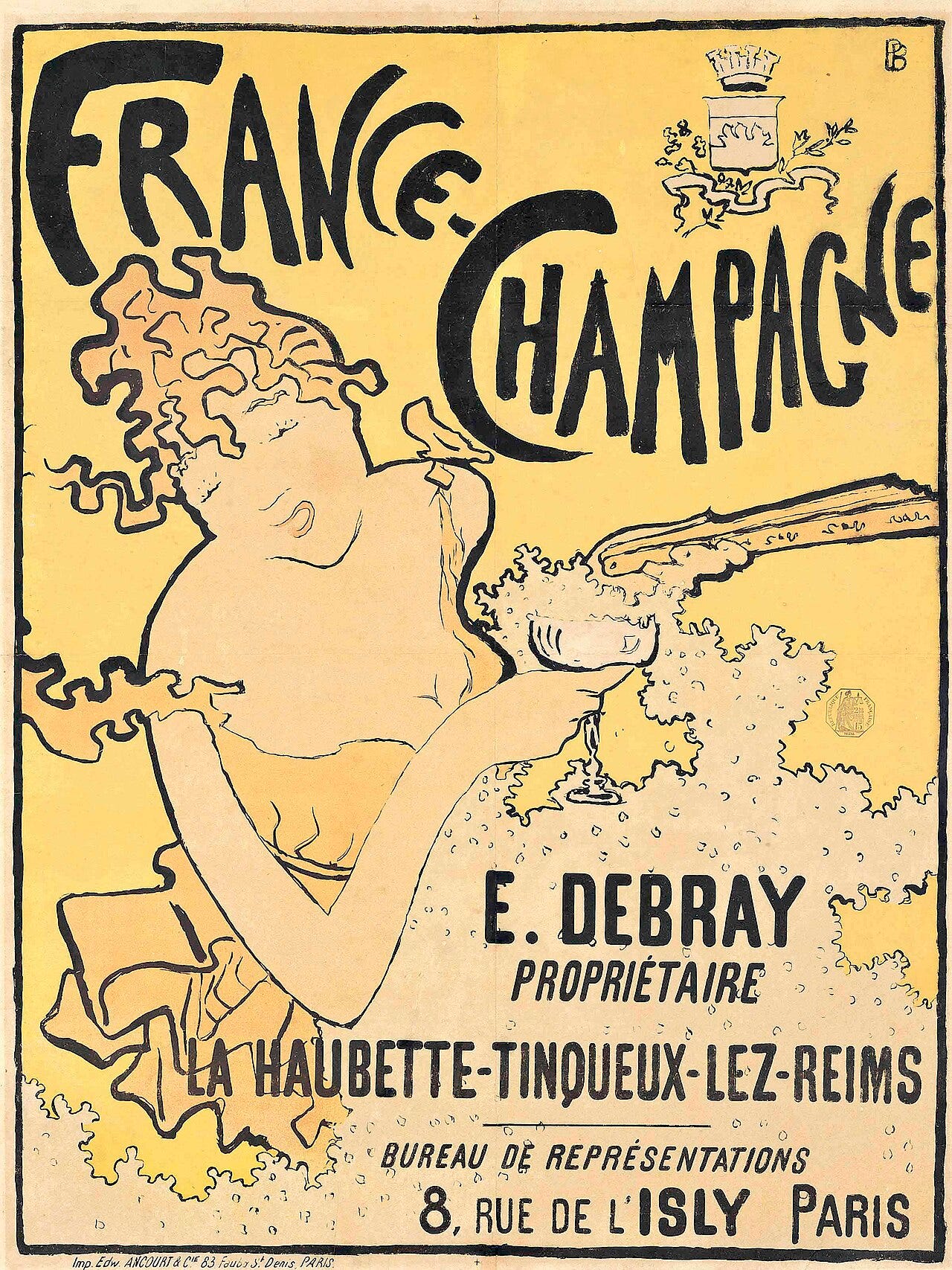
Bonnard's first real success was not a painting but an advertisement. Around 1889 he was asked to design a poster for a champagne house. France Champagne appeared on the walls of Paris in 1891, showing a laughing woman in a froth of bubbles.
It was an instant hit and helped launch his career. It also introduced him to colour lithography, the medium of the great poster age.
The same printing workshop soon worked with Toulouse Lautrec, and Bonnard's poster is often credited with helping steer Lautrec toward the form. The prize money let Bonnard leave the government office for good.
The printmaker of Paris life
For much of the 1890s Bonnard was as much a printmaker and illustrator as a painter, and this is often overlooked.
In 1893 he illustrated music books written by his brother in law, the composer Claude Terrasse. He drew for the avant garde review La Revue Blanche, designed folding screens, and in 1899 the dealer Ambroise Vollard issued his lithograph series Some Scenes of Paris Life.
In 1900 Vollard published Bonnard's illustrations for Paul Verlaine's poems Parallelement, a landmark in modern book design. These were not sidelines. The flat colour and quick, telling line of his prints fed straight back into his paintings.
The secret Marthe kept
In 1893 Bonnard met a young woman who called herself Marthe de Meligny and claimed noble roots. It was an invention. Her real name was Maria Boursin, and she came from ordinary provincial stock.
Bonnard seems not to have learned the truth until they married in 1925, more than thirty years after they met. On the marriage papers her true identity finally appeared.
She became his constant model and, increasingly, a private, anxious companion who kept the world at a distance. The persistent story that she was a permanent bathing invalid is overdrawn.
She had health troubles, but she also travelled, posed, and ran their homes for decades.
Renee Monchaty and the yellow painting
There was a shadow over the marriage. In the early 1920s Bonnard had a serious relationship with a younger woman, Renee Monchaty, a former model. Around 1921 to 1923 he began a canvas, Young Women in the Garden, using both Renee and Marthe as models.
In 1925 he married Marthe. Soon after, Renee took her own life.
Bonnard put the unfinished painting away and did not touch it for more than twenty years. Only after Marthe died did he return to it, flooding the ground with brilliant yellow, the colour the Metropolitan Museum links to his memory of Renee.
He finished it in 1945 and 1946, a quiet act of mourning.
The Midi light, and a friend called Matisse
In 1910 Bonnard discovered the south of France, and its light changed his colour forever. In the mid 1920s he settled at Le Cannet, above Cannes, in a small hillside house he called Le Bosquet.
Its rooms and garden became the setting for many of his finest interiors.
Nearby lived Henri Matisse, and the two were close friends and gentle rivals for decades.
Their letters between 1925 and 1946 survive. During the Second World War, when Bonnard was isolated and grieving, Matisse sent him news, encouragement, and even food parcels.
Two of the greatest colourists of the century, checking on each other by post.
The retouching that never stopped
Bonnard was famously unable to leave a painting alone. He worked from small pencil notes in pocket diaries and from memory, tacking unstretched canvases to the wall and returning to them for months or years, building the colour in tiny touches.
A beloved anecdote, told by the critic Georges Besson, has Bonnard slipping a little box of paints past the guards at a museum to secretly improve a picture already hanging.
Historians treat the smuggling story as probably embellished. But the habit behind it is real and well documented. He retouched finished works for the rest of his life. For Bonnard, a painting was never truly done.
The last touch of yellow
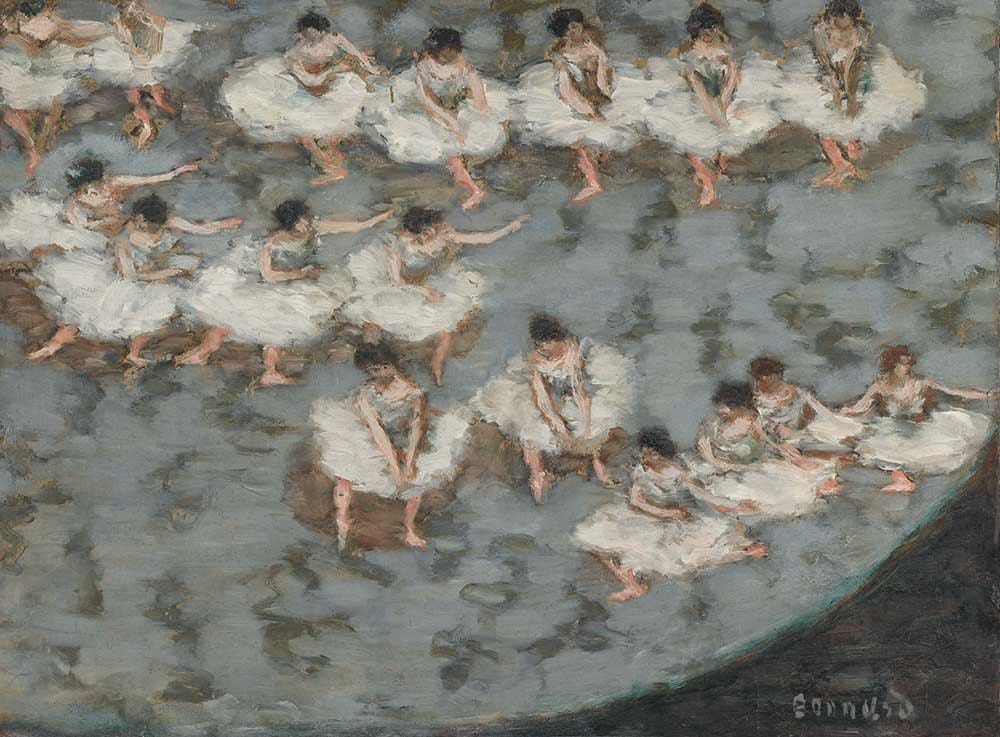
Bonnard died at Le Cannet on 23 January 1947, aged 79. His final canvas was The Almond Tree in Blossom, a small view of the flowering tree in his garden.
By the accounts of his circle, days before his death, too weak to stand, he studied it and judged the green patch of ground wrong. He asked his nephew to change it, saying that spot needed yellow. It was, fittingly, one more retouch.
His reputation then dipped. Picasso dismissed his colour as a potpourri of indecision. Later generations reversed that verdict entirely, and Bonnard is now ranked among the finest colourists of modern art.
The Pierre Bonnard questions that keep coming up
What is Pierre Bonnard famous for?
Intimate, intensely coloured scenes of domestic life, and his many paintings of his wife Marthe.
What were the Nabis?
A group inspired by Gauguin who treated painting as flat colour and pattern rather than realism.
Did he paint from life?
No, he worked from memory and small notes in the studio, often over many months.
When did he die?
In 1947, in the south of France.
More secrets to unlock


Why the colour still glows
Bonnard was once dismissed as a mere decorator, too pretty, too domestic. The verdict has reversed completely. Major museums now build blockbuster shows around him, and his glowing rooms are seen as a high point of twentieth century colour.
One last detail. Across more than fifty years Bonnard painted his wife Marthe several hundred times, almost always as the young woman he had met in 1893. In his pictures she never aged, not even in 1942, the year she died.
He simply could not leave his pictures alone.