
Titian was the greatest painter of Renaissance Venice and one of the most influential artists who ever lived. For 60 years he dominated European painting, the favorite of emperors and popes.
Born around 1488 in the Dolomite village of Pieve di Cadore, he ruled Venetian painting for sixty years, worked for popes and for the emperor Charles V, and in his final years loosened his brush into a smoky, almost abstract late style that pointed straight to Rubens and Rembrandt.
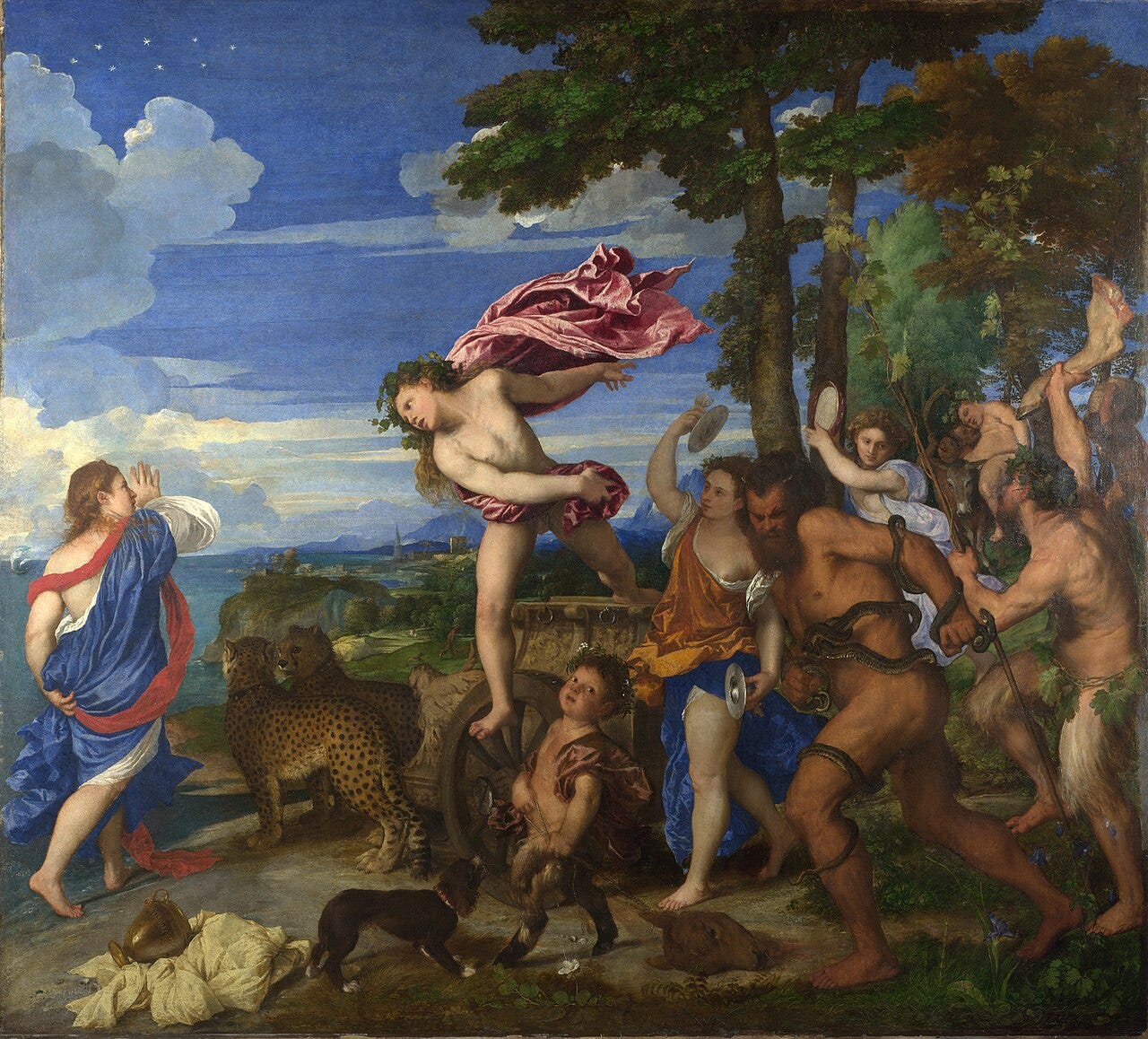
Where Florentine artists prized drawing, Titian prized color. He built whole worlds out of glowing, layered paint, and late in life loosened his brush so far that he seemed to invent a freer kind of painting three centuries early.
More incredible painter stories
If Titian pulled you in, you will love these too:


A whole shade of warm reddish hair is still named after him. Here is the whole story.
Titian at a glance
1488. Born Tiziano Vecellio around this year in Pieve di Cadore, in the Dolomites.
1518. The Assumption over the Frari altar put him at the top of Venice.
1533. Charles V knighted him and made him a count palatine, ranks no painter had held.
1551. Began the poesie for Philip II, mythologies painted like poems.
1576. Died in Venice during the plague, and alone among its victims received a church burial, at the Frari.
The master of Venetian color
Renaissance art had two camps. Florence and Rome, led by Michelangelo, believed drawing was everything. Venice, led by Titian, believed in color and light.
Titian built his figures not from hard outlines but from warm, glowing layers of oil paint. This Venetian colorito, color as the soul of a picture, became one of the great traditions of Western art.
Range, reach, and the nudes
Titian is famous for his range and his reach. He painted everything at the highest level: altarpieces, myths, and some of the most sensual nudes in art, like the Venus of Urbino, a milestone in the long story of the nude.
He was also the portraitist kings fought over, and his influence runs straight through Rubens, Velazquez and Manet. For centuries, to learn color was to study Titian.
Reading a Titian in three seconds
A Titian glows from within.
Luminous color. Deep reds, golds and blues built from many thin, glowing layers.
Soft form. Bodies modeled with color and light rather than hard lines.
Rich texture. Velvet, skin and fur you can almost feel.
The loose late style. In old age his brushwork broke into rough, free strokes, startlingly modern.
The painter of emperors
Titian became the official painter to the most powerful man in Europe, the Holy Roman Emperor Charles V, and then to his son Philip II of Spain.
A famous story tells that when Titian dropped his brush, the emperor himself bent down to pick it up, an unheard of honor that captured how high a painter could now rise.
For Philip he made a series of sensual mythological paintings he called his poesie, or visual poems.
The loose late style
Titian’s most surprising chapter came at the end. As an old man he painted with extraordinary freedom, applying paint in rough patches, smears and even, it was said, with his fingers.
Up close these late works look almost abstract, dissolving into pure paint. For me they are the most modern thing painted before 1600, pointing ahead to Rembrandt, the Impressionists, and modern painting itself.
From a mountain village to the top of Venice
Born around 1488 in the mountains north of Venice, Titian came to the city young and rose fast, soon outshining his teachers Bellini and Giorgione.
He lived long, grew rich and famous, ran a busy workshop, and was shrewd about money and reputation. Few artists have enjoyed such a long reign at the very top.
How Titian died
Titian died in 1576, very old, during an outbreak of plague in Venice.
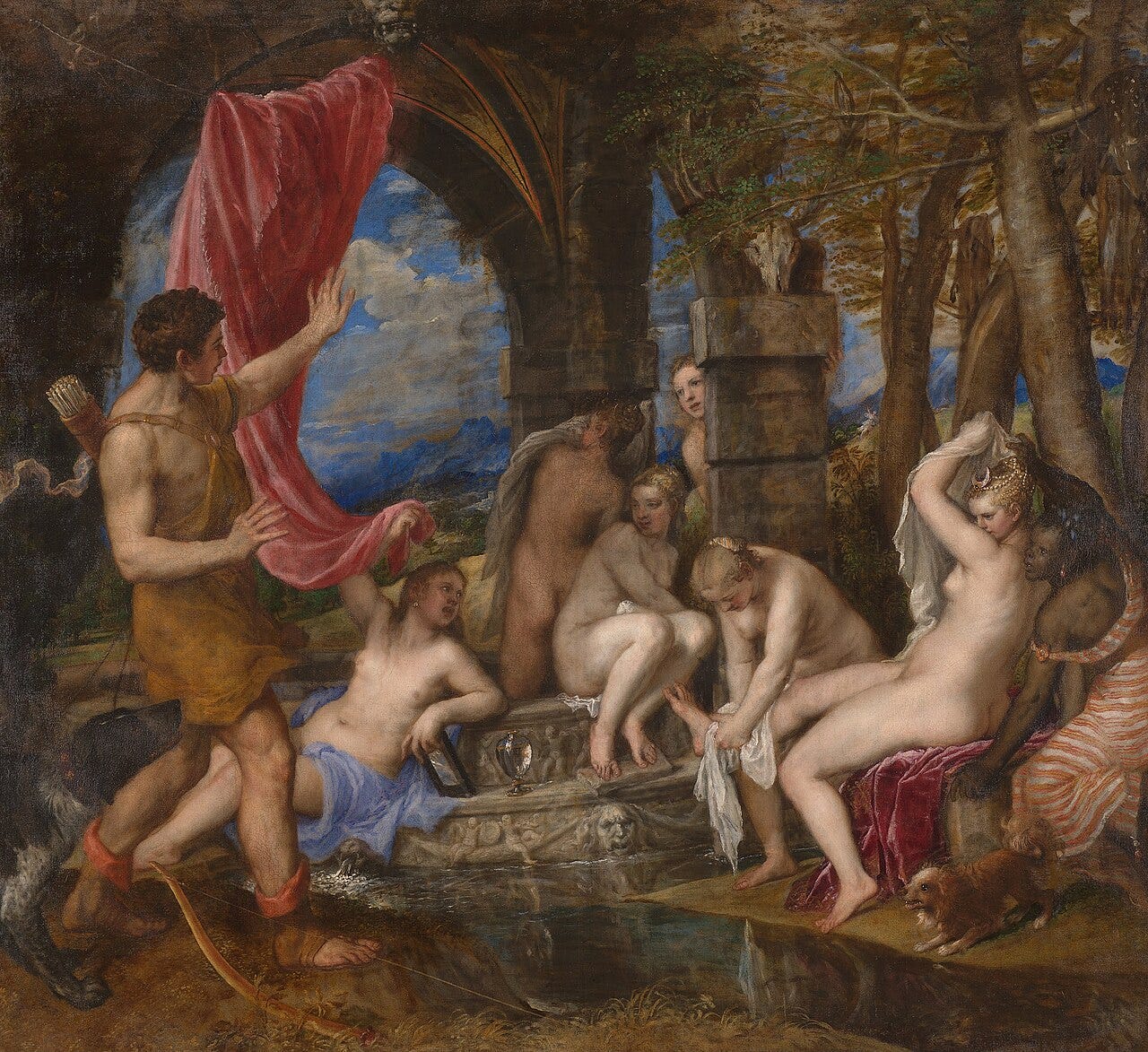
He was given a rare honored burial despite the epidemic. He had painted for around six decades. His afterlife says it best: in 2012 his Diana and Callisto was saved for the public for 45 million pounds.
Prado, Venice and London
Italy, Spain and a few great museums hold the best of him.
The Museo del Prado, Madrid. The richest collection, full of his work for Charles V and Philip II.
Venice. Where his great altarpieces still hang, including in the Frari church.
The National Gallery, London. Home to Bacchus and Ariadne.
Outside Europe, the Metropolitan Museum of Art in New York owns his Venus and the Lute Player.
The birth year no one can fix
Titian was born in Pieve di Cadore, a mountain town in the Dolomites on the Venetian side of the Alps.
The year is a real puzzle. Most scholars today place it around 1488 to 1490, though older accounts once said 1477. Part of the confusion came from Titian himself.
Late in life he told King Philip II that he was older than the records suggest, perhaps to hurry along payments he was owed.
His family, the Vecellio, had lived in Cadore since the fourteenth century. His father Gregorio held local and military posts, and his older brother Francesco painted too.
So the exact candles on the cake stay uncertain. What is firm is the place: a village of timber and stone far from the lagoon that would make him famous.
Apprentice in Bellini's Venice
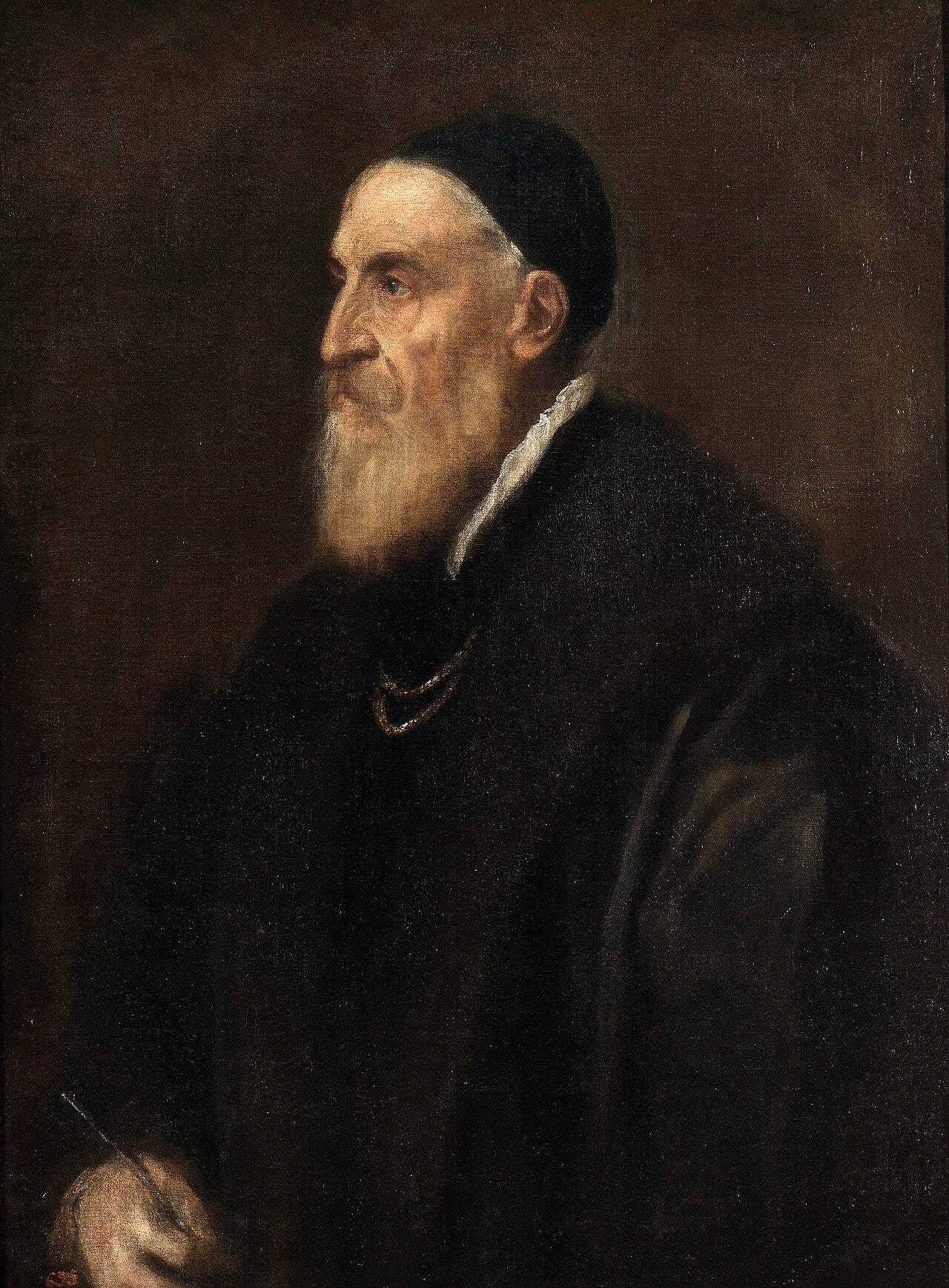
Around the age of nine or ten, Titian left the mountains for Venice, then one of the richest cities in the world. He started not with a painter but with a mosaic maker named Sebastiano Zuccato.
He soon moved into the orbit of the Bellini family, the leading workshop in the city. He passed briefly through Gentile Bellini's studio, and after Gentile died in 1507 he trained under Gentile's brother, Giovanni Bellini, the finest Venetian painter of the day.
From Giovanni he learned to build a picture out of color and light rather than hard drawn line. That lesson shaped everything he did later.
By his early twenties he was already painting portraits and small devotional works that people struggled to tell apart from his teachers.
The Giorgione problem
The young Titian fell in with Giorgione, another painter formed in Bellini's circle.
The two worked so closely, and so alike, that art historians still argue over who painted what in those years. Some pictures long given to Giorgione are now credited to Titian, and the other way around.
In 1508 they painted frescoes together on the outside walls of the Fondaco dei Tedeschi, the German merchants' warehouse by the Rialto.
Only faint traces survive today. When Giorgione died young in 1510, probably of plague, he left works unfinished. Contemporary writers record that Titian completed at least one, adding the landscape to Giorgione's Sleeping Venus.
That handover is where Titian's own career truly begins.
The Assumption that put him on top
In 1516 Titian began the picture that made him the leading painter of Venice.
It was a towering altarpiece for the high altar of Santa Maria Gloriosa dei Frari, the great Franciscan church. Known as the Assunta, or Assumption of the Virgin, it shows Mary rising to heaven on a bank of cloud.
The canvas stands close to seven metres tall, and it was unveiled in 1518.
Nothing in Venice looked quite like it. The red robes, the upward surge, and the crowd of reaching apostles below all pull the eye toward the sky.
That same red anchors our list of red paintings across art history, from David’s Death of Marat to Monet’s poppy fields.
It still hangs where Titian meant it to hang, over the same altar, more than five hundred years later. Few paintings have stayed home so long.
The Pesaro altarpiece and its sideways Madonna
Fresh from the Assunta, Titian took on a second altarpiece for the Frari, this one for the Pesaro family. He worked on it from about 1519 to 1526.
Instead of placing the Virgin dead center, as tradition demanded, he pushed her up and to one side. The saints, donors and worshippers climb toward her on a diagonal.
It sounds simple. It was not. Venetian painters copied that off center design for the next two hundred years. The picture also records real people.
Jacopo Pesaro, a church commander, kneels with his relatives to give thanks for a naval victory over the Ottomans. Standing in the Frari today, you can see the Assunta and the Pesaro altarpiece within a few steps of each other.
The poesie for a Spanish king
From about 1551 Titian painted a run of large mythological canvases for Philip II of Spain. He called them poesie, meaning visual poems.
Nearly all draw on the Metamorphoses of the Roman poet Ovid. The set included Danae, Venus and Adonis, Diana and Actaeon, Diana and Callisto, and the Rape of Europa.
They are full of gods, pursuit and desire, painted in loose, glowing color. Titian shipped them from Venice to Spain across roughly a decade.
Today they hang scattered across museums in London, Edinburgh, Madrid and Boston. When a few are brought together, as they occasionally are, you can read them as the linked cycle he intended.
Charles V on horseback at Muhlberg
Before Philip came his father, the Holy Roman Emperor Charles V.
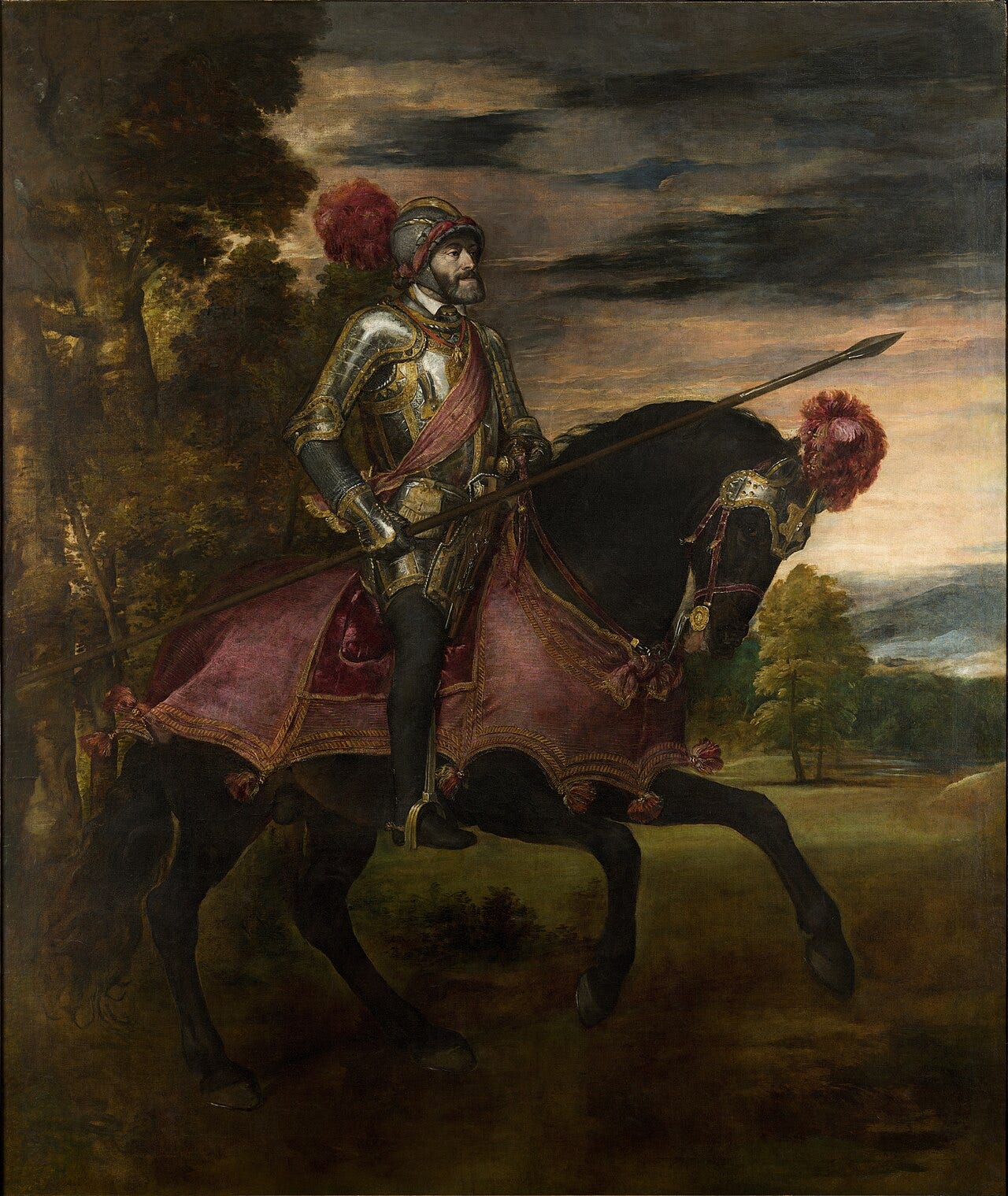
In 1548 Titian painted him as a mounted soldier, lance in hand, riding out after his victory at the Battle of Muhlberg the year before.
The Emperor wears real armour and rides alone against a wide evening sky. There is no crowd and no allegory, just a tired ruler and his horse.
That quiet is what made it powerful. The equestrian portrait became the template later court painters borrowed, from Rubens to Velazquez.
The canvas now hangs in the Prado in Madrid. Charles was the most powerful man in Europe, and he chose a painter from a mountain village to fix his image for history.
The count's title and the fallen brush
Charles V did not just hire Titian. He raised his rank.
In 1533 the Emperor named him a Count Palatine and a knight of the Golden Spur, honours almost never handed to a painter. Titian's children were ennobled too.
One famous story has the Emperor bending down to pick up a brush that Titian had dropped while painting him. When the courtiers gasped, Charles is said to have replied that Titian deserved to be served by an emperor.
Treat that tale with care. It was written down later and may be part legend. What is documented is the rank and the trust.
The triumvirate with Aretino and Sansovino
Titian's closest allies were not painters. Around 1527 two newcomers reached Venice: the writer Pietro Aretino and the sculptor and architect Jacopo Sansovino. The three became inseparable friends, a trio some later called the triumvirate.
Each helped the others. Sansovino was rebuilding the heart of Venice in stone. Aretino, a feared and widely read writer, acted as Titian's unofficial publicist, talking up his pictures in letters that reached courts across Europe.
Aretino also helped steer Titian toward his grandest patrons, the Emperor among them. When Aretino died in 1556, Titian lost more than a friend.
He lost the sharpest voice promoting his name. It was one of the cleverest working partnerships in the history of art.
The businessman behind the brush
Titian was as careful with money as he was with paint. He negotiated hard, secured a state pension in Venice, and invested in property and the timber trade back in Cadore.
His dealings with Philip II show the other side. The King was slow to pay, and Titian's letters to Madrid nag, politely, for money owed on the poesie and other works.
He ran a busy workshop to keep up with demand. His son Orazio worked at his side, handling business and helping finish pictures, while assistants turned out copies of popular compositions.
That is partly why some paintings signed by Titian vary so much in quality. The best are his own hand. Others came from the shop he built to keep Europe supplied.
More secrets to unlock


The Titian questions that keep coming up
What is he known for? Glowing Venetian color, mythologies, nudes and imperial portraits.
When did he live? Born around 1488, died in 1576.
Where was he from? The Venetian Republic, in northern Italy.
Why is a hair color named Titian? After the warm reddish gold hair he loved to paint.
Who did he work for? Emperor Charles V and King Philip II, among others.
When was Titian born? No one knows for certain. Most scholars now place his birth in Pieve di Cadore around 1488 to 1490, though a traditional date of 1477 was long repeated. Titian himself claimed to be older than the records suggest, which muddied the question further. His death in Venice on 27 August 1576, during an outbreak of plague, is firmly documented.
Who taught Titian to paint? He began with the mosaic maker Sebastiano Zuccato in Venice, then joined the Bellini family workshop. His real teacher was Giovanni Bellini, the leading Venetian painter of the time. Just as important was his early partnership with Giorgione, whose style shaped Titian's first works so strongly that scholars still debate which of the two painted certain pictures.