
Johannes Vermeer is the most mysterious of the great painters: barely 34 finished pictures, almost no record of his life, not one certain self portrait, and two centuries of being forgotten before the world called him a genius. What he left is light.
He is famous and unknown at the same time, and that gap is the whole story.
We know he lived his whole life in one small Dutch city, ran out of money, and died young in debt with eleven children. We do not know what he looked like, who taught him, or how he made his paintings glow.
The Vermeer we love is half painting, half detective story.
The Vermeer file, in brief:
He lived from 1632 to 1675, almost entirely in Delft, in the Dutch Republic.
Only about 34 paintings by him survive. He worked slowly and sold little.
His real subject is light: women in quiet rooms by a window.
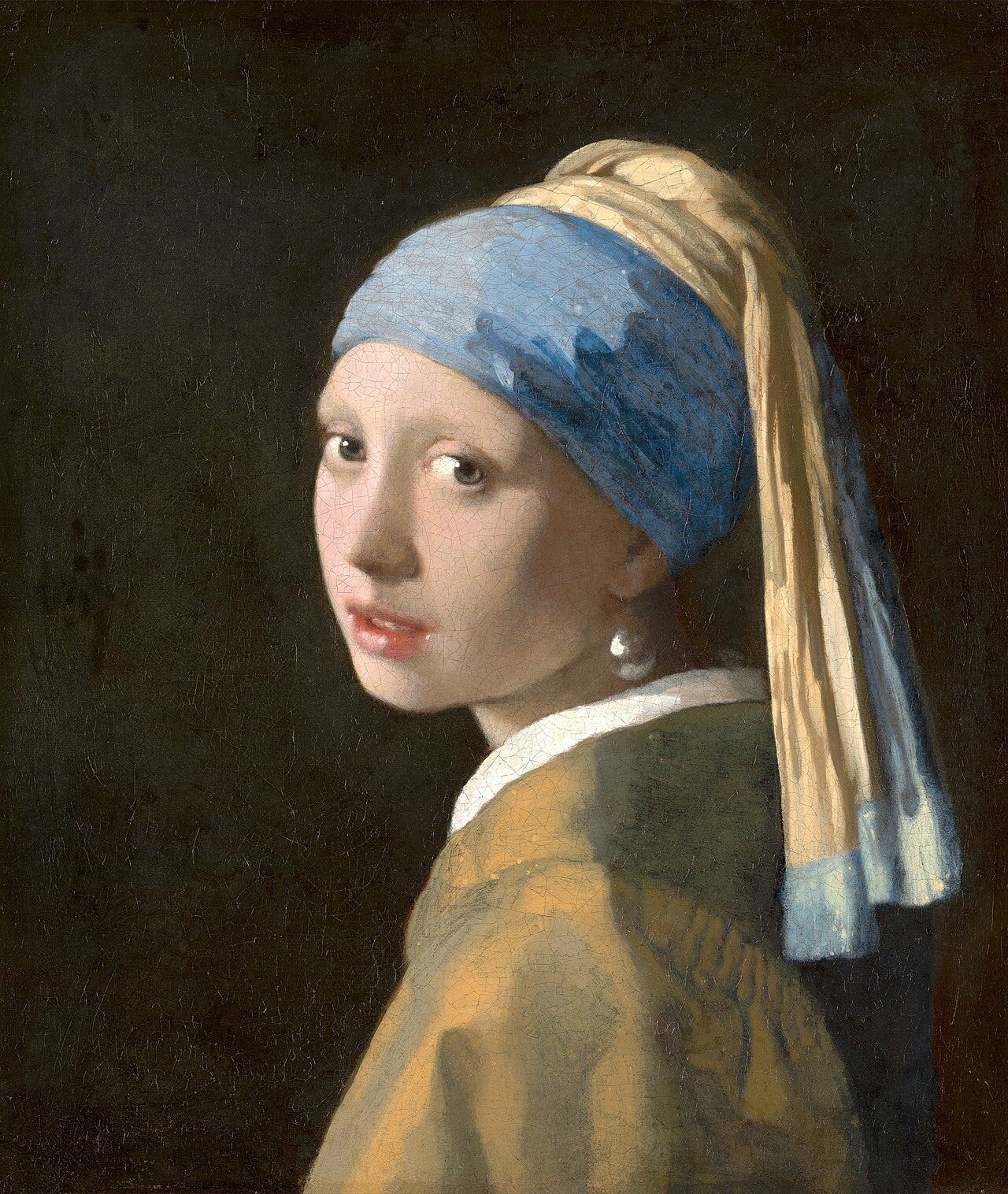
His most famous work, Girl with a Pearl Earring, is not even a portrait.
He was forgotten for 200 years, then rediscovered in the 1860s.
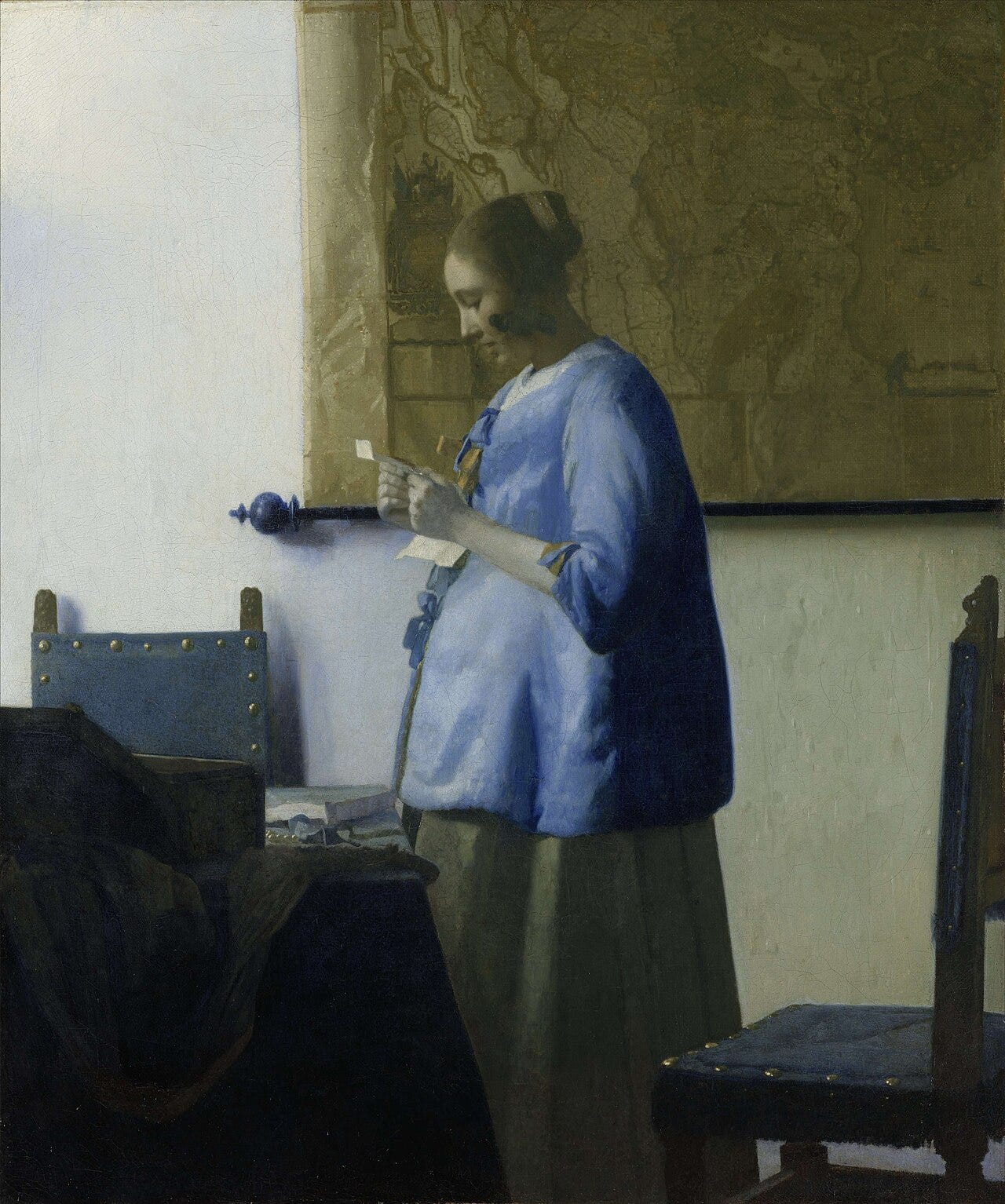
He returned to the same subject again and again, women reading or writing letters by a window, in works gathered together in Letter Paintings: 12 Famous Works of Reading and Writing.
More incredible painter stories
If Vermeer pulled you in, you will love these too:


So this guide begins where the record goes quiet, with the man himself.
Vermeer at a glance
1632. Born in Delft, an innkeeper’s son.
1653. Married Catharina Bolnes and joined the painters’ guild in the same year.
1665. Girl with a Pearl Earring, painted around this time.
1672. The French invasion collapsed the Dutch art market, and his finances with it.
1675. Died at 43, leaving eleven children and enormous debts.
The painter who left almost no trace
The first strange thing about Vermeer is how little we know him.
He was born in Delft in 1632, the son of an innkeeper and art dealer, and he seems never to have left the region. No letters survive. No diary. No teacher is recorded. There is not a single portrait we can be sure shows his face.
He worked as an art dealer alongside his painting, and raised a large family, eleven of his fifteen children surviving.
When the French invaded the Dutch Republic in 1672, the art market collapsed, and Vermeer with it. He died in 1675, suddenly, deep in debt, and his widow had to hand paintings to the baker to settle the bread bill.
For a man now ranked beside Rembrandt, that is an astonishingly thin paper trail.
The family that kept him afloat
For a man who left no words, his household is unusually well recorded, and it explains a lot.
In 1653 Vermeer married Catharina Bolnes, a Catholic woman from a wealthier family, and converted to her faith. Her formidable mother, Maria Thins, took them into her house and quietly funded his career.
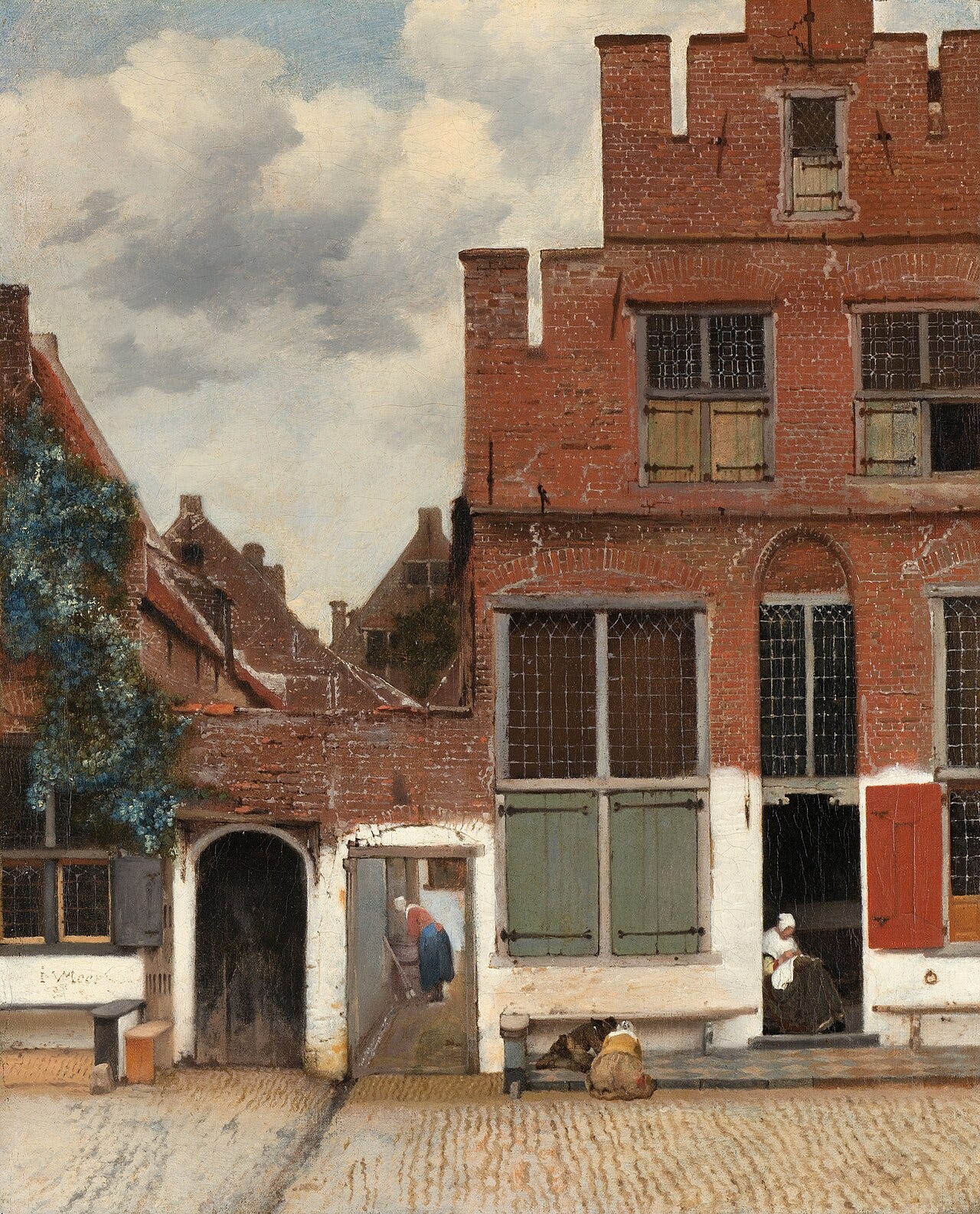
That gave him room to paint at his own slow pace. Many of his interiors are believed to show rooms in that very house: the same windows, the same chairs, the same map on the wall.
When he died, Catharina was left with the children and the debts. She blamed his collapse on the war and the paintings he could no longer sell, and fought for years to keep a few of his works away from creditors.
Barely thirty four pictures
Most great painters leave hundreds of works. Vermeer left a handful.
Around 34 paintings are accepted as his, and that may be close to everything he ever made. He worked at a crawl, sometimes a painting or two a year, layering thin glazes and adjusting endlessly.
Part of it was money spent, not saved. Between his day job dealing art and a houseful of children, time and cash were always short. I get into the full reason in Why Did Vermeer Paint So Few Paintings.
The light in the room
Stand in front of a real Vermeer and the subject barely matters. What stops you is the light.
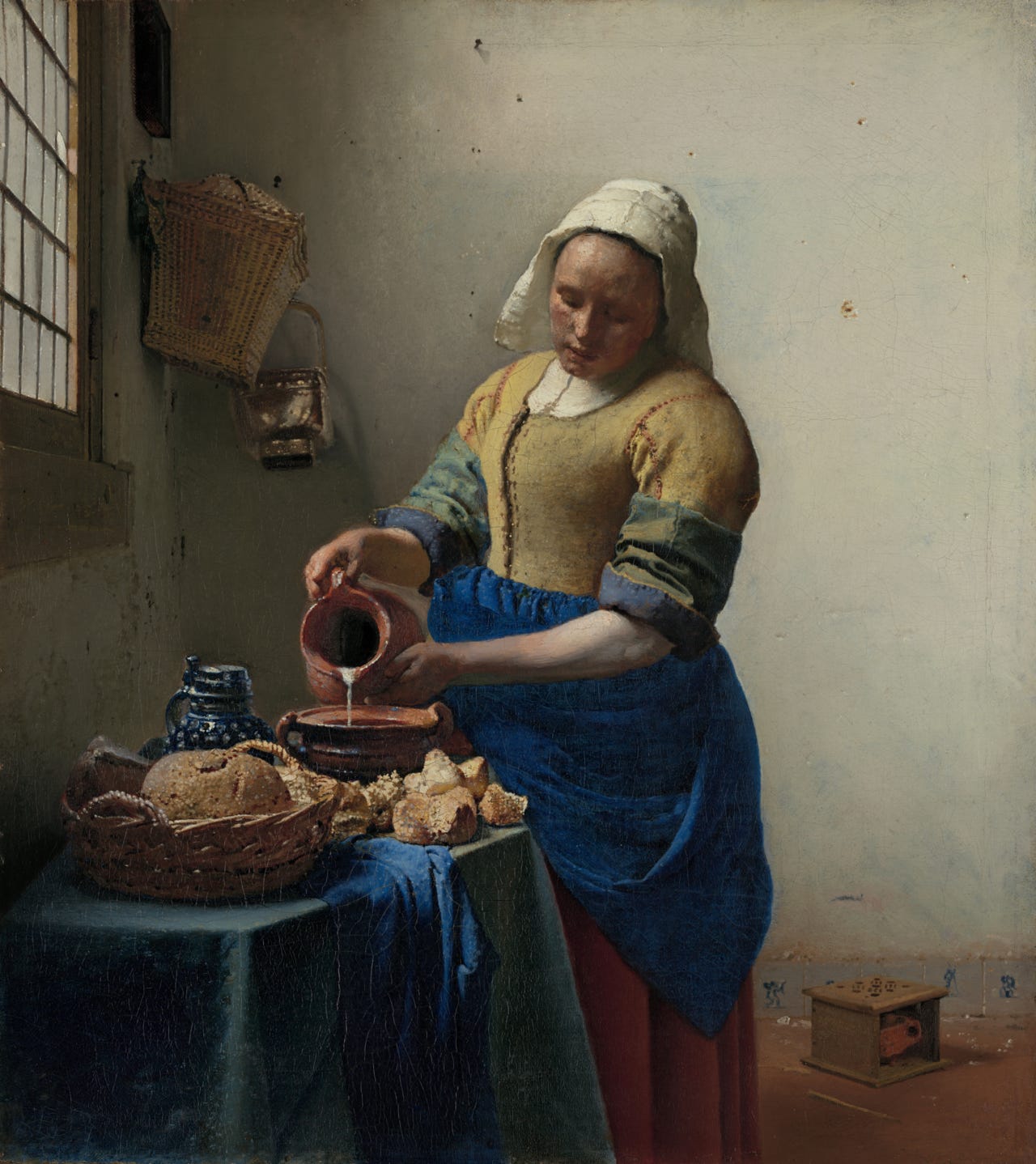
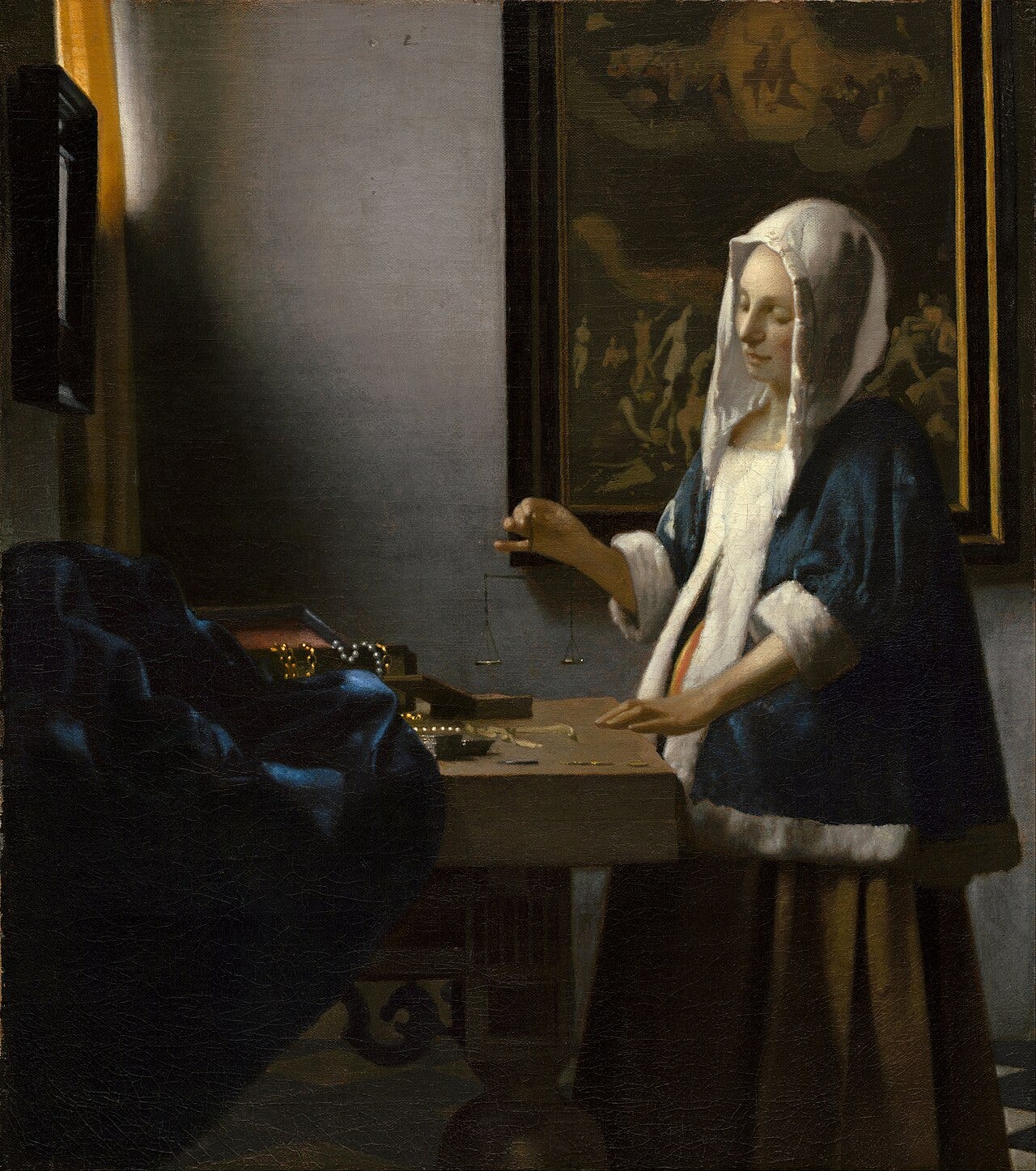
It almost always comes from a window on the left, falls across a wall, and lands on a woman reading, pouring milk, weighing pearls. He built it out of soft, grainy highlights, tiny dots of pale paint on bread, on brass, on the rim of a jug.
The play of light and shade behind it, what we call chiaroscuro, is older than Vermeer. What he added was stillness, and an almost photographic glow.
That glow is also the heart of a 400 year old argument: did he trace what he saw through a lens? I weigh the case in Did Vermeer Use a Camera Obscura.
Look hard at The Milkmaid
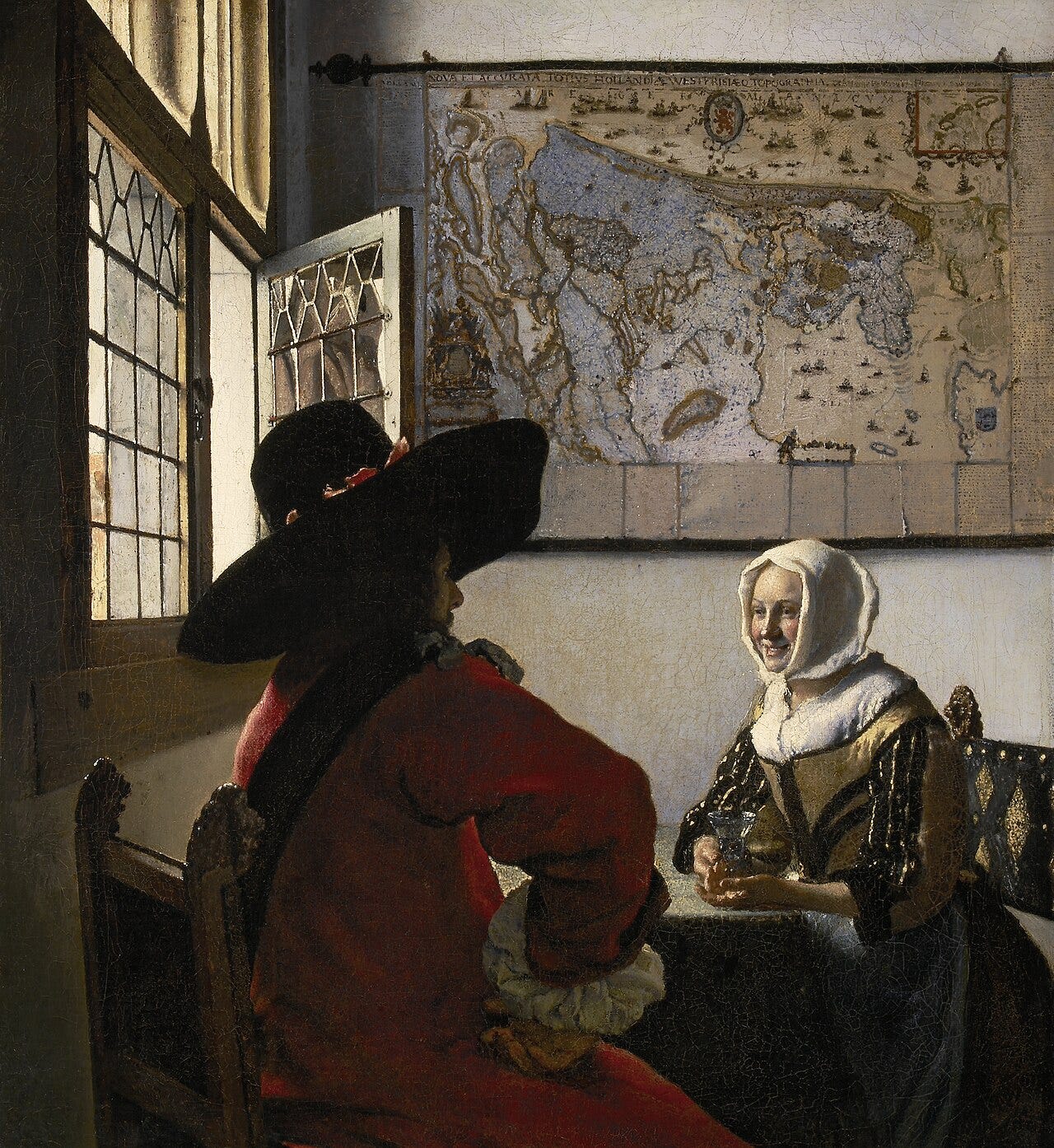
If one painting shows what Vermeer could do, it is The Milkmaid.
A servant stands at a table, pouring a thin stream of milk from a jug. That is the entire event. Yet he turns it into something close to sacred.
Daylight floods a rough wall, the crust of the bread catches dozens of tiny dots of light, and her heavy arms and thick blue apron feel utterly real and utterly still.
Scans show he kept changing his mind, painting out a wall map and a basket, and removing a footwarmer near her feet. He stripped the scene back until nothing was left but a woman, a jug, and the light.
A simple kitchen chore ends up feeling like the most important moment in the world.
The blue that cost a fortune
One color did more for Vermeer’s glow than any optical trick.
He was devoted to natural ultramarine, a blue ground from lapis lazuli, mined in far away Afghanistan and carried across the world. Pound for pound it cost more than gold, and most painters saved it for the robe of a Virgin.
Vermeer used it everywhere, openly in aprons and tablecloths, and secretly in underlayers and shadows, where it warms the whole picture from beneath.
That reckless love of the most expensive pigment on the market is one reason his rooms feel lit from within, and one reason he died with so little.
The most famous face that is not a portrait
Everyone knows the Girl with a Pearl Earring. Almost no one knows the catch.
She is not a portrait of a real person. She is a tronie, a Dutch type of painting that shows a character or a mood rather than a named sitter, here a girl in an exotic turban turning to look at us.
Even the pearl is a kind of illusion, too big to be real, painted with barely two strokes of white. Who she is, and why she will not leave us alone, is its own story in Who Is the Girl with a Pearl Earring.
Lost for two hundred years
Then something close to impossible happened. The world simply forgot him.
After his death Vermeer slipped out of art history. His paintings were sold under other, more famous names, a Rembrandt here, a de Hooch there, because a real Vermeer meant little to buyers. For roughly two centuries he was a minor footnote.
His rescue came in the 1860s, when a French critic, Theophile Thore, writing as William Burger, tracked down his scattered works and championed them in print.
Within a generation a forgotten Delft painter had become one of the most admired names in art.
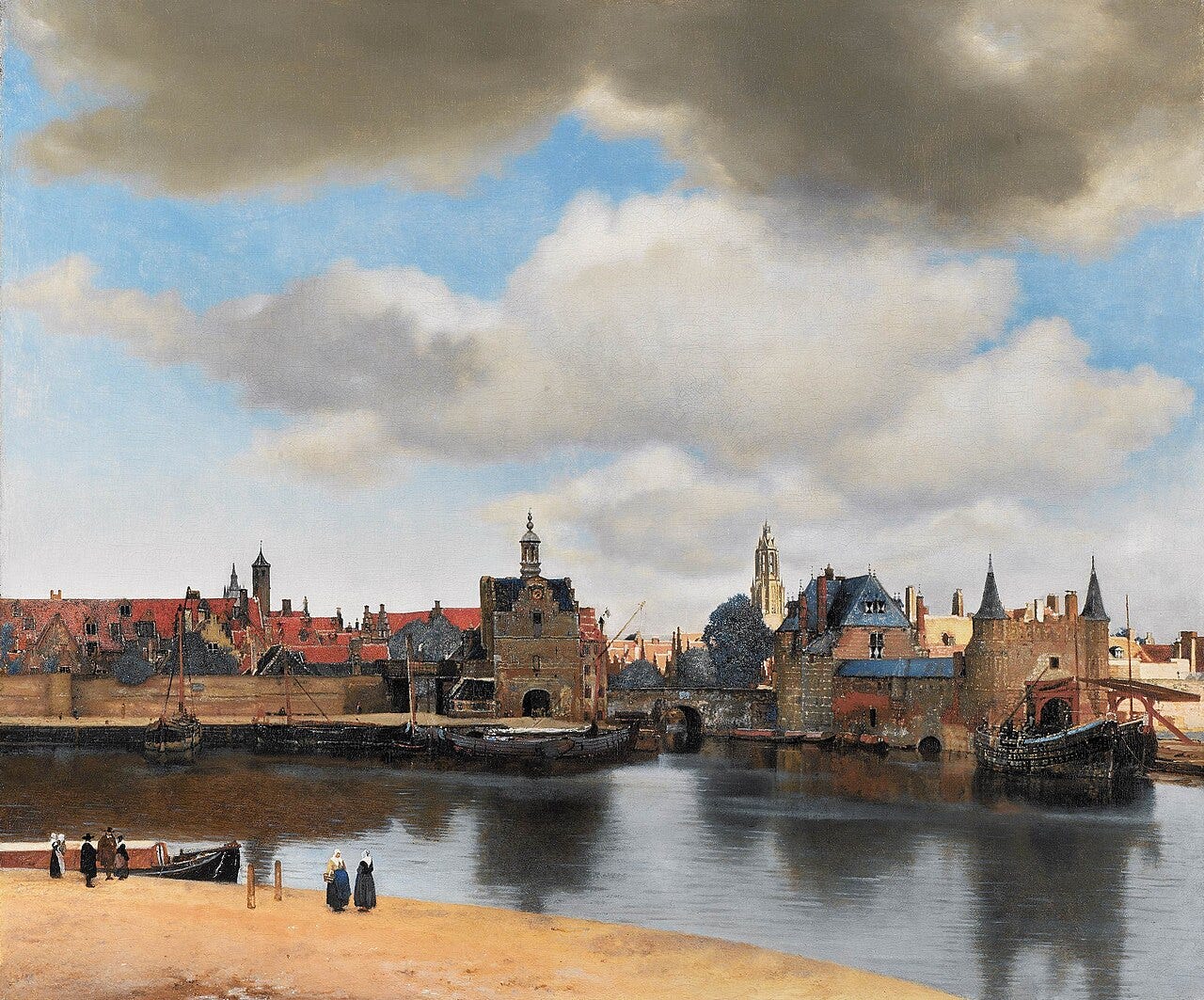
The most beautiful painting in the world?
Vermeer painted almost only indoor scenes, which makes his one great outdoor picture, the View of Delft, stand apart.
It shows his home town across the water under a vast, moving sky, the brickwork catching sun while clouds throw the rest into shadow.
Two centuries later the novelist Marcel Proust called it the most beautiful painting in the world, fixing on one detail, a small patch of yellow wall. In his novel a character collapses and dies while gazing at exactly that patch.
For a painter once erased from history, it is a strange afterlife: worshipped by one of the greatest writers of the next age over a few inches of yellow paint.
The forger who needed him
Vermeer is so prized, and so scarce, that he created the perfect target for fraud.
In the 1930s and 40s a failed Dutch painter named Han van Meegeren manufactured brand new Vermeers, fake religious scenes that experts hailed as lost originals.
He sold one to the Nazi leader Hermann Goering during the war. When the Allies found it, Van Meegeren was arrested for selling a national treasure to the enemy, a crime that could mean death.
His defense was extraordinary. He confessed that the painting was no treasure at all, but his own forgery, and to prove it he painted a fresh fake under guard.
He went from traitor to folk hero overnight. The scandal says everything about how badly the world now wanted Vermeers. The full account of how he pulled it off is in The Man Who Forged Vermeer and Fooled the Nazis.
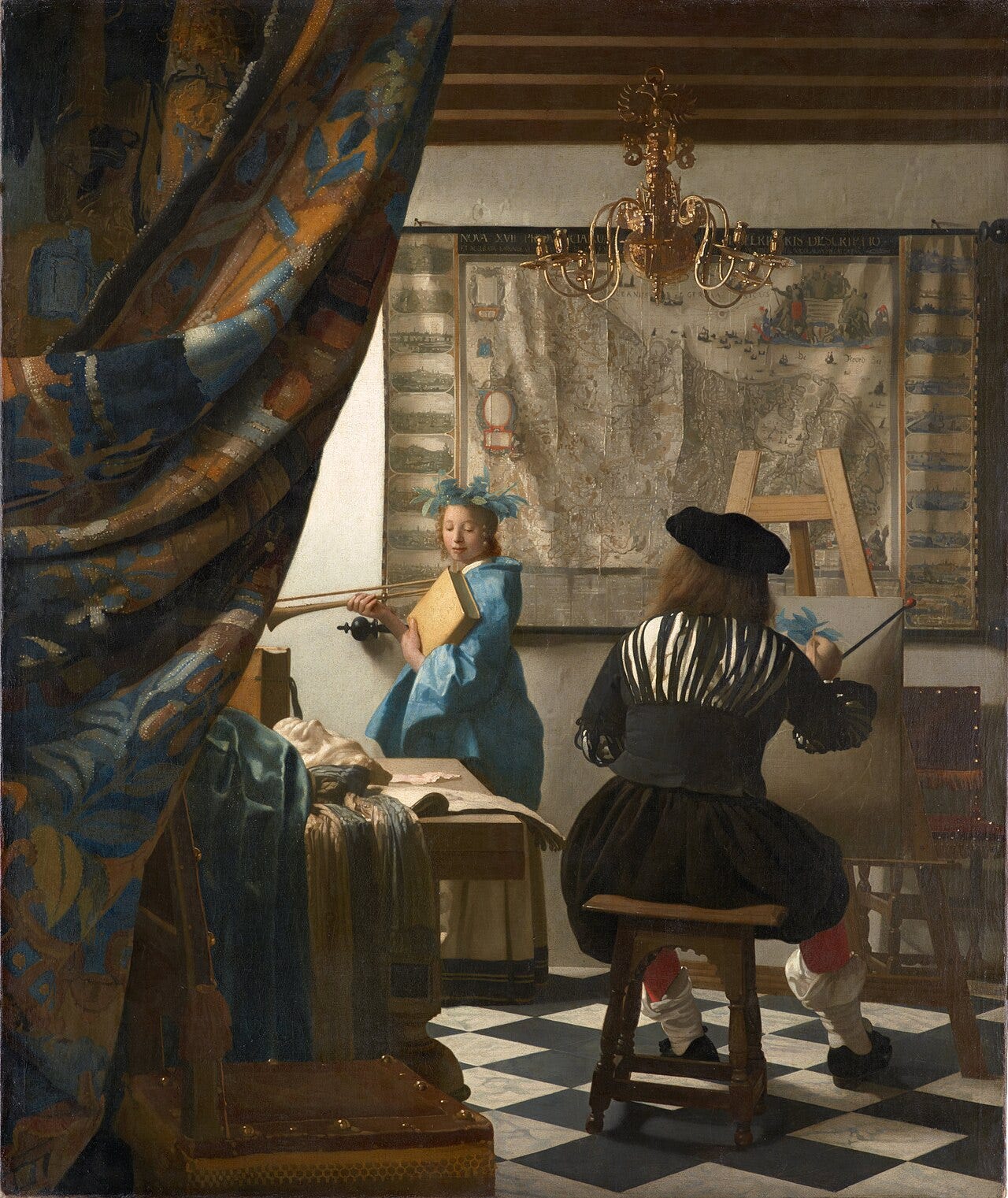
His place in the Dutch Golden Age
Vermeer belongs to the Dutch Golden Age, the explosion of painting in the 17th century Dutch Republic, and within it to the genre painters who showed ordinary daily life rather than kings or saints. Rembrandt and Frans Hals worked in that same explosion, and the 12 paintings that best sum up the period run from tavern jokes to Vermeer's own silent milkmaid.
He was not the only master of the quiet interior. Pieter de Hooch painted similar sunlit rooms, Gerard ter Borch painted satin and letters, Rembrandt towered over them all from Amsterdam.
What sets Vermeer apart is the silence and the light. Others told little stories. Vermeer stopped time.
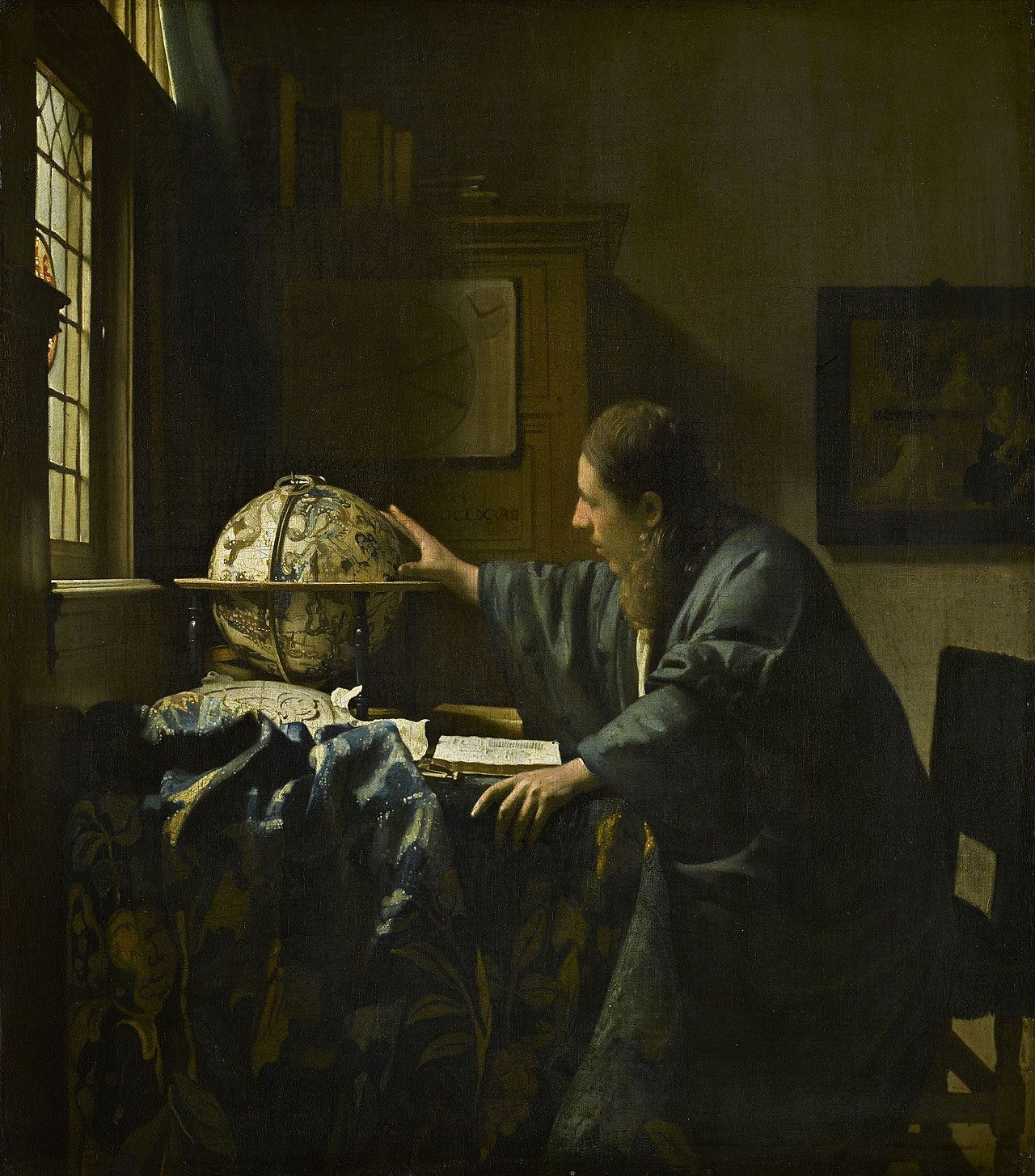
If you only look at three
Girl with a Pearl Earring, around 1665. The face that is not a face, lit like a candle.
The Milkmaid, around 1658. A servant pouring milk, and one of the quietest pictures ever to feel monumental.
View of Delft, around 1660. His home town under a moving sky, one of the great cityscapes in art.
Seeing them in the flesh
Vermeer is scarce, so seeing several at once is a real event.
The Mauritshuis in The Hague holds the Girl with a Pearl Earring and the View of Delft. The Rijksmuseum in Amsterdam has The Milkmaid and several more. In New York, the Metropolitan Museum of Art has the largest group outside the Netherlands.
The Vermeer questions that keep coming up
Why is Vermeer famous? For his unmatched painting of light and quiet, and for the mystery around his life and tiny output.
How many paintings did Vermeer make? Only about 34 survive, and that may be close to his whole career.
Is Girl with a Pearl Earring a real person? No, it is a tronie, a study of a character, not a portrait of a named woman.
Did Vermeer use a camera obscura? It is strongly suspected and hotly debated, but never proven.
When was Vermeer born? He was baptised on 31 October 1632, in Delft, in the Netherlands.
How did Vermeer die? Suddenly in December 1675, at 43, deep in debt, leaving his family ruined.
Was he famous in his lifetime? No. He was largely forgotten for nearly two centuries.
Where can I see Vermeer? Mainly the Mauritshuis and Rijksmuseum in the Netherlands, and the Met in New York.
More secrets to unlock


A genius bought for the price of a sandwich
The strangest fact about Vermeer is not in the paint. It is in the price.
In 1881, the Girl with a Pearl Earring, grimy and unsigned, changed hands for about two guilders plus a small fee, the cost of a modest meal. The man who bought her recognized something under the dirt.
Today she is called the Mona Lisa of the North, and the painter nobody could name for 200 years is one of the most loved in the world.
