
Wassily Kandinsky was the Russian painter widely credited with making the first purely abstract art, the man who said he could hear colors and see music, and who walked away from a law career at the age of thirty to chase paint.
That credit is now disputed: Hilma af Klint painted fully abstract canvases in Stockholm as early as 1906, years before Kandinsky's own breakthrough. Kazimir Malevich pushed Russian painting even further from the object, into pure geometry, a story told in the Kazimir Malevich complete story.
He turned the canvas into a symphony of line and color, and wrote the book that taught the world to take abstraction seriously.
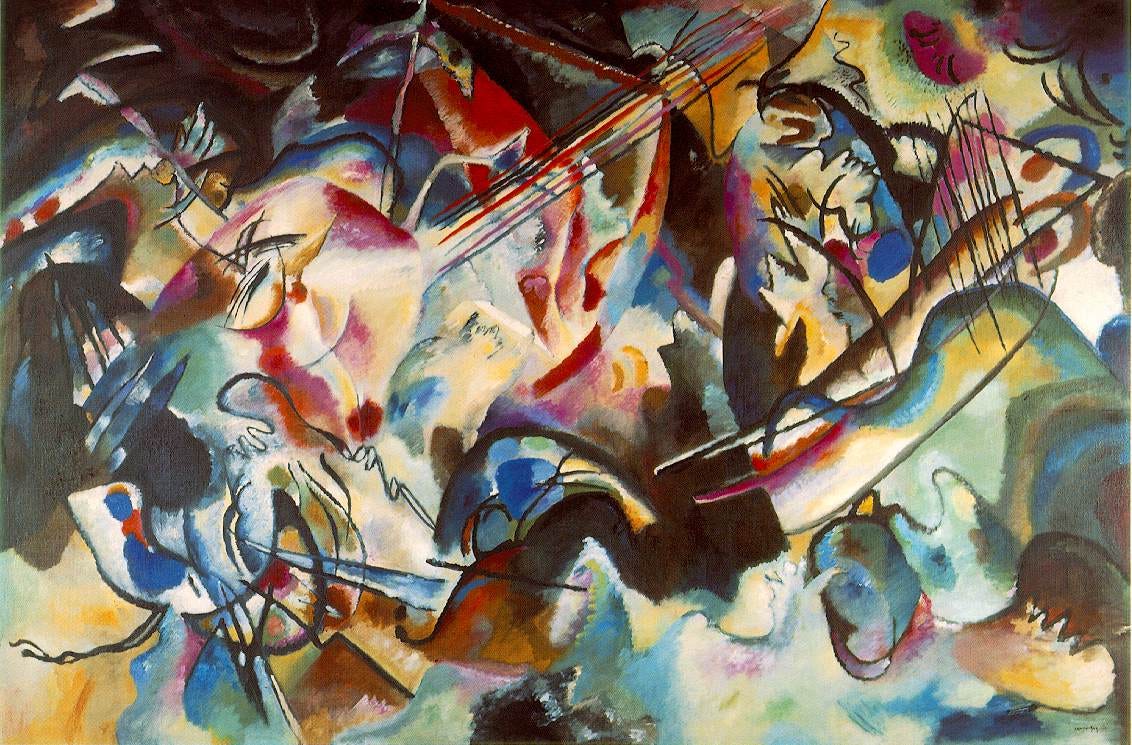
Kandinsky wanted painting to do what music does: move you directly, with no story to explain. That simple, radical idea helped invent abstract art.
More incredible painter stories
If Wassily Kandinsky pulled you in, you will love these too:


Wassily Kandinsky at a glance
1866. Born in Moscow into a tea merchant family.
1896. Turned down a law professorship and left for Munich at thirty.
1911. Founded the Blue Rider with Franz Marc and published On the Spiritual in Art.
1922. Joined the Bauhaus, teaching next door to Klee.
1944. Died at Neuilly-sur-Seine, a French citizen since 1939.
He saw music and heard color
Kandinsky seems to have had synesthesia, a crossing of the senses in which a sound carries a color and a color rings like a note.
He titled his works Compositions and Improvisations, borrowing from music on purpose, and believed the right abstract arrangement of color could touch the soul as directly as a chord.
The leap into abstraction
Around 1910 he began letting recognizable subjects dissolve into pure shape and color. He told a story about it: coming into his studio at dusk, he saw a glowing, beautiful painting he could not identify, until he realized it was one of his own canvases lying on its side.
The subject had vanished and the beauty had not. That, he decided, was the future.
The book that argued for abstraction
In 1911 he published Concerning the Spiritual in Art, a short, intense book arguing that color and form carry meaning on their own, without copying the world.
It became the manifesto a whole generation of abstract painters leaned on, and it is still in print today.
The Blue Rider
In Munich he co founded Der Blaue Reiter, the Blue Rider, a circle of artists pushing toward freer, more spiritual color. It was one of the engines of German Expressionism, and it placed Kandinsky at the center of the European avant garde just as everything was about to change.
Bauhaus, then exile
Kandinsky taught for years at the Bauhaus, the famous German design school, where his style grew crisp and geometric, full of circles and grids.
When the Nazis shut the Bauhaus down and branded his work degenerate, he fled to Paris, where he painted his strange, biomorphic final pictures until his death in 1944.
Born into Moscow money
Kandinsky was born in Moscow on 16 December 1866, into a prosperous family. His father worked in the tea trade, and the household could afford music lessons, travel and books.
When he was young the family moved south to Odessa, the Black Sea port where he grew up. He learned the cello and the piano as a boy, and he drew.
The money mattered. Because his family was comfortable, he could one day walk away from a safe profession and start again in a foreign country at an age when most people are settled.
The law professor he chose not to become
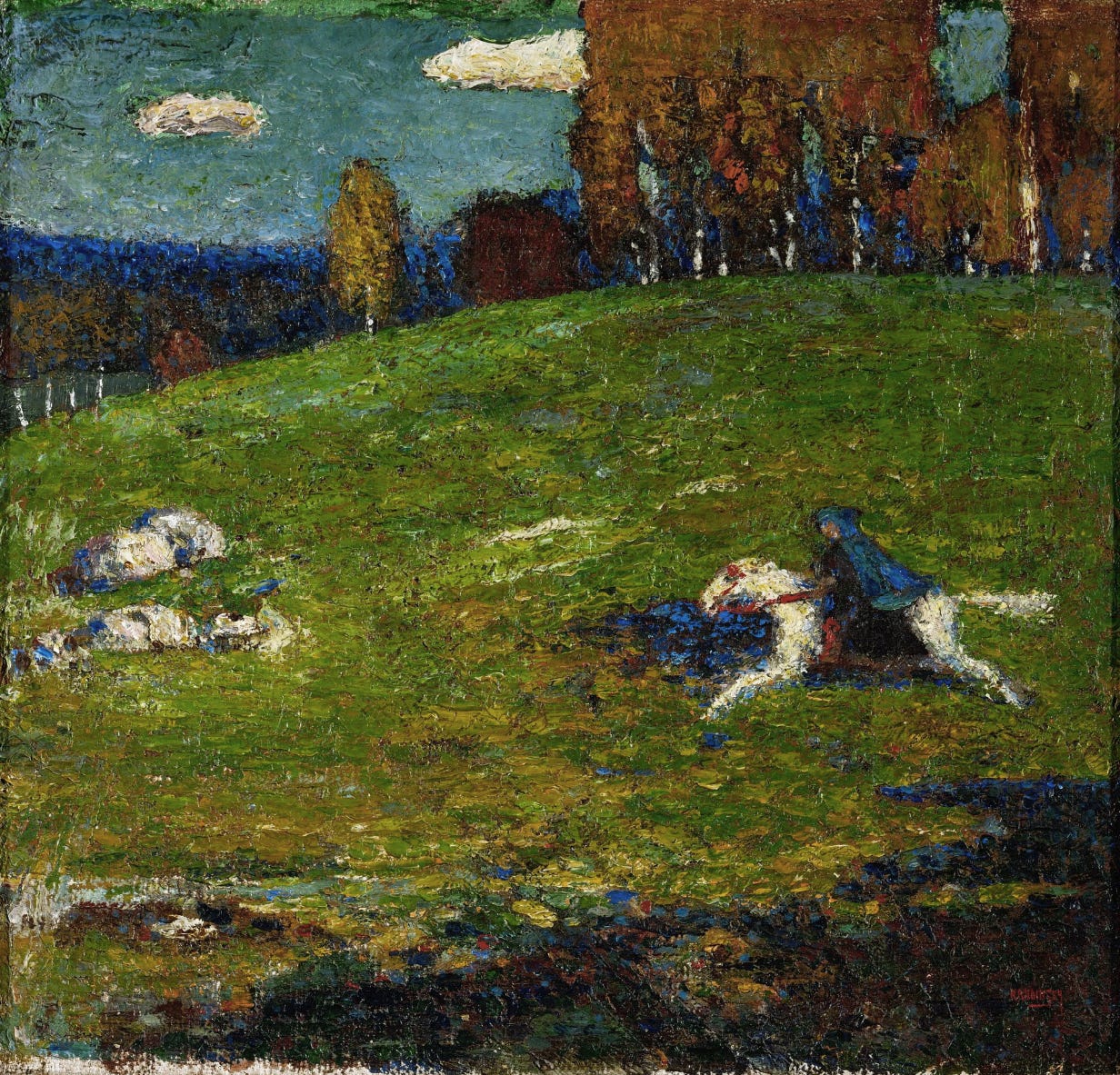
Here is the fact that surprises people. Kandinsky trained as a lawyer, not an artist. He studied law and economics at the University of Moscow.
In 1889 he joined an expedition to the Vologda region in the far north, studying peasant law and local customs. He remembered the painted wooden houses there, glowing with color inside, as something close to living inside a picture.
He qualified and did well. Around 1896 he was offered a chair of Roman law at the University of Dorpat. He turned it down and, at the age of 30, decided to become a painter instead. The idea that he was a bohemian who never held a job is a myth.
A Haystack he could not read
Two experiences in the mid 1890s pushed him toward paint. At a French Impressionist show in Moscow he stood in front of one of Claude Monet's Haystacks and could not tell what it showed until he checked the catalogue.
That unsettled him and thrilled him. If a picture could work without a clear subject, then color and form might be the real subject.
In 1896 he heard Richard Wagner's opera Lohengrin at the Bolshoi Theatre in Moscow. As the music played, he later wrote, he seemed to see colors moving in front of him. Within months he closed his law career and left for Germany.
Starting over in Munich at thirty
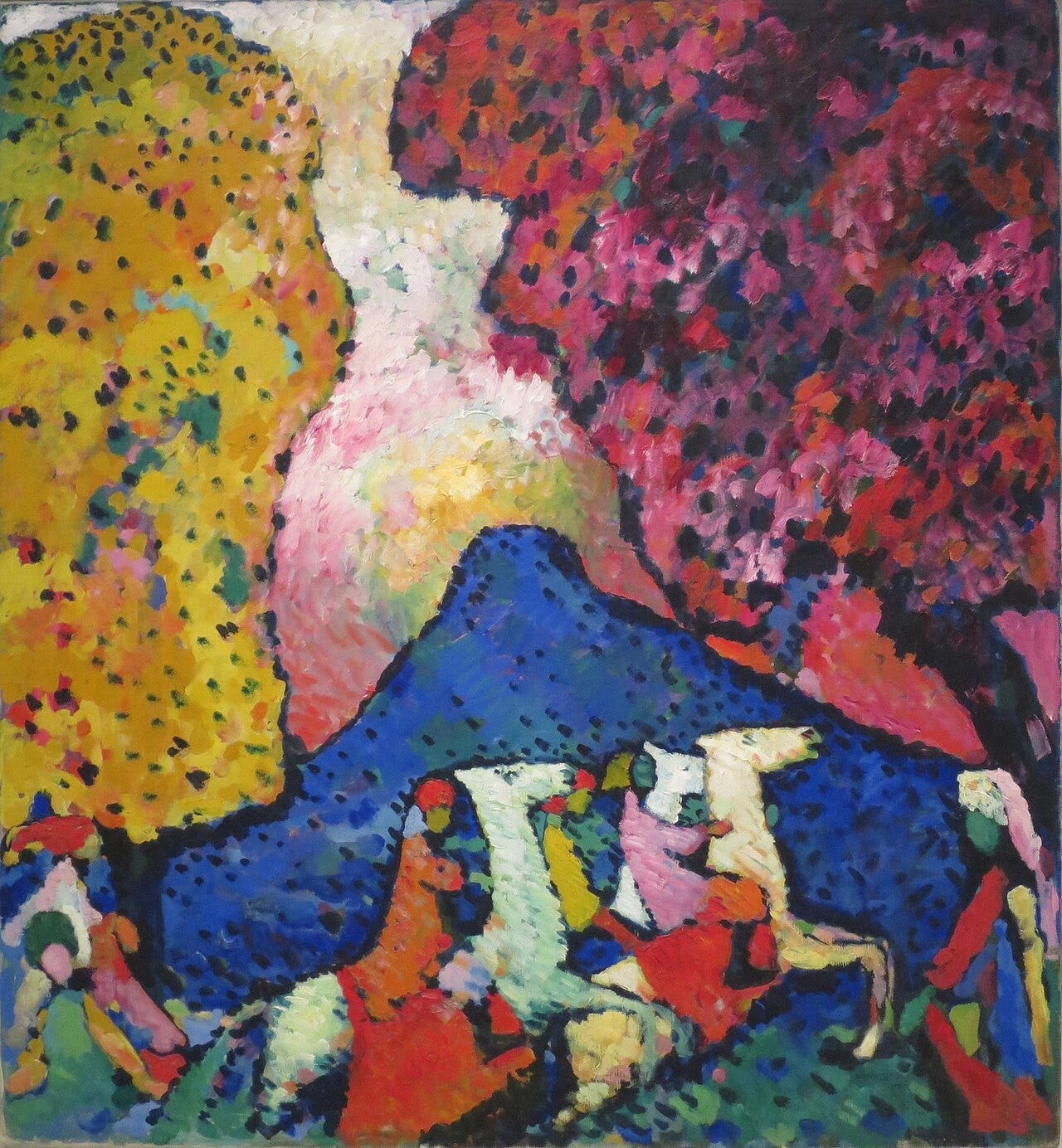
In 1896 Kandinsky settled in Munich, then one of the liveliest art cities in Europe. He enrolled at the private school of the painter Anton Azbe, learning life drawing and anatomy from scratch, then moved on to the Munich Academy of Fine Arts.
Progress was slow. He was older than the other students and starting late, and for years his work stayed close to landscape and Russian folk scenes.
Munich also gave him a community. The city held a large circle of Russian artists working abroad, and he found teachers, friends and, soon, students of his own.
The school he built called Phalanx
Kandinsky did not wait long to organize other people. In 1901 he helped found Phalanx, an artists' association in Munich that put on exhibitions and ran its own school. He taught there and served as its president.
The group pushed newer French and German art in a city that usually preferred the safe and the official.
Phalanx mattered most for one enrollment. In early 1902 a young German student named Gabriele Munter joined his painting class. She became his most important companion for the next twelve years.
Gabriele Munter and the house at Murnau
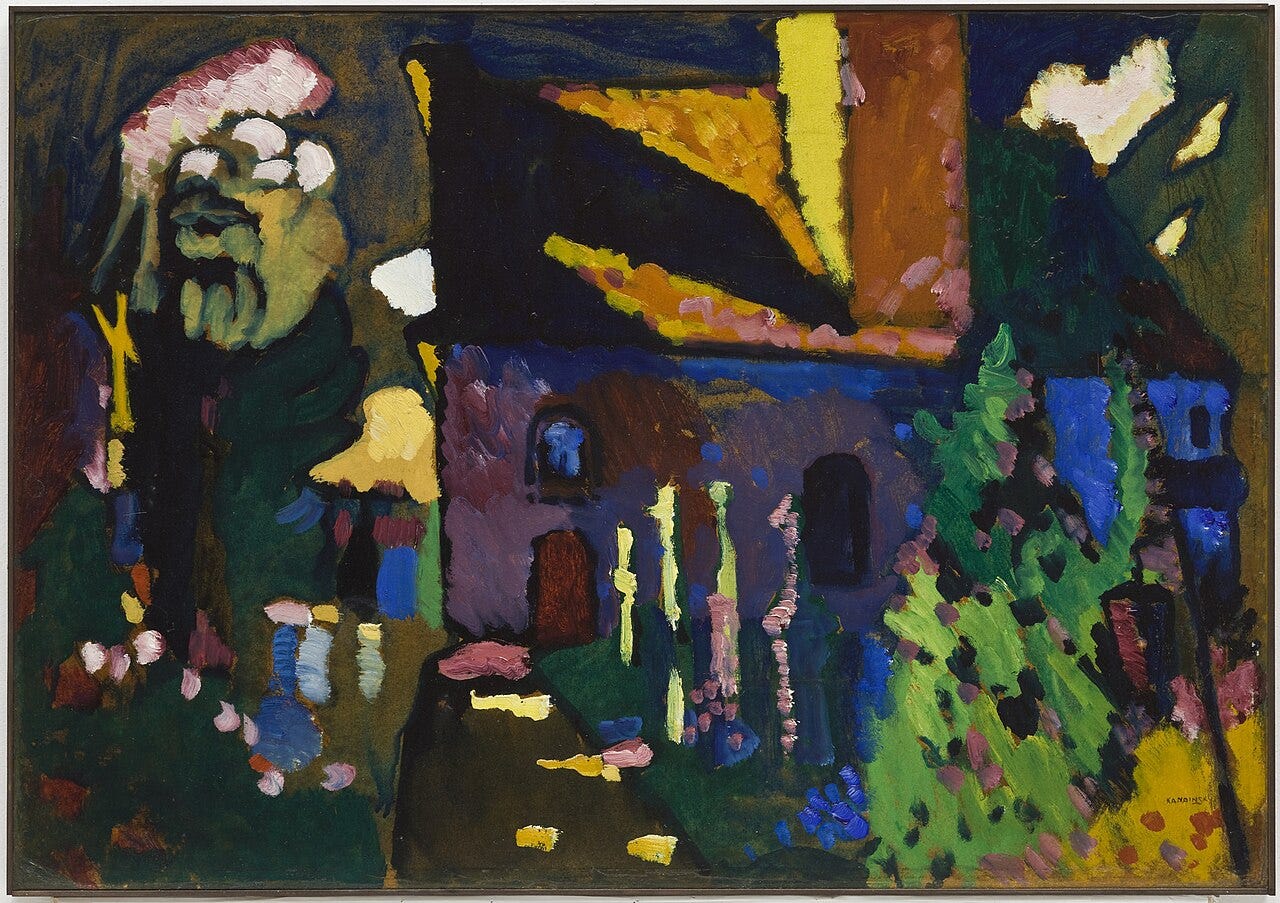
Munter and Kandinsky became a couple around 1903, while his first marriage slowly ended. For years they traveled, working in Holland, Tunisia, Dresden and Paris.
From 1908 they spent long stretches in Murnau, a Bavarian town below the Alps. Painting the local hills and churches, both artists flattened their shapes and pushed their color until the landscape almost dissolved.
This is where Kandinsky moved to the edge of abstraction.
There is a debt here too. After they parted, Munter kept dozens of his early works safe through two wars and gave them to the Lenbachhaus museum in Munich in 1957.
Back to Moscow for the revolution

When the First World War broke out in 1914, Kandinsky left Germany and Munter and returned to Russia. In 1917 he married Nina Andreevskaya, a much younger Moscow woman, and the marriage lasted the rest of his life.
The new Soviet government at first welcomed experimental artists. Kandinsky became a professor at the Moscow Academy in 1918, founded an Institute of Artistic Culture in 1919, and helped set up more than twenty museums across the country.
Then the mood turned. As Soviet policy swung toward realism and usefulness, his spiritual, abstract ideas fell out of favor, and at the end of 1921 he and Nina left for Berlin.
The Bauhaus years, next door to Klee
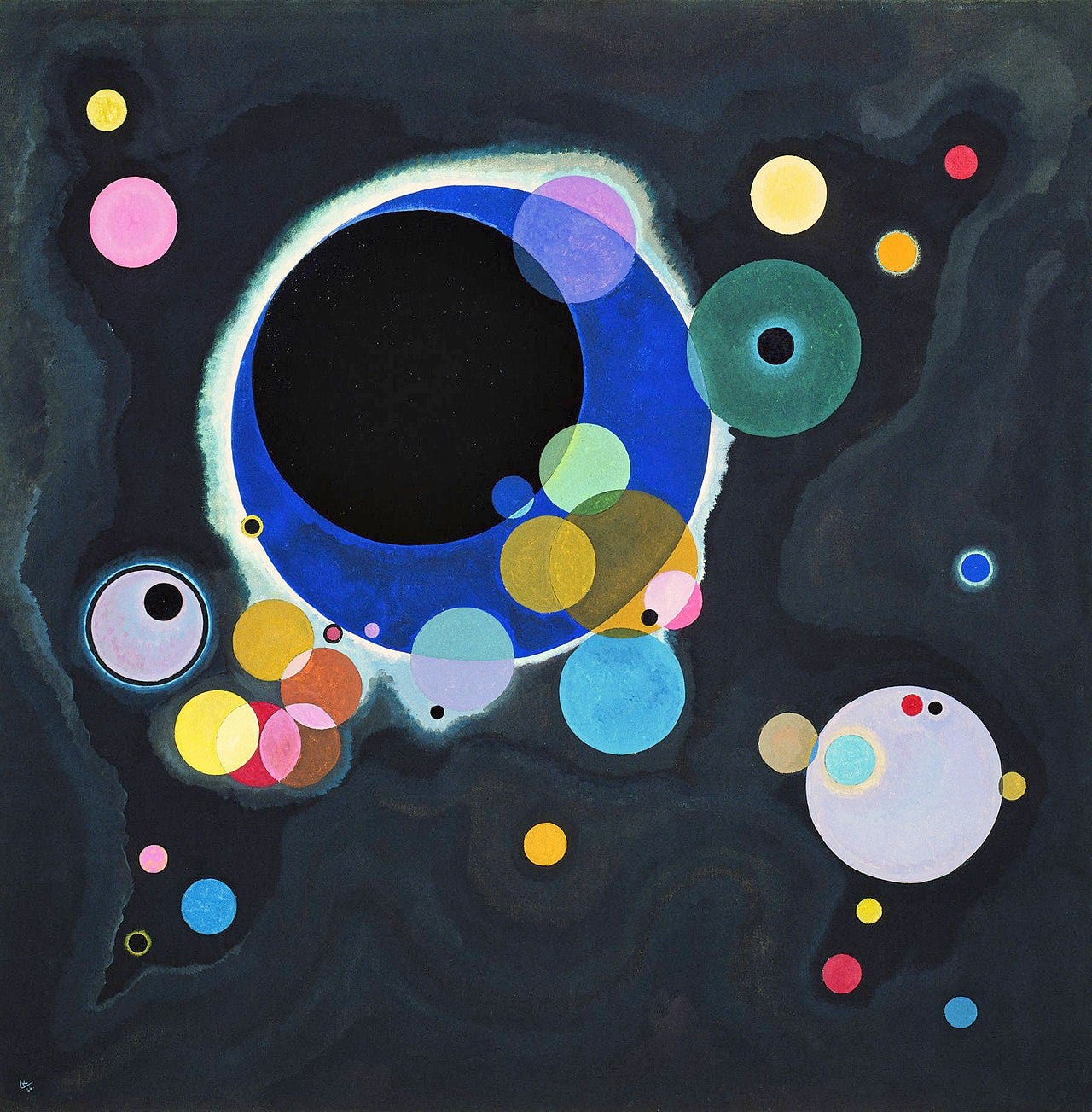
Early in 1922 Kandinsky was offered a post at the Bauhaus, the German school of art, design and architecture. He taught the elements of form, ran a course on color and directed the mural workshop.
There he lived beside his friend Paul Klee in one of the school's masters' houses. In 1924 the two joined Lyonel Feininger and Alexej Jawlensky to show together as the Blue Four.
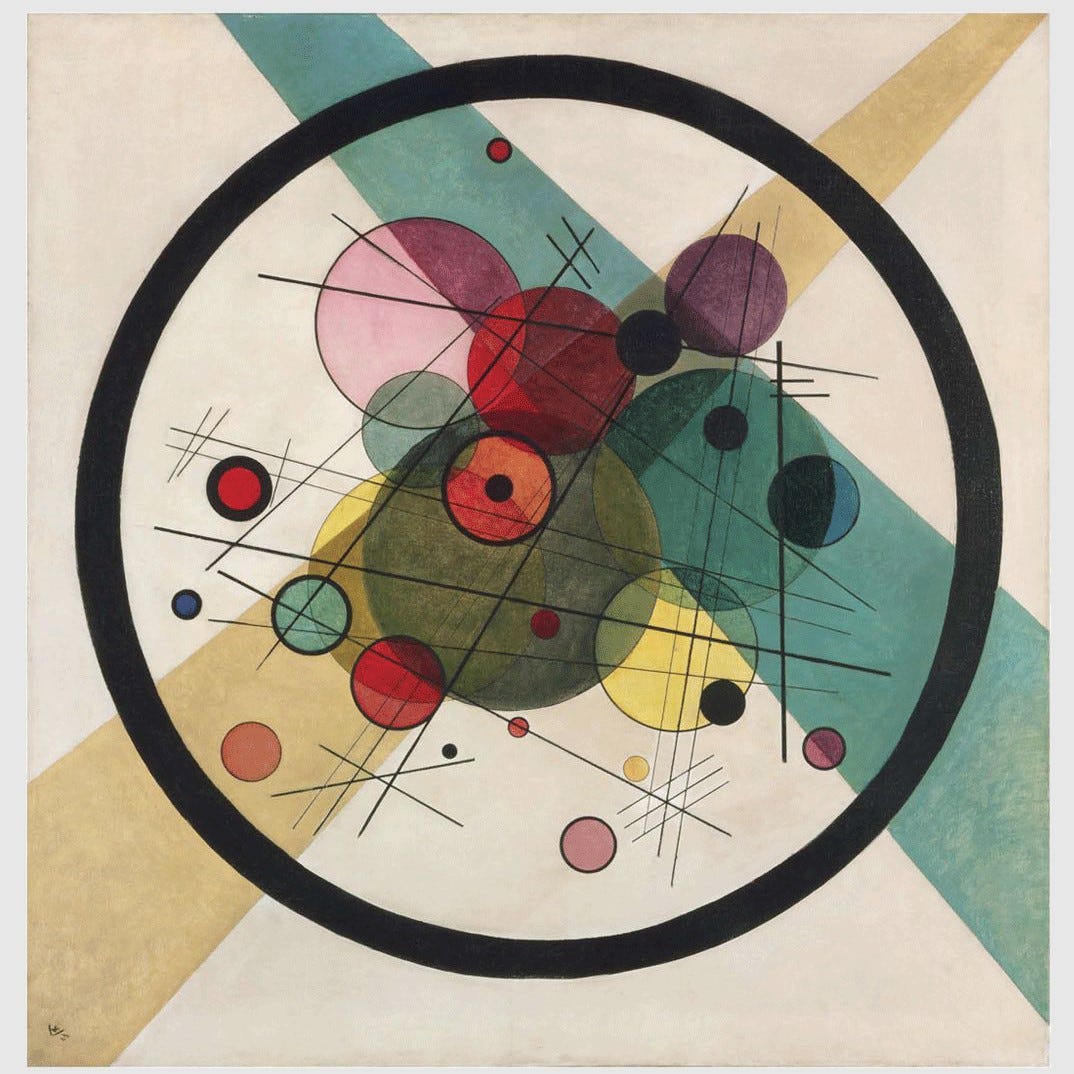
His style tightened into circles, grids and clean geometry. In 1926 he set out his teaching in a second book, Point and Line to Plane, and in 1928 he took German citizenship. These were his steadiest, most productive years.
Branded degenerate, then Paris
In 1933 the Nazis forced the Bauhaus to close, and Kandinsky left Germany for good. The regime seized his work from German museums and mocked art like his in its 1937 Degenerate Art show.
He settled in an apartment in the Paris suburb of Neuilly sur Seine and lived there for eleven years. His late work softened again, with floating shapes that look like small water creatures.
He became a French citizen in 1939. He died at Neuilly on 13 December 1944, three days before his 78th birthday.
More secrets to unlock


The Wassily Kandinsky questions that keep coming up
Who was Wassily Kandinsky? A Russian painter, a pioneer of abstract art.
When was he born? In Moscow, in 1866.
When did he die? In Neuilly, near Paris, in 1944.
What is he famous for? Among the first purely abstract paintings and the book Concerning the Spiritual in Art.
What did he do before painting? He trained and taught as a lawyer until the age of thirty.
Where can I see his work? The Guggenheim in New York and the Museum of Modern Art and the Centre Pompidou in Paris hold major groups.
Was Kandinsky Russian, German, or French? All three, at different times. He was born in Moscow in 1866 and grew up Russian. He spent most of his career in Germany, where he took citizenship in 1928. After fleeing the Nazis he moved to France and became a French citizen in 1939.
Did Kandinsky really give up a law career to paint? Yes. He studied law and economics in Moscow and was offered a chair of Roman law at the University of Dorpat around 1896. He turned the professorship down and moved to Munich to train as a painter at the age of 30.
Kandinsky gave up a respectable life in law at thirty to gamble on color, then lived to see the Nazis hang his paintings in a show meant to mock them.
He died near Paris in December 1944, a French citizen since 1939. The largest collection of his work anywhere hangs in the Guggenheim in New York, a museum whose founding collection was built around more than 150 Kandinskys.
Kandinsky and Paul Klee were close friends who taught side by side at the Bauhaus and had earlier exhibited together in Der Blaue Reiter. Klee's career is covered in Paul Klee, The Complete Story.