
Zinaida Serebriakova, 1884 to 1967, was one of the first great women painters of Russia. She made her name at 25 with a joyful self portrait, then lost almost everything to revolution and exile, and was separated from two of her children for 36 years.
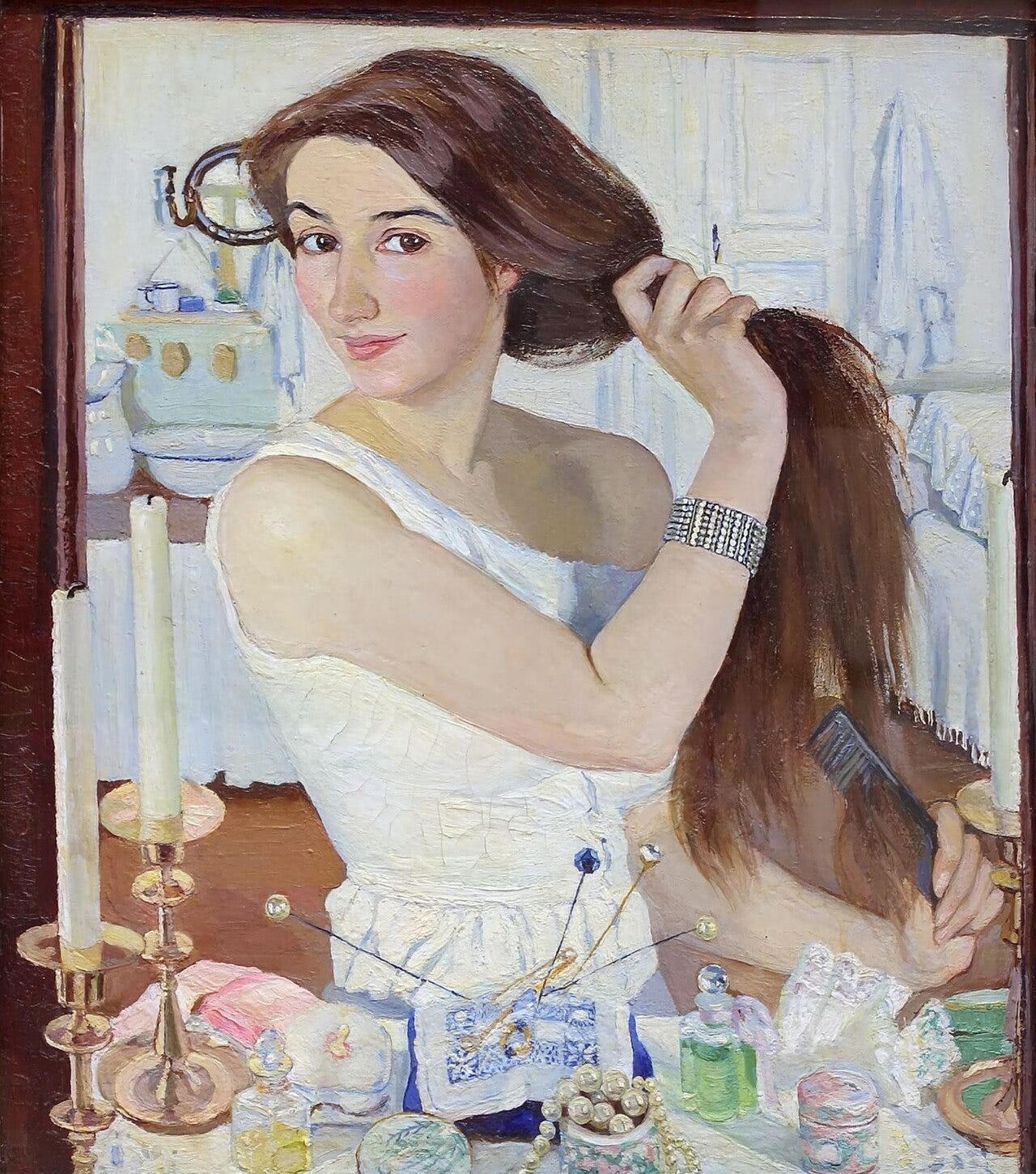
Her art is warm and classical in a century that raced toward abstraction. That is exactly why she was sidelined, and why she feels like a rediscovery now.
More incredible painter stories
If Zinaida Serebriakova pulled you in, you will love these too:


Zinaida Serebriakova at a glance
1884. Born on the Neskuchnoye estate, into the Benois and Lanceray artistic dynasty.
1909. At the Dressing Table, the mirror self portrait that made her name.
1919. Widowed at 34 when typhus took her husband, leaving her four children.
1924. Left for Paris for a commission and was never able to return.
1967. Died in Paris, two years after Soviet retrospectives finally brought her fame home.
The self portrait that made her name
In 1909 she painted herself at her mirror, brushing her hair, smiling at the viewer. At the Dressing Table is fresh, intimate and full of life.
The Tretyakov Gallery bought it, and overnight Serebriakova was a name in Russian art. She was 25.
An artistic dynasty
She was born into the Benois and Lanceray family, a dynasty of architects, painters and stage designers at the heart of Russian culture.
She grew up around the World of Art group, which prized beauty, craft and the past. That taste shaped her for life.
Peasants, children, and her own mirror
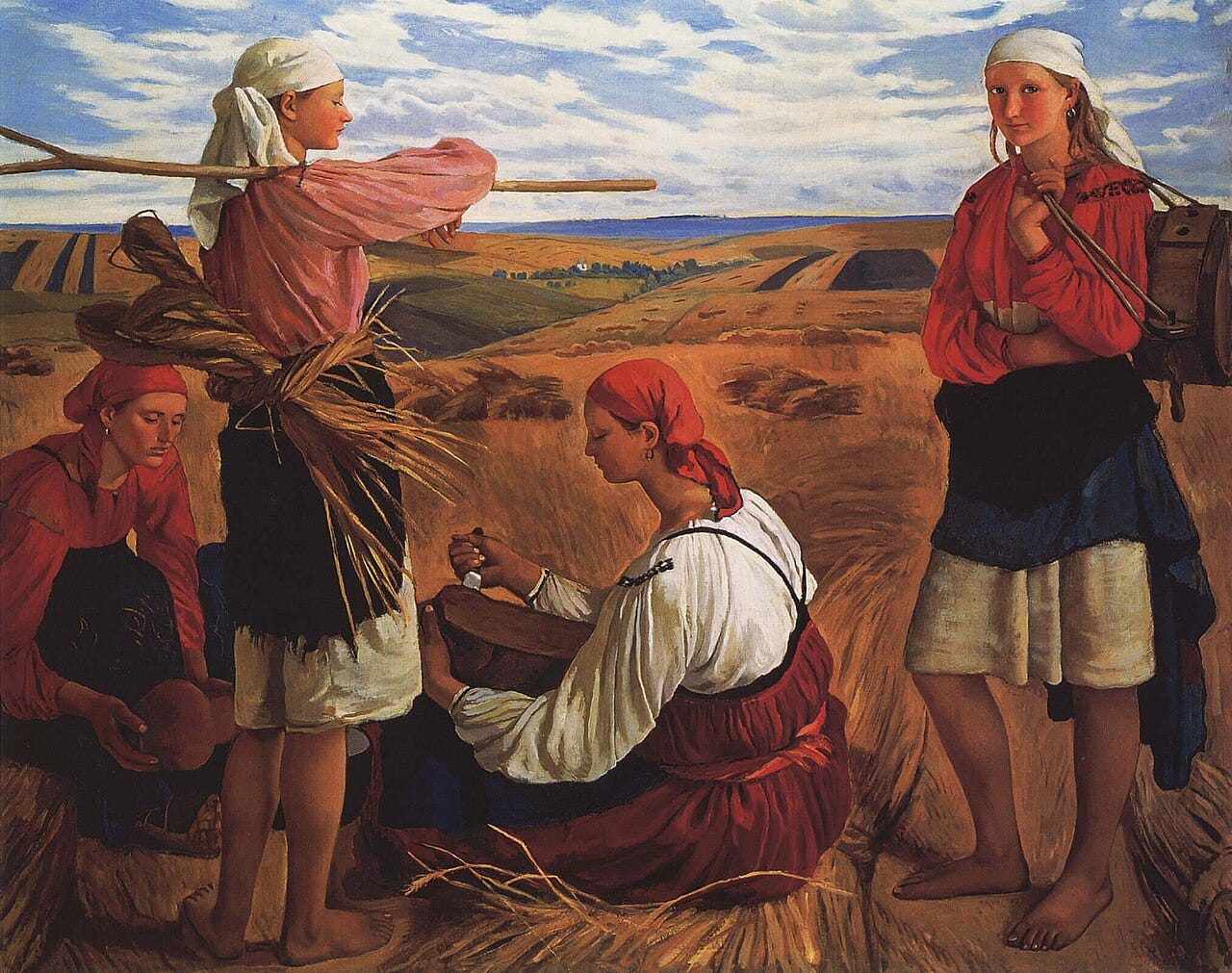
She painted what she loved: peasant women at harvest, her own children half asleep, bathers, and herself. Her line is calm, her color clear, her mood tender.
This is a confident realism with a classical backbone. Her many a self portrait and family portrait reads like a private diary in paint.
The exile that split her family
In 1919 her husband Boris died of typhus, leaving her with four children and no money. She kept painting through hunger.
In 1924 she left for Paris to earn a living, planning to send for the children. She managed to bring only two. The other two stayed in the Soviet Union, and she did not see them again for about 36 years, until a thaw in the 1960s let them reunite.
The mirror, the harvest field, the sleeping children
First, At the Dressing Table of 1909, the breakthrough self portrait.
Second, her peasant scenes like the Bleaching of Linen, where field workers rise against a wide sky.
Third, her sleeping and waking children, painted with a mother's tenderness and a master's control.
The myth of the artist behind the times
While Malevich and Kandinsky pushed into abstraction, Serebriakova stayed figurative. For decades that made her look old fashioned to both Soviet and Western eyes.
It was a misjudgment. A major retrospective at the Tretyakov in 2017 drew huge crowds and put her firmly back among the greats.
Where her world survives
The Tretyakov Gallery in Moscow holds her famous self portrait. The Russian Museum in Saint Petersburg has more.
Morocco, and the long road home
In 1928 and 1932 Serebriakova traveled to Morocco and filled sketchbooks with fast, sunlit pastels, a warm contrast to her Russian winters.
The reunions came slowly, and official recognition even more so: Soviet exhibitions in 1965 and 1966 finally showed her work at home after decades away.
Born on the Neskuchnoye estate
Zinaida Lanceray was born on 10 December 1884 at the family estate of Neskuchnoye, then in Kursk Province, near Kharkiv in what is now Ukraine.
Her father, the sculptor Evgeny Lanceray, died in 1886, reportedly of tuberculosis, when Zinaida was about two years old. Her widowed mother moved the children to St Petersburg, into the Benois family house, but they returned to Neskuchnoye every summer.
Those summers shaped her. The fields, the gardens, and the peasant households around the estate became subjects she painted for the rest of her life. She was the youngest child, and by most accounts the quietest and the most drawn to drawing.
The uncle who guided her, the grandfather who built
Serebriakova did not have to look far for teachers. Her maternal grandfather, Nikolai Benois, was a leading architect and an academician of architecture in imperial Russia.
Her uncle, Alexandre Benois, was a painter, critic, and one of the founders of the World of Art movement, known in Russian as Mir iskusstva.
He mattered to her personally, not just by name. The family called him uncle Shura, and he steered many of her early choices. He advised which studios she should enter, travelled with her mother and her through Italy, and later encouraged her toward Paris.
When her first major self portrait appeared in 1910, he was among the first to see that a serious new painter had arrived.
Italy, the Hermitage, and a Paris studio
Her training was steady rather than formal. She finished a girls' gymnasium in St Petersburg in 1900, then briefly attended the art school founded by Princess Maria Tenisheva.
In 1902 and 1903 she travelled in Italy, partly for her health and partly to study the old masters, with Alexandre Benois as a guide.
Back in St Petersburg she worked in the studio of the portrait painter Osip Braz, though she later said she gained little there.
What she valued more was the Hermitage, where she copied old masters in the galleries almost daily. After her marriage she added drawing and watercolour study at the Academie de la Grande Chaumiere in Paris.
Marrying her first cousin
In 1905 Zinaida married Boris Serebriakov, her first cousin and a future railway engineer. The two had known each other since childhood at Neskuchnoye.
Because they were close relatives, the Orthodox Church resisted the union. The couple had to obtain special permission before a priest would agree to perform the ceremony.
Once married, they were, by every family account, devoted to one another. Four children followed over the next years, two sons and two daughters.
The family split its time between St Petersburg in winter and Neskuchnoye in the warmer months, where she painted almost constantly.
1917, and the title that never arrived
By her early thirties Serebriakova was an established figure in Russian art. Her self portrait at the mirror had entered the Tretyakov Gallery, and large peasant scenes had followed.
In 1917 she was nominated for the title of Academician of the Imperial Academy of Arts. The honour never came. The election was overtaken by the events of the revolution and simply did not take place.
It was a small sign of a much larger break. Within two years the settled world she had painted would be gone, and she would spend the rest of her life working under pressure rather than out of happiness.
Widowed in 1919
The revolution destroyed the world around Neskuchnoye. The estate was looted and burned, and the family fled to Kharkov.
In March 1919 Boris Serebriakov died of typhus, which he had caught after a period of imprisonment. Zinaida was left a widow with four children and her mother to support.
There was almost no money. In Kharkov she took work at the university archaeological museum, drawing finds for a small wage.
Out of this grief came one of her best known paintings, House of Cards, which shows her four children not long after their father's death. Even in these years her canvases often stayed light, as if painting were a way to hold the family together.
Backstage at the Mariinsky
In December 1920 Serebriakova moved with the children to Petrograd, the renamed St Petersburg. Life was still hard, but the city gave her a new subject.
Her daughter Tatyana trained as a ballet dancer, and Alexandre Benois arranged access to the former Mariinsky Theatre. Serebriakova spent long hours in the dressing rooms and rehearsal halls behind the stage.
There she made a series of pastels and paintings of dancers pinning costumes, tying shoes, and waiting to go on. These backstage scenes, made across the early 1920s, count among the warmest works of her Russian years, and they were the last large group she painted before she left the country.
The patron, Belgium, and a French passport
Paris was not easy, but she did find support. A Belgian collector, Baron Jean de Brouwer, paid for her two journeys to Morocco and commissioned decorative panels for his estate in Belgium.
Between commissions she painted in France, England, Italy and Switzerland, and studied sculpture in the Louvre. Her work stayed classical and figurative at a time when the Paris art world often looked elsewhere.
During the German occupation of Paris, contact with her family in the Soviet Union was cut off, and letters resumed only after the war. In 1947 she took French citizenship, a quiet admission that the return she had hoped for was not going to come.
A daughter at the door in 1960

For decades Serebriakova was cut off from two of her children, who remained in the Soviet Union. Her mother died there in the 1930s, and the two never met again.
The thaw under Khrushchev finally opened a door. In 1960 her daughter Tatyana was allowed to visit Paris, the first time mother and daughter had seen each other in about thirty six years.
Recognition at home followed. Exhibitions of her work in Moscow, Kyiv and Leningrad in 1965 and 1966 drew large crowds, and the Russian Museum bought a group of her paintings.
She never travelled back. Zinaida Serebriakova died in Paris on 19 September 1967 and was buried at the Russian cemetery of Sainte Genevieve des Bois.
More secrets to unlock


Serebriakova gets filed as the woman who refused to modernize while Malevich and Kandinsky reinvented painting around her. I think that framing has it backwards. Staying figurative while everyone else chased abstraction took more nerve than following the trend.
House of Cards, painted right after her husband's death, says more about grief than any of her cheerful garden portraits. A woman who could paint her children playing cards weeks after burying their father was not avoiding the loss, she was working through it in the only language she had.
Her backstage Mariinsky pastels get treated as a footnote to the peasant scenes that made her famous, and that ranking is wrong. Dancers pinning costumes in a cold dressing room are more alive than any harvest field she painted from memory of a lost estate.
Her strongest work comes from the pre-revolution years at Neskuchnoye, before 1924. Once she was painting commissioned panels in Belgium and sketching Morocco for a patron, the subjects that made her name largely disappeared from her output.
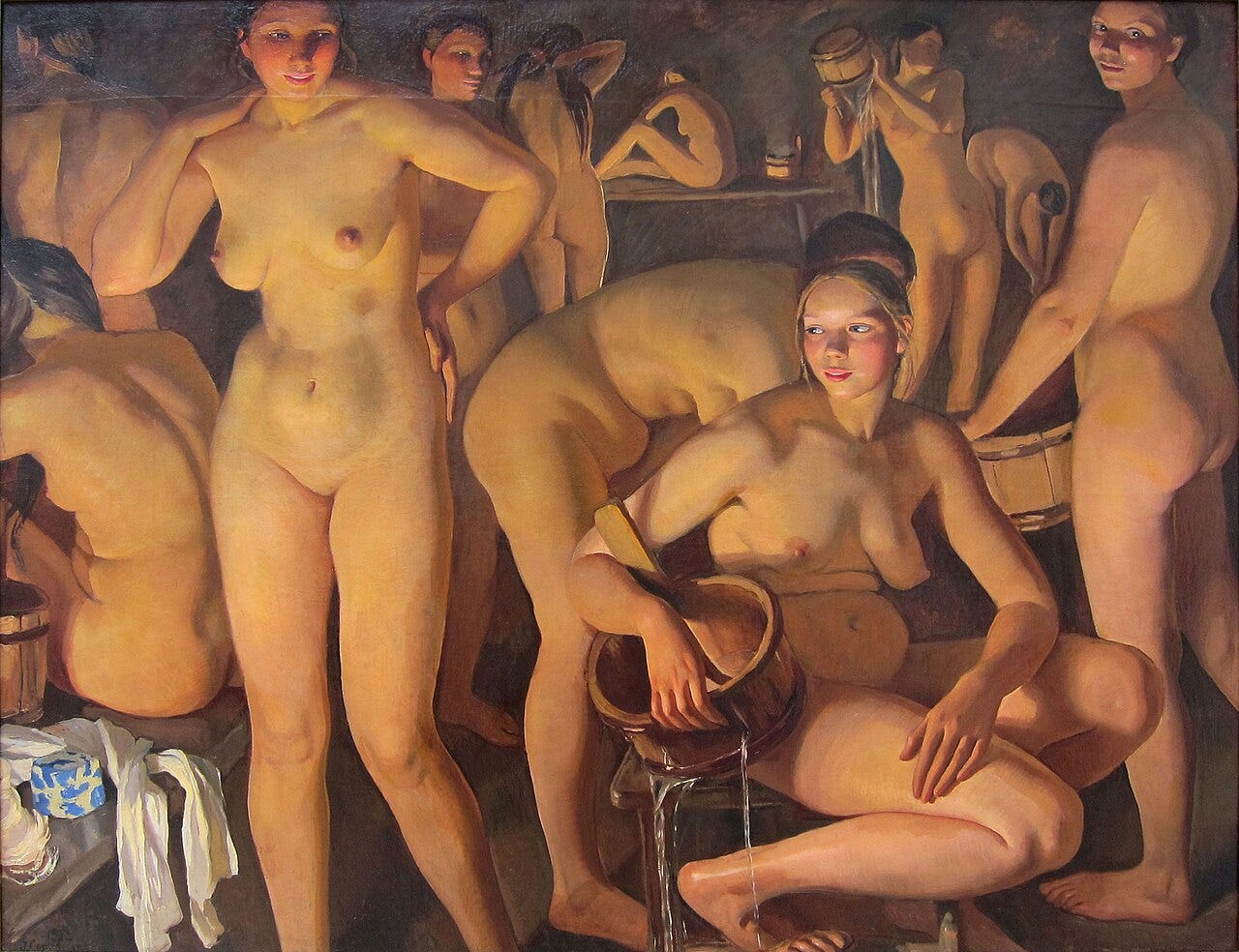
Compare her Bath House nudes to Boris Kustodiev, a Russian contemporary who painted the same bathhouse subject as buxom, idealized fantasy. Serebriakova's bathers look observed rather than staged, closer to what a woman's body actually looks like stepping out of cold water.
The Zinaida Serebriakova questions that keep coming up
When was Zinaida Serebriakova born? In 1884, near Kharkiv. She died in Paris in 1967.
What is she famous for? Her 1909 self portrait At the Dressing Table and her warm figure paintings.
Why did she leave Russia? Widowed and destitute after the revolution, she went to Paris in 1924 to earn money.
What happened to her children? She was separated from two of them for about 36 years before reuniting.
Where can I see her work? The Tretyakov Gallery in Moscow and the Russian Museum in Saint Petersburg.
Did Zinaida Serebriakova marry her cousin? Yes. In 1905 she married Boris Serebriakov, her first cousin. Because the Orthodox Church did not permit marriage between close relatives, the couple had to obtain special permission before the wedding. They had four children before Boris died of typhus in 1919, leaving her a widow at thirty four.
When did Zinaida Serebriakova become a French citizen? She took French citizenship in 1947. She had left Soviet Russia in 1924 meaning to earn money and return, but the authorities refused to let her back, and two of her children stayed in the Soviet Union for decades. She died in Paris in 1967.