
Albert Bierstadt was a German born American painter famous for huge, glowing landscapes of the American West. His giant canvases of the Rocky Mountains made the frontier look like a paradise drenched in golden light.
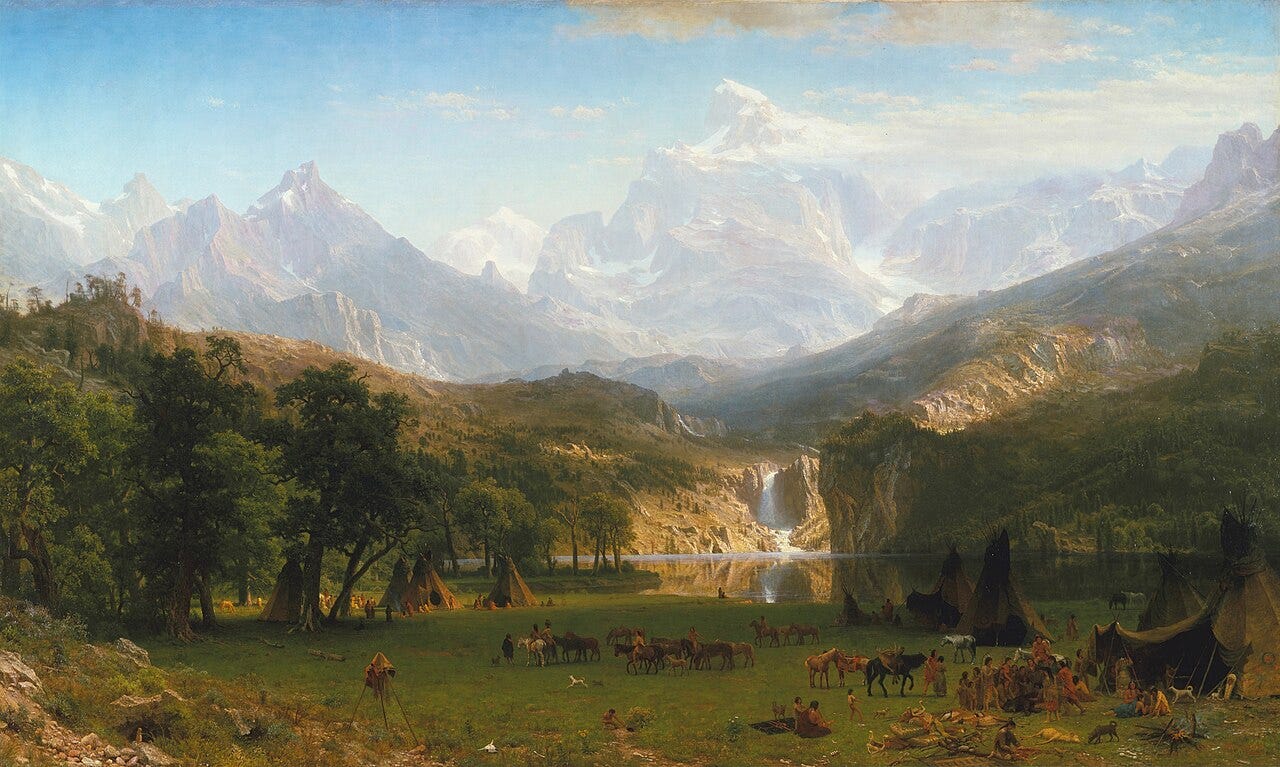
He arrived when most Americans had never seen the West with their own eyes. His paintings, unveiled like theater with dramatic lighting, gave the public its first sweeping vision of those mountains, and made him rich and famous. Eleven other painters worked that same wide angle on nature, gathered alongside him in a wider set of landscape views.
More incredible painter stories
If Albert Bierstadt pulled you in, you will love these too:


Then taste turned against him, and he died almost forgotten. Here is the whole story of the man who sold America its own wilderness.
Albert Bierstadt at a glance
1830. Born in Solingen, Germany, and raised in New Bedford, Massachusetts.
1859. Joined the Lander expedition west, sketchbooks filling with the Rockies.
1865. The Rocky Mountains, Lander’s Peak sold for 25,000 dollars, an American record.
1882. His Hudson River mansion, Malkasten, burned down with work inside.
1902. Died in New York, out of fashion. The giant canvases now anchor American wings.
The man who sold America its own wilderness
Bierstadt is famous for scale and for spectacle. He painted the American West bigger, brighter and more heavenly than anyone before him.
For an eastern public that had only read about the Rockies and Yosemite, his enormous glowing canvases were the closest thing to actually standing there. He did not just paint the West, he sold the whole country a dream of it.
The painter who sold the West
His method was part art, part expedition, part business. In the 1860s Bierstadt joined survey trips across the Rockies and the Sierra Nevada, sketching and taking photographs on the spot.
Back in his New York studio he worked those studies up into vast canvases, some over three meters wide. Then he charged the public admission to see a single painting, unveiling it under dramatic light like a stage show.
One picture could be a whole event.
How to spot a Bierstadt in three seconds
A Bierstadt is easy to recognize once you know the recipe.
The glow. Warm, theatrical light pours through clouds and mist, a style often called luminism.
The scale. Enormous canvases meant to surround and overwhelm you.
Tiny humans. People and animals shrunk to specks beneath towering peaks, to make nature feel vast.
Crisp detail. Every rock and pine sharply painted, a habit from his German training.
It is a grand kind of landscape painting, tuned in the mood of Romanticism, where nature is sublime and humans are small.
From Dusseldorf to the Rockies
Bierstadt's glowing style came from a clear lineage.
He trained in Dusseldorf, Germany, whose school prized sharp detail and high finish. From the old master Claude Lorrain he took the trick of flooding a scene with golden light.
And he belonged to the later wave of the Hudson River School, the American painters who treated wild nature with awe and drama.
He fused German precision with American ambition, and aimed it at the biggest landscape on earth.
Truth versus spectacle
Bierstadt was selling a feeling more than a map, and critics knew it. They accused him of exaggerating, of moving peaks around and flooding scenes with impossible light.
They were right, but it misses the point. He was painting the West as a myth. And in doing so he also recorded a world about to vanish, painting great herds of bison and Native American camps just as both were being pushed off the land for good.
To me that is where the real Bierstadt lives, in the world he set down just before it was gone, far more than in the postcard peaks.
Fame, then a fall
For a while Bierstadt was one of the best paid artists in America, courted by collectors and Congress alike.
Then tastes changed. The quiet, intimate scenes of the Impressionists made his theatrical mountains feel old fashioned and overcooked.
Late works were rejected, his prices collapsed, and he died in 1902 nearly forgotten. Only decades later was he rediscovered as a defining painter of the American West.
The immigrant who struck it rich
Bierstadt was born in 1830 in Solingen, Germany, and came to New Bedford, Massachusetts, as a baby when his family emigrated.
As a young man he returned to Europe to train in Dusseldorf, then came home and headed west, the journeys that would define his career. He became wealthy, built a grand house on the Hudson, and traveled constantly in search of new views.
Three Bierstadts to start with
If you want three Bierstadts to start with, begin here.
The Rocky Mountains, Lander's Peak (1863), the picture that made his name.
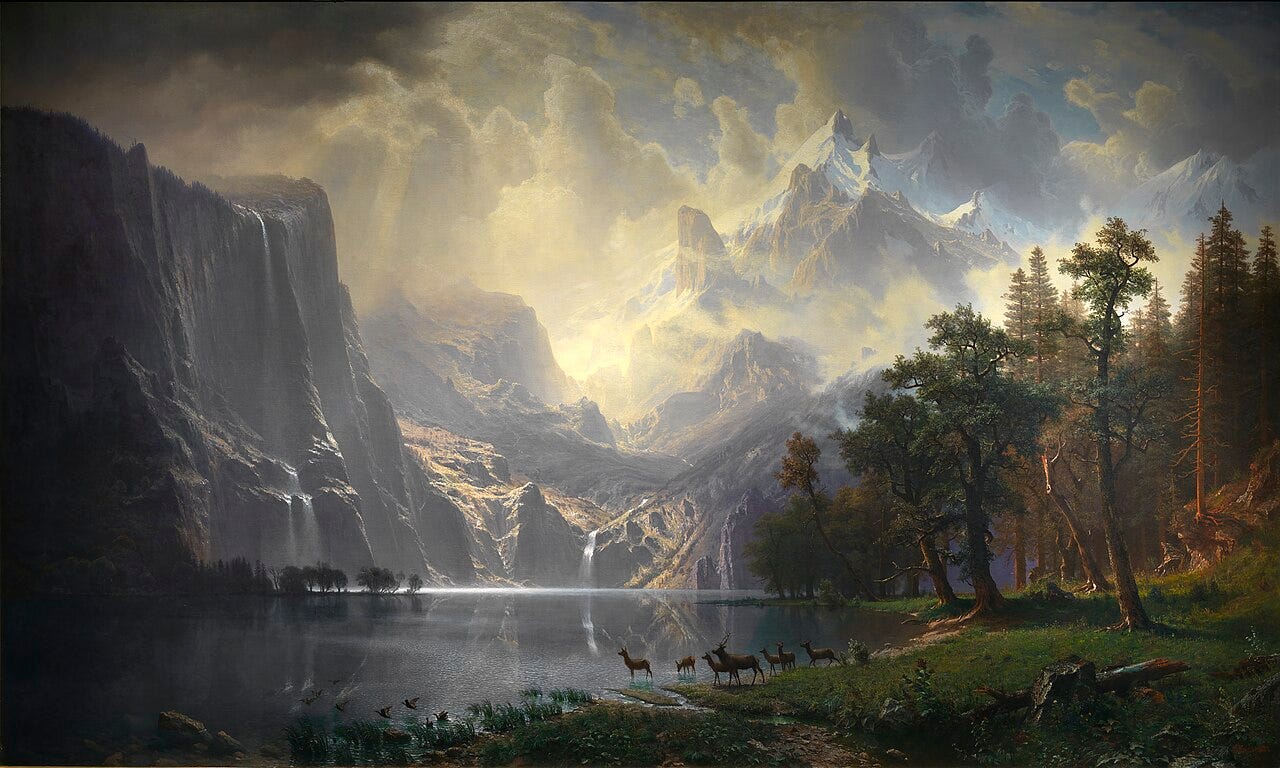
Among the Sierra Nevada, California (1868), his golden Yosemite dream.
A Storm in the Rocky Mountains, Mount Rosalie (1866), spectacle at full volume.
Where his giant canvases hang today
His giant canvases hang in major American museums.
The Metropolitan Museum of Art, New York. Home to The Rocky Mountains, Lander's Peak.
The Smithsonian American Art Museum, Washington. Strong holdings of his western scenes.
The Fine Arts Museums of San Francisco. Fitting home for his Yosemite and Sierra views.
The expeditions that filled his sketchbooks
Bierstadt did not imagine the West from a New York studio. He went and saw it. In 1859 he joined a government survey led by Frederick Lander that pushed into the Rocky Mountains and the South Pass of Wyoming.
He traveled with sketchbook and camera, gathering studies of peaks, light and Native encampments. Back east he built these fragments into enormous finished canvases.
In 1863 he set out again, crossing the continent with the writer Fitz Hugh Ludlow to reach Yosemite and the Pacific coast. The raw material for a whole career came from these long, hard journeys into country few eastern viewers had ever seen.
The single painting spectacles
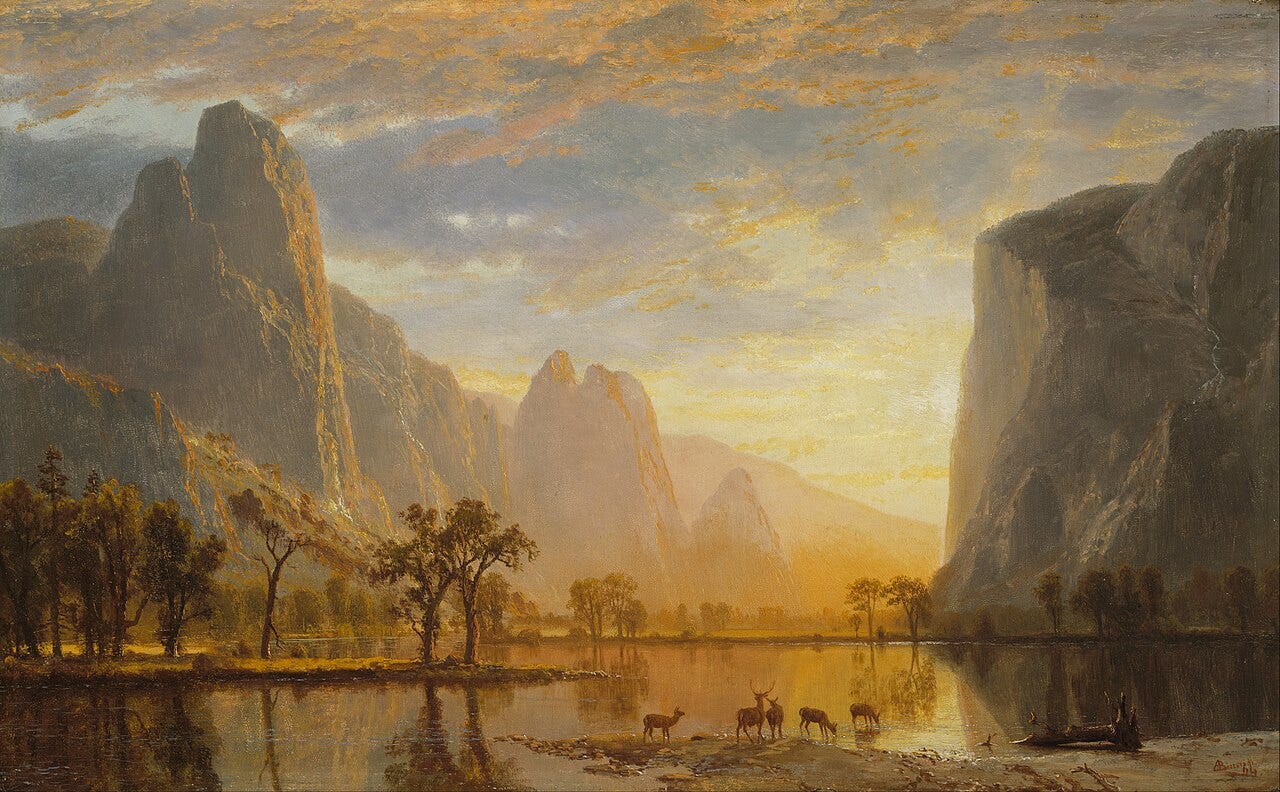
Bierstadt turned an exhibition into an event. He would show one giant canvas at a time in a darkened room, framed by curtains and lit for drama, and charge the public admission to file past it.
His The Rocky Mountains, Lander's Peak of 1863 toured like a touring show. It later sold for around twenty five thousand dollars, an enormous sum, and in 1867 The Domes of the Yosemite fetched a similar price.
For a stretch of the 1860s he was among the richest and most famous painters in America. He had grasped, earlier than most, that a painting could be marketed like theatre.
The mansion on the Hudson that burned
With his fortune Bierstadt built a grand house he called Malkasten, high above the Hudson River at Irvington, north of New York City. It was part home, part studio, part stage for his success.
In 1882 the mansion caught fire and burned, taking with it furnishings and a number of works. It was a heavy blow, both personal and financial.
The fire came just as his star was fading. The lavish house that had proclaimed his triumph did not outlast the decade in which his reputation began to slip.
The Last of the Buffalo
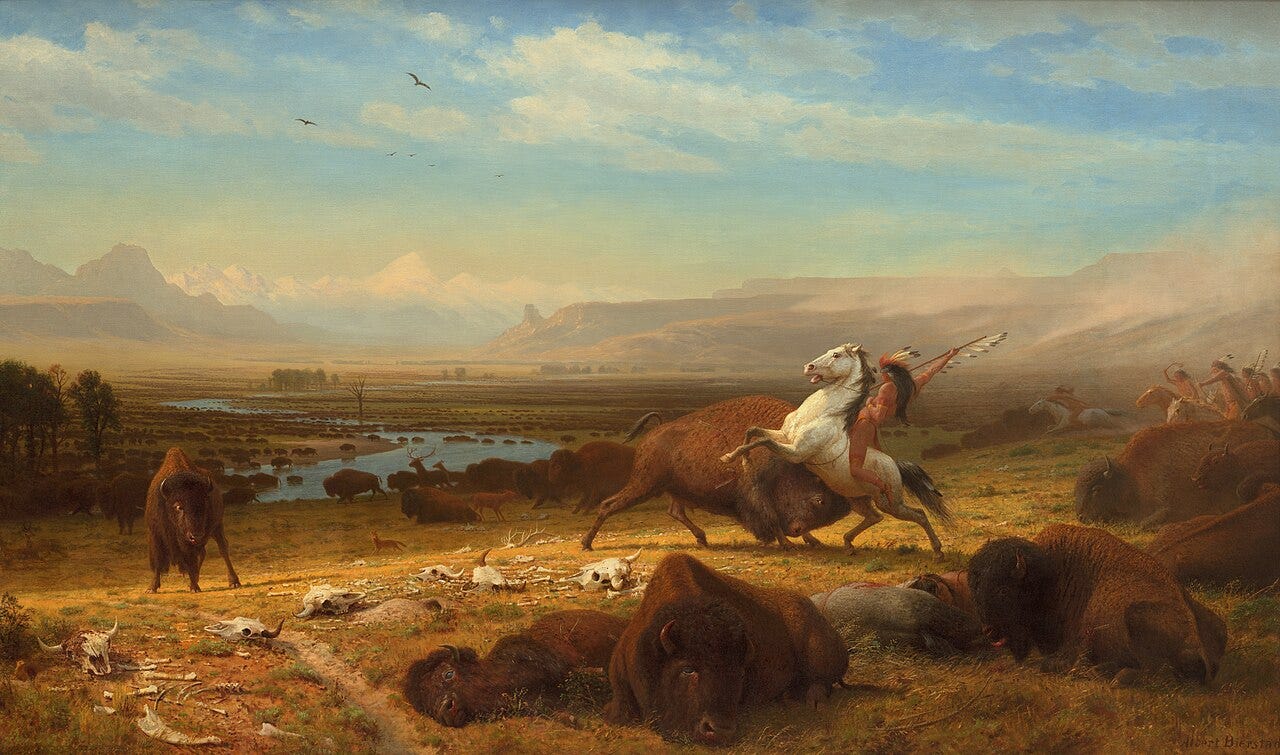
Late in his career Bierstadt painted The Last of the Buffalo, a large scene of a bison hunt on the plains, finished around 1888. By then the great herds were nearly gone, wiped out within a single generation.
He submitted the painting to the American selection for the 1889 World's Fair in Paris. The committee turned it down, judging his grand manner out of date beside the newer French painting of the day.
The rejection stung and marked how far taste had moved. The very drama that had made him rich now looked, to younger eyes, like a relic of an earlier age.
Yosemite, and a painter who shaped the parks
Bierstadt's shining views of Yosemite and the Rockies did more than sell tickets. They helped fix in the public mind the idea that these places were wonders worth protecting.
His images circulated while the country was debating whether to set such land aside, and they lent the argument a picture to rally around. The West he painted was idealized, but the impulse to preserve it was real.
His name is still on the map. A peak in Colorado, Mount Bierstadt, rises above fourteen thousand feet, a lasting marker for the immigrant who taught America to look at its own frontier.
Honored by the courts of Europe
At his height Bierstadt was not just an American success. His giant western views traveled across the Atlantic, and European governments showered him with honors.
He was received by royalty, and over his career he collected decorations from several European states, including the Legion of Honour in France. For a German born immigrant who had grown up in a New England whaling town, it was a long climb.
That international fame is easy to forget now, because his eclipse was so complete. For a couple of decades, though, the man who painted the Rockies was one of the best known artists in the Western world.
More secrets to unlock


The Albert Bierstadt questions that keep coming up
What is he known for? Huge glowing landscapes of the American West.
What school did he belong to? The later Hudson River School, trained in Dusseldorf.
Did he exaggerate? Yes, he heightened the light and moved peaks for effect.
When did he live? Born in 1830, died in 1902.
Why did Bierstadt fall out of fashion? When Impressionism arrived in the 1880s, his theatrical mountains looked overcooked, his prices collapsed, and he died nearly forgotten in 1902.
For decades his giant canvases sat unwanted in storage, dismissed as overcooked scenery. Today The Rocky Mountains, Lander’s Peak holds a wall at the Met and Among the Sierra Nevada draws crowds at the Smithsonian, proof that the myth he painted outlived the taste that once buried him.
Bierstadt's panoramic Western landscapes continued a tradition of American wilderness painting that Thomas Cole had founded decades earlier with the Hudson River School. Cole's career is covered in Thomas Cole, The Complete Story.