
Canaletto was the Venetian painter who turned his city into the most desirable view in the world. His sunlit pictures of the canals, the Grand Canal, St Mark's Square, the regattas, are so crisp and detailed they look almost photographic, and they made Venice the ultimate souvenir three centuries before the camera. Those same canal views often folded in the Rialto Bridge, earning Canaletto a place among the famous bridge paintings too.
He signed himself Giovanni Antonio Canal, but the world knew him as Canaletto, and by the 1700s his crisp views were the most coveted souvenir a Grand Tourist could ship home.
His real name was Giovanni Antonio Canal. Canaletto, the little Canal, was the nickname that stuck and became one of the most bankable brands in art.
Born: Venice, 1697
Known for: the veduta, precise views of Venice
Died: Venice, 1768
More incredible painter stories
If Canaletto pulled you in, you will love these too:


Canaletto at a glance
1697. Born in Venice, son of a theater set painter. The name is a diminutive of his father’s.
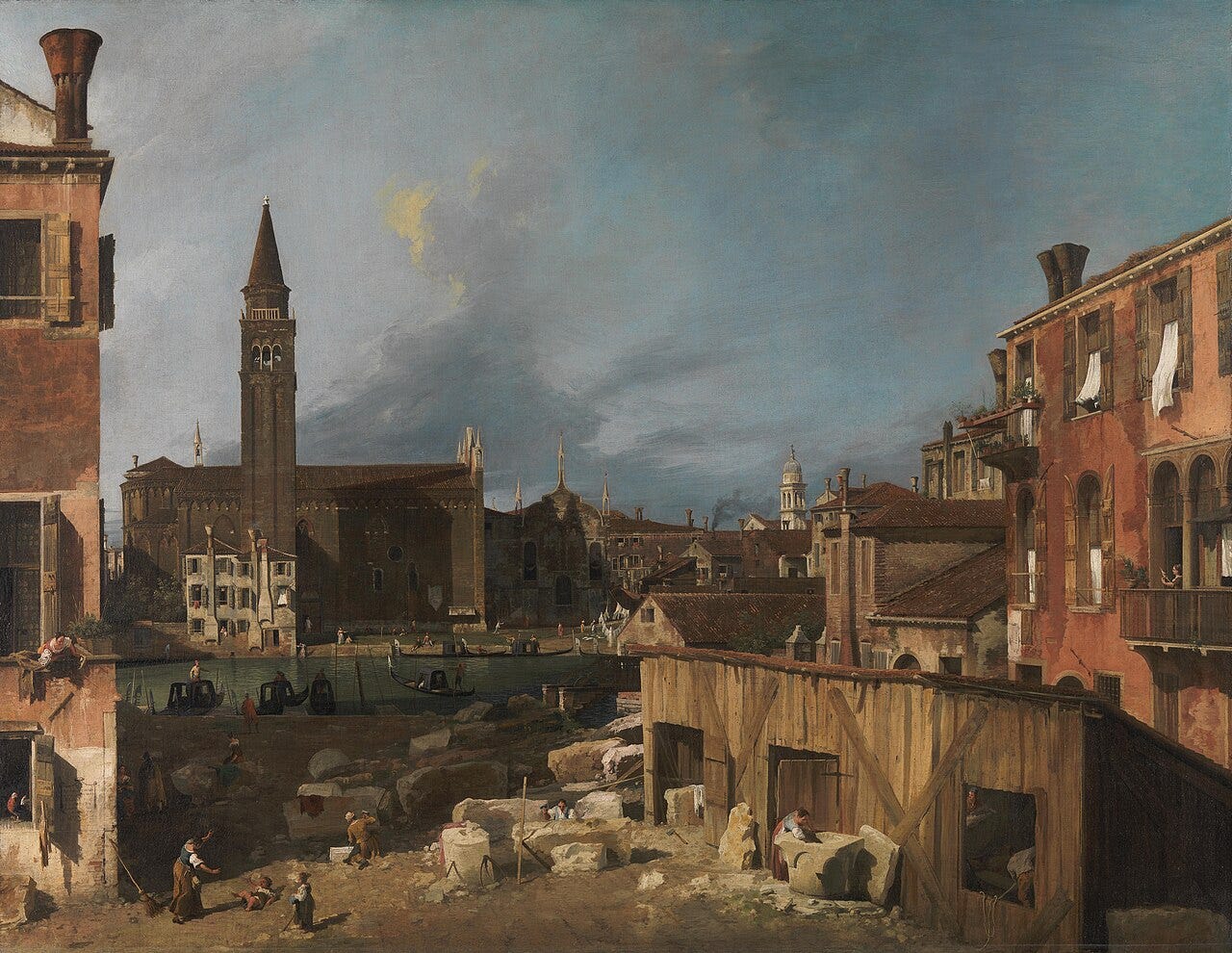
1725. The Stonemason’s Yard, Venice seen from its working side, around this year.
1746. Moved to London for nearly a decade of Thames views.
1763. Finally elected to the Venetian Academy, at 65.
1768. Died in Venice. The finest hoard of his work already belonged to the British crown.
The view as a luxury good
Canaletto specialized in the veduta, the detailed city view. His main customers were wealthy young Britons doing the Grand Tour, the long European trip that finished a gentleman's education. They wanted a glowing picture of Venice to hang back home.
He met that demand so well that more Canalettos hang in Britain than anywhere else, the holiday photos of the eighteenth century aristocracy.
Did he cheat with a camera?
Canaletto almost certainly used a camera obscura, a box that projects a live image onto a surface, to help map out his scenes. It gave his perspective its uncanny accuracy.
But he was no slave to it. He quietly adjusted buildings, widened canals and shifted landmarks to make a better picture. His Venice is more perfect, and more sunlit, than the real one.
The capricci
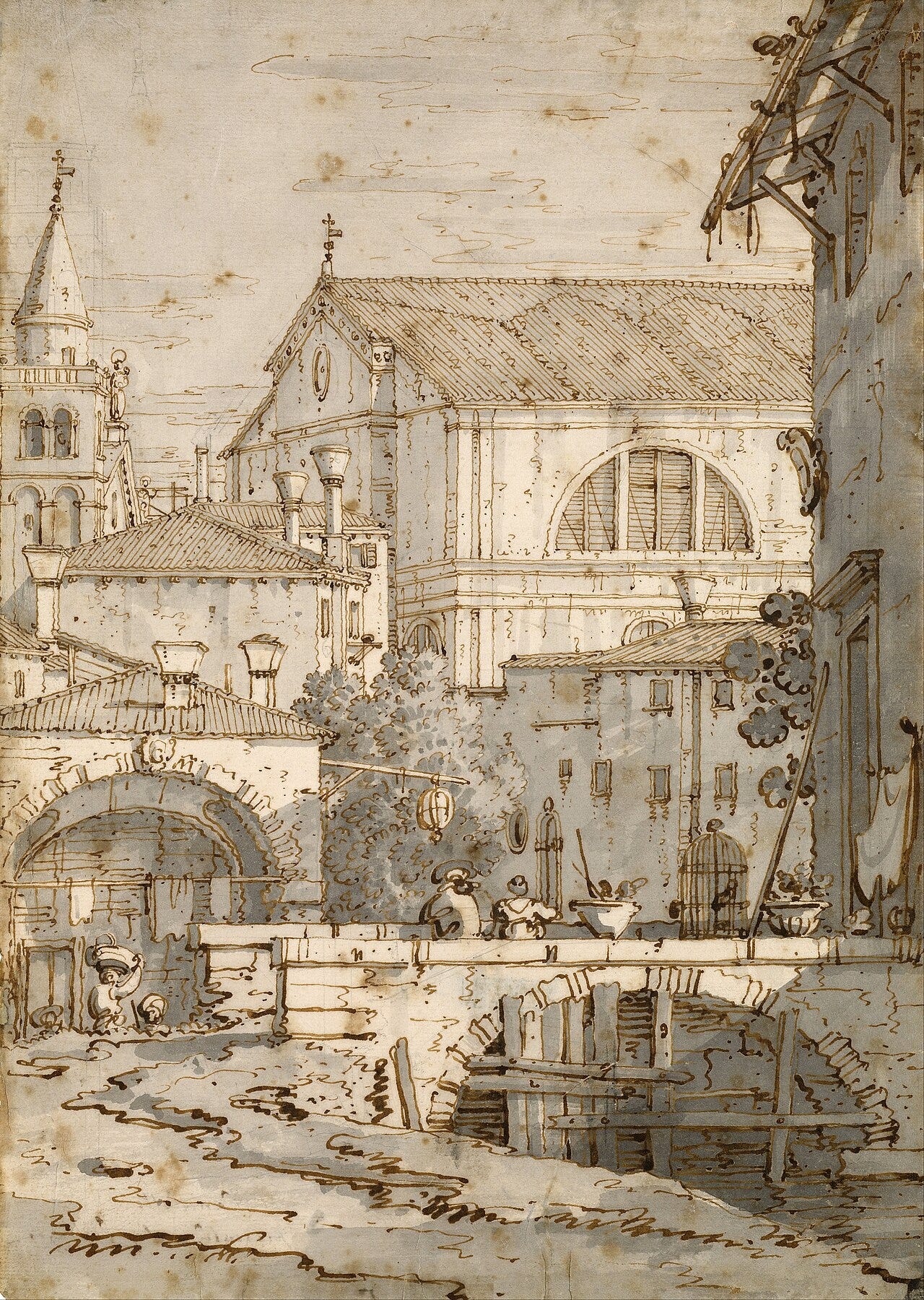
Alongside his real views he painted the capriccio, an invented scene that mixes real monuments with imaginary ones, or sets a famous building somewhere it never stood. It let him play architect and fantasist.
These flights of fancy were as prized as his accurate views. You can read about the form in what is a capriccio.
Ten years on the Thames
When war in Europe choked off the Grand Tour and his Venetian sales, Canaletto did the logical thing. He followed his customers home. He spent about a decade in England, painting London, the Thames and country houses with the same bright clarity.
His views of old London Bridge and Westminster are now precious records of a city that has almost entirely vanished.
The dealer who built the brand
Canaletto did not reach English collectors by luck. His agent was Joseph Smith, the British consul in Venice, who acted as his dealer and shipped the views home to clients on the Grand Tour.
In 1762 Smith sold his own huge collection to King George III, which is why the Royal Collection still holds more Canaletto paintings and drawings than anywhere else on earth.
From the stage to the canvas
Before the views, Canaletto trained as a theatrical scene painter in his father's workshop, building backdrops for Venetian operas.
That schooling in stagecraft never left him. The careful framing, the deep perspective and the sense of a city arranged like a set all come straight from the theatre.
The other Canaletto
Confusingly, there were two. His nephew Bernardo Bellotto trained under him and used the name Canaletto abroad, in Dresden, Vienna and Warsaw.
His Warsaw views were so exact that they later helped guide the rebuilding of the city after 1945. Telling uncle from nephew still keeps specialists arguing over attributions.
The Stonemason’s Yard, and a king’s hoard
The National Gallery in London holds The Stonemason's Yard, his most human view of working Venice, away from the postcard. For the deepest collection of all, the Royal Collection holds the pictures Joseph Smith sold to George III.
The boy from Venice, and the name from his father
He was born Giovanni Antonio Canal in Venice in 1697. His father, Bernardo Canal, painted scenery for the theatre, and the family name was Canal.
That is where the nickname comes from. Canaletto means little Canal, a tag that set the son apart from the father. Bernardo lived from 1674 to 1744, so father and son worked in the same city for decades.
Young Giovanni Antonio trained beside him. Painting stage sets taught him perspective and how to build a convincing structure on a flat surface.
Those two skills, perspective and architecture, run through everything he made later. The name stuck so hard that most people never learn his real one.
Rome, around 1720, and the turn to real views
Around 1720 Canaletto travelled to Rome. He was still working in the theatre then, helping paint stage sets with his father.
Rome changed his direction. Its ruins and streets pulled him toward painting real places rather than imaginary backdrops. Back in Venice he made a decision that set his whole career.
He gave up the low status work of scene painting and began to paint the city itself.
These street and canal pictures are called vedute, the Italian word for views. It was a practical bet as much as an artistic one. Venice was full of visitors who wanted to take the city home with them, and by the early 1720s he had found his subject.
The prints that carried his name across Europe
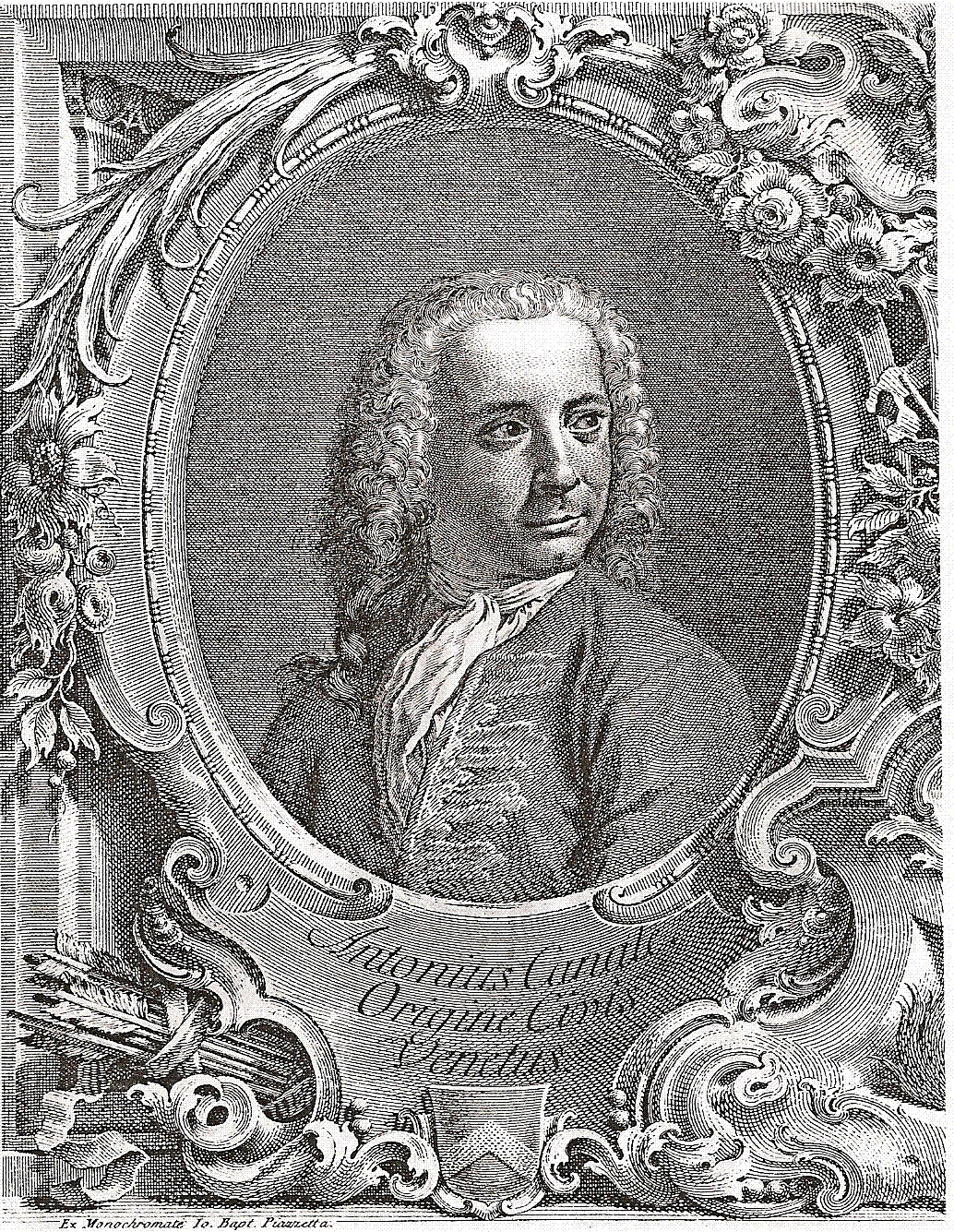
In 1742 the engraver Antonio Visentini published a set of prints after Canaletto. The collection was called Urbis Venetiarum Prospectus, and it gathered thirty eight of his views into one volume.
Prints did something paintings could not. They travelled cheaply, and they reached people who would never see the originals. The book spread his compositions across Europe and pushed his fame well beyond Venice.
Wealthy young British men on the Grand Tour were among his keenest customers, and many arrived already knowing his work from the prints.
That is part of why so much of his output ended up in England. The engravings also fixed certain views as the definitive Canaletto image.
How he moved a building for a better picture
Canaletto is often called a topographer, a painter of accurate places. The truth is more interesting.
His views look exact. The perspective is careful and the daylight is clear and even. But he was willing to bend the facts for a stronger composition.
In his view of the Piazza San Marco from the Procuratie Nuove, he took liberties with the architecture, enlarging parts of the buildings to make the scene more dramatic.
He rearranged, widened and adjusted where it helped the picture. So a Canaletto is not a photograph. It is a designed image that feels true.
The National Gallery puts it plainly. He was always concerned with satisfying composition, not simply recording a view.
The regatta and the golden barge
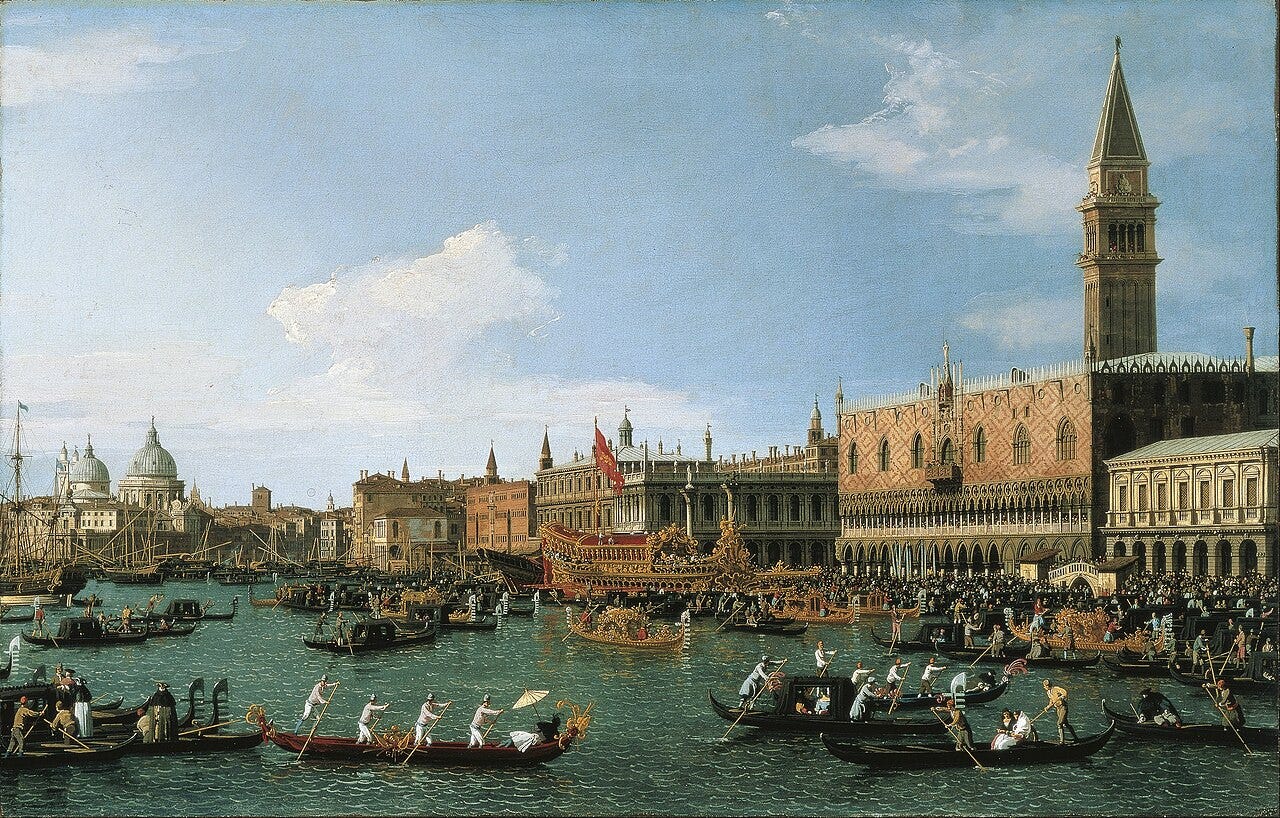
Some of his most popular pictures show Venice at play. The city ran a calendar of public ceremonies, and Canaletto painted the biggest of them.
One is the regatta on the Grand Canal, the annual boat race held on 2 February, when crowds packed the banks and one oared gondolas raced up the water.
Another is Ascension Day in the basin of San Marco. At its centre sits the Bucintoro, the gold and red state barge of the Doge, crowded with figures.
Every year the Doge sailed out on it for the ceremony that symbolically married Venice to the sea. These festival scenes gave buyers spectacle, colour and a sense of occasion. They were, in effect, the trophy views.
When war emptied Venice
Canaletto's business ran on tourists, and tourism is fragile. In the 1740s war spread across Europe. The War of the Austrian Succession made travel harder and cut the flow of visitors to Venice.
His main customers, the British, largely stopped coming. So in 1746 Canaletto did the logical thing. He followed the money to where his customers lived, and sailed to England.
He arrived in London and stayed for most of the next decade, into the mid 1750s. It was a big move for a man in his late forties who had built his whole career on one city.
The decision tells you something about him. He was a working professional first, chasing his market, not a dreamer waiting for inspiration.
Warwick, Eton, and the English country house
In England Canaletto painted his new surroundings the way he had painted Venice. He made views of London along the Thames, but he also travelled for commissions.
He painted Warwick Castle more than once for its owner, giving the medieval fortress the same clear light he gave the Grand Canal. He painted Eton College across a meadow by the river, a calm English scene of picnics and boats.
English patrons also wanted their country houses recorded, and he obliged. The subjects were new, yet the method was the same. Careful perspective, bright skies, tiny busy figures.
Some viewers felt the English work was cooler than his Venice pictures, while others found a fresh, watchful quality in how he looked at a country he did not know.
The rumor that Canaletto was a fake
His years in England came with a strange problem. Some British buyers began to doubt that the painter in London was the real Canaletto, and a few suspected an impostor was trading on the famous name.
By long repeated accounts, he answered in the most direct way possible. He invited the public to come and watch him paint, so they could see the genuine artist at work.
This story is often told, though it is hard to pin down with certainty, so treat it as tradition rather than proven fact.
What is clear is that his reputation in England cooled over time. The doubts, fair or not, chipped at his standing abroad, and when he finally went home to Venice, part of the shine had worn off the name.
Home to Venice, and the Academy at last
Canaletto returned to Venice and kept working into old age. Recognition from his own city came late. He was elected to the Venetian Academy of Fine Arts in 1763, reportedly after being turned down more than once before.
For a painter of his fame, that delay is telling. View painting was seen as a lesser craft than grand history or religious pictures, and the academy was slow to honour it.
He went on painting Venice almost to the end. Canaletto died in Venice on 20 April 1768, at the age of seventy. He left behind thousands of images of a city that has barely changed, which is why a Canaletto view can still feel like a window onto the Venice a Grand Tourist saw.
The Canaletto questions that keep coming up
What is Canaletto famous for? Precise, sunlit views of Venice, the veduta, the detailed city view.
Did Canaletto use a camera obscura? Almost certainly, as a drafting aid, though he freely adjusted what he saw to make a better picture.
Where can you see the most Canalettos? In Britain, above all the Royal Collection, thanks to the dealer Joseph Smith and King George III.
Was Canaletto his real name? No. He was born Giovanni Antonio Canal in Venice in 1697. Canaletto is a nickname meaning little Canal, used to tell him apart from his father Bernardo Canal, who was also a painter. The nickname stuck so firmly that his given name is now rarely used.
Did Canaletto really paint in England? Yes. He arrived in London in 1746, as war across Europe cut the flow of tourists to Venice and took his British customers with them. He stayed for most of the next decade, painting London along the Thames, Eton College and English country houses, before returning to Venice.
More secrets to unlock


The man who turned a city into a souvenir
Canaletto sold the idea that a place could be a possession, and shaped how the world has pictured Venice ever since, its glow built up in patient layers of oil paint. To me his Venice is a fib you forgive on sight, sunnier and tidier than the real city, and better for it.
One last fact. His London years, from 1746 to 1755, began under a cloud. Rumours spread that the real Canaletto had not come and that an impostor was using his name.
In 1749 he answered them by inviting the public into a garden to watch him paint a view of Whitehall, his proof in plain sight.