
Edvard Munch was the Norwegian painter who put raw human anxiety on canvas and created The Scream, one of the most recognized images on earth.
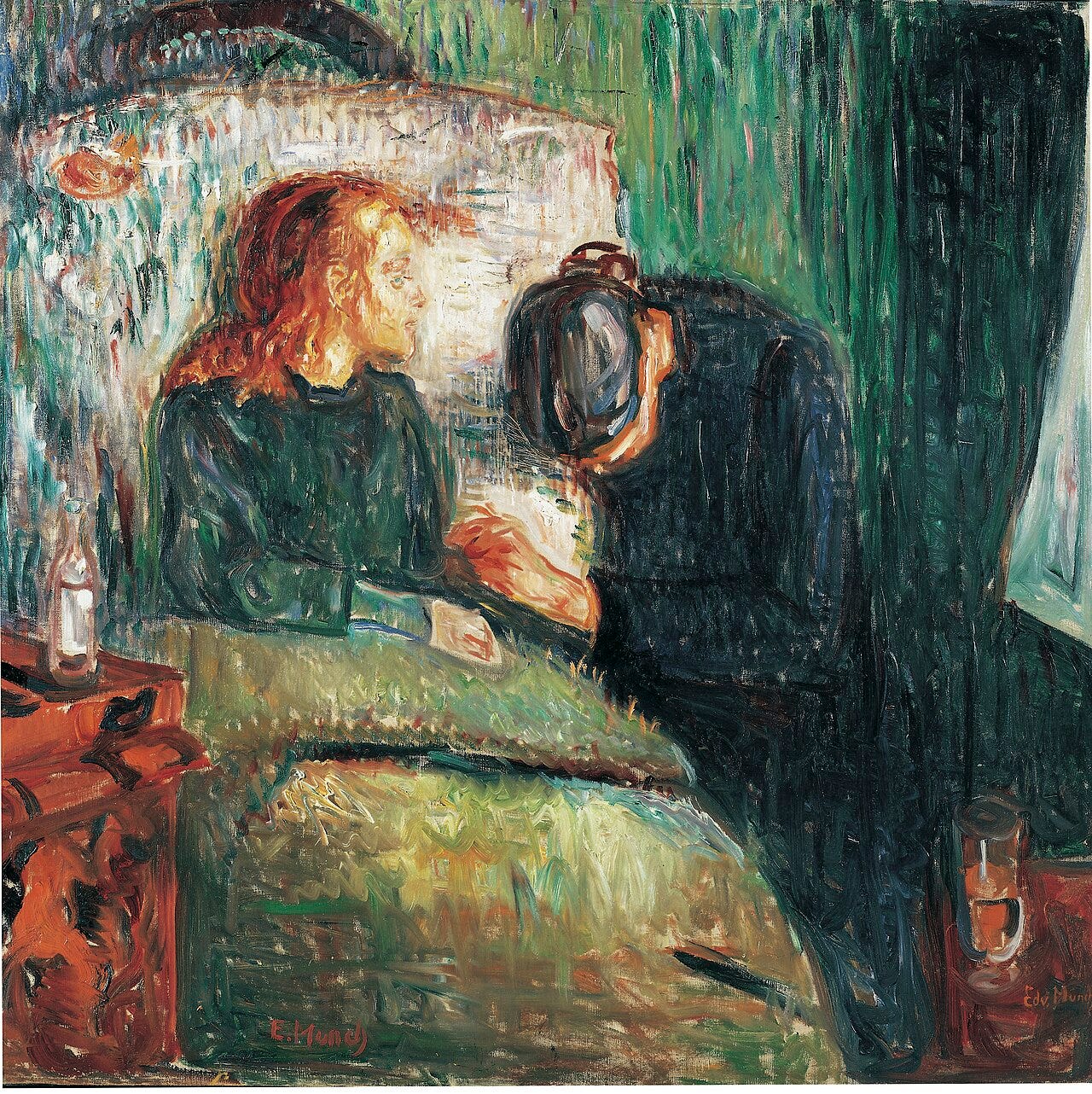
He is a founder of Expressionism. Born in Norway in 1863 and painting until his death in 1944, he turned his own grief, illness and jealousy into swirling, uneasy scenes like The Sick Child, Madonna and the lifelong Frieze of Life, and left almost his entire output to the city of Oslo.
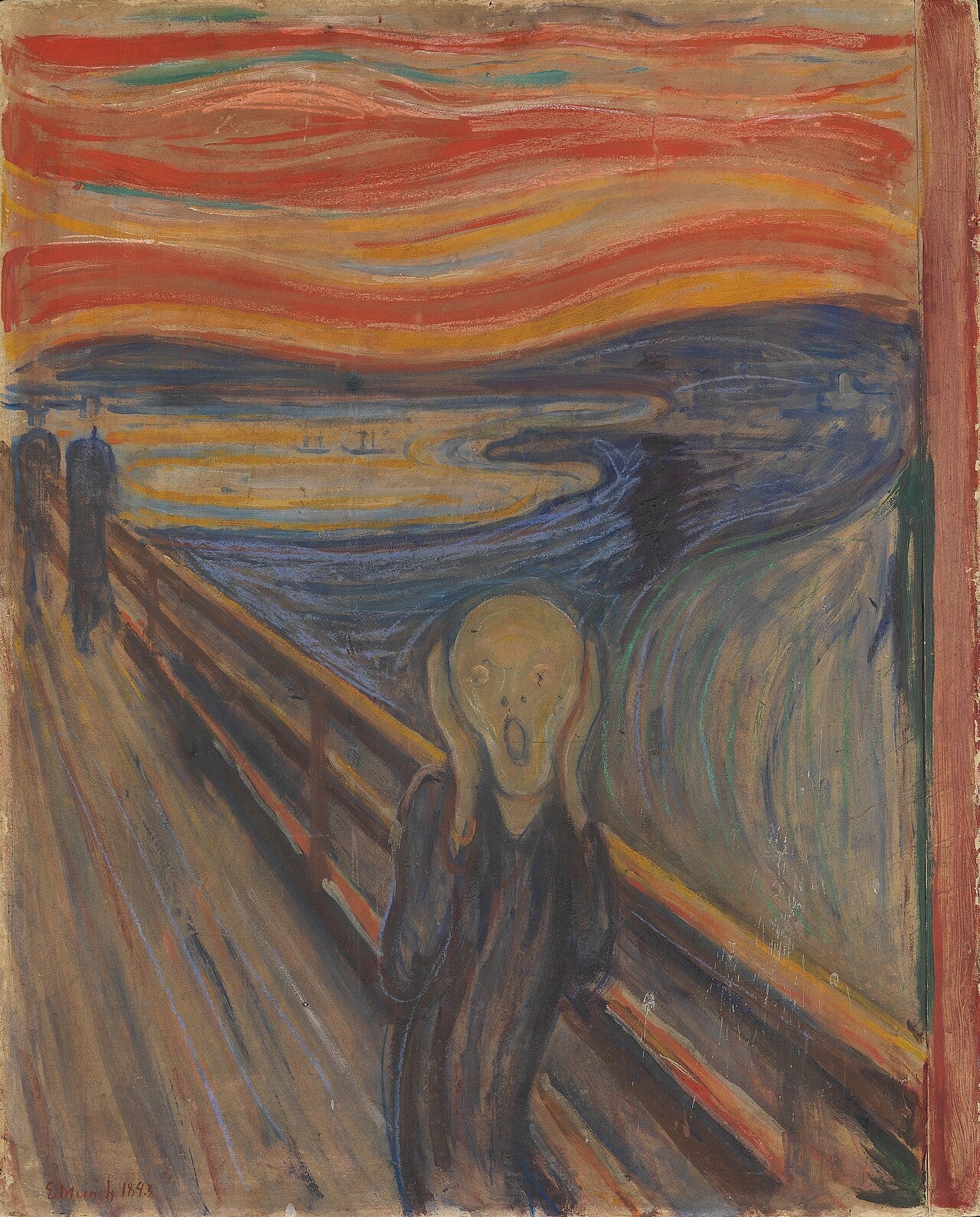
His work is full of dread, grief, love and jealousy, drawn in swirling lines and uneasy color. It looks like the inside of a troubled mind, because that is exactly what he set out to paint.
More incredible painter stories
If Edvard Munch pulled you in, you will love these too:


His own life was shadowed by death and breakdown from childhood on. Here is the whole story.
Symbolism to Expressionism, Munch’s leap
Munch grew out of Symbolism, which painted moods and ideas rather than the visible world, and he helped push it into Expressionism. His Scream now anchors a wider survey of famous Expressionist paintings that runs all the way to Franz Marc's blue horses.
The idea was simple and radical: a painting should show emotion directly, even if that means distorting color, line and space. A red sky did not have to be realistic. It had to feel the way fear feels.
Edvard Munch at a glance
1863. Born in Løten, Norway. Illness and death filled the family house.
1892. His Berlin exhibition was shut within a week. The scandal made his name.
1893. The Scream.
1908. A breakdown in Copenhagen. The clinic cure brightened his palette for good.
1944. Died at Ekely, leaving more than a thousand paintings to the city of Oslo.
Modern anxiety, before the word existed
Munch is famous above all for capturing modern anxiety before anyone had a word for it. The Scream became the universal symbol of panic, dread and the pressure of modern life.
Long before therapy and self help, he was painting the human nervous system from the inside. That is why his work still feels so current, and why a single image of his is parodied on phone cases and emojis worldwide.
The Scream, in brief
Munch said The Scream came from a real moment. Walking at sunset near Oslo, he saw the sky turn blood red and felt an infinite scream passing through nature.
The figure is not screaming. It is covering its ears against a scream coming from the world itself. He made several versions, and on one he scribbled that it could only have been painted by a madman, words confirmed in 2021 to be his own.
The Munch signature
His style is instantly his own.
Swirling lines. Skies, water and air ripple in long wavy bands, as if the whole world is unsteady.
Uneasy color. Acidic reds, greens and yellows chosen for emotion, not realism.
Simplified, haunted figures. Faces reduced to masks of grief, longing or fear.
Repetition. He painted the same charged scenes again and again, like returning to a wound.
The Frieze of Life
Munch did not think in single pictures but in one giant lifelong project he called The Frieze of Life.
It was a series about love, anxiety and death, meant to be shown together as the story of a human soul. It includes The Scream, The Sick Child, Madonna and The Dance of Life. He returned to these themes for decades, reworking them like chapters.
One of those reworked canvases shows a woman bent over a man's neck. Munch called it Love and Pain, a friend renamed it Vampire and the title stuck, now grouped with other paintings in vampires in art: 12 paintings before and after Dracula.
What he took from Van Gogh and Gauguin
Munch sharpened his vision in Paris and Berlin in the 1880s and 1890s.
From Vincent van Gogh he saw how raw color and thick, urgent brushwork could carry pure emotion. From Paul Gauguin he took flat shapes and symbolic color.
The Symbolist poets and painters taught him to paint states of mind. He fused it all into something darker and more personal.
Breakdown, a gunshot, and recovery
Munch lived hard. A stormy affair with a woman named Tulla Larsen ended with a pistol going off and shattering part of one of his fingers, an injury that haunted him.
Years of heavy drinking and anxiety led to a full nervous collapse in 1908, and a long stay in a clinic. He came out calmer, and much of his later work is brighter and steadier, if less famous than the tormented early pictures.
Degenerate art, death and a gift to Oslo
In the 1930s the Nazis branded Munch a degenerate artist and pulled his work from German museums.
He spent his final years outside occupied Oslo, fearing the Nazis would seize his art. When he died in 1944, he left almost everything he owned, thousands of works, to the city of Oslo, which is why a whole museum is devoted to him today.
The thefts of The Scream
The Scream is so famous it has been stolen twice. In 1994 one version was taken from a Norwegian museum, and in 2004 armed thieves grabbed another in broad daylight.
Both were eventually recovered. Few paintings carry such a criminal record, and for me it says everything about how deeply The Scream lodged itself in the culture.
Oslo, above all
Oslo is the place.
The National Museum of Norway, Oslo. Home to the most famous painted version of The Scream.
The Munch Museum (MUNCH), Oslo. A whole museum built around the huge collection he left the city.
Outside Norway, the Metropolitan Museum of Art in New York holds a strong group of his prints.
Born in Loten, raised in Kristiania
Edvard Munch was born on 12 December 1863 in Loten, a farming district in eastern Norway. He was the second of five children in a middle class family that was short of money and often unwell.
In 1864 the family moved to Kristiania, the city we now call Oslo, after his father took a post as medical officer at Akershus Fortress. They lived on a modest doctor's salary and changed address often.
His mother, Laura Cathrine, died of tuberculosis in 1868, when Edvard was five. His aunt Karen then moved in and raised the children.
So the artist behind Norway's most famous image grew up in genteel poverty in the same small capital he would paint for the rest of his life.
A devout father and a house of dread
Munch's father, Christian Munch, was an army doctor and a deeply religious man. The deaths in the family hit him hard. He fell into spells of gloom and read the losses as punishment sent by God.
He filled the home with two things at once: prayer and fear. By the fire he would read his children Bible lessons and history, then the ghost stories of Edgar Allan Poe.
For a sickly boy already kept in bed for whole winters, this planted a lasting dread of death and a fascination with it. That mood never left Munch's work.
The anxiety we feel in his paintings started at the family table, in a father who loved his children and frightened them in the same breath.
Teaching himself, then art school
Illness kept young Munch out of school for months at a time. To fill the empty hours he drew everything around him: rooms, portraits, landscapes and copies of other artists' work.
At 17 he wrote a line in his diary that reads like a vow. It is my decision now to become a painter.
His aunt Karen encouraged him. In 1880 he enrolled at the Royal School of Art and Design in Kristiania, where he could finally draw from live models.
He rented a studio in the city with several friends and found his first real mentor, the older painter Christian Krohg, who told him to find his own way.
In 1889 he held his first solo exhibition in Kristiania and won a state scholarship to Paris.
The Kristiania Bohemians and Hans Jaeger
In the 1880s Munch fell in with the Kristiania Bohemians, a circle of writers and artists led by the anarchist thinker Hans Jaeger. The group rejected the rules of respectable society. They preached free love and argued against marriage.
Jaeger had one command that changed Munch: write your own life. Put your real experience on the page, not a polite copy of the world.
Munch and Jaeger grew close, and the effect showed at once. When Munch painted The Sick Child in 1885 and 1886, drawing on the death of his sister Sophie, critics and even his fellow painters attacked its raw, unfinished surface.
That painting was Munch turning his own grief into art, exactly as Jaeger had urged.
Berlin 1892, a scandal and the Black Piglet
In 1892 the Association of Berlin Artists invited Munch to show a large group of paintings. The German public was not ready. His raw color and dark subjects caused an uproar, and the show was shut down after only one week.
Munch was delighted. I could not have a better form of publicity, he wrote to his aunt Karen. The scandal split Berlin's art world and carried his name across Germany.
He stayed on and found a new circle at a wine tavern the writer August Strindberg nicknamed the Black Piglet. Around those tables sat the Polish author Stanislaw Przybyszewski and the Norwegian musician Dagny Juel, in nights of heavy drinking and hard talk about art and life.
The paintings he called his children
Munch hated to part with his own work. He treated his pictures almost as family, and if he did sell one he would often paint the scene again to keep a version for himself.
That is why so many Munch images exist in several painted versions, plus prints of the same subject. He surrounded himself with them for decades, stacking canvases through the rooms and studios of his home.
The habit built one of the largest bodies of work any single artist has ever kept. When it passed to the city of Oslo, the collection came to almost 28,000 works of art, one of the world's largest holdings by a single artist. Munch never let go.
The kill or cure treatment for his canvases
Munch's care for his art could look like neglect. At his home he left many paintings outdoors, standing in the garden through rain, wind and snow.
Conservators have since found human footprints and dog paw prints on prints and drawings, along with traces of bird droppings and water damage on the paintings.
He seems to have trusted the rough weather to toughen a picture, a kill or cure approach to his own work.
The proof turned up after his death in 1944. As his bequest was gathered, a thawing snowball was found to hold fragments of a canvas, the painting Workers in Snow from 1913 to 1915.
Few artists have exposed their work to the elements on purpose. Munch did, and some of it survived.
The Aula murals and The Sun

After his recovery, Munch took on the biggest commission of his life. Between 1909 and 1916 he painted the decorations for the assembly hall, or Aula, of the University of Oslo.
These were huge canvases, and the mood was the opposite of The Scream. They are full of light, health and open air. At the center stands The Sun, painted around 1910 to 1913, a sunrise pouring its rays across a fjord until the whole sky seems to lift.
The Aula project marked Munch's turn from dread toward energy and daylight. The man who gave the world its picture of anxiety spent years painting one of art's great images of hope, hanging over the heads of graduating students in his own capital.
Ekely, the recluse and his dogs
In 1916 Munch, now famous, bought Ekely, a former plant nursery on the edge of Oslo. He moved into its wooden villa and built himself several studios, including an open air one for painting outside.
Ekely became his refuge for the rest of his life, and he grew ever more private there. He painted the fruit trees, the garden and the horses in the fields in loose, colorful strokes.
He kept dogs for company, among them a fox terrier named Fips, and he feuded with his neighbours and the tax authorities over small matters.
He also kept painting himself. In late self portraits such as Self Portrait Between the Clock and the Bed, made from 1940 to 1943, he studied his own aging body with plain honesty.
Munch painted The Scream in 1893 as a howl against modern anxiety; a few years earlier in Ostend, James Ensor had already filled his canvas Christ's Entry into Brussels with a crowd of grinning carnival masks.
The Edvard Munch questions that keep coming up
What is he known for? The Scream, and pioneering Expressionism.
Why did he paint The Scream? He felt an overwhelming wave of anxiety during a blood red sunset.
Where was he from? Norway, raised in Oslo, then called Kristiania.
How did he die? Of natural causes in 1944, aged 80, in occupied Norway.
What movement was he part of? Symbolism and Expressionism.
Is the figure in The Scream actually screaming? No, and this is the common misreading. Munch based the image on a walk at sunset when he felt a scream pass through nature itself. The figure is not making that sound. It is hearing it, and pressing its hands over its ears to shut it out.
Did Edvard Munch ever marry? No. Munch never married. His most serious relationship, with Tulla Larsen, ended in 1902, and afterward he kept his distance from close attachments, living alone with his work and his dogs.
More secrets to unlock


Munch spent his final years as a recluse in Nazi occupied Oslo before dying of pneumonia in 1944 at eighty, a period our piece on how Edvard Munch died covers closely.
Munch is often paired with the Swiss painter Ferdinand Hodler, whose Symbolist canvases share his fixation on death and the cycle of life. Hodler's own story is told in Ferdinand Hodler, The Complete Story.