
Henri Rousseau was the self taught French painter of dreamlike jungles, a customs clerk who never left France yet filled his canvases with tigers, lions and giant moonlit flowers.
Trained painters laughed at his flat, childlike style. Then Picasso threw him a banquet, and the avant garde crowned the amateur a master.
Born in Laval in 1844, he spent decades collecting tolls at the edge of Paris and only painted seriously in his forties, building tigers and moonlit forests from zoo visits, hothouse plants and cheap picture books; by his death in 1910 the customs clerk who never saw a jungle was one of the most loved painters of his age.
He is proof that the rules of the academy are not the same thing as imagination. He had almost none of the first and an ocean of the second.
More incredible painter stories
If Henri Rousseau pulled you in, you will love these too:


Henri Rousseau at a glance
1844. Born in Laval, a tinsmith’s son.
1871. Took a post at the Paris toll gates, the job behind the nickname Le Douanier.
1886. First showed at the Salon des Indépendants, to open laughter.
1908. Picasso threw a banquet in his honor at the Bateau-Lavoir.
1910. Died in Paris. Apollinaire wrote his epitaph and Brancusi carved it into the stone.
The Sunday painter
Rousseau spent his working life as a Paris toll collector, which earned him the nickname Le Douanier, the customs man. He painted on weekends, taught himself from books and museums, and only took it up seriously in his forties.
He never had a single proper lesson.
Jungles he never saw
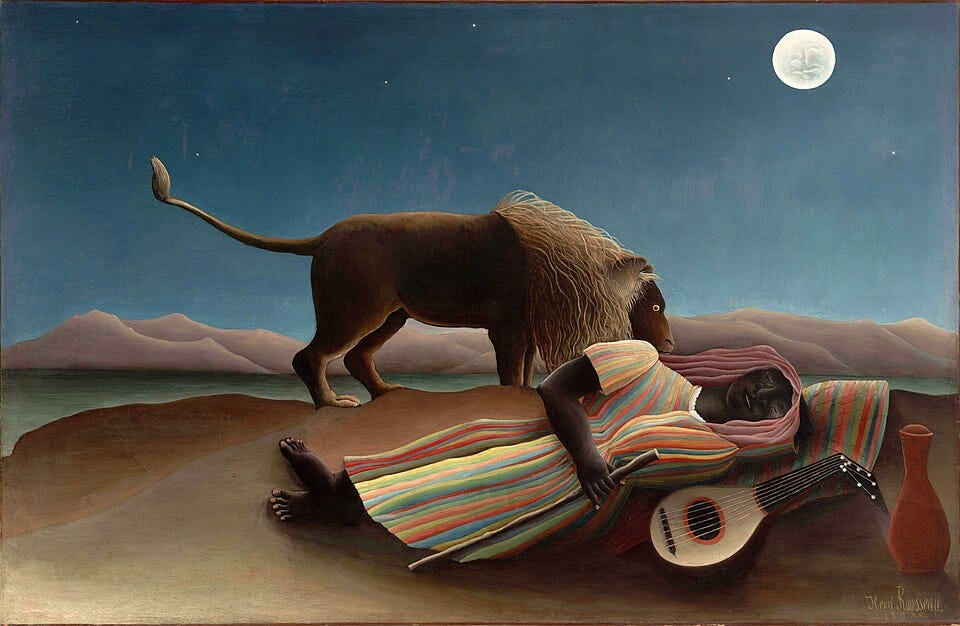
His most famous works are steaming jungles: The Dream, Tiger in a Tropical Storm, The Sleeping Gypsy. Yet Rousseau never left France. The lion standing guard over the sleeping figure still ranks among the most famous lion paintings in Western art.
He built his jungles from the hothouses of the Paris botanical garden, the zoo, and cheap picture books, then made them feel more real than the real thing.
Laughed at, then loved
The Salon critics mocked his flat space and stiff figures for years. But a younger generation saw something modern in his directness.
In 1908 Picasso threw a famous banquet in his honor, and writers like Apollinaire took him seriously. The amateur had become a hero to the avant garde.
On trial, and the customs myth
Two things people get wrong about Rousseau. First, he was never really a border customs officer; he was a modest Paris toll clerk who checked goods coming into the city, yet the grander nickname stuck for life.
Second, in 1907 he was dragged into court over his part in a bank fraud. He got off lightly, partly because the judges decided he was too innocent to have grasped the scheme, the very naivety his critics mocked in his paintings.
Even the law treated him like one of his own wide eyed figures.
A dream logic of his own
Flat space, hard outlines, impossible silence: whether his naive eye was innocent or quietly knowing is still argued. Either way he opened a door.
The landscape he invented looked back to no one and forward to the Surrealists, who claimed him as an ancestor.
The four canvases that carry his name
A handful of paintings carry his fame: The Dream, The Sleeping Gypsy, Tiger in a Tropical Storm, and Carnival Evening. Each one is a still, strange world you could step into.
Born in Laval, a tinsmith's son
Henri Rousseau was born on 21 May 1844, in Laval, a town in western France. His father worked as a tinsmith, shaping and mending metal for a living.
Money was tight. The father fell into debt, and the family lost the house where Henri was born. Rousseau was not a strong pupil. He picked up a school prize for drawing and music, but little else marked him out.
Nothing in that modest start pointed to a painter. There were no art lessons, no wealthy patron, no gallery in the family. All his life he spoke of himself as a self made man who taught himself everything.
The soldier who never saw Mexico
As a young man Rousseau joined the French army, enlisting in the 1860s. He served a few years in an infantry regiment, stationed in France.
Later a colorful story spread that he had sailed to Mexico with French troops and seen real jungles there. It is not true. Rousseau never left France in his life.
The French army did fight in Mexico during the 1860s, and Rousseau enlisted in that same period, which is probably how the two tales got tangled together.
Friends repeated the legend, and Rousseau, who enjoyed a good story about himself, did little to correct it. His jungles came from Paris, not from any voyage.
Life at the toll gate
For most of his working life Rousseau held a plain government job. From the early 1870s he worked for the Paris toll service, collecting the octroi, a local tax charged on goods entering the city.
He stood at the gates and checked wagons of wine, food, and building material.
The pay was small and the rank was low. He was a minor clerk, not a grand official. But the shifts were long and quiet, and that suited him. Between wagons he sketched, daydreamed, and planned pictures in his head.
He kept the post for around fifteen years, into the mid 1880s. It gave him a steady wage, a little free time, and the nickname that would follow him for the rest of his life and beyond.
Picking up the brush past forty
Rousseau came to painting late. He was already in his forties when he began to take it seriously, teaching himself with no schooling and no master.
He copied works at the Louvre, where the museum granted him a permit to set up his easel among the old paintings.
In 1893, at forty nine, he retired from the toll house to paint full time. His pension was tiny, so the choice meant real poverty.
He moved between small flats in modest Paris neighborhoods and scraped by giving lessons in music and drawing to local children.
Most men his age were settling into a quiet retirement. Rousseau instead started a new life as a full time artist, betting everything on pictures that almost no one yet wanted to buy.
Showing at the Salon des Independants
The official Salon would never have taken Rousseau. Its juries wanted a polish he did not have. His door was the Salon des Independants, an open exhibition founded in 1884 with no jury and no prizes, where anyone who paid the fee could hang work.
Rousseau first showed in 1886, including a night scene called Carnival Evening. From then on he exhibited there almost every year until his death.
Critics often treated him as a joke. Reviewers laughed at the stiff figures and the flat, patient detail, and some visitors came partly to mock.
Yet he kept returning, canvas after canvas. That loyalty to the one show that would have him is a large part of how his work survived to be seen at all.
Where his painted world came from
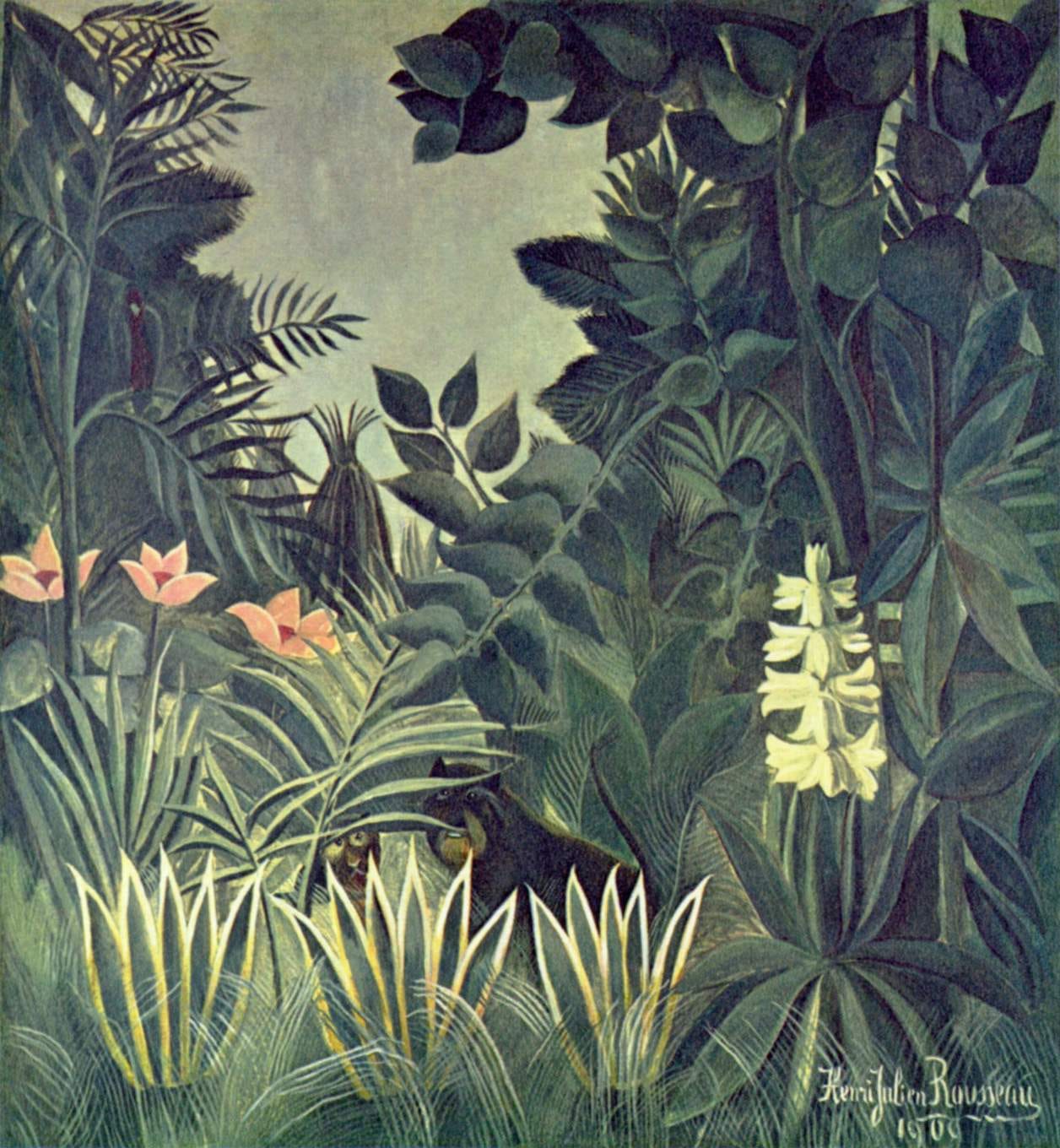
Rousseau never saw a jungle, so he built his out of the city around him. He spent hours in the Jardin des Plantes, the Paris botanical garden, drawing leaves inside its glass greenhouses. He studied live animals at the zoo attached to it.
He visited colonial expositions, where plants, people, and objects from far away were put on display. He collected illustrated magazines and cheap prints of wild beasts and distant lands.
He even looked at stuffed animals to get a lion or a tiger right.
Then he combined it all from memory and imagination. Each leaf was copied with care, but the forest as a whole existed nowhere except on his canvas and inside his head.
The academics he longed to equal
Here is the surprise about Rousseau. He did not set out to break the rules. He admired the most respectable painters of his day.
His heroes were academic stars like Jean Leon Gerome and William Bouguereau, men whose smooth, finished pictures filled the official Salon. Rousseau wanted to paint like them, and he believed his own careful, detailed style already did.
He thought of himself as a serious history painter, not an outsider. He kept dreaming of medals, state commissions, and official glory right to the end.
The joke of art history is that the very things he could not do, the flatness and the strangeness, are what we now prize.
The night Picasso threw him a banquet
Around 1908 the young Pablo Picasso bought a large Rousseau portrait for a few francs at a junk shop. To mark it, he threw a banquet for the old painter in his ramshackle studio building, the Bateau Lavoir in Montmartre.
The guests were the sharp young figures of the Paris avant garde, among them the poet Guillaume Apollinaire. The evening was half tribute and half student prank, with plenty of drinking and teasing.
Rousseau, honored and touched, took it entirely at face value. He played his violin for the room and beamed at the attention. The banquet became one of the famous legends of modern art, and it showed how the new generation had quietly adopted the retired toll clerk as one of their own.
Portraits, patriotic pictures, and a lonely end

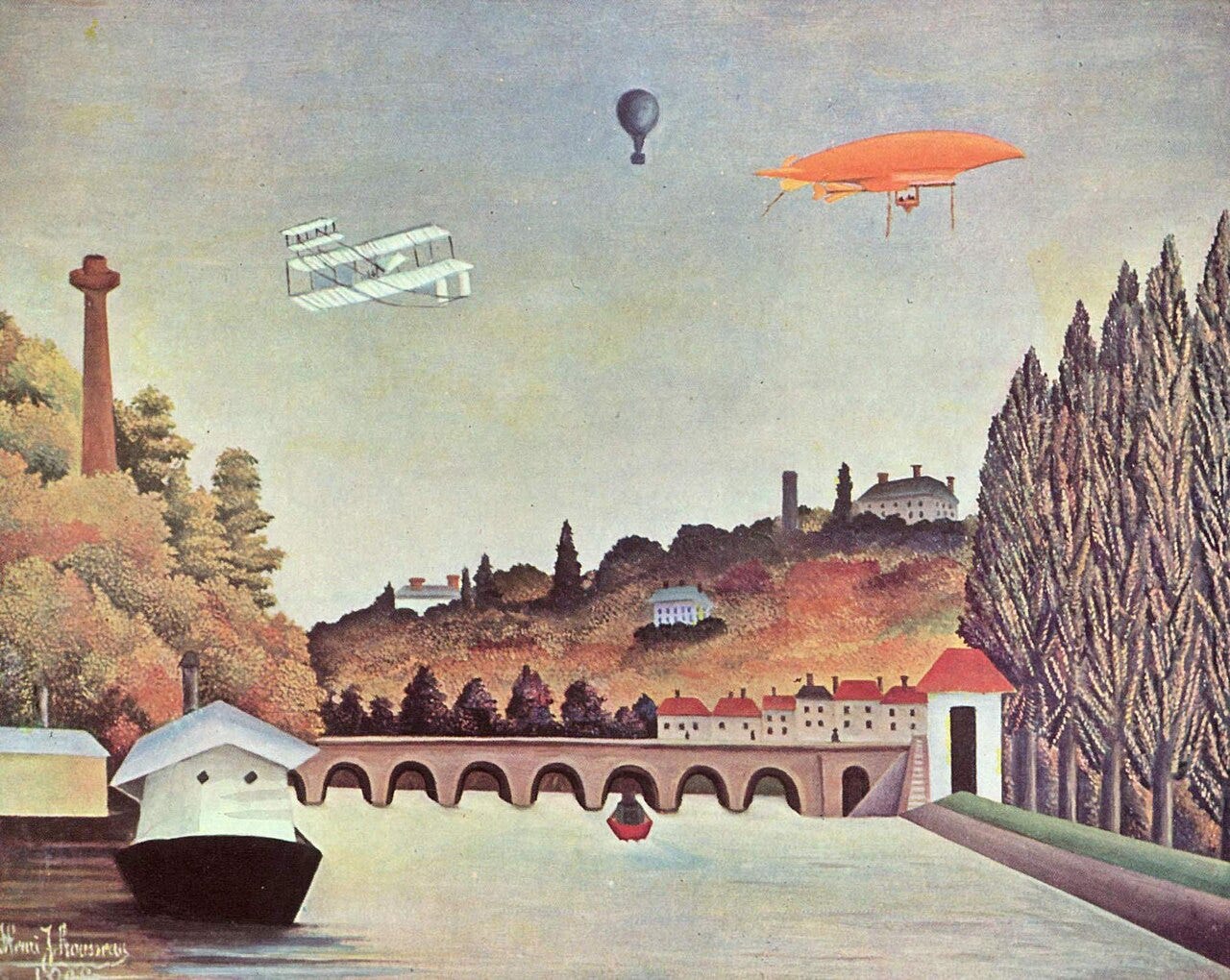
Rousseau painted far more than jungles. He made portraits of friends and neighbors, including the art dealer Joseph Brummer, shown seated with a cigarette. He painted odd portrait landscapes, setting a stiff figure against a Paris view.
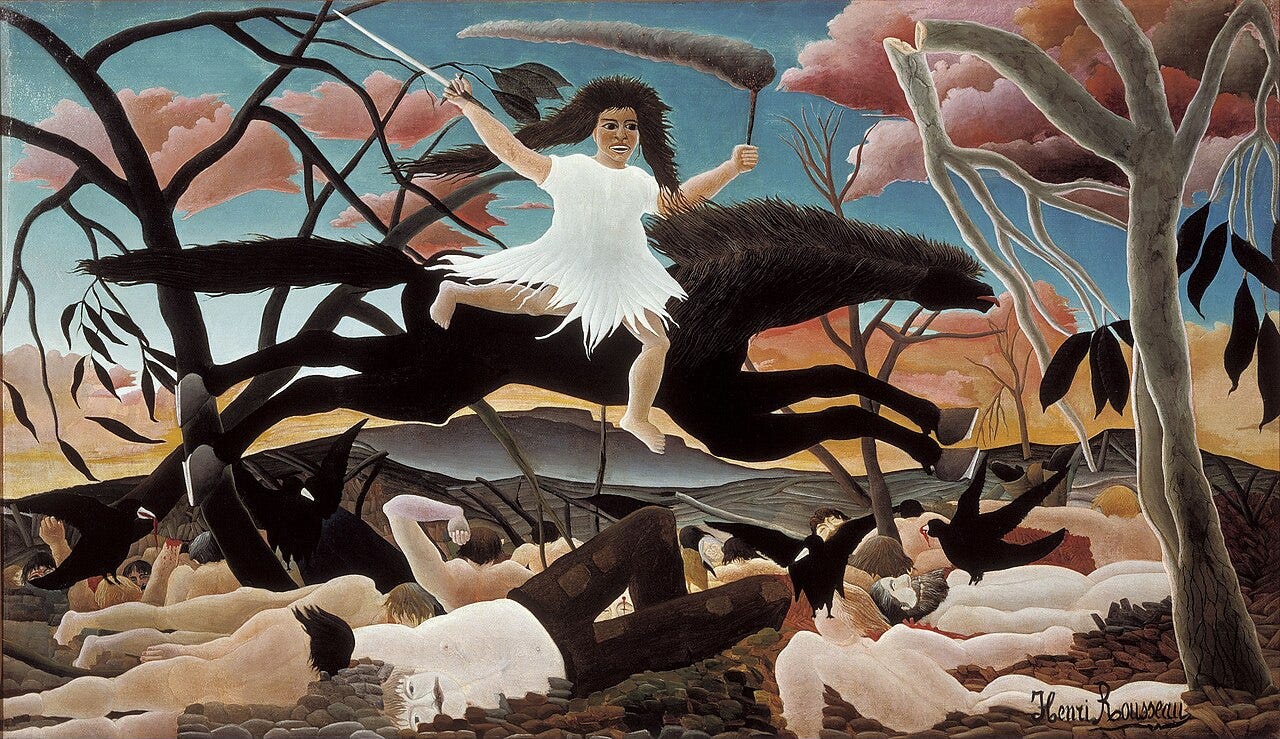
He reached for grand patriotic and allegorical subjects too, such as War in 1894 and pictures honoring the French republic, chasing the serious themes of Salon art. Recognition came slowly, and the money barely came at all.
He died on 2 September 1910, in a Paris hospital, from an infection in his leg that turned deadly. Only a small group stood at his pauper's grave.
Within a year the avant garde honored him with a memorial show, and his reputation has only grown ever since.
More secrets to unlock


Henri Rousseau worked as a customs toll collector for over twenty years before anyone called him a painter; Grandma Moses, born Anna Mary Robertson, did not pick up a paintbrush seriously until her seventies, when arthritis forced her to give up embroidery.
The Henri Rousseau questions that keep coming up
Did Henri Rousseau ever see a jungle? Never. The Douanier built his jungles from the Paris botanical gardens, taxidermy halls, and illustrated albums, which is exactly why they look like dreams.
Why is he called Le Douanier? A gentle joke: he worked as a toll collector at the Paris customs gates, not a customs officer proper, and painted on Sundays until retiring at 49.
Did Picasso really throw him a banquet? Yes, the famous 1908 banquet in the Bateau-Lavoir, half homage, half prank, that ended with Rousseau telling Picasso: we are the two great painters of the age, you in the Egyptian style, I in the modern.
What is The Sleeping Gypsy? His 1897 canvas of a lion sniffing a sleeping woman under a full moon, rejected by his hometown, now one of MoMA's most beloved paintings.
How was Rousseau treated in his lifetime? As a joke by the Salon public and as a discovery by the avant-garde: Jarry, Apollinaire, Delaunay, and Picasso collected and defended him before his death in 1910.
Where can I see Rousseau? MoMA for The Sleeping Gypsy and The Dream, the Musée d'Orsay for War and the Snake Charmer, and the National Gallery in London for Surprised!
Who was Henri Rousseau? A Paris toll clerk nicknamed Le Douanier who taught himself to paint in his forties and won over Picasso’s circle.
When was he born? In Laval, France, in 1844.
How did he die? In Paris, in 1910, of a leg infection, still poor.
What is he famous for? Dreamlike jungle paintings like The Dream and The Sleeping Gypsy.
What style is he? Naive art, a precursor of Surrealism.
Where can I see his work? MoMA in New York holds The Dream and The Sleeping Gypsy.
Did Henri Rousseau ever visit a jungle? No. For all the rich forests he is famous for, Rousseau never left France. He built his jungles from the Paris botanical garden and its zoo, from colonial expositions, from illustrated magazines, and from stuffed animals. The legend that he saw tropical forests while serving with the French army in Mexico is false.
What was Henri Rousseau's real job? For about fifteen years, from the early 1870s to the mid 1880s, Rousseau worked as a clerk for the Paris toll service, collecting the octroi, a tax on goods brought into the city. It was a low paid, minor post, not a senior customs position. He did not paint full time until he retired in 1893.
Rousseau finished The Dream, his last great jungle, only months before he died in 1910, poor and still dismissed by the official art world.
It now hangs in MoMA, and the customs clerk who never left France is one of the most loved painters of his age.
You can explore works by Henri Rousseau in the collection of the Metropolitan Museum of Art.