
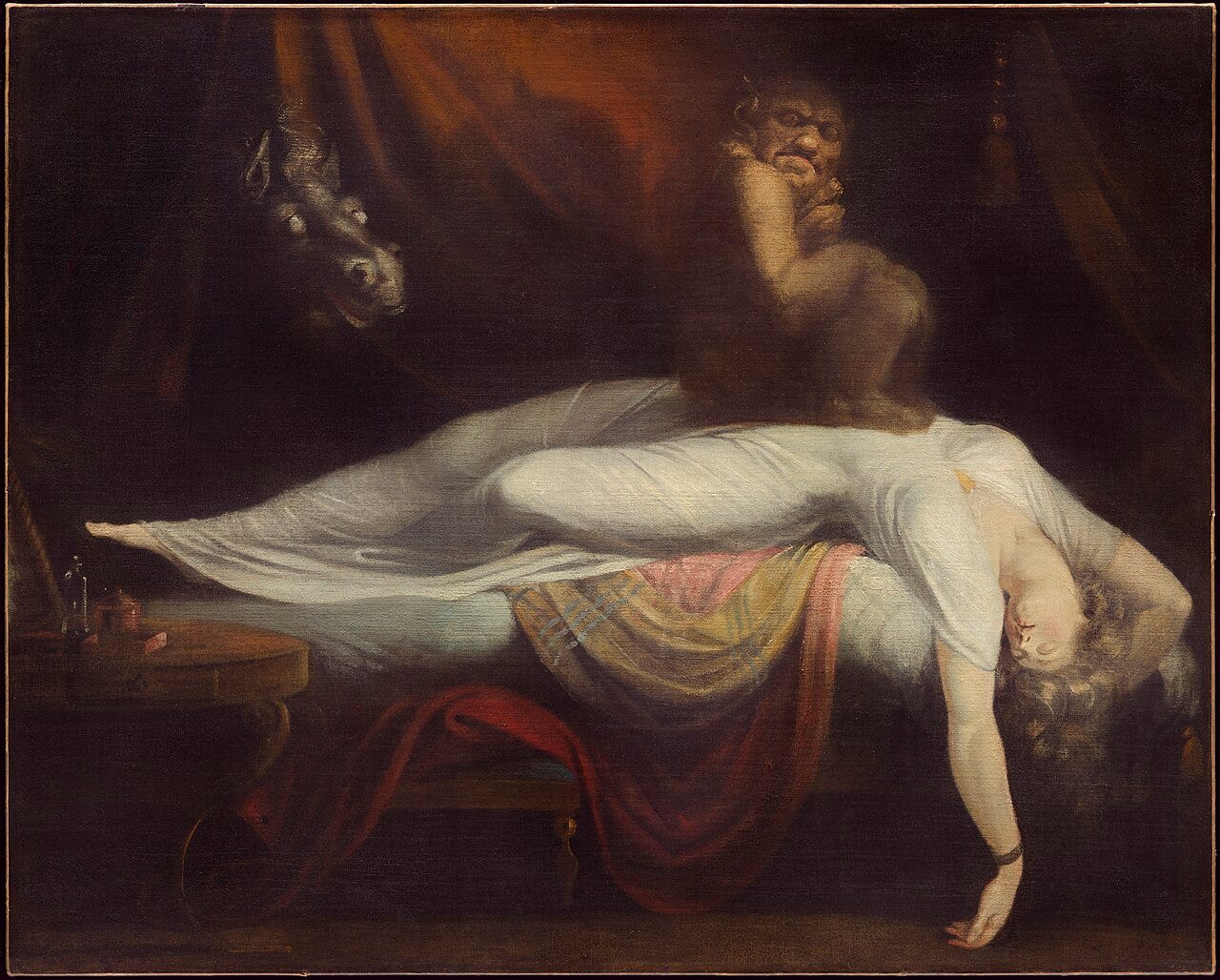
Henry Fuseli, 1741 to 1825, was a Swiss born British painter who turned dreams into nightmares on canvas. His most famous work, The Nightmare of 1781, shows a sleeping woman crushed by a demon while a wild horse stares from the dark.
It made him a sensation and still haunts horror imagery today. Trained first as a Zurich minister, he reinvented himself in London as a Royal Academy professor, pouring Shakespeare, Milton and raw dread into a Romanticism no rival dared to paint.
Most painters of his time wanted beauty and order. Fuseli wanted the thing that wakes you at 3am. Here is the man behind it.
More incredible painter stories
If Henry Fuseli pulled you in, you will love these too:


Henry Fuseli at a glance
1741. Born Johann Heinrich Füssli in Zurich, a portraitist’s son.
1763. Fled Zurich after exposing a corrupt magistrate in a pamphlet.
1781. The Nightmare, the painting that gave fear a face.
1799. Opened the Milton Gallery, forty seven paintings, and lost everything. The Royal Academy made him professor of painting the same year.
1825. Died at 84 and was buried in St Paul’s, near Reynolds.
The painting that gave fear a face
When The Nightmare appeared at the Royal Academy in 1782, London had never seen anything like it. A woman lies thrown back in sleep. A squat demon, an incubus, sits on her chest. A blind horse pushes its head through the curtain.
It was not a scene from the Bible or ancient Rome. It was a bad dream, painted as if real. Prints of it sold everywhere, and the image has been copied ever since.
People still argue over what it means. Fuseli never fully explained it, which is part of why it grips us.
The Swiss minister who became a London star
Trained first for the church, he left for London, anglicized his name, and reinvented himself as a painter.
He rose to become a professor at the Royal Academy, respected even by those who found his work strange. He was learned, sharp tongued, and obsessed with the extremes of feeling.
The circle that fed his imagination
He was close to William Blake, and the two shared a taste for visions and a distrust of polite taste.
The writer Mary Wollstonecraft, a founder of feminism, fell intensely for him. He kept her at a distance, and the episode marked them both.
Where the muscle meets the macabre
His figures have the heavy muscles of Michelangelo, but they twist and loom like a stage lit by lightning. He loved Shakespeare and Milton, and painted their darkest moments.
This is Romanticism at its most feverish, often crossing into the erotic and the macabre. His treatment of the nude is charged, never calm.
From a bad dream to a fairy wood to a Norse god
First, The Nightmare of 1781, the image that made him famous and never let go.
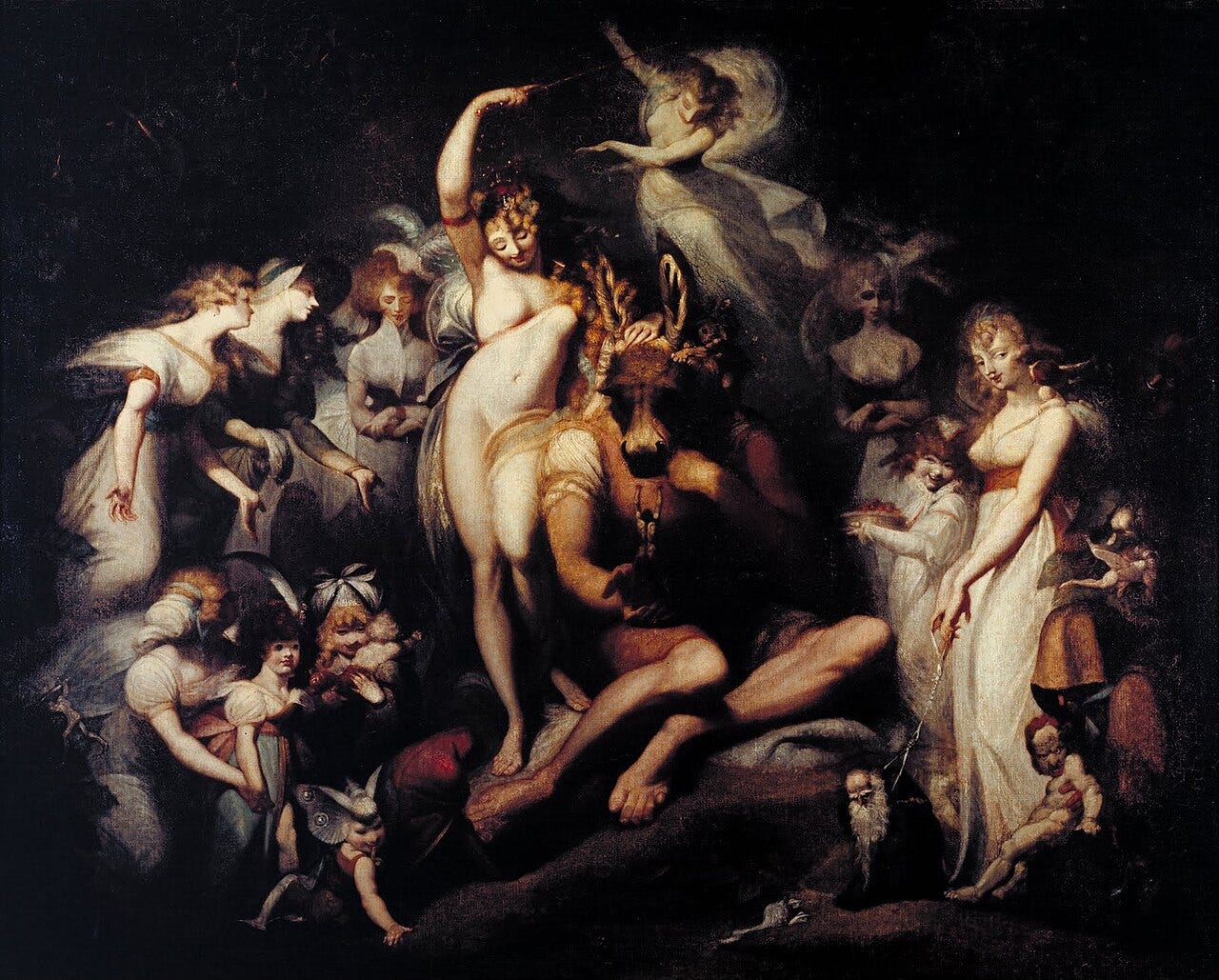
Second, Titania and Bottom, a swirling fairy scene from A Midsummer Night's Dream, proof he could make even comedy feel uncanny.
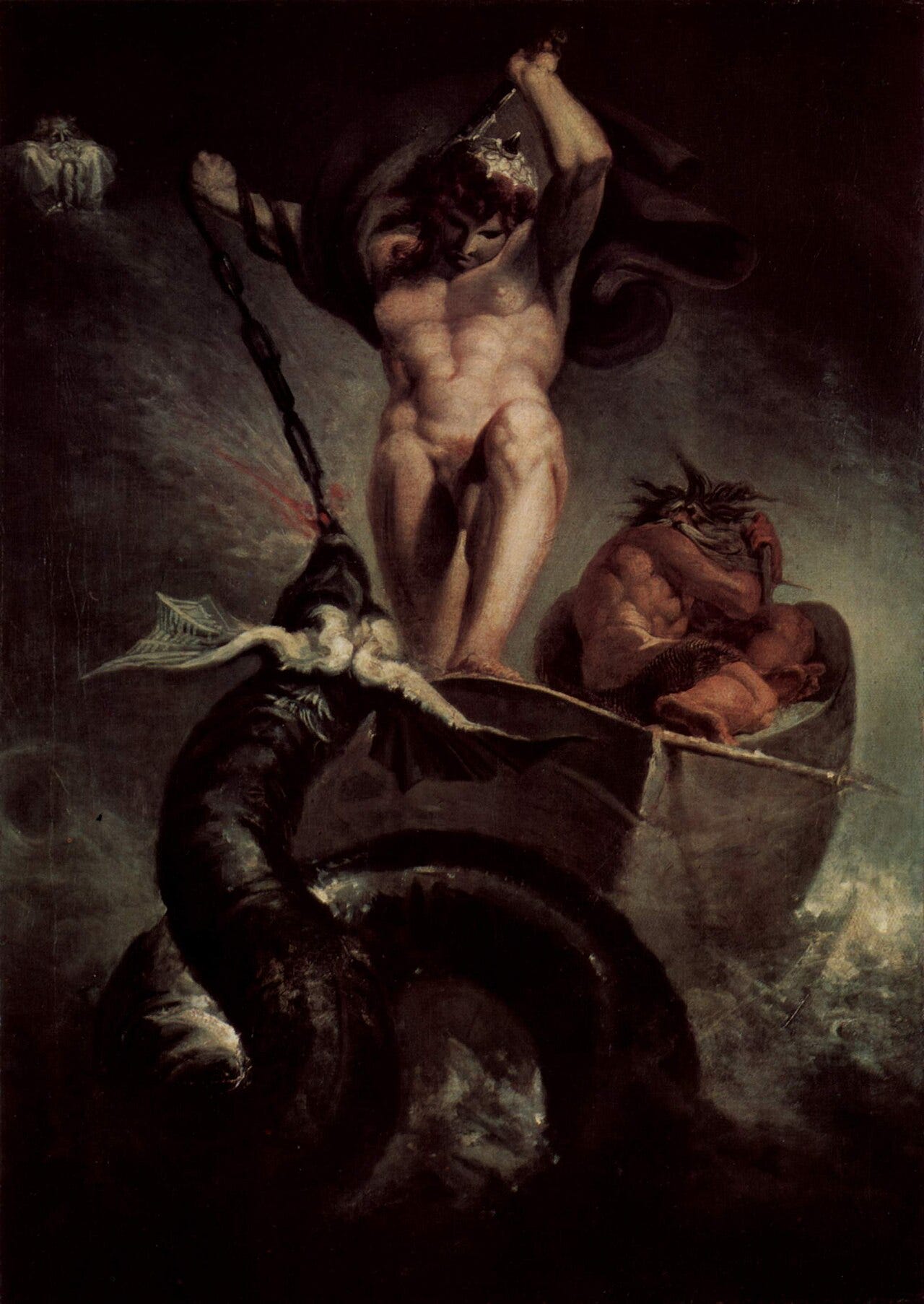
Third, Thor Battering the Midgard Serpent, a thunderous piece of history painting he gave to the Royal Academy.
The myth of the gentle Romantic
Romanticism is often sold as misty mountains and tender feeling. Fuseli is the proof it had a darker engine.
He was painting fear, desire and the unconscious a century before Freud gave them names. Freud is even said to have kept a print of The Nightmare on his wall.
Where his nightmares hang
The most famous version of The Nightmare is at the Detroit Institute of Arts. The Tate in London holds more of his dreamlike work.
The professor who shocked the Academy
Fuseli was no outsider shouting from the edge. He became a professor of painting at the Royal Academy and later its Keeper, shaping a whole generation of British artists.
He also gambled. For years he poured himself into a Milton Gallery, a room of huge canvases illustrating Paradise Lost. It lost money, but it shows how far he would push scale and ambition for a poem he loved.
The scandal that drove him from Zurich
He was born Johann Heinrich Fussli in Zurich in 1741, the son of a portrait painter and writer. The family steered him toward the church, and he was ordained a Protestant minister at twenty.
He did not stay a clergyman for long. With his friend Johann Kaspar Lavater, the young Fussli helped expose a corrupt local magistrate, and the powerful family behind the official turned on them.
To escape the fallout he left Zurich for good in the early 1760s. He drifted through Germany and on to England, where he anglicized his name to Henry Fuseli and slowly turned from letters to painting.
Eight years in Rome, and Michelangelo
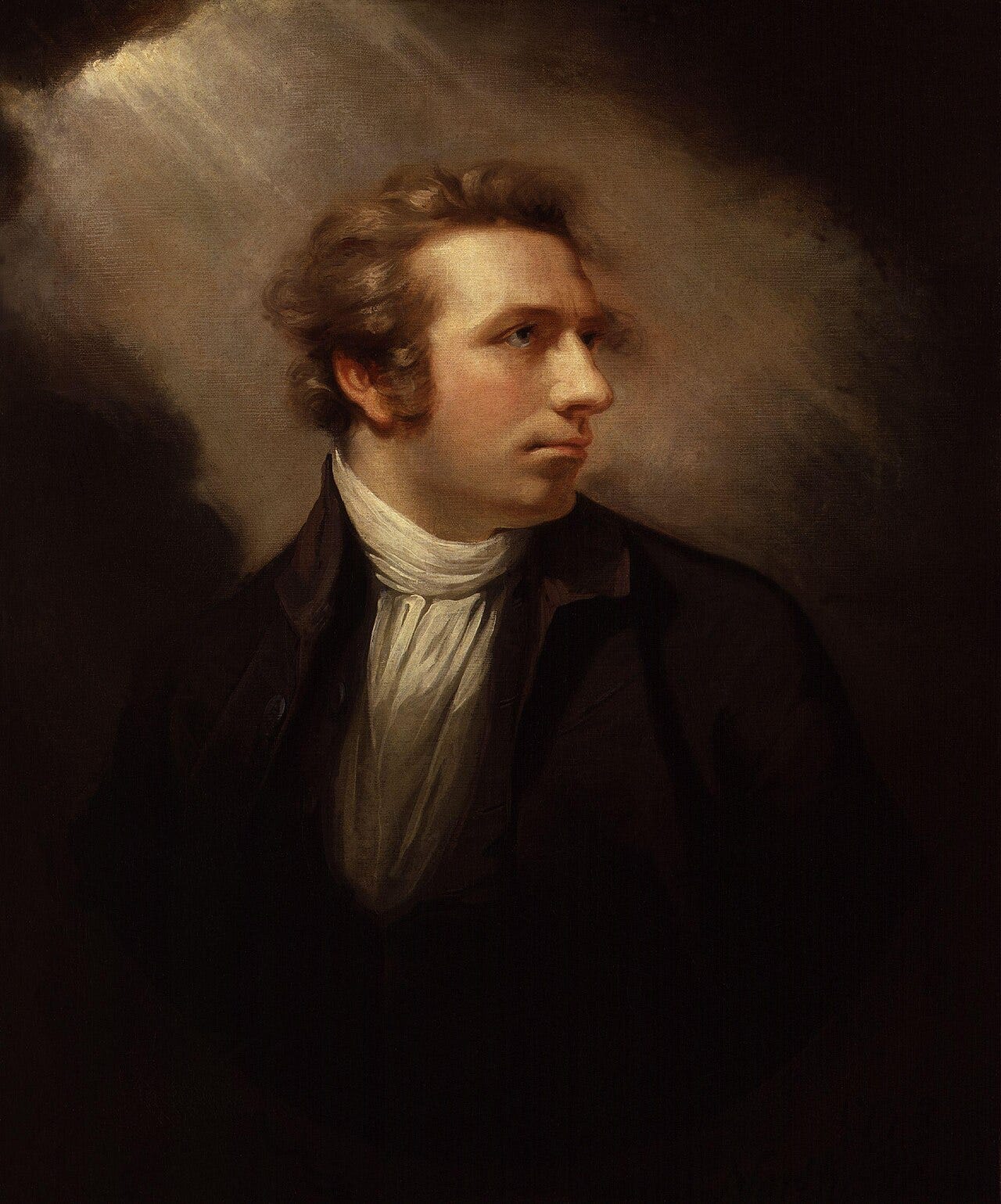
In England the painter Joshua Reynolds looked at Fuseli's drawings and urged him to make art his life. To train properly, Fuseli went to Italy, and he stayed from 1770 to 1778.
He spent most of that time in Rome, and one thing overwhelmed him: the ceiling of the Sistine Chapel. He would lie on his back for hours studying Michelangelo's giant figures, and the muscular, twisting bodies entered his work forever.
He came back from Italy a changed painter. The heroic, straining nudes that fill his pictures of nightmares and myths were born on the floor of that chapel, staring up.
The Milton Gallery that ruined him
Fuseli loved literature as much as paint, and his grandest scheme grew out of it. Between the 1790s and 1800 he created a whole Milton Gallery, a series of large canvases based on Paradise Lost and other poems by John Milton.
He gambled years and much of his money on the project, hoping the public would pay to see it. When the gallery opened in London around 1799 and 1800, it drew respect but not enough visitors, and it lost money.
The failure stung, though it did not break him. The Milton pictures remain some of his most radical attempts to paint the invisible, from Satan to sin and death.
Mary Wollstonecraft and a one sided love
Fuseli moved among the writers and radicals of London, and one of them fell hard for him. The pioneering feminist Mary Wollstonecraft, author of A Vindication of the Rights of Woman, became deeply attached to him in the early 1790s.
By some accounts she proposed a shared domestic life alongside Fuseli and his wife Sophia, a plan she seems to have imagined as high minded and platonic. Sophia refused to have her in the house, and the door closed.
Wollstonecraft soon left for Paris in the middle of its revolution, wounded by the rejection. The episode is a reminder of how central Fuseli was to the intellectual life of his day, not just its art.
The friend of William Blake
Among the artists who orbited Fuseli was the poet and printmaker William Blake, who became a genuine friend. The two shared a taste for visions, myth and the darker reaches of the imagination.
Blake admired the older man and once wrote a wry couplet about how the world praised Fuseli's foreign air. Fuseli, for his part, defended Blake's strange genius when many dismissed it.
Their friendship links two of the most unusual imaginations in British art. Between them they pushed painting toward dream and nightmare, away from the polite portraits of the age.
The private drawings of tangled hair
There is a stranger, more secret Fuseli. Away from his public pictures he made private drawings of women, often his wife Sophia, with wildly elaborate braided and towering hairstyles.
The images carry a charge of fetish and control, and they were not made for exhibition. For a long time they were kept quietly out of view.
Modern scholars now study them closely as a window into his desires and his times. They show that the man who painted public nightmares kept some of his most personal ones on paper, for his eyes alone.
The writer behind the painter
Fuseli never stopped being a man of letters. He spoke and wrote several languages, and before he was a known painter he made his living partly by translating and by his pen.
He translated the German scholar Winckelmann on ancient art into English, and he later wrote sharp, quotable Aphorisms on Art. As Professor of Painting at the Royal Academy, he delivered lectures that students copied down and remembered for their wit and bite.
This double life set him apart. He read Homer, Dante, Shakespeare and Milton in the original or close to it, and he painted straight out of that reading. His pictures are, in a real sense, literature turned into paint.
More secrets to unlock


The Henry Fuseli questions that keep coming up
When was Henry Fuseli born? In 1741 in Zurich, Switzerland. He died in London in 1825.
What is he famous for? The Nightmare of 1781, one of the first paintings of a pure bad dream.
What does The Nightmare mean? Fuseli never said. It mixes sleep, desire and dread, and invites your own reading.
What style did he paint in? An intense, theatrical Romanticism, full of muscle, shadow and the macabre.
Where is The Nightmare? The best known version is at the Detroit Institute of Arts.