
Jacques Louis David was the painter of the French Revolution and then of Napoleon, the artist who turned Neoclassicism into propaganda and propaganda into art.
He painted a murdered radical like a saint, crowned an emperor on canvas, and ended his life in exile. No painter ever stood closer to power, or fell further with it.
Born in Paris in 1748, he led Neoclassicism for half a century and trained the men, from Ingres to Gros, who ran French art after him.
His brush followed the politics of his age so closely that his life reads like the story of France itself, from the guillotine to the throne.
More incredible painter stories
If Jacques Louis David pulled you in, you will love these too:


Jacques Louis David at a glance
1748. Born in Paris. His father died in a duel when he was nine.
1774. Won the Prix de Rome on the fourth try and left for Italy.
1784. The Oath of the Horatii stopped Rome, then Paris.
1793. Voted for the king’s death as a deputy, then painted The Death of Marat.
1825. Died in exile in Brussels. France refused the return of his body.
The Death of Marat, a murder turned into an icon
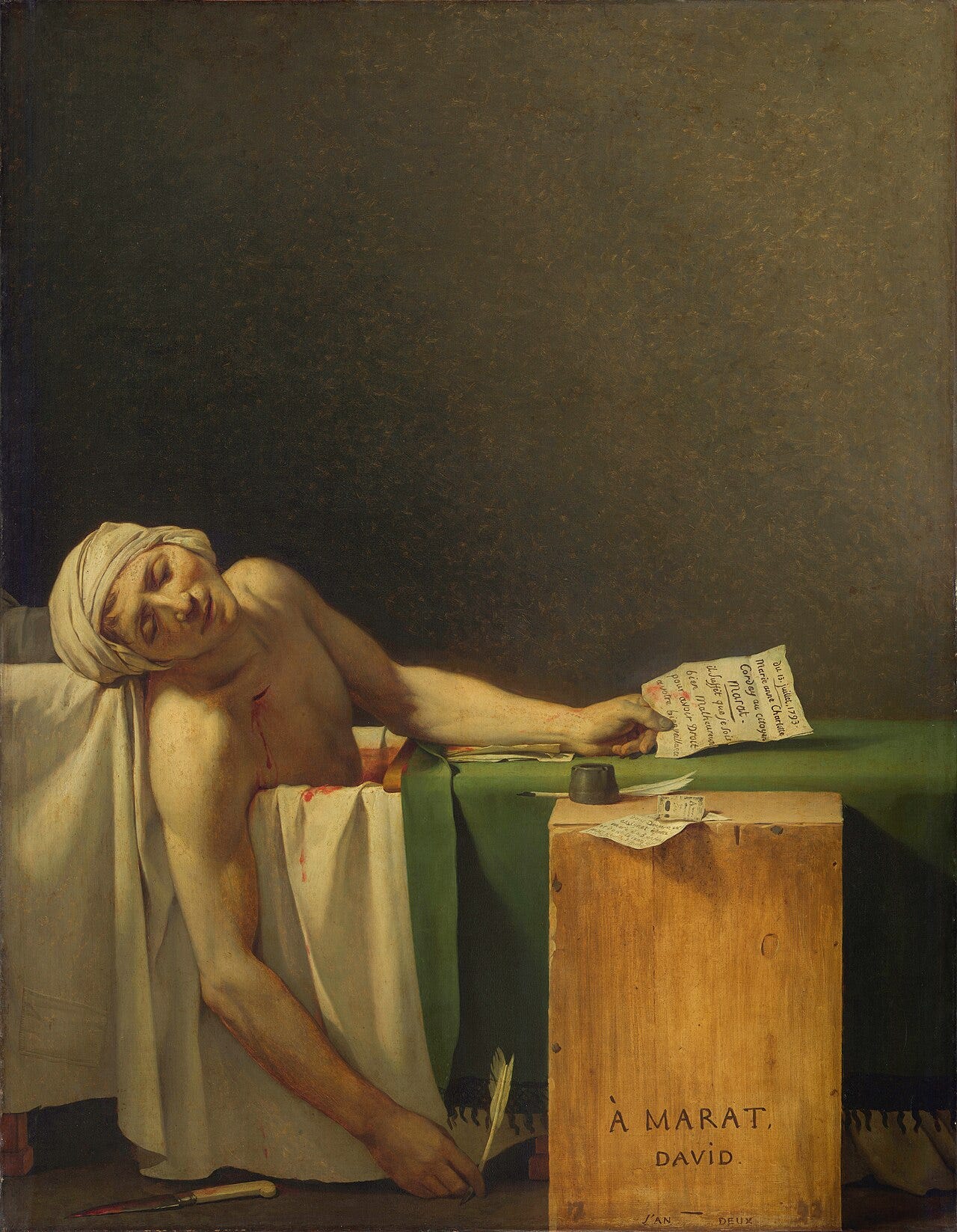
In 1793 his friend the radical journalist Marat was stabbed in his bath. David painted him slumped and pale, pen still in hand, lit like a saint in a dark void.
It remains one of the most powerful pieces of political history painting ever made, a real murder turned into a secular altarpiece.
From the Revolution to the Emperor
When the Terror ended, David was jailed, then found a new master: Napoleon. He painted Napoleon Crossing the Alps as a hero on a rearing horse, and the vast Coronation in which the general crowns himself.
The painter of the Republic had become the painter of the Empire.
Neoclassicism as a weapon
David made Neoclassicism the official language of his time: clean line, Roman subjects, a clear moral in every scene. He trained a whole generation, including Ingres and Gros, and set the rules that the young Romantics, led by Delacroix, would later fight to break.
His handling of the nude set the standard taught in every academy.
Exile and the end
When Napoleon fell, David fled to Brussels and never set foot in France again. He died there in 1825, struck by a carriage as he left a theatre, still the most important painter of his age and an exile from the country he had served.
The teacher who ruled French art
David did not only paint power, he taught it. His studio was the largest in France, turning out hundreds of pupils, among them Gros, Gerard and the young Ingres.
Through them his cool, linear style governed French painting for half a century, which is exactly why the next generation, led by Delacroix, had to fight so hard to break free of it.
The five canvases that carried his fame
A handful of paintings carry his fame: the Oath of the Horatii, the Death of Marat, the Death of Socrates, Napoleon Crossing the Alps, and the enormous Coronation of Napoleon. Each one is an argument as much as a picture.
Born in Paris in 1748, an orphan of a duel at nine
Jacques Louis David was born in Paris on 30 August 1748. His father was a prosperous dealer in textiles, comfortable enough to give the boy a solid start.
That start broke apart in 1757. When David was nine, his father was killed in a duel. His mother left him with two of her brothers, both in the building trades, who raised him without much warmth and expected him to become an architect.
The boy wanted to draw instead. He pushed against the family plan until they agreed to let him try painting. So the future painter of Roman virtue and imperial glory began as a half orphan handed between relatives, already stubborn about the one thing he meant to do.
The swelling on his cheek and the speech it cost him
For his whole adult life David carried a growth on the left side of his face. Sources of record describe it as a tumour on the cheek that pressed on his speech.
It gave him a thick, slurred delivery. At his trial after the Revolution he is said to have defended himself badly, stumbling over the same phrases.
You will often read that the swelling came from a sword wound in a fencing bout as a young man. That origin is a repeated tradition, not a fact the major museums confirm.
What is documented is plainer and harder. A man who could command a canvas in total silence could not always make himself understood out loud.
Four failures, one attempt on his own life, then Rome in 1774
David trained under Joseph Marie Vien, a history painter feeding the new taste for ancient Greece and Rome. At eighteen he entered the school of the Royal Academy of Painting and Sculpture.
Then came the Prix de Rome, the state scholarship every young French painter wanted. It paid for years in Italy and all but promised commissions back home.
David failed the competition four times, and the discouragement went deep enough that he reportedly tried to starve himself to death.
On the fifth try, in 1774, he finally won. He reached Rome in 1775. The lesson he drew was not modesty. It was that talent had to be forced through by will.
The years in Rome that pointed him at antiquity
Rome remade him. David spent roughly five years drawing after ancient statues, Roman reliefs, and the ruins of the old city. He filled sketchbooks with figures, gestures, and the fall of drapery copied straight from marble.
The soft, decorative manner he had learned in Paris fell away. In its place came clear outlines, sober color, and figures built like sculpture. This turn toward Greek and Roman models is what we call Neoclassicism.
One myth is worth clearing up. David did not invent it alone. His teacher Vien already leaned that way, and the wider revival of antiquity in Rome was under way before he arrived. What David did was give the style force and a public.
The Oath of the Horatii stops Rome and Paris in 1784
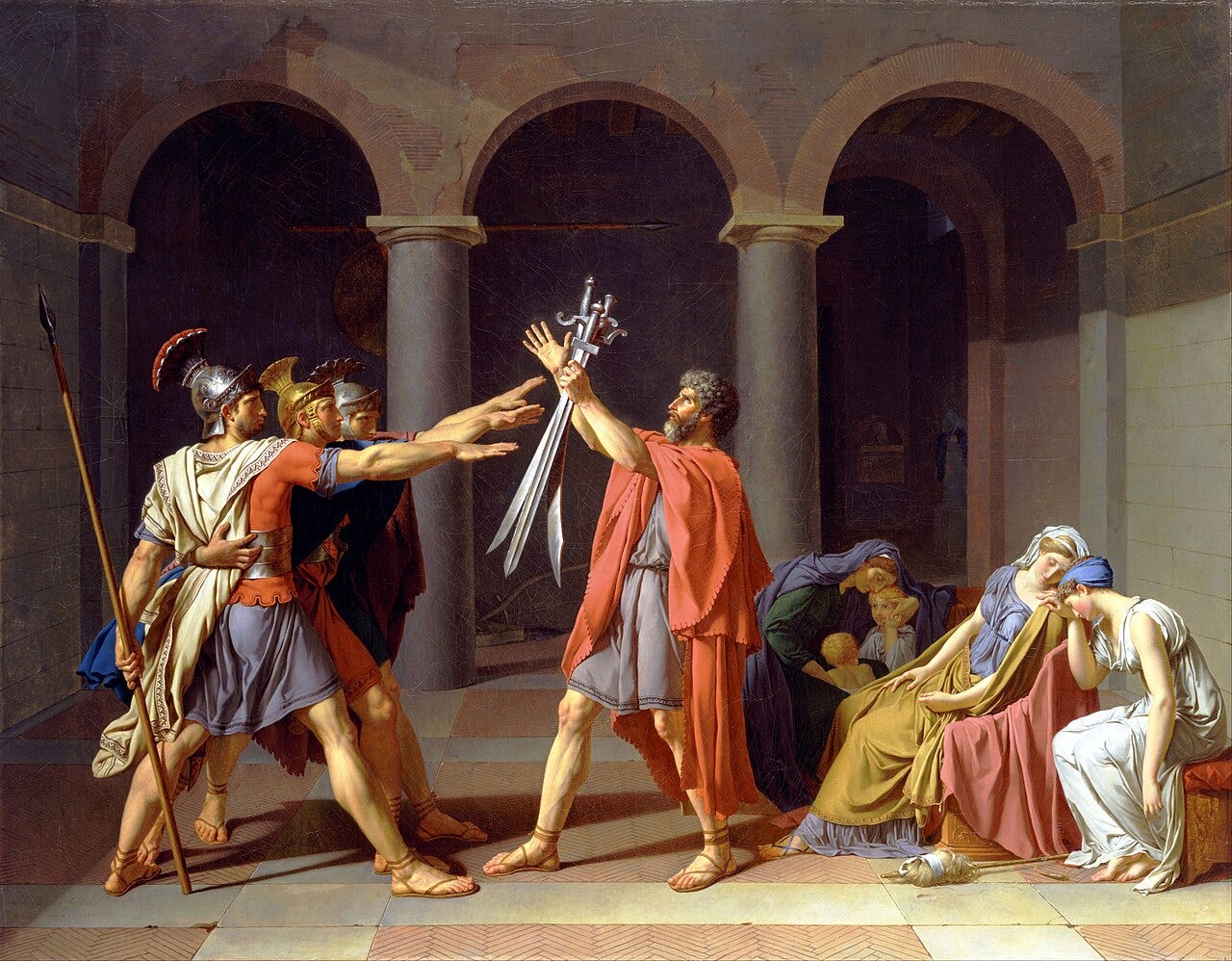
David painted the Oath of the Horatii in Rome in 1784, on a royal commission from the government of Louis XVI. The subject came from early Roman history: three brothers swearing to their father to fight for their city, whatever it costs their family.
He showed it first in his Roman studio, and crowds came. When it reached the Paris Salon of 1785, it landed as an event.
Viewers read the taut, upright soldiers against the weeping women as a lesson in duty over feeling. Critics treated David at once as the leader of the French school. He was thirty six, and the painting made every later commission possible.
Elected to the Academy, then turning to break it
Success brought official standing. David was received into the Royal Academy of Painting and Sculpture in 1783, the body that controlled who exhibited and who rose in French art.
Within a decade he was trying to tear it down. As the Revolution advanced, he attacked the Academy as a closed, privileged club that served the old order. In 1793 the Convention abolished it, and David was central to the campaign.
The move fit the man. He had spent years locked out of that same system by its competitions, and now he had the power to end it. He rebuilt French art teaching around his own studio instead.
The deputy who voted for the king's death
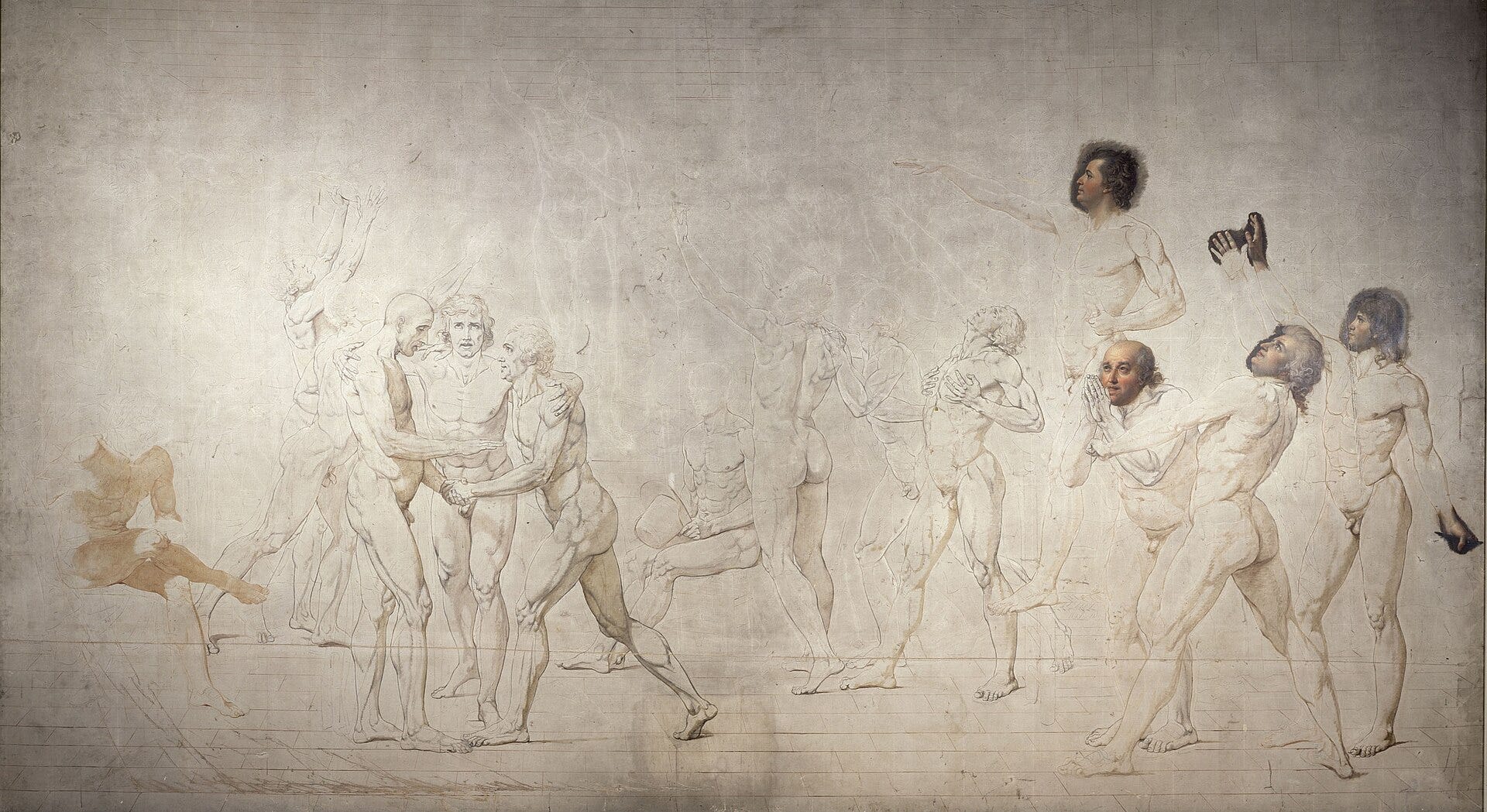
In 1792 David was elected to the National Convention, the assembly running France as a republic. He sat with the radical Montagnard faction alongside Robespierre.
When the Convention tried Louis XVI, David voted for the king's execution. Louis was guillotined in January 1793.
David also became the Revolution's stage manager. He organized huge public festivals, struck commemorative medals, and designed the solemn funerals the new state gave its martyrs.
He staged the funeral of the murdered deputy Lepeletier and, months later, the funeral rites for Jean Paul Marat, and he painted both men dead as republican saints.
For a few years the most powerful figure in French art was also a working politician who had helped kill his king.
Arrested twice after Robespierre fell
David tied himself closely to Robespierre. In July 1794 Robespierre was overthrown and sent to the guillotine.
David was arrested soon after. He was held for about four months in 1794, mostly in the Palais du Luxembourg in Paris, then released, then jailed again for roughly two more months in 1795.
Prison could have ended him. Instead it gave him a subject. He asked to be allowed to keep painting, and behind bars he began planning a large canvas about ancient Rome and the cost of civil war.
He survived the backlash that killed many of his allies, and came out with his ambition intact and a new picture already forming.
The Sabine Women, and the day he charged at the door
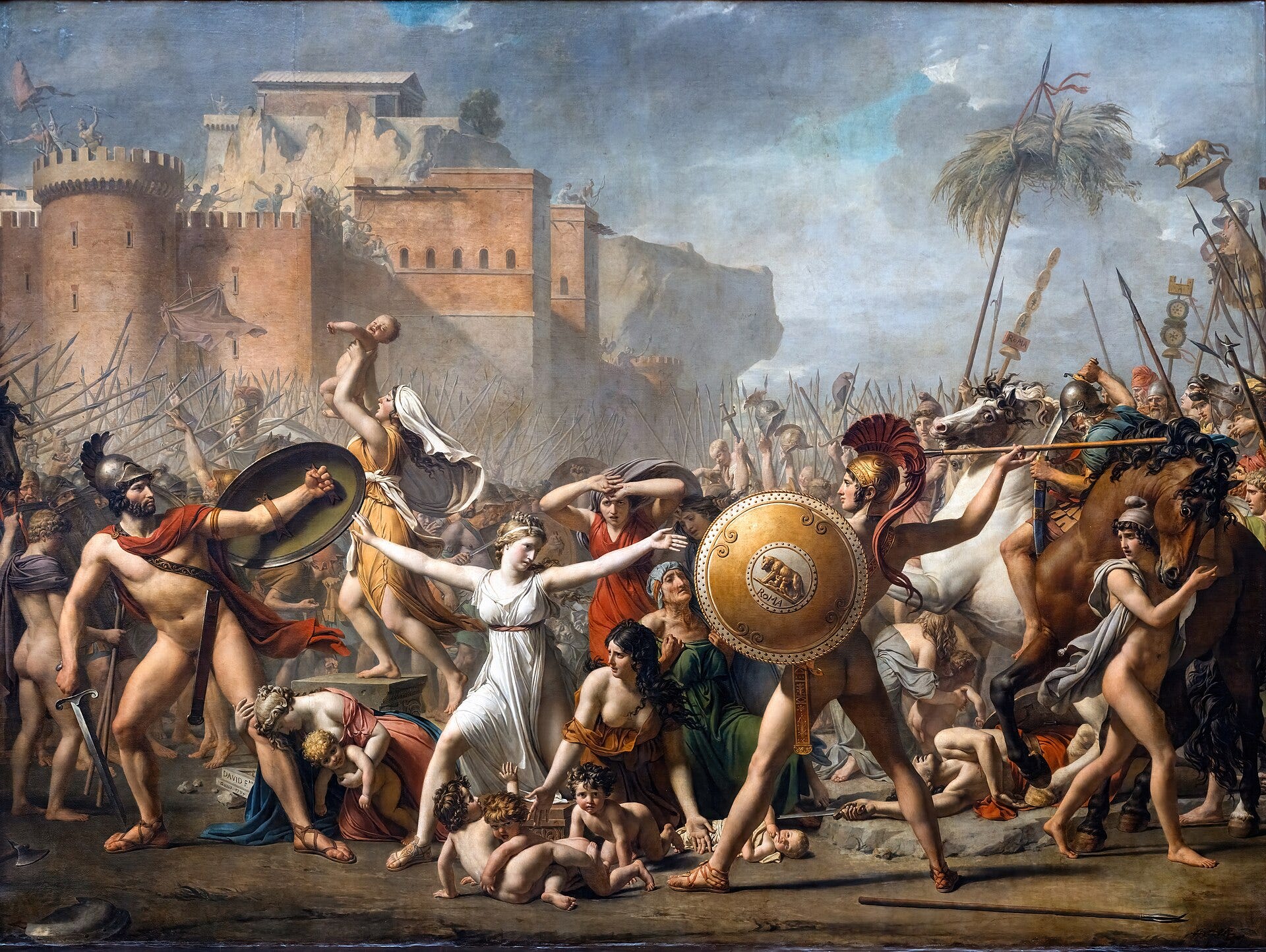
The picture David planned in prison became The Intervention of the Sabine Women, finished in 1799. It shows Sabine women throwing themselves between their fathers and their Roman husbands to stop the killing.
The meaning was aimed at his own country. After years of Revolution, terror, and score settling, David offered a plea for reconciliation.
Then he did something unusual for a serious French painter. Rather than send it to a free public Salon, he put it on paid display from December 1799 and charged an entry fee at the door.
Critics grumbled that a former republican deputy was selling tickets to his art. David kept the exhibition open for years and pocketed the receipts.
More secrets to unlock


David, from the Oath to exile, in brief
Who was Jacques Louis David? The leading French Neoclassical painter and the artist of the Revolution and Napoleon.
When was he born? In Paris, in 1748.
How did he die? In Brussels, in 1825, in exile, after being hit by a carriage.
What is he famous for? The Death of Marat and Napoleon Crossing the Alps.
What movement did he belong to? Neoclassicism, which he led.
Where can I see his work? Above all the Louvre in Paris.
Did Jacques Louis David really vote to execute the king? Yes. As an elected deputy in the National Convention, David voted for the death of Louis XVI, who was guillotined in January 1793. He was not a bystander to the Revolution. He sat with its radical wing, staged its festivals and martyr funerals, and later paid for that record with two spells in prison after Robespierre fell in 1794.
How did Jacques Louis David die? David died in exile in Brussels on 29 December 1825, at the age of seventy seven. He had left France after Napoleon's fall in 1815 and never returned. Accounts of record say his final decline followed a carriage accident in the city. He was still working in his last years, painting mythological scenes and portraits far from the Paris he had once ruled.
Napoleon Crossing the Alps shows the general on a rearing white horse, calm in a storm. The real Napoleon crossed on the back of a mule, led by a local guide. David painted the legend, not the man, and that is exactly why we remember it.