
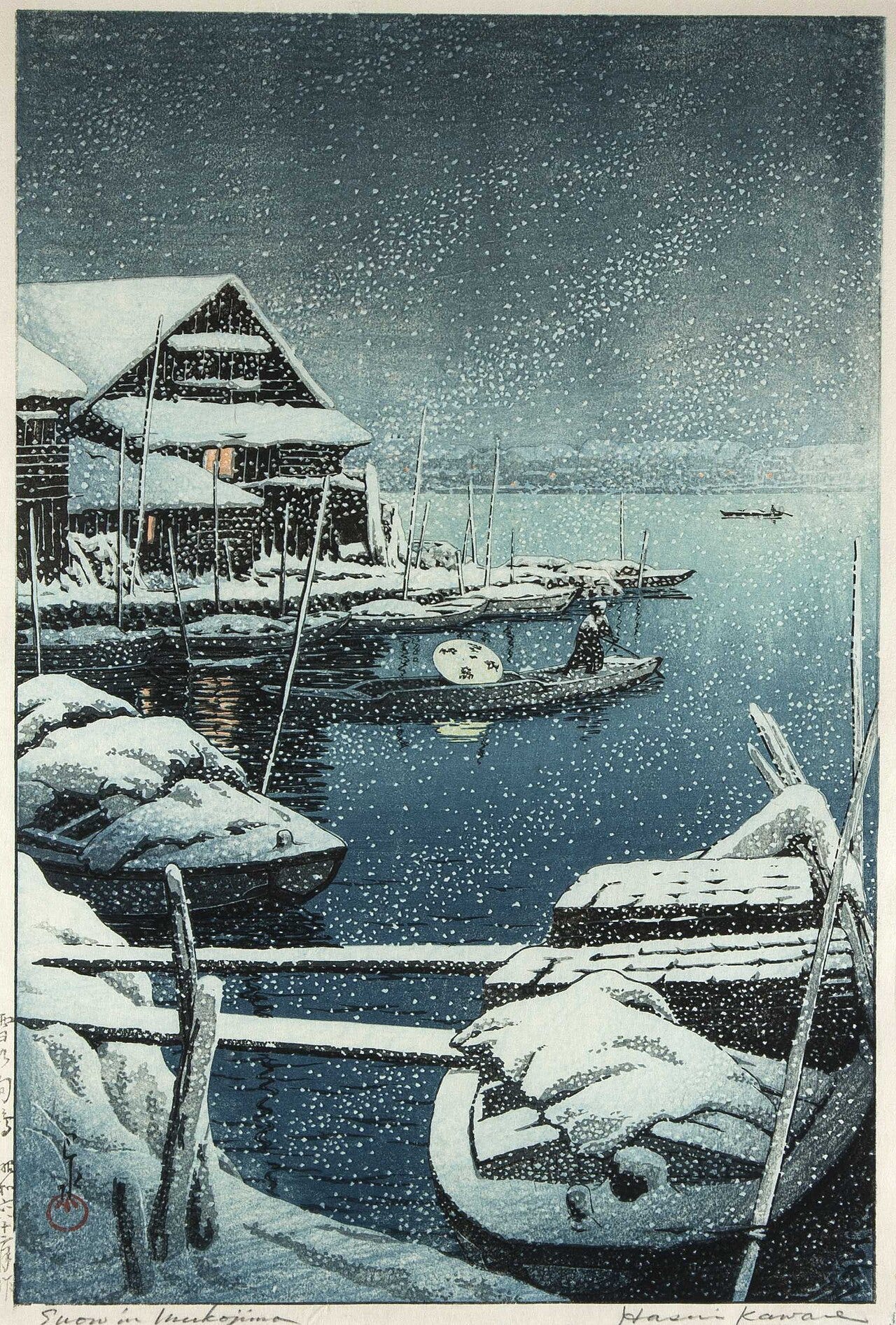
Kawase Hasui, 1883 to 1957, was the last great master of the Japanese woodblock print. He spent his life traveling Japan and turning quiet moments, snow on a shrine, rain on a lake, lamplight at dusk, into some of the most beloved prints of the 20th century.
As the star of the shin hanga movement, he worked hand in hand with the publisher Watanabe Shozaburo, rebuilt his life work after the 1923 Great Kanto earthquake burned his blocks, and was named a national living treasure the year before he died.
He carried a centuries old craft into the modern age, and an earthquake nearly ended it. Here is his story.
More incredible painter stories
If Kawase Hasui pulled you in, you will love these too:


Kawase Hasui at a glance
1883. Born Bunjiro Kawase in Tokyo’s Shiba district.
1918. Joined the publisher Watanabe and the shin hanga movement.
1923. The Great Kanto earthquake destroyed his sketchbooks and woodblocks.
1956. Japan recorded his craft as an intangible cultural property, built around one snowy print.
1957. Died in Tokyo at 74, the last great master of the landscape print.
The last master of the woodblock
Hasui worked in the tradition of the woodcut, the same craft behind Hokusai's Great Wave. A design is cut into wood, inked and pressed by hand, often in many layers of color.
By the 20th century photography and modern life had pushed the old prints aside. Hasui helped bring them back.
What shin hanga was
Hasui was the star of shin hanga, the new prints movement. It revived the classic Japanese woodblock for a modern audience, including Western collectors hungry for Japonisme.
He worked closely with the publisher Watanabe Shozaburo, who organized the carvers and printers. Hasui designed, the workshop produced, a team behind every image.
The earthquake that burned his blocks
In 1923 the Great Kanto earthquake struck Tokyo and a firestorm followed. Hasui lost sketchbooks and printing blocks in the disaster.
He responded by traveling and drawing even more, rebuilding his life's work from the ashes. The loss makes the survival of his images feel hard won.
Snow, rain, and the hush before dark
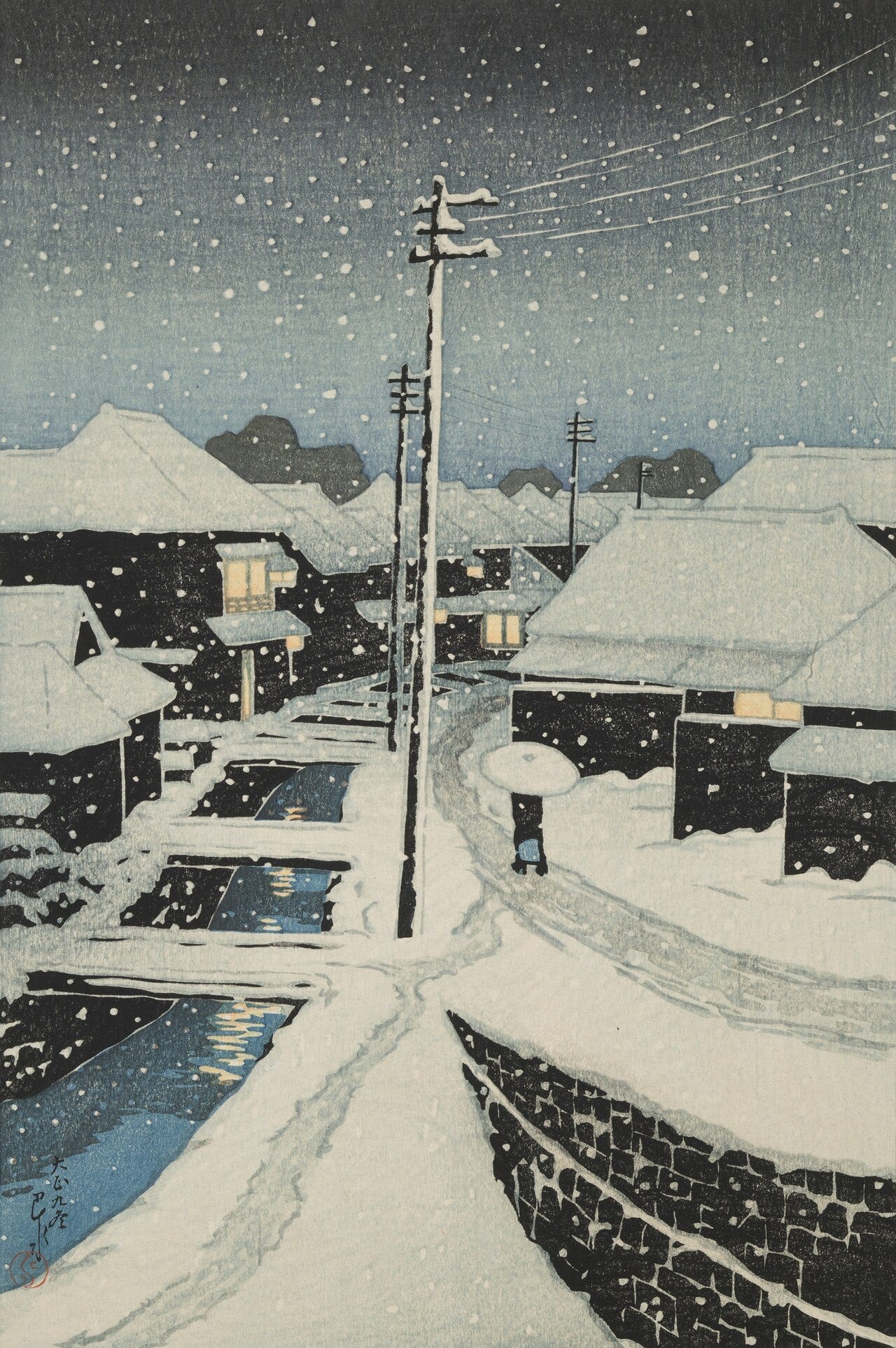
Look for the weather and the hush. Hasui is the painter of snow, rain, mist and twilight, a quiet landscape with a single small figure or a lit window.
He shows an old, gentle Japan just as the country was modernizing fast. The calm is part nostalgia, part farewell.
Start with the snow, then the rain
First, his snow scenes, like the shrine at Shiba in falling snow, all silence and soft white.
Second, his rain and twilight harbors, where lamplight doubles on wet stone.
Third, his temple and lake views, calm water under a wide evening sky.
The myth of mere nostalgia
It is easy to call shin hanga pretty nostalgia for tourists. That misses the skill and the moment.
Hasui was a master designer recording a country in the act of changing. In 1956 Japan recognized his craft as a national treasure, the year before he died.
New York and Boston hold the deepest collections
The Metropolitan Museum of Art holds many Hasui prints. The Museum of Fine Arts, Boston has a deep Japanese print collection with his work.
A print made by a team
A shin hanga print was teamwork. Hasui drew the design, a carver cut the blocks, a printer pressed the colors in layers, and Watanabe published. One image could take dozens of careful steps.
He designed more than 600 prints over his life. His quiet scenes found fans far from Japan, and the collector Steve Jobs was among the Westerners drawn to shin hanga prints like his.
Born in the Shiba district in 1883
Kawase Hasui was born in the Shiba district of Tokyo in 1883. His given name was Bunjiro, and Hasui came later, an art name.
The family ran a small business in braided silk cord and thread, the kind of trade that dressed kimono and stitched everyday life together.
His mother's brother was the comic writer Kanagaki Robun, a man with deep ties to kabuki theatre. That link mattered. Hasui kept a foot in the theatre world for years, designing actor portraits and, later, stage sets.
So the boy grew up around both commerce and performance, in a Tokyo that was still half Edo. The city he was born into would be the city he drew for a lifetime.
The shop he was meant to inherit
As the son of the house, Hasui was expected to take over the family shop. Art was a hobby, not a future.
His health complicated everything. He was frail as a boy and stayed that way for life. Sent often to the hot spring town of Shiobara, where an aunt lived, he fell for the quiet of snow, rain and mist.
Those trips planted the subjects he would return to for decades.
He did not come to art full time until 1908, when his father passed the business to a relative. Hasui was in his mid twenties by then, a late start by any measure. The shop had failed to hold him, and that release set him free to draw.
He wanted to paint like a Westerner
Hasui did not set out to make Japanese prints at all. His first ambition was Western style painting.
In 1907 he joined the Hakubakai, the White Horse Society, a circle devoted to oil painting and European landscape. There he took guidance from Okada Saburosuke, a leading Western style painter of the day.
The pull of oil and perspective stayed with him. You can see it later in the depth of his skies and the weight of his water. He never fully chose one tradition over the other.
Instead he carried the Western eye into an old Japanese craft, which is part of why his prints feel both familiar and new.
The teacher who first said no
By many accounts, Hasui first tried to study under Kaburagi Kiyokata and was turned away. Kiyokata told him he was not ready and should study more.
Hasui went back to work and kept at it. In 1910 Kiyokata finally took him on, and it was Kiyokata who gave him the name Hasui. Kiyokata worked in the Nihonga tradition of Japanese style painting, and through him Hasui found his way toward prints.
One detail is worth flagging. The story of the early refusal is widely repeated in print histories, though museum records simply note that Kiyokata became his teacher in 1910.
Either way, the lesson stuck. Hasui was a slow, patient learner who arrived late and stayed.
The publisher who bet on new prints
The man who turned Hasui into a printmaker was a publisher, not an artist. Shozaburo Watanabe ran a print business in Tokyo and had a plan.
He wanted to revive the old woodblock trade with fresh designs, a movement that became known as shin hanga, or new prints. Watanabe met Hasui through Kiyokata and published his first landscape prints around 1918 and 1919.
The partnership lasted the rest of Hasui's life.
Watanabe supplied the carvers, the printers and the commercial nerve. Hasui supplied the eye. Without Watanabe there is no Hasui as we know him, and without Hasui, Watanabe's new prints might have stayed a nice idea.
The two needed each other, and the work shows it.
Sketchbooks carried across Japan
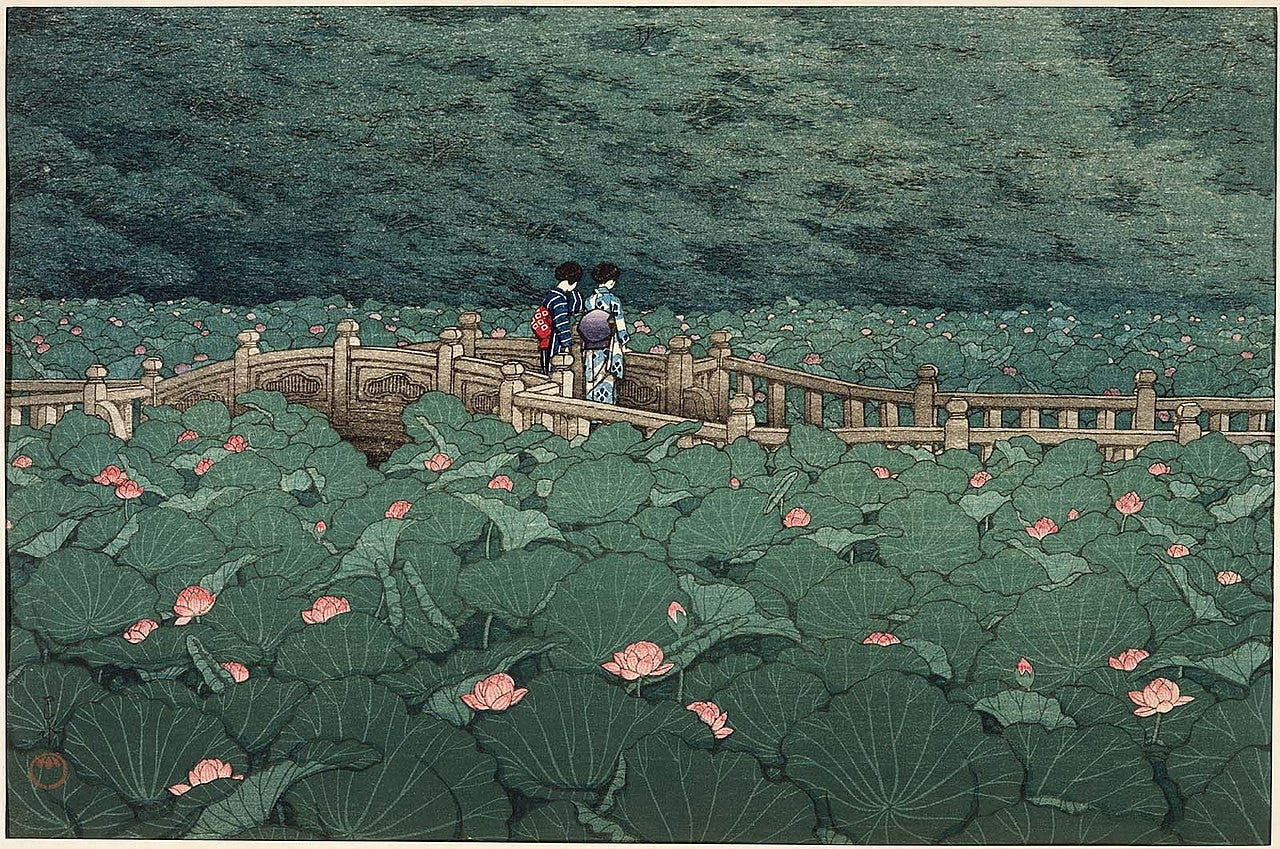
Hasui built his prints on the road. He traveled constantly, criss crossing Japan with a sketchbook and a box of watercolours.
He would sit in front of a temple gate or a harbour at dusk and paint the scene on the spot. Back in Tokyo, those watercolour sketches became the designs that carvers cut into wood. The travel was the method, not a break from it.
Over his career he produced more than 600 prints, grouped into roughly seventeen series, covering nearly every region of the country.
That is a large body of work for one lifetime. It also means his prints add up to a kind of atlas. Follow them and you travel the Japan of the 1920s to the 1950s, one quiet corner at a time.
The collectors who chased him, from Muller to Jobs
Hasui found some of his most devoted fans outside Japan. The American collector Robert Muller assembled one of the great holdings of these new prints, now kept by the Smithsonian in Washington. His name turns up in the scholarship again and again.
The most famous modern admirer, though, was Steve Jobs. By widely reported accounts, the Apple founder began collecting Hasui in the early 1980s and gathered a couple of dozen of his prints over the years.
Treat the Jobs details as reported rather than fully documented by a museum. What is clear is the pattern. Hasui's calm, exact landscapes travel well, and they have quietly drawn collectors for a century.
A print recorded to save a craft
Late in life Hasui took part in an unusual act of preservation. In 1953 a committee charged with protecting Japan's cultural heritage asked him to design a new print, Snow at Zojoji Temple.
The point was not just the picture. Officials documented the entire process, from Hasui's design to the carving and the printing, to record the collaborative craft of shin hanga before it faded.
The work was recognised in connection with Japan's system for safeguarding an Important Intangible Cultural Property.
In plain terms, the government treated the making of the print as something worth saving, not only the print itself. It was a rare honour, and a sign of how far the old woodblock trade had slipped by the 1950s.
His death in 1957, and a Japan slipping away

Hasui died in Tokyo in 1957, at the age of 73. He worked nearly to the end.
Cancer put him in hospital, and by several accounts he completed his final design there, a temple scene, before his death that November. The 1953 Snow at Zojoji is often remembered as his signature late image, a hushed temple gate under falling snow.
For all his travels, Hasui kept returning to a Japan that was vanishing as he drew it. Wooden bridges, lantern lit lanes, ferries and shrines were giving way to concrete and rail.
His prints hold that older country still. Look closely and you are seeing a place that modern Japan was already leaving behind.
More secrets to unlock


The Kawase Hasui questions that keep coming up
When was Kawase Hasui born? In 1883 in Tokyo. He died there in 1957.
What is he famous for? Shin hanga landscape woodblock prints of snow, rain and twilight.
What is shin hanga? A 20th century revival of the Japanese woodblock print for a modern market.
What did the 1923 earthquake destroy? Many of his sketchbooks and printing blocks were lost in the disaster.
Where can I see his work? The Met in New York and the Museum of Fine Arts in Boston.
What was Kawase Hasui's real name? He was born Kawase Bunjiro in Tokyo in 1883. Hasui was an art name, given to him around 1910 by his teacher Kaburagi Kiyokata. Japanese artists often took such names, so the name on the prints is not the one on his birth record.
How many prints did Kawase Hasui make? Museum records credit him with more than 600 landscape prints, organised into around seventeen series over roughly forty years. He traveled across almost every region of Japan to gather the scenes, which is why his output reads like a portrait of the whole country.