
Paul Gauguin was a French Post Impressionist who walked away from a comfortable life as a stockbroker, abandoned his family, and chased an idea of paradise to the islands of the South Pacific.
Working first in Brittany, then in Arles alongside Van Gogh, and finally in Tahiti, he turned flat, unnatural color into a new language that reshaped modern art.
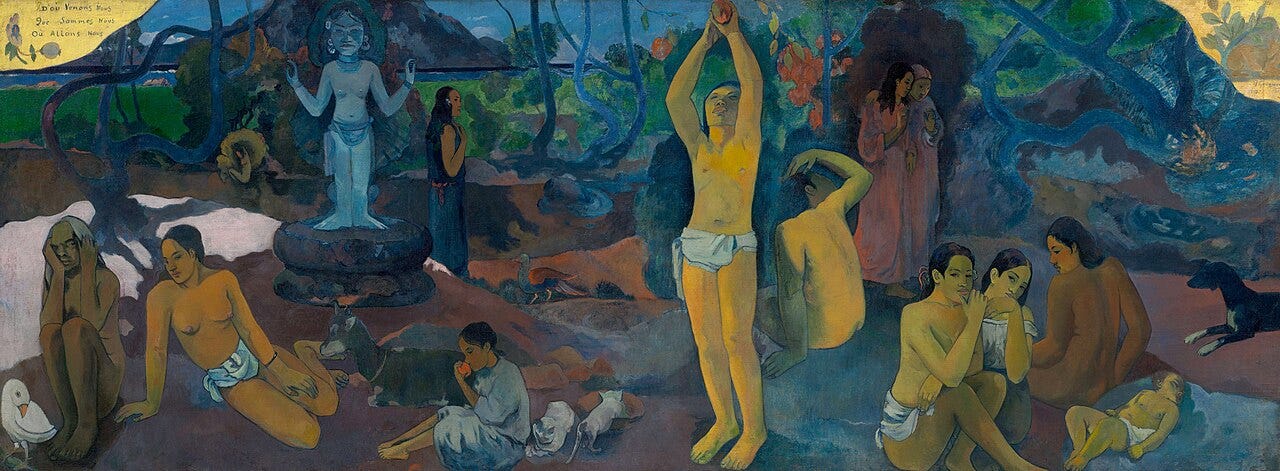
He used color like no one before him, not to copy nature but to express feeling and dream. That freedom opened the door to Matisse, Picasso and modern art.
He left France for the first time in 1891, chasing a version of the tropics that turned out to be far more colonized than he expected, and his own account of that decision is unpacked in Why Did Gauguin Go to Tahiti?.
More incredible painter stories
If Paul Gauguin pulled you in, you will love these too:


His legend of the artist who gave up everything for art hides a darker, more troubling truth. Here is the whole story, including the parts often left out.
Paul Gauguin at a glance
1848. Born in Paris in a year of barricades. His toddler years were spent in Lima.
1882. The stock market crash pushed the broker toward full time painting.
1888. Nine weeks with Van Gogh in Arles that ended with a razor and a severed ear.
1891. First departure for Tahiti.
1903. Died in the Marquesas at 54, in a house he had named the House of Pleasure.
The man who freed color
Gauguin freed color from reality. He filled his pictures with flat areas of intense, unnatural color outlined in dark lines, painting a red dog or a pink beach if it felt true.
This belongs to Post Impressionism and to Symbolism, art that values mood and meaning over appearances. The next generation took his liberated color and ran with it.
From stockbroker to painter
Gauguin’s start was ordinary. He had a solid career as a Paris stockbroker, a wife and five children, and painted only on weekends.
When the stock market crashed in the 1880s, he made a drastic choice: he gave up business to paint full time, and gradually left his family behind. He bet everything on art, and never really looked back.
The five signs of a Gauguin
A Gauguin is easy to spot.
Flat, intense color. Large areas of saturated color, not blended but laid down in strong shapes.
Dark outlines. Forms ringed with strong contours, a style borrowed partly from stained glass.
Dreamlike scenes. Figures that feel symbolic and still, not snapshots of real life.
The South Seas. Tahitian people, fruit and idols, painted as a lost paradise.
Brittany and the leap to color
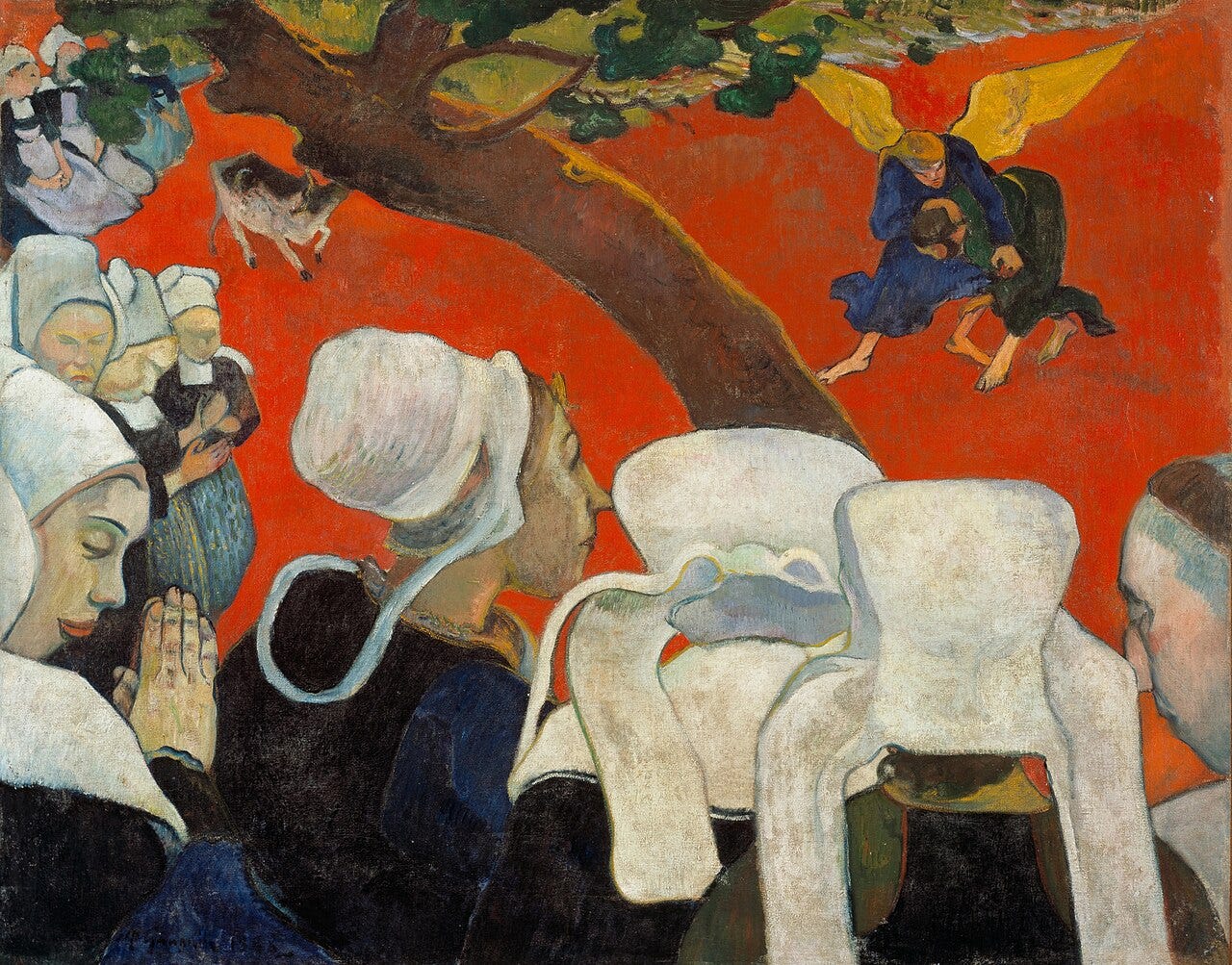
Before Tahiti, Gauguin found his style in Brittany, in rural France, painting peasants and their faith.
There he made Vision after the Sermon, where the ground turns flaming red, a sharp break from realism. He and his circle called this new flat, symbolic style Synthetism.
Arles, and the night with Van Gogh
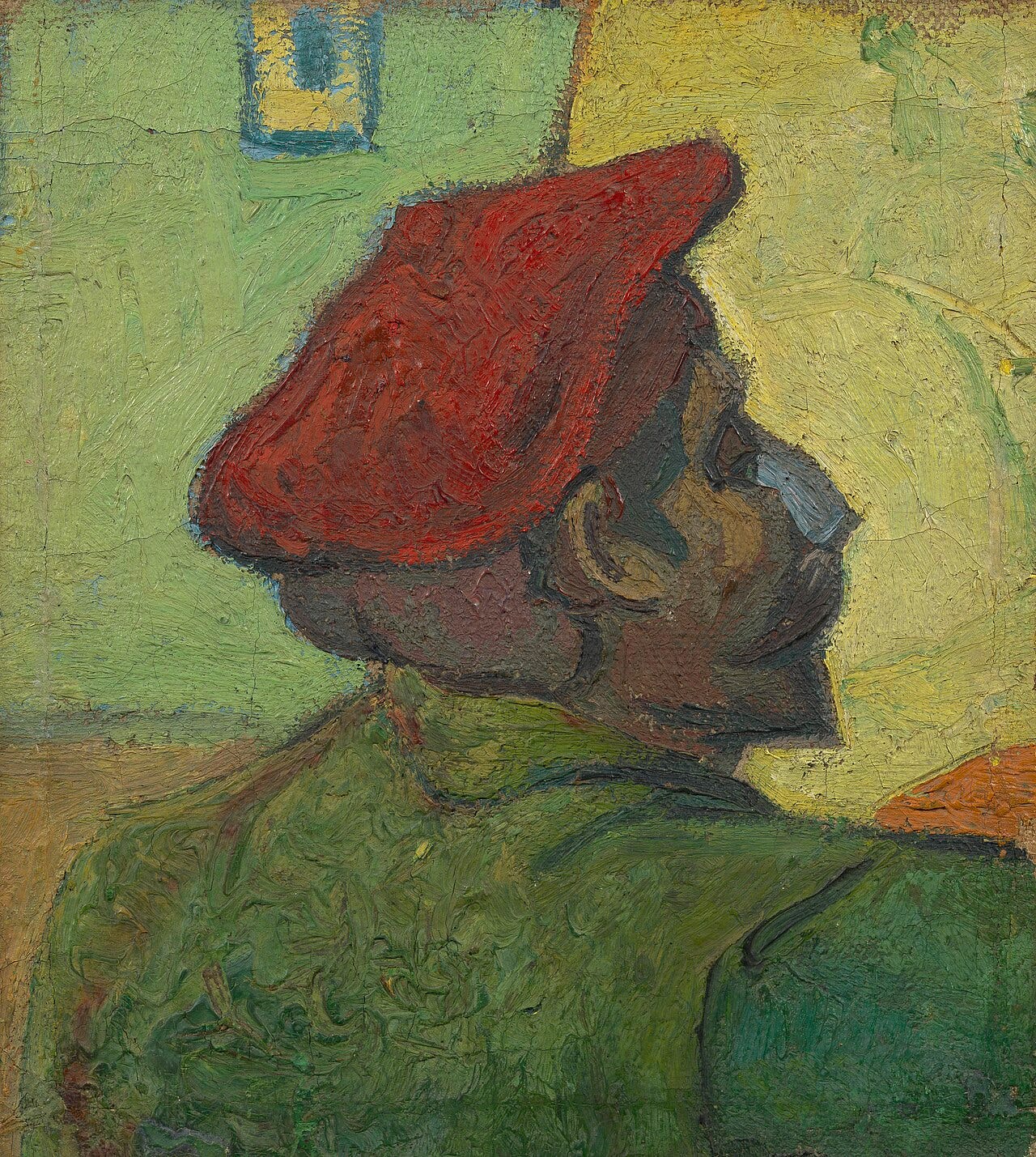
In 1888 Gauguin joined Vincent van Gogh in Arles, in the south of France, to paint together.
The two strong willed men clashed badly, and after weeks of tension the visit ended on the night Van Gogh cut off part of his own ear. The dream of an artists’ colony collapsed.
Tahiti, and the troubling truth
In 1891 Gauguin sailed to Tahiti, seeking an untouched paradise. What he found was a place already changed by French colonial rule, so he painted the myth he wanted rather than the reality.
Here the honest account gets dark. In Tahiti Gauguin took very young teenage girls as partners and likely spread syphilis among them. His genius and his exploitation cannot be separated, and any full picture of him has to hold both.
How Gauguin died
Gauguin spent his last years in the remote Marquesas Islands, sick, in debt and at war with the colonial authorities.
He died there in 1903, at 54, largely alone. Soon after, big exhibitions in Paris revealed his power and his fame exploded.
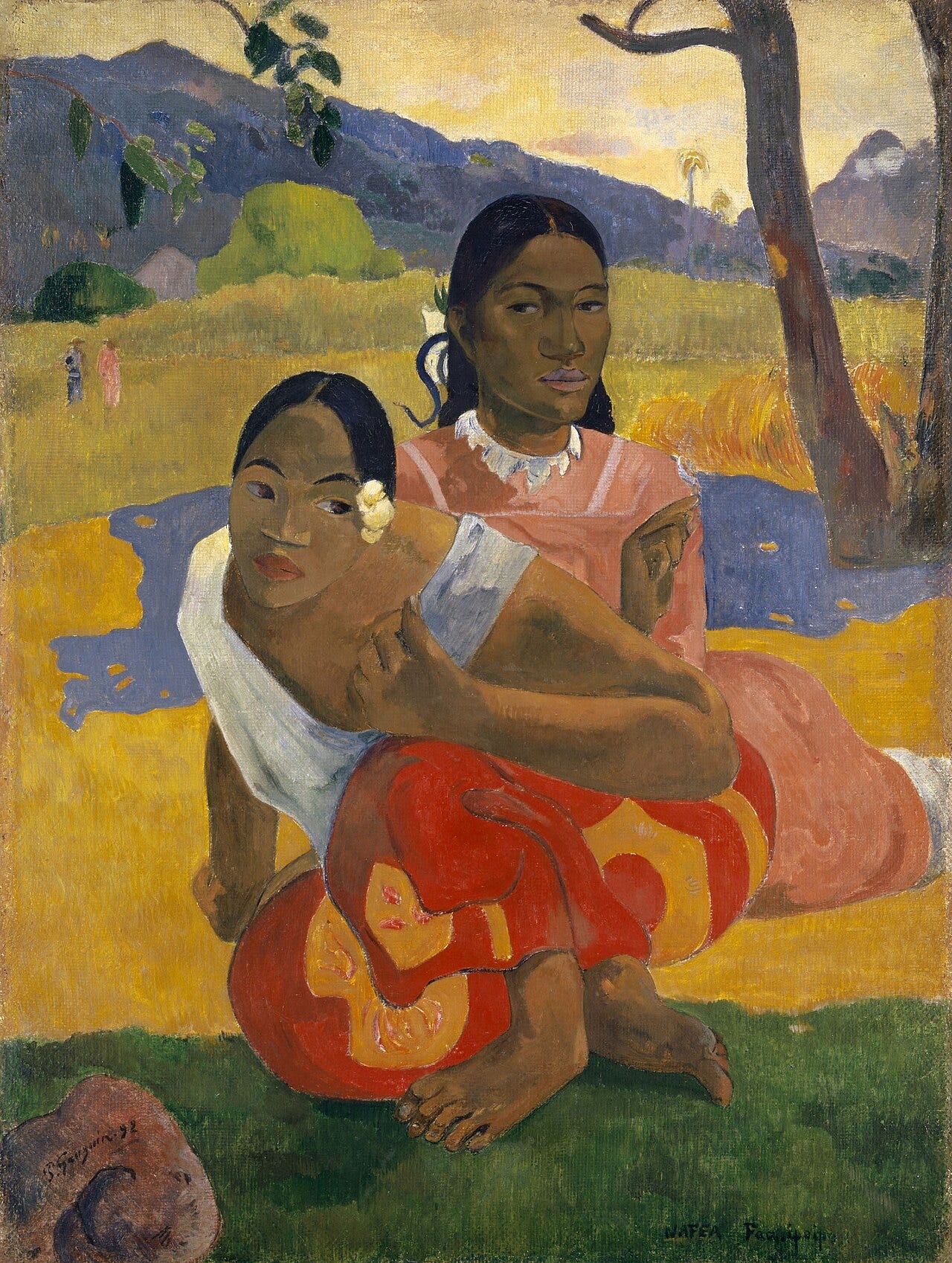
For me the strangest turn is the price. In 2015 his Tahitian canvas Nafea Faa Ipoipo reportedly sold for about 210 million dollars, among the highest sums ever paid for a painting.
Orsay and Boston, above all
His work is scattered across the great museums.
The Musee d’Orsay, Paris. Rich in his Brittany and Tahitian paintings.
The Museum of Fine Arts, Boston. Home of Where Do We Come From? What Are We? Where Are We Going?
Major museums worldwide. From London to New York to Moscow.
Beyond Paris, the Art Institute of Chicago and the Metropolitan Museum of Art in New York hold major Tahitian canvases.
Born in Paris in a year of barricades
Paul Gauguin was born in Paris on 7 June 1848. That spring the city had risen in revolt, toppling the king and declaring a republic.
His father, Clovis Gauguin, was a journalist with republican politics. When Louis Napoleon seized power at the end of 1851, France turned dangerous for men like him.
In 1849 the family had already sailed for Peru, hoping Clovis could start a newspaper in Lima. He never arrived. He died of a heart attack during the crossing, near the tip of South America.
That left his widow with two small children aboard a ship bound for a continent she barely knew. Gauguin began life shaped by upheaval and by the sea, two forces that followed him to the end.
The granddaughter of a firebrand
Gauguin's mother, Aline Chazal, came from a household of ideas and conflict. Her own mother was Flora Tristan, one of the earliest voices of French socialism and of women's rights.
Tristan wrote and campaigned for workers and for women, and published a study of the London poor in 1840. She died in 1844, four years before Gauguin was born, so he never met her.
Still, her name traveled with the family. Gauguin grew up knowing he descended from a woman who had defied convention and paid for it in exhaustion and poverty.
Later, when he cast himself as an outsider at war with polite society, he was drawing on a family memory as much as a pose. His rebellion was partly inherited.
A childhood in Lima
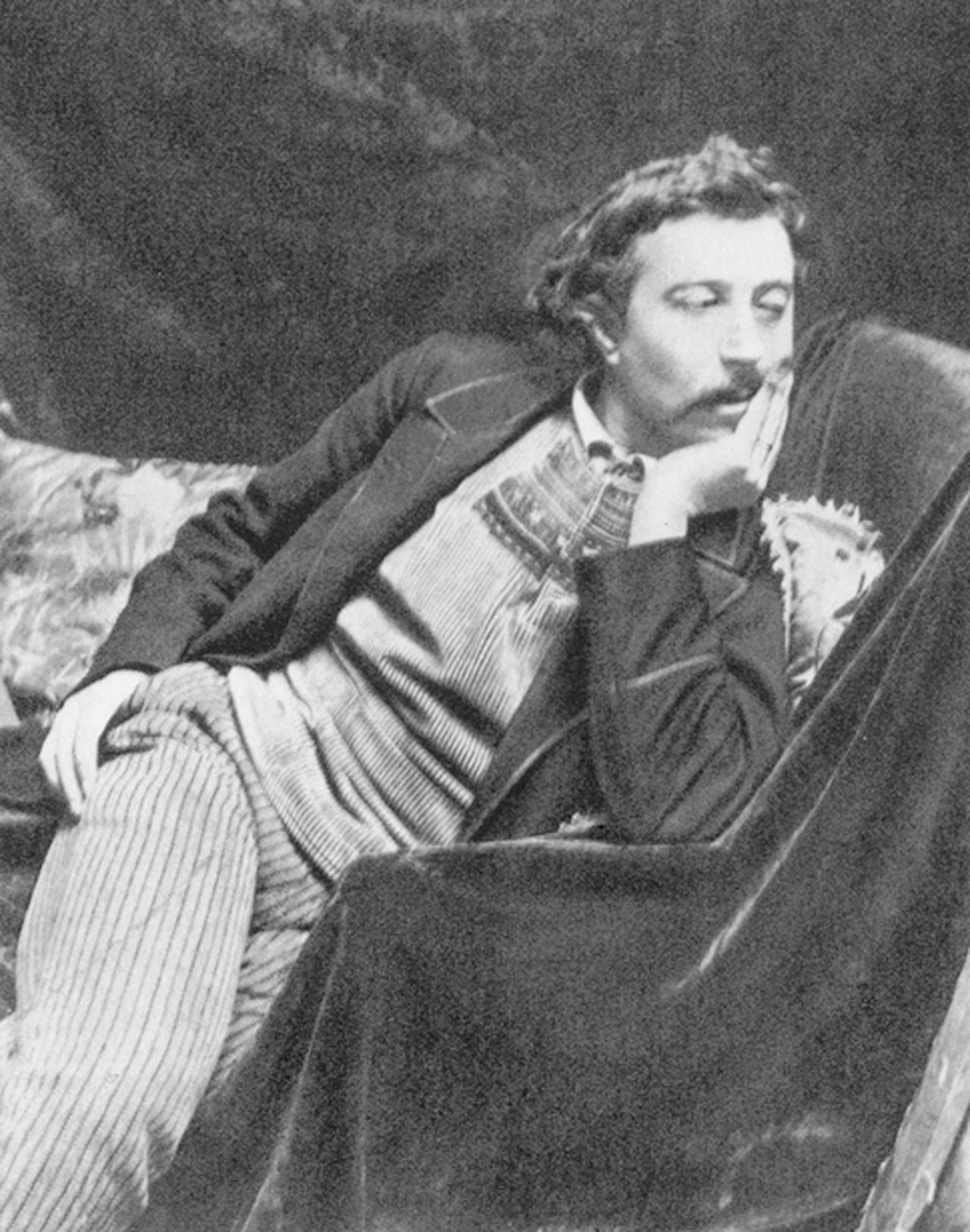
After his father's death, Gauguin's mother pressed on to Lima with her children. There the family was taken in by her granduncle, Don Pio de Tristan, a wealthy and powerful man.
For roughly four years the boy lived in comfort in a grand Peruvian house, waited on by servants, surrounded by color and warmth he never forgot.
He was about six when the family returned to France in 1855, settling near Orleans with his paternal grandfather.
The change was hard. Peru had felt like paradise. France felt gray and narrow. Gauguin spoke of Lima all his life as a lost Eden.
That early taste of a warm, distant place, and the ache of losing it, planted something. Decades later he sailed across the world trying to find it again.
Six years at sea
At seventeen, Gauguin went to sea. In 1865 he joined the merchant marine as an officer's apprentice, sailing first to Rio de Janeiro. For the next years he crossed the oceans, to South America, to the Mediterranean, to the northern seas.
In 1868 he entered the French navy, and served aboard a ship during the war with Prussia in 1870 and 1871. All told he spent about six years working the world's shipping lanes.
His mother died in 1867 while he was away, and he learned of it late. The sea gave him independence early and a habit of leaving.
It also gave him a picture of the globe as something a restless man could simply board a ship and cross, an idea that would define the rest of his life.
The stockbroker with a good salary
When Gauguin left the navy in 1871, his guardian Gustave Arosa found him a job on the Paris stock exchange. Gauguin proved good at it. Through the 1870s he was a working broker with a steady and often large income.
In 1873 he married a young Danish woman, Mette Sophie Gad. Over the next decade they had five children. On the surface his life looked settled, prosperous, ordinary.
He wore the suits, kept the apartment, took the salary. Yet Arosa also collected paintings, and Gauguin began buying art and painting on Sundays.
For years the two lives ran side by side, the reliable broker and the amateur who could not stop. One of them was going to win, and it would cost him everything.
A collector before a painter
Before Gauguin made important pictures, he bought them. With his broker's money he assembled a collection of the new Impressionists, works by Pissarro, Cezanne, Manet and Monet, at a time when few people wanted them.
Camille Pissarro became his teacher and friend. The older man showed him how to work outdoors and how to build a picture from patches of color, and brought him into the Impressionist exhibitions, where Gauguin showed his own paintings from 1879 onward.
He was, for a while, the rich amateur among professionals. That apprenticeship mattered. The flat, patterned style he later invented grew out of Impressionism and then broke sharply from it.
He learned the rules from Pissarro so he could spend the rest of his life abandoning them.
The crash that made him a painter
The turning point was money. In early 1882 the Paris stock market crashed when a major bank, the Union Generale, collapsed. Fortunes vanished, and work for brokers dried up. Gauguin's income fell hard.
Rather than scramble back into finance, he read the disaster as permission. By 1883 he had left broking to paint full time, telling himself the market would never be safe again anyway.
It was a reckless choice for a man with a wife and five children. He was thirty five and had no proven talent that anyone would pay for.
The decision began years of poverty that never truly ended. Gauguin liked to say the crash freed him. In truth it removed the excuse he had been using to stay comfortable.
Copenhagen, and a marriage that broke
With no income in Paris, Gauguin took his family to Mette's homeland. In late 1884 they moved to Copenhagen, where her Danish relatives could help. It went badly.
He tried selling tarpaulins for a French firm and failed, spoke little Danish, and felt judged by his wife's respectable family. Mette wanted a provider. Gauguin wanted to paint, and would not be moved.
In 1885 he returned to Paris with his young son Clovis, leaving the rest of the family behind. He and Mette never truly lived together again.
He had chosen art over marriage, plainly and permanently. For the rest of his life he wrote her letters and sent money when he had it, which was rarely.
Panama, Martinique, and a fever
In 1887 Gauguin made his first real flight to the tropics. With the painter Charles Laval he sailed to Panama, where the French were digging a canal, hoping to earn quick money. The work was brutal and brief.
Broke and sick, the two men crossed to the Caribbean island of Martinique. There, for a few months, Gauguin painted the rich hills and the people around him, and something in him settled. The light and heat felt like Lima returned.
Then illness caught up. Dysentery and fever forced him home to France late in 1887, weak and penniless. The trip was a failure by any practical measure.
It was also a rehearsal. Gauguin now knew, in his body, that his real subject lay far from Europe.
The last years in the Marquesas
In 1901 Gauguin left Tahiti for the more remote Marquesas Islands, settling at Atuona on Hiva Oa. There, as in Tahiti, he took a local girl in her early teens as a companion, part of a pattern that museums today address plainly and critically.
He built a house he called the House of Pleasure and kept painting, though his health was failing from heart trouble and syphilis.
He also picked fights. He urged local people not to send their children to the mission schools and to resist the colonial taxes, which set him against both the Catholic bishop and the French authorities.
Early in 1903 a court convicted him of libeling the administration and sentenced him to a fine and prison. He was appealing when he died at Atuona on 8 May 1903, poor and in pain, at fifty four.
More secrets to unlock


The Paul Gauguin questions that keep coming up
What is he known for? strong, flat color and his paintings of Tahiti.
When did he live? Born in 1848, died in 1903.
Why is he controversial? In Tahiti he exploited very young girls under colonial rule.
What happened with Van Gogh? Their 1888 stay together ended as Van Gogh cut off part of his ear.
Where did he die? In the Marquesas Islands, in the South Pacific.
Where and when was Paul Gauguin born? He was born in Paris on 7 June 1848, during the revolt that made France a republic that year. His father died in 1849 while sailing the family to Peru, and Gauguin spent his early childhood in a wealthy household in Lima before returning to France in 1855.
What did Gauguin do before he became a painter? He spent about six years at sea in the merchant marine and French navy from 1865, then worked as a Paris stockbroker through the 1870s. He married Mette Gad in 1873, had five children, and painted only on the side until the 1882 market crash pushed him to paint full time by 1883.
Gauguin lived with Van Gogh in Arles for only nine weeks before it ended in a breakdown neither man ever fully explained, a story told in what happened between Van Gogh and Gauguin.