
Piero della Francesca was the early Renaissance painter who turned geometry into stillness. His figures stand calm and solid in clear, silent light, with no drama and no rush, as if time has stopped.
He was also a serious mathematician, and you can feel the ruler and the compass behind every quiet face.
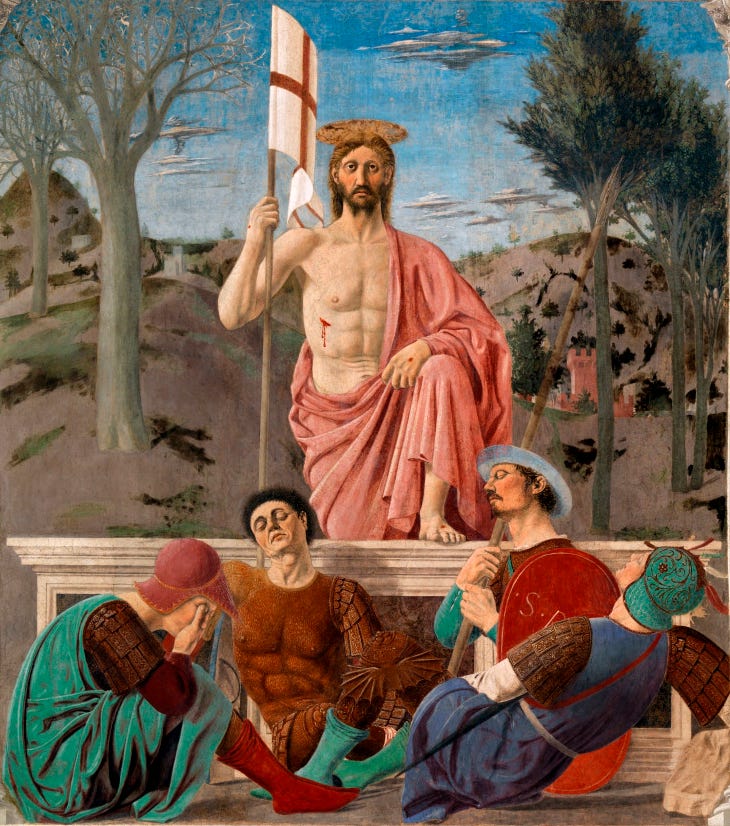
Half forgotten for centuries, he is now seen as one of the most modern feeling painters of the 1400s.
Born: Borgo San Sepolcro, around 1415
Known for: calm geometric figures, clear light, mathematical perspective
Died: Sansepolcro, 1492
More incredible painter stories
If Piero della Francesca pulled you in, you will love these too:


Piero della Francesca at a glance
1415 to 1420. Born around this year in Sansepolcro, a merchant’s son.
1439. Documented in Florence, assisting Domenico Veneziano.
1452. Began the Legend of the True Cross frescoes in Arezzo around this time.
1480. Deep in his mathematical treatises by this decade, painting less and less.
1492. Died in Sansepolcro on October 12, the day Columbus reached the Americas.
The painter who was also a mathematician
Piero did not just use perspective, he wrote books on it. He produced treatises on geometry and on the mathematics of perspective, real scholarly texts. For him, painting and measurement were the same pursuit.
That is why his pictures feel so ordered. Every figure sits in a space you could measure, lit by an even daylight that never flickers. See what is fresco painting.
Stillness as a style
Where other painters chased movement and emotion, Piero chose calm. His people have round, sculptural faces, half closed eyes, and a strange serenity. They do not gesture or weep. They simply are.
His finest work, the fresco cycle of the Legend of the True Cross in Arezzo, turns a violent story into a procession of quiet, monumental scenes. His Resurrection in Sansepolcro shows Christ rising with the steady gaze of a statue.
Lost, then found
After his death Piero faded from view for a long time. His abstract, geometric calm did not match the taste for drama that followed. For centuries he was a footnote.
The twentieth century rescued him. Modern artists and critics, drawn to his clean forms and flat colour, saw a kindred spirit. Today his Flagellation of Christ is studied as one of the most puzzling and perfect small panels ever made.
You can explore works by Piero della Francesca in the collection of the Metropolitan Museum of Art.
The merchant's son from Sansepolcro
Piero was born in the small Tuscan town of Borgo Sansepolcro, most likely between about 1415 and 1420.
His father Benedetto dei Franceschi was a leather and wool dealer who wanted his son in the family trade. So young Piero was drilled in mathematics and bookkeeping. That head for numbers never left him.
He stayed loyal to the town his whole life. He kept a house there, held local offices, and in 1480 became prior of a religious confraternity.
When he painted the Baptism of Christ, he set the sacred moment in the hills around Sansepolcro, town walls and all.
Learning the trade, then jumping to Florence
Piero did not appear fully formed. Records show him working with a local painter, Antonio d'Anghiari, in Sansepolcro during the 1430s.
The real leap came in 1439. That year he turns up in Florence, working next to Domenico Veneziano on a fresco cycle for the church of Sant'Egidio. Those frescoes are lost now, which is a real shame. But the partnership mattered.
Domenico was a specialist in soft, even daylight and clean color. Beside him, Piero learned to wash a whole scene in one calm, steady light instead of harsh spotlighting.
What Florence taught him about space
Florence in 1439 was alive with a new idea. You could build believable depth on a flat panel using pure geometry.
Masaccio had already pulled it off in fresco. Paolo Uccello was obsessed with it. The scholar Leon Battista Alberti had written the rulebook.
Piero took all of it in, then pushed further. He treated the picture surface as a hidden grid and placed every figure, tree and building at a measured size and distance. For Piero, math was the skeleton that made a painting feel true.
The Baptism of Christ, the calmest picture in London
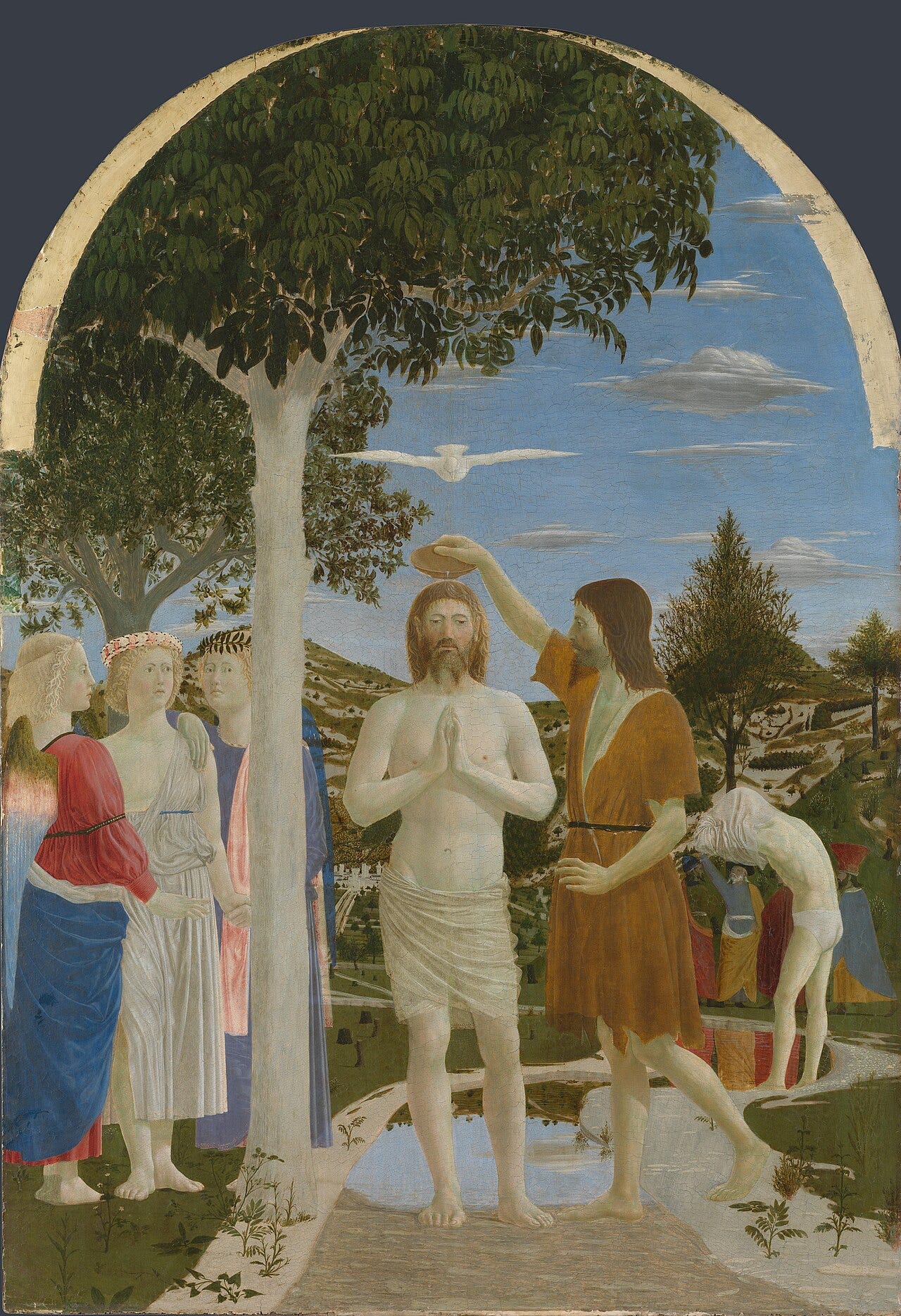
The earliest painting we still have by Piero is the Baptism of Christ, now in the National Gallery in London. It probably dates to somewhere between 1437 and 1445.
Christ stands in a shallow stream while John the Baptist tips a bowl of water over his head. Three angels watch from the left. A white dove hovers overhead, flying almost out toward you.
Everything is weighed and still. The dove, the bowl, Christ's praying hands and a pale walnut tree all fall on one vertical line down the center. The Gallery bought the panel in 1861.
The Arezzo walls and one of art's first nights
Piero's largest surviving work covers the main chapel of the church of San Francesco in Arezzo. He painted it across the 1450s and into the 1460s.
The subject is the Legend of the True Cross, a long medieval story that follows the wood of the cross from a seed on Adam's grave all the way to a battlefield. Piero told it out of sequence, arranging the scenes for balance rather than plot.
One panel changed everything. The Dream of Constantine shows the emperor asleep in his tent before battle, as an angel swoops in from above. It counts among the first real night scenes in Italian painting.
The Flagellation, the puzzle nobody can solve
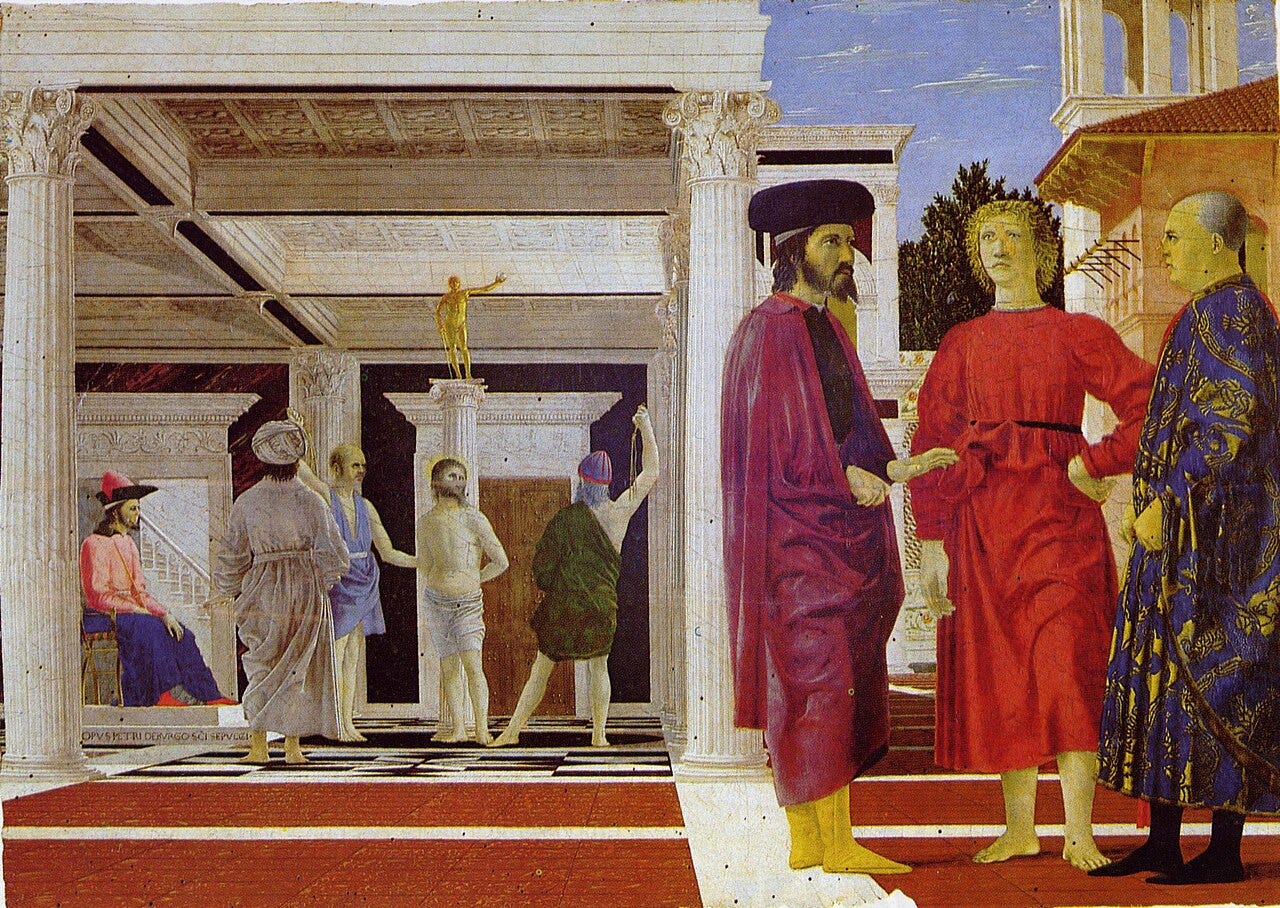
Tucked inside the National Gallery of the Marches in Urbino is a small panel that scholars cannot stop fighting over. It is the Flagellation of Christ, painted in the late 1450s.
The layout is strange on purpose. Christ is being whipped, yet he is pushed into the back left, small and far off under a paneled ceiling.
Up front on the right, three men stand and talk, large and unbothered, as if the beating behind them is not happening.
Who are they? Nobody knows for sure. One tally counts around forty five published theories. Some read two grieving fathers and a dead son. Others see a coded response to the fall of Constantinople in 1453.
Two faces on a coin, one hidden scar
Two of the most recognizable faces of the Renaissance hang in the Uffizi. They are Federico da Montefeltro, Duke of Urbino, and his wife Battista Sforza, painted around 1473 to 1475.
Both appear in strict profile, like heads stamped on an ancient coin. That choice was not only about elegance. Federico had lost his right eye and the bridge of his nose in a tournament accident.
Piero painted him only from the left, hiding the injury and turning a scar into a clean silhouette.
Battista faces him with chalk pale skin. She had died young, in 1472, so the panel is likely a memorial made after her death.
The altarpiece with an egg hanging from the ceiling
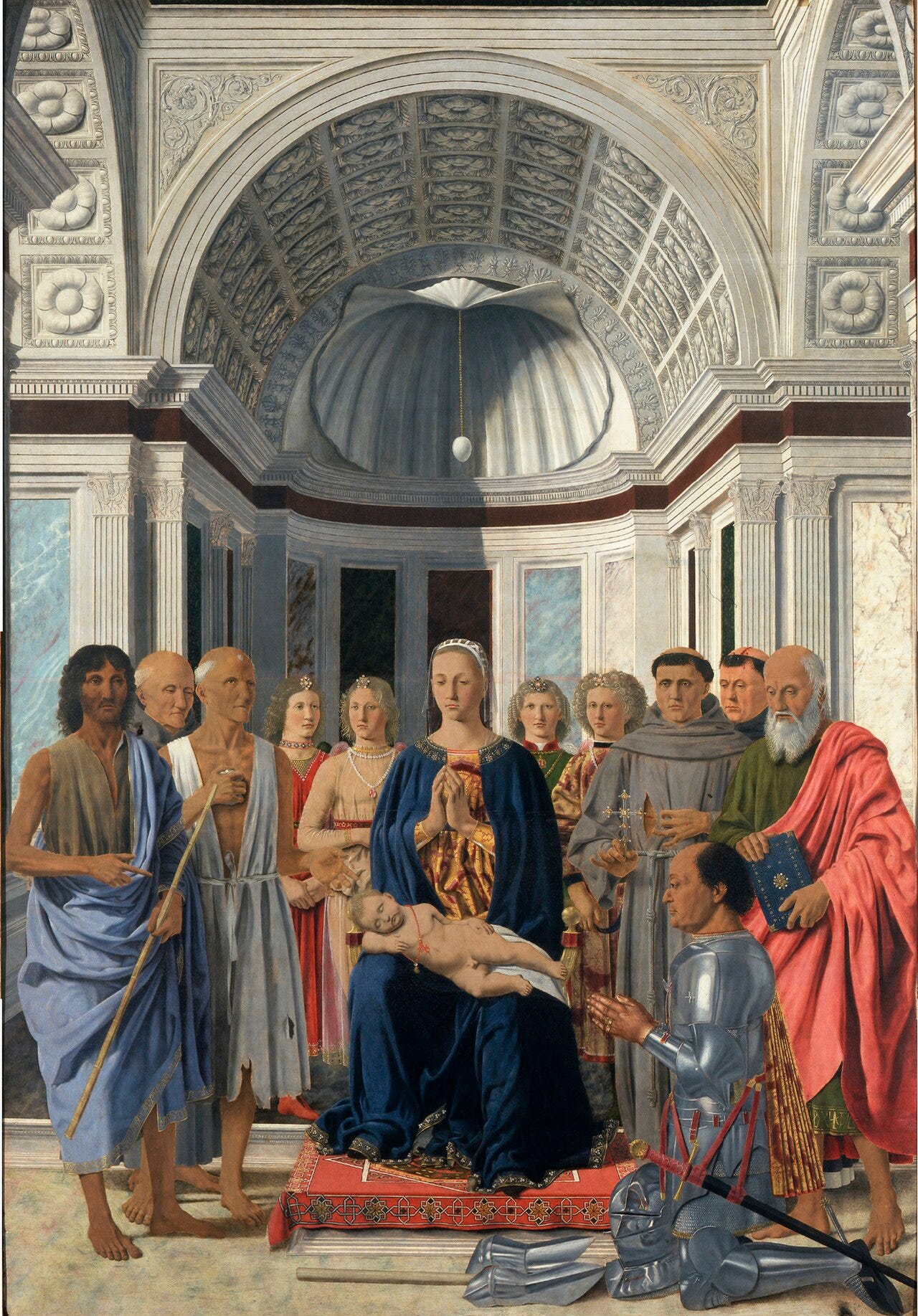
In the Pinacoteca di Brera in Milan hangs one of Piero's final great works, made around 1472 to 1474.
The Virgin and Child sit enthroned inside a marble church, ringed by saints and angels. Kneeling in full armor at the front is Federico da Montefeltro again, the duke in the flesh.
Then you spot it. From a shell shaped dome above the throne, a single ostrich egg hangs on a thin thread.
Why an egg? It was an old symbol of the virgin birth, and the ostrich also sat on the Montefeltro coat of arms. Piero placed his so carefully that people have puzzled over it for centuries.
The books he wrote when he set down the brush
Here is the twist most people miss. Piero did not just paint with geometry. He wrote whole books about it.
In his later years he produced a treatise called De prospectiva pingendi, meaning On Perspective in Painting. It was the first book of its kind written by a working artist.
He copied and illustrated the main manuscript by hand, and it survives today in Parma, filled with his own diagrams.
He also wrote on the five regular solids, the perfect shapes the Greeks Plato and Pythagoras had prized. Vasari later accused another scholar, Luca Pacioli, of publishing Piero's work on those solids as his own.
Going blind, and dying as a new world opened
Giorgio Vasari, writing the next century, passed on a sad tale. He said Piero went blind in old age and gave up painting for good.
The timing is tricky. Signed papers from 1490 survive in Piero's own hand, and his will of 1486 describes him as old but sound in mind and body. So any blindness came very late, if it came at all.
Piero died in his own house in Sansepolcro on 12 October 1492. By chance, that is the same day Christopher Columbus first sighted land in the Americas. One age was closing as another opened.
The Piero della Francesca questions that keep coming up
What is Piero famous for?
Calm, geometric figures in clear light, and his control of mathematical perspective.
Was he really a mathematician?
Yes. He wrote scholarly treatises on geometry and perspective.
Why was he forgotten?
His cool, abstract calm fell out of fashion, until modern eyes rediscovered him in the 1900s.
Why was Piero della Francesca forgotten for so long? His quiet, geometric style fell out of fashion after the Renaissance. He was rediscovered only in the twentieth century, when modern painters saw how radical his sense of order was.
More secrets to unlock


Why Piero feels modern
Piero strips painting down to light, form and order, the same things modern artists chased five hundred years later. Stand in front of his Resurrection and the silence is total.
That is why a man from a small Tuscan town now hangs in the story of modern art.
One last detail. In old age Piero may have gone blind, and he seems to have stopped painting to focus on his mathematics. The artist of perfect sight ended his life among numbers, not pictures.