
Pierre Auguste Renoir was a French Impressionist who made joy his subject. While other painters chased storms and struggle, he painted sunlight, dancing, flushed cheeks and good company, and became one of the best loved artists in the world.
Born poor in Limoges in 1841, he rose from painting flowers on porcelain to Luncheon of the Boating Party, and kept working with brushes slipped between his bandaged, arthritic fingers until his death in 1919.
He helped invent Impressionism beside Claude Monet, then spent his life celebrating beauty and pleasure without apology. His Luncheon of the Boating Party and Dance at the Moulin de la Galette are hymns to a happy afternoon.
More incredible painter stories
If Pierre Auguste Renoir pulled you in, you will love these too:


He kept painting even when arthritis twisted his hands, brushes wedged between his bandaged fingers. Here is the whole story.
Pierre Auguste Renoir at a glance
1841. Born in Limoges, a tailor’s son. The family moved to Paris while he was small.
1862. Entered Gleyre’s studio and met Monet, Sisley, and Bazille.
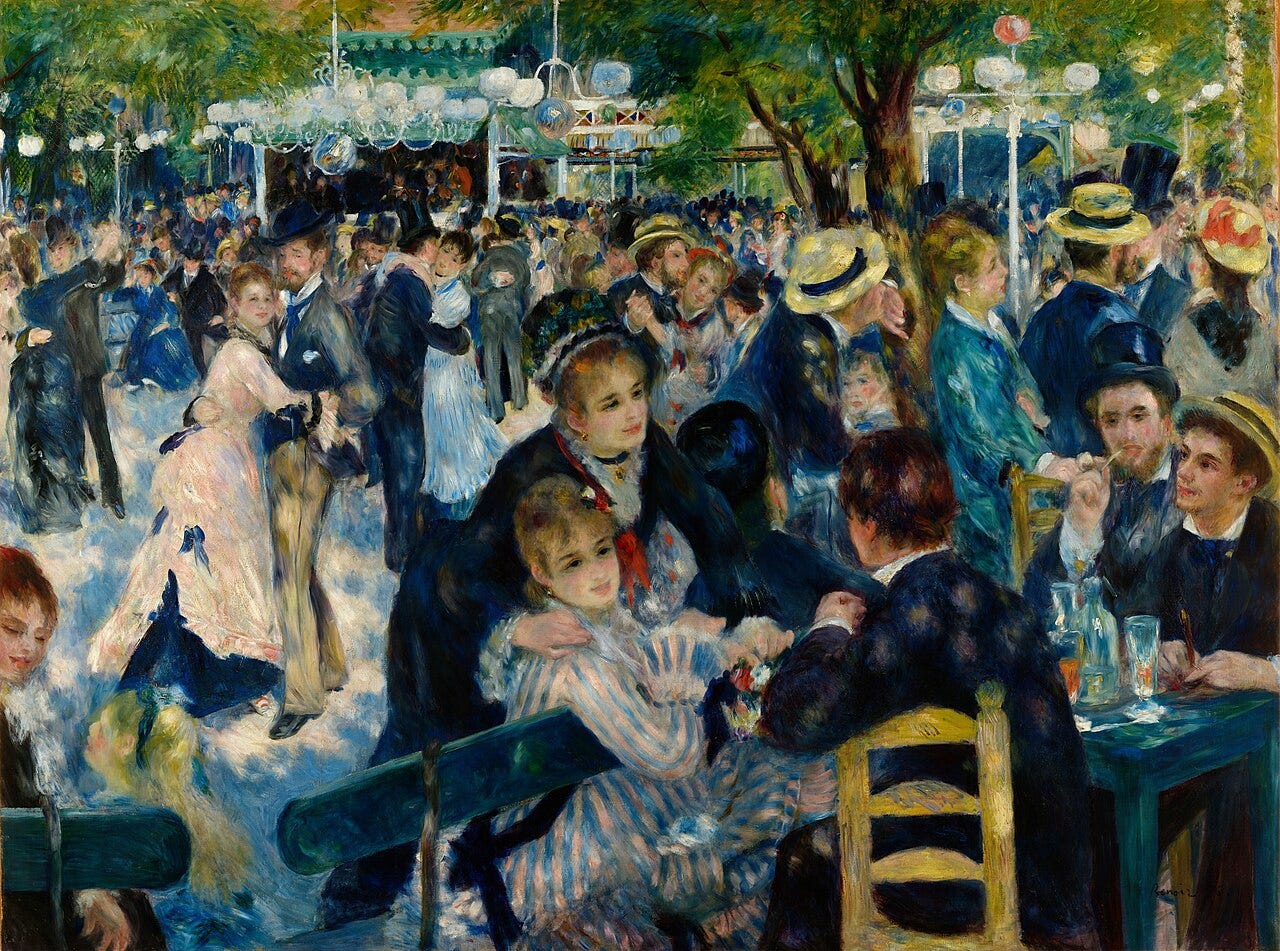
1876. Le Moulin de la Galette, dappled light over a Montmartre dance.
1892. The French state bought Young Girls at the Piano, consecration at last.
1919. Died at Cagnes-sur-Mer at 78, months after seeing his own work hanging in the Louvre.
The man who decided to paint only happiness
Renoir is famous for painting happiness. His scenes of dances, boating parties and sunlit gardens feel warm, alive and generous.
He said there was enough that was ugly in life, and he saw no reason to add to it. That choice, beauty as a deliberate stand, makes his best work irresistible and is why his crowds still feel like people you would want to join.
How to spot a Renoir in three seconds
A Renoir is easy to feel before you analyze it.
Soft, feathery strokes. Edges melt, especially in skin and foliage, giving a warm glow.
Dappled light. Sunlight filtered through leaves, scattering spots of color across faces and tables.
Rosy flesh. He loved painting people, especially women and children, with warm, living skin.
A happy crowd. Friends eating, flirting and dancing, caught mid moment.
Much of it was painted outdoors, chasing real light.
The Ingres turn
Around 1881 Renoir grew restless. A trip to Italy and the example of Raphael made him feel Impressionism was too loose, too formless.
For a while he tightened his style, drawing firmer outlines, in what is called his Ingres or sour period. Later he relaxed again into warm, full bodied late work, full of bathers in glowing color.
A famous family
Renoir’s warmth carried into his family. His son Jean Renoir became one of the greatest film directors in history, and later wrote a tender memoir of his father.
Another son, Pierre, became a well known actor. The painter of happy gatherings founded a creative dynasty of his own.
Paris, Washington and a few walls worth the trip
Paris and a few key museums hold the best of him.
The Musee d’Orsay, Paris. Home to Dance at the Moulin de la Galette and more.
The Phillips Collection, Washington. Home of Luncheon of the Boating Party.
The Met and the Barnes, USA. Deep holdings of his figures and bathers.
Bal du Moulin de la Galette is at the Musée d'Orsay in Paris, and Luncheon of the Boating Party at the Phillips Collection in Washington. The Metropolitan Museum of Art in New York holds many Renoirs.
Born in Limoges in 1841
Pierre Auguste Renoir was born on 25 February 1841 in Limoges, in central France. His father, Leonard, was a tailor. His mother worked as a seamstress. The family had little money and several children to feed.
When Renoir was still small, around 1844, they moved to Paris looking for steadier work. They settled in a cramped flat near the Louvre, in the old heart of the city.
So the boy grew up a few minutes from one of the greatest painting collections in the world, without a franc to his name.
He also had a fine singing voice as a child. For a while the choirmaster at the local church, the composer Charles Gounod, wanted to train him for the stage. Money decided otherwise. He would earn his living with his hands.
The china factory that taught his hand
At 13, in 1854, Renoir left school to earn money. His family placed him in a porcelain workshop, the firm of Levy Freres.
His job was to paint decorations onto white china. He started with small sprays of flowers on the edges of plates and cups, then worked up to little figures and portraits, including profiles of Marie Antoinette.
He was fast and neat, and the older painters nicknamed him Monsieur Rubens, half in mockery, half in respect.
Then the trade collapsed. By the late 1850s, factories began printing the same patterns onto china by machine, far cheaper than a boy with a brush.
Renoir was out of work. Those years were not wasted. Painting flowers on curved porcelain taught him a light, quick touch he never lost.
Fans, blinds, and a way into art school
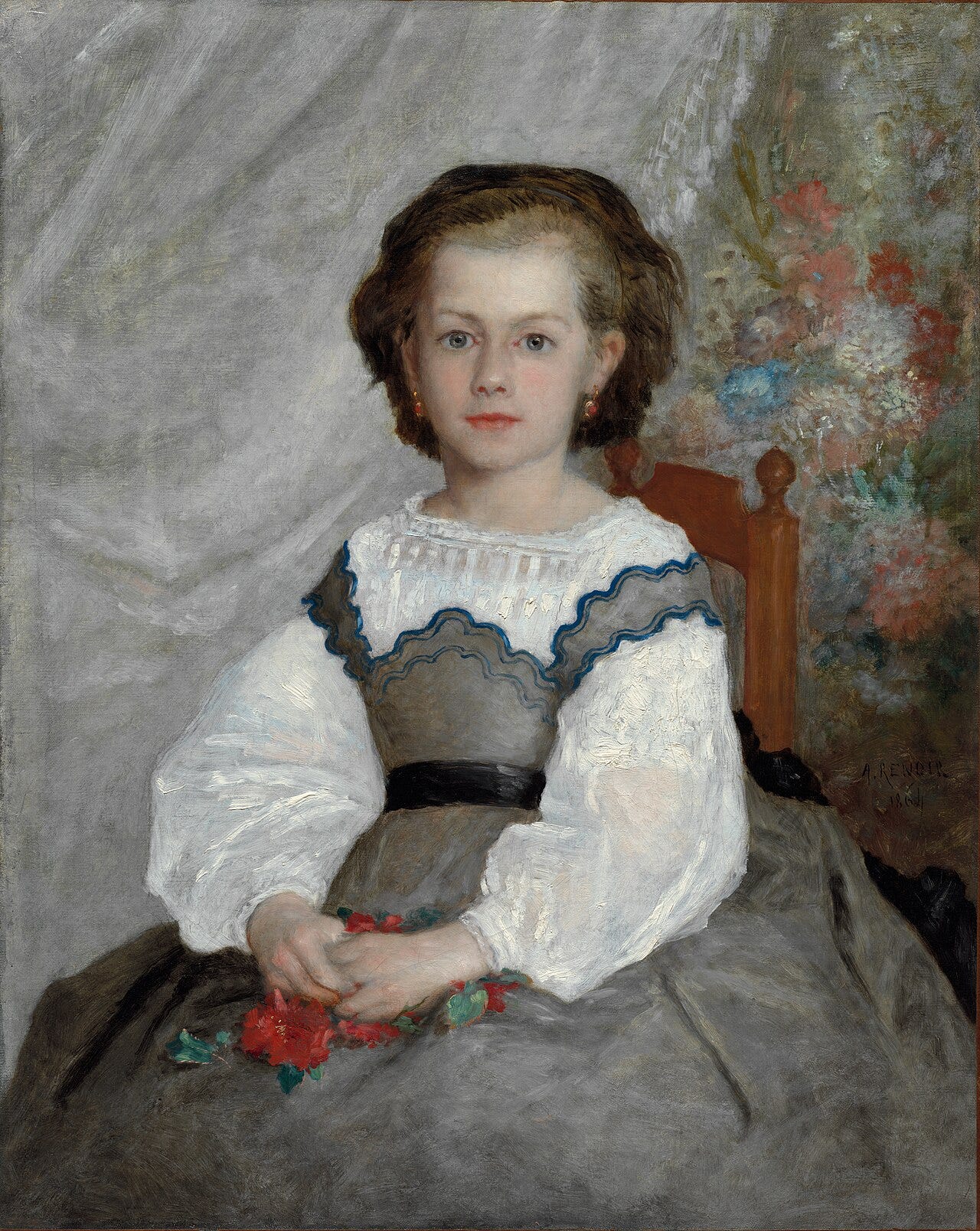
Out of the china trade, Renoir took whatever painting jobs he could find. He was saving for a real goal: the Ecole des Beaux Arts, the state art school in Paris.
He decorated folding fans, copying scenes by earlier French painters onto the paper. He painted window blinds and shades, turning out cheap decorative work at speed.
One story has him painting blinds so convincingly for a firm supplying missionaries that clients mistook them for stained glass.
He also decorated the walls of a Paris cafe. Every coin went toward tuition and paint. In 1862, the effort paid off. He passed the entrance exam and enrolled at the Ecole des Beaux Arts, a poor boy stepping into the official art world.
Charles Gleyre's studio, 1862
Alongside the state school, Renoir joined a private teaching studio run by the Swiss painter Charles Gleyre. Gleyre charged little and let students work fairly freely, which suited a young man with no cushion behind him.
It was here, around 1862 and 1863, that Renoir met three other students who would change his life: Claude Monet, Alfred Sisley, and Frederic Bazille.
The four became close friends. They were restless with the dark, polished style the school prized, and hungry to paint the real world in daylight.
Gleyre once looked at a study by Renoir and said, coolly, that he seemed to paint for fun. Renoir answered that if it were not fun, he would not do it. The remark says almost everything about the painter he became.
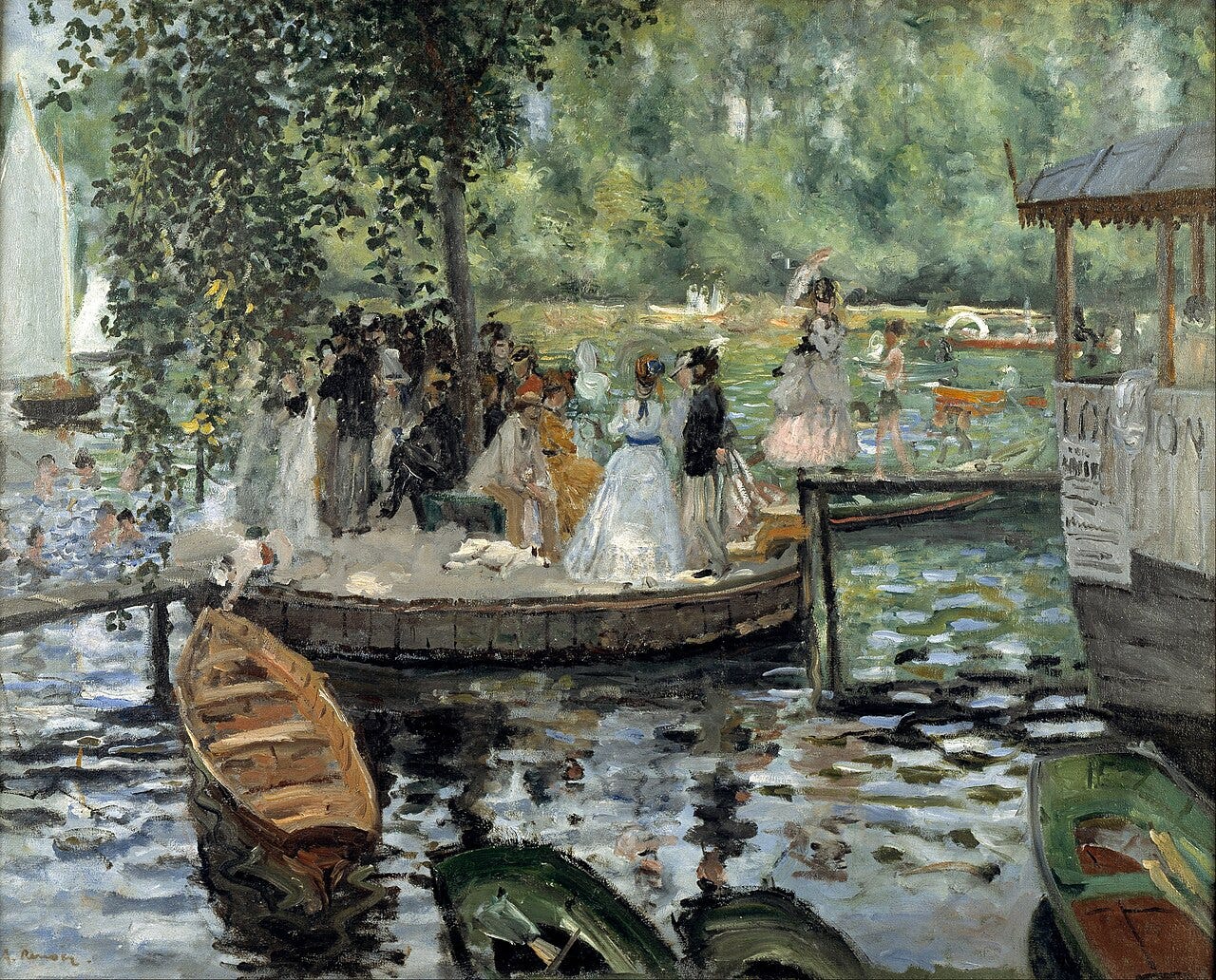
La Grenouillere, 1869
By 1869 Renoir was broke, sometimes going without proper meals, sleeping at friends' places and sharing paint.
That summer he set up his easel beside Monet at La Grenouillere, a floating cafe and bathing spot on the Seine at Croissy, just outside Paris.
Day trippers rowed, swam, and flirted there on Sundays. The two friends painted the same scene side by side: boats, water, dappled sun, people at leisure.
To catch light moving on water, they gave up smooth finish. They worked in short, loose dabs of color laid down fast, letting the eye blend them from a step back.
That quick, sketchy touch, worked out together at La Grenouillere, became the core of the Impressionist method.
Le Moulin de la Galette, 1876
In 1876 Renoir painted one of the warmest crowd scenes in French art, the Bal du moulin de la Galette, now in the Musée d'Orsay in Paris.
The Moulin de la Galette was an open air dance garden in Montmartre, then a hilly working district full of artists. On Sunday afternoons ordinary Parisians came to dance, drink, and talk under the trees.
Renoir set up nearby and painted the sunlight falling through the leaves in soft blue and pink patches across faces, hats, and dresses.
He used friends and local young women as his dancers, so the picture is a portrait of his own circle. It is a plain scene of people enjoying a day off, painted as if joy were the only subject worth the trouble.
Luncheon of the Boating Party, 1880 to 1881
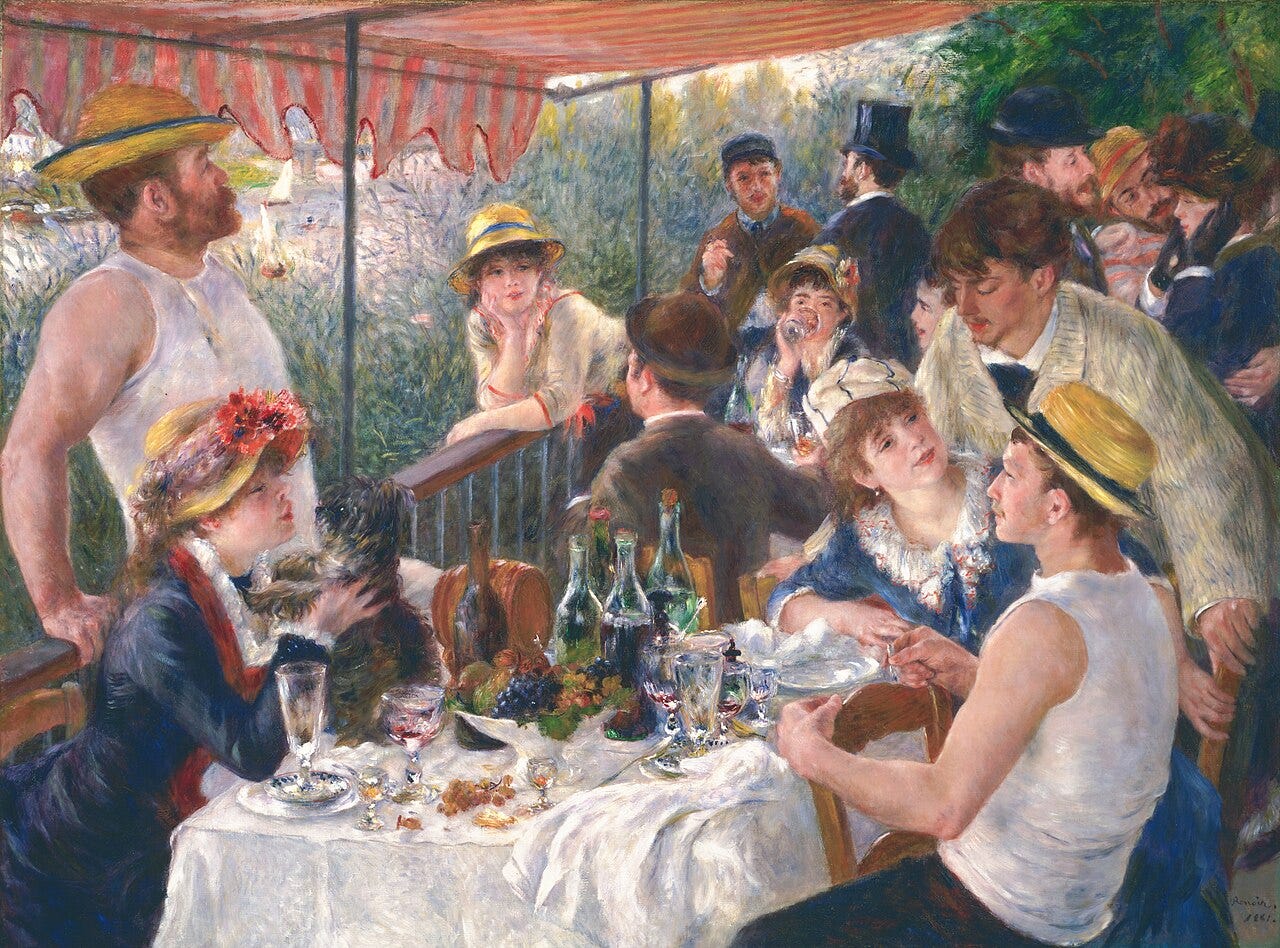
Between 1880 and 1881 Renoir painted a lunch on a balcony above the Seine, the Luncheon of the Boating Party, now in the Phillips Collection in Washington.
The setting was the Maison Fournaise, a riverside restaurant at Chatou popular with rowers. The wine, fruit, and glasses are still on the table; the party is winding down in the afternoon heat.
Every figure is a real friend, and most have been identified. The painter Gustave Caillebotte sits astride a chair on the right. The actress Ellen Andree drinks from a glass.
In the left foreground, a young woman plays with a small dog. She is Aline Charigot, a seamstress who would later become Renoir's wife.
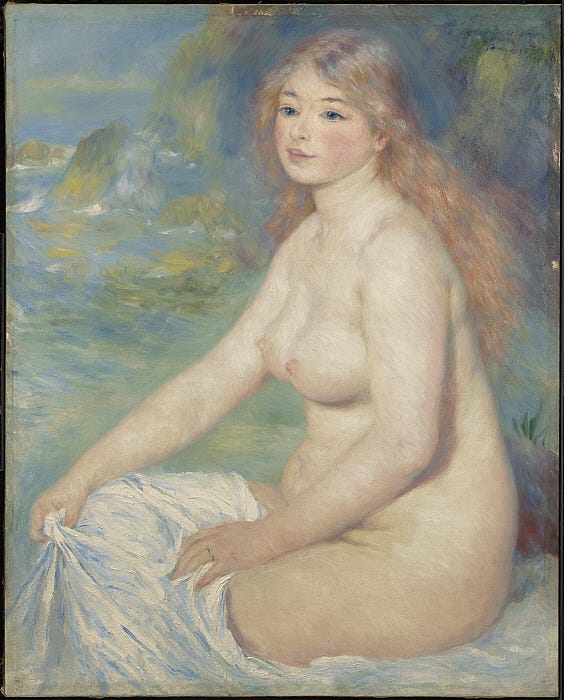
The pearly nudes and the return to warmth
After his hard, dry period in the mid 1880s, Renoir slowly loosened again, and the change is easiest to see in his nudes.
He turned away from sharp outlines and cool control and went back to soft, rounded forms bathed in warm light. The skin in these late paintings has a faint pinkish, pearly glow, built from many thin layers of color rather than firm edges.
He painted bathers by rivers and in gardens, full figures set against green leaves and blue water, a private world with no anecdote and no message.
Works like the Grandes Baigneuses of 1887 show the shift underway. For the rest of his life, the female body in sunlight stayed his favorite theme.
The move south to Cagnes sur Mer
From the 1890s Renoir suffered from rheumatoid arthritis, a joint disease that slowly stiffened and twisted his hands. Cold Paris winters made it worse. Seeking sun and gentler air, he spent more and more time on the Mediterranean coast.
In 1907 he bought an old olive farm called Les Collettes at Cagnes sur Mer, near Nice, and built a house among the ancient trees. He settled there for good in 1908.
The warm light suited both his health and his painting. Surrounded by olive groves, orange trees, and models, he kept working outdoors. The house at Les Collettes still stands today as a Renoir museum, with his studio and garden much as he left them.
The sculptures he made with his voice
In his last decade Renoir added a new craft, sculpture, even though his hands could no longer hold a modeling tool.
Around 1913 the dealer Ambroise Vollard arranged for a young sculptor, Richard Guino, to work under him. Guino did the physical modeling in clay.
Renoir sat beside him and directed every move. He pointed with a cane or with a stick held in his stiffened fingers, telling Guino to add clay here, take it away there, until the form matched what he saw.
The results, warm figures and busts in his own style, count as real Renoirs even though another pair of hands shaped the clay. Across his whole life he produced a huge body of work, often estimated at around 4,000 paintings.
Working to the last, at 78
Renoir worked almost to the very end. He died in 1919, at 78, in his home in the south of France.
He left behind around 4,000 works, an enormous outpouring of color and pleasure across nearly 60 years.
The Pierre Auguste Renoir questions that keep coming up
What is Renoir's most famous painting? The Bal du moulin de la Galette of 1876 at the Musée d'Orsay, and the Luncheon of the Boating Party of 1881 at the Phillips Collection in Washington.
Why did Renoir break with Impressionism? After an 1881 trip to Italy and Raphael, he decided he had gone as far as instantaneity could take him, and turned to firmer drawing in his so-called Ingres period.
How did Renoir paint with arthritis? Rheumatoid arthritis crippled his hands from around 1900; he painted to the end with brushes wedged into his bandaged fingers, and even directed sculpture through assistants' hands.
How much does a Renoir cost? Bal du moulin de la Galette's smaller version sold for 78.1 million dollars in 1990, for years the second-highest price ever paid at auction.
Was Renoir's son the filmmaker? Yes, Jean Renoir, director of La Grande Illusion, who wrote the tender memoir Renoir, My Father about growing up amid the models and canvases.
Where can I see Renoir? The Musée d'Orsay in Paris, the Phillips Collection in Washington, the Barnes Foundation in Philadelphia with 181 canvases, and his last house at Cagnes-sur-Mer, Les Collettes.
More secrets to unlock


Renoir and the joy of life, your questions
What is he known for? Joyful Impressionist scenes of dances, boating parties and sunlit life.
When did he live? Born in 1841, died in 1919.
Where was he from? Limoges, in France, raised in Paris.
Did he have a famous family? Yes, his son Jean Renoir was a great film director.
Why did he paint with brushes strapped on? Severe arthritis crippled his hands in old age.
Did Renoir have his brush tied to his hand? No, and this is a common misunderstanding. In his final years arthritis curled his fingers so tightly that he could not pick up a brush in the normal way. His helpers did not strap or tie the brush to his wrist. Instead they placed the handle into his already bent fingers, sometimes protecting the skin of his palm with a light cloth. Once the brush was wedged in place, Renoir moved his whole arm to paint. He kept working almost daily until his death on 3 December 1919, aged 78.
What happened when Renoir went to Italy? In 1881 and 1882 Renoir studied the old masters at first hand. He was shaken by the work of Raphael in Rome and by the ancient wall paintings dug up at Pompeii. Their clear drawing made his own loose, sunny style suddenly feel weak to him. For a few years afterward he tightened everything, using hard outlines in a manner closer to Ingres, before finding his way back to soft warmth.