
Pieter Bruegel the Elder, who lived from about 1525 to 1569, was the greatest painter of the Northern Renaissance and the master of peasant life, snowy hunts and crowded human comedy.
We know almost nothing certain about him, yet his roughly forty surviving paintings shaped how the world pictures ordinary life. Working in Antwerp and Brussels, he turned proverbs, festivals and the turning seasons into vast panoramic scenes, and founded a painting dynasty that carried his name for generations.
The little we know for sure
Born around 1525 to 1530, the exact place and date unknown.
Crossed the Alps to Italy, which transformed his landscapes.
Painted peasants, proverbs and the seasons of the year.
Founded a dynasty of painters with his two sons.
Died in Brussels in 1569, leaving only about forty works.
More incredible painter stories
If Pieter Bruegel the Elder pulled you in, you will love these too:


A life we can barely reconstruct
For an artist this important, the record is almost empty. We are not sure exactly where or when he was born, and only a handful of dates are solid.
He trained in Antwerp, married his teacher's daughter, and worked for a print publisher before turning to painting. Most of what we say about his character is guesswork built around the pictures.
The Alps changed how he saw the world
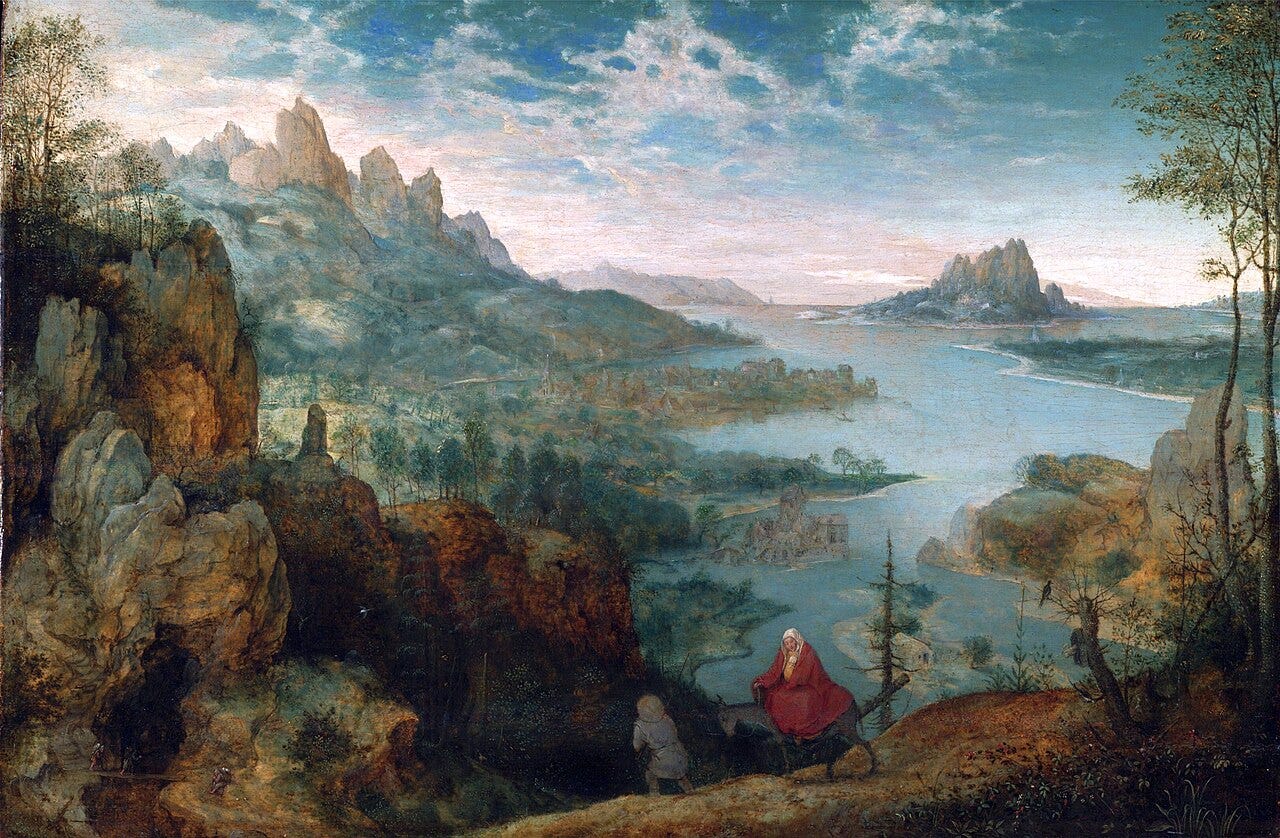
Around 1552 Bruegel traveled to Italy. What struck him most was not Rome but the journey: crossing the Alps.
Those vast mountains and valleys poured into his landscapes, giving him the high, sweeping viewpoint that makes his winter scenes feel like looking down on the whole world.
He was not actually a peasant
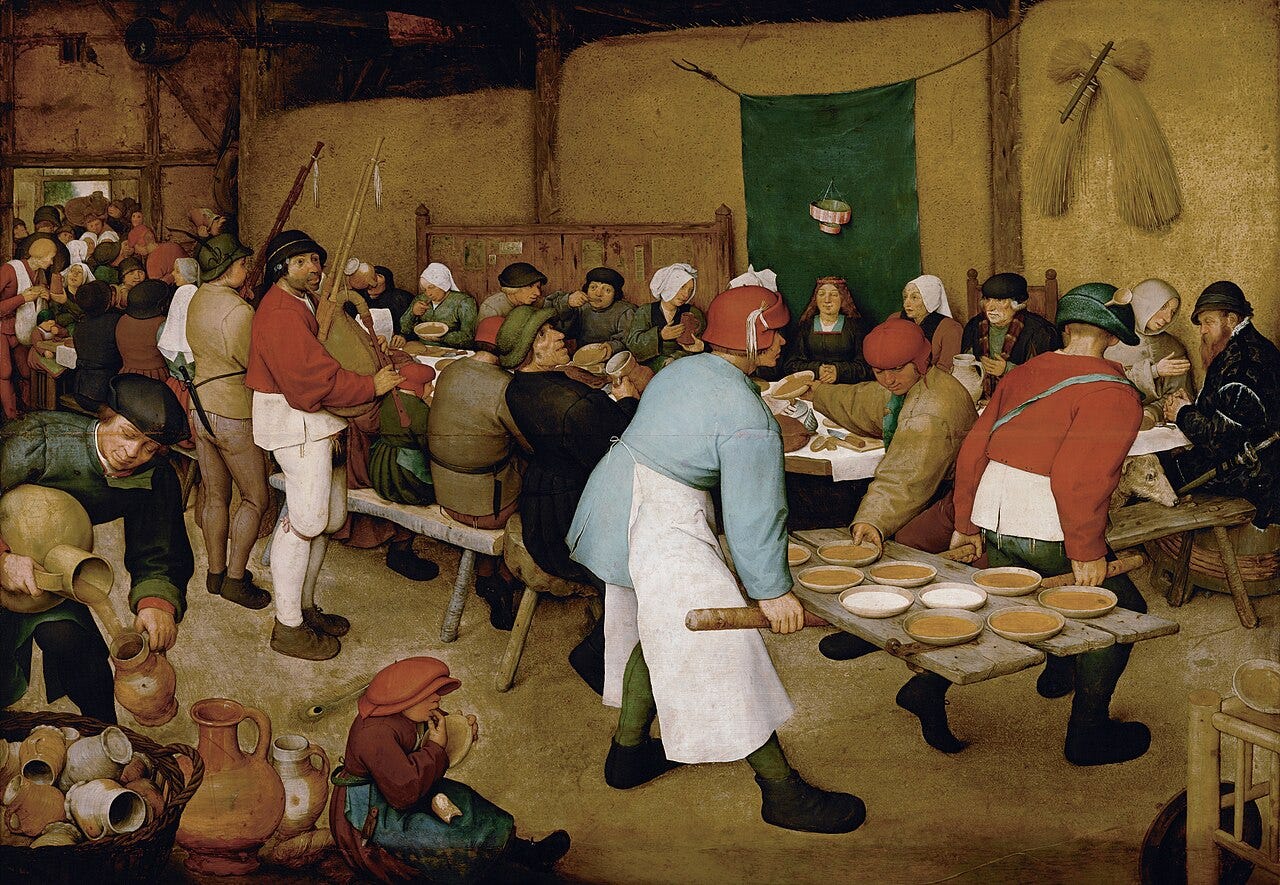
He is nicknamed Peasant Bruegel, and the label sticks because he painted village weddings, dances and drunken feasts. But the man himself was educated and moved in learned, humanist circles.
He painted peasants the way a sharp, sophisticated observer would, with humor, sympathy and a cool eye, not as one of them.
He painted the world as a stage
Bruegel filled his panels with crowds. He turned Dutch proverbs into a whole village of fools, painted the months of the year as scenes of everyday life, and showed death as an army sweeping across the land.
Look closely and there is always a story, a joke or a warning hidden in the corner. He hides his real subject in plain sight, often tiny, off to one side.
He told his wife to burn his work
Bruegel lived under harsh Spanish rule in the Netherlands, a time of religious persecution and political danger. Some of his drawings carried sharp, satirical messages.
On his deathbed, the story goes, he asked his wife to burn a number of them, afraid they were too biting and might bring trouble on his family after he was gone.
One picture he is said to have asked her to keep instead of burning was The Magpie on the Gallows, now one of the pictures in our list of green paintings across art history.
He founded a painting dynasty
His two sons became painters too. Pieter Brueghel the Younger made a living copying his father's works, while Jan Brueghel the Elder became famous for delicate flowers and worked with Rubens.
Confusingly, the family even changed the spelling. Pieter dropped the letter h from Brueghel around 1559, which is why the father is Bruegel and the sons are Brueghel.
You can explore works by Pieter Bruegel the Elder in the collection of the Metropolitan Museum of Art.
The years in Italy and the road to Rome
Around 1552 Bruegel set out on the long journey south to Italy, a rite of passage for northern painters of his day. He reached Rome, and by some accounts traveled as far as Sicily and the Strait of Messina.
In Rome he worked for a time with the famous miniaturist Giulio Clovio, who owned several of his early pieces. It is the one firm collaboration we can name from these years.
What stayed with him was not the ruins or the antique statues that dazzled other visitors. It was the road itself, and above all the mountains he crossed to reach the plain of Italy.
The engravings that paid the bills
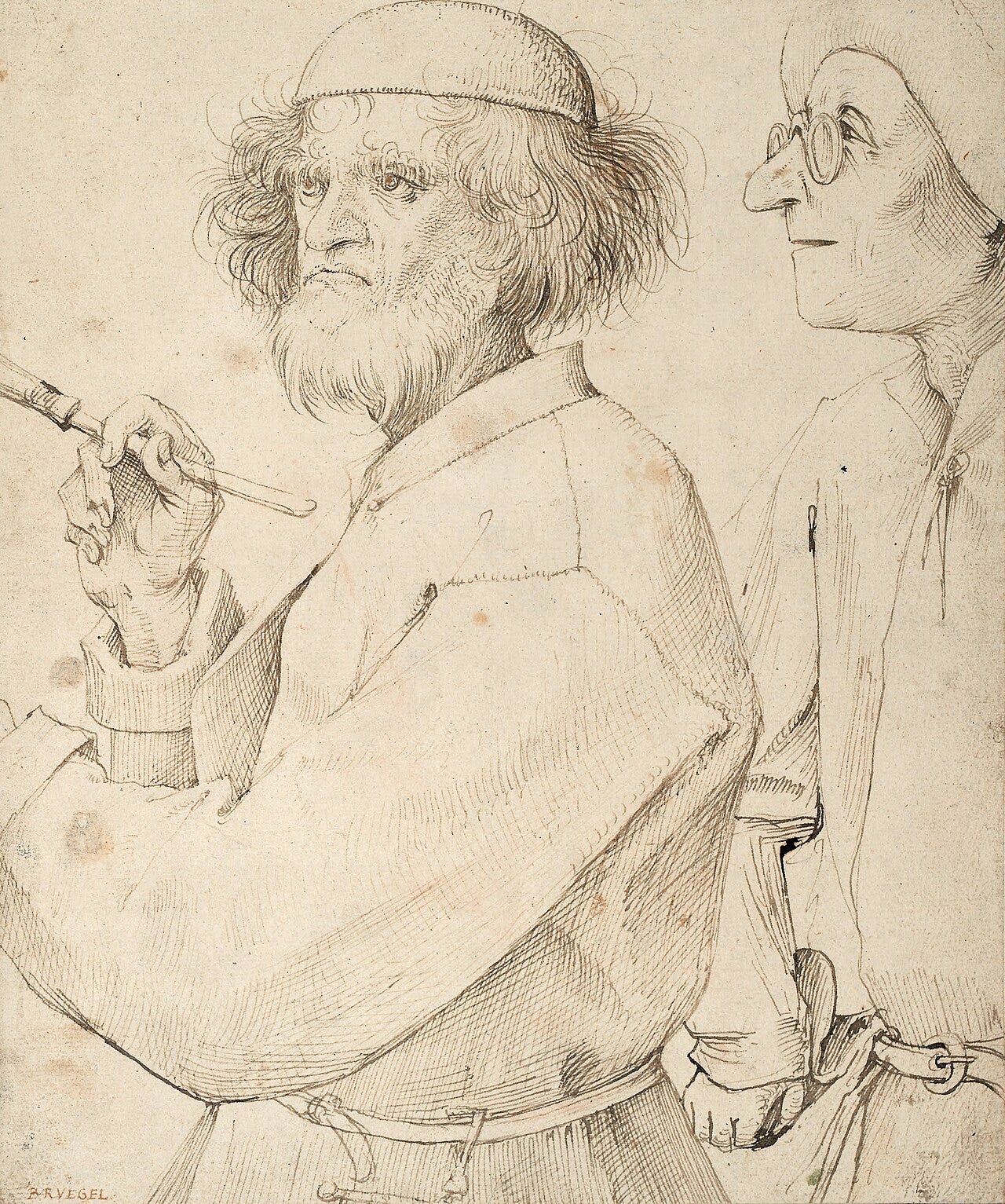
Back in Antwerp, Bruegel found steady work as a designer of prints. He drew for Hieronymus Cock, whose publishing house carried the sign of the Four Winds and sold engravings across Europe.
For Cock he produced Alpine landscapes, biblical scenes, and moralizing images such as Big Fish Eat Little Fish and the series of the Seven Deadly Sins. Other hands cut the copper plates, but the invention was his.
These prints reached far more people than his paintings ever could. For much of his own century, Bruegel was known first as the man behind these widely sold engravings.
The second Bosch
Bruegel came of age when the strange, crowded visions of Hieronymus Bosch, dead a generation earlier, were still in fashion. He learned to work in that vein, filling scenes with demons, hybrids and small human folly.
The link was pushed for profit. The print Big Fish Eat Little Fish, designed by Bruegel, was published in 1557 with Bosch's name on it rather than his own, because a Bosch sold better.
Bruegel soon moved past the copying. He kept the teeming detail but grounded it in real villages and real weather, so the fantasy gave way to a close look at ordinary life.
The cycle of the seasons
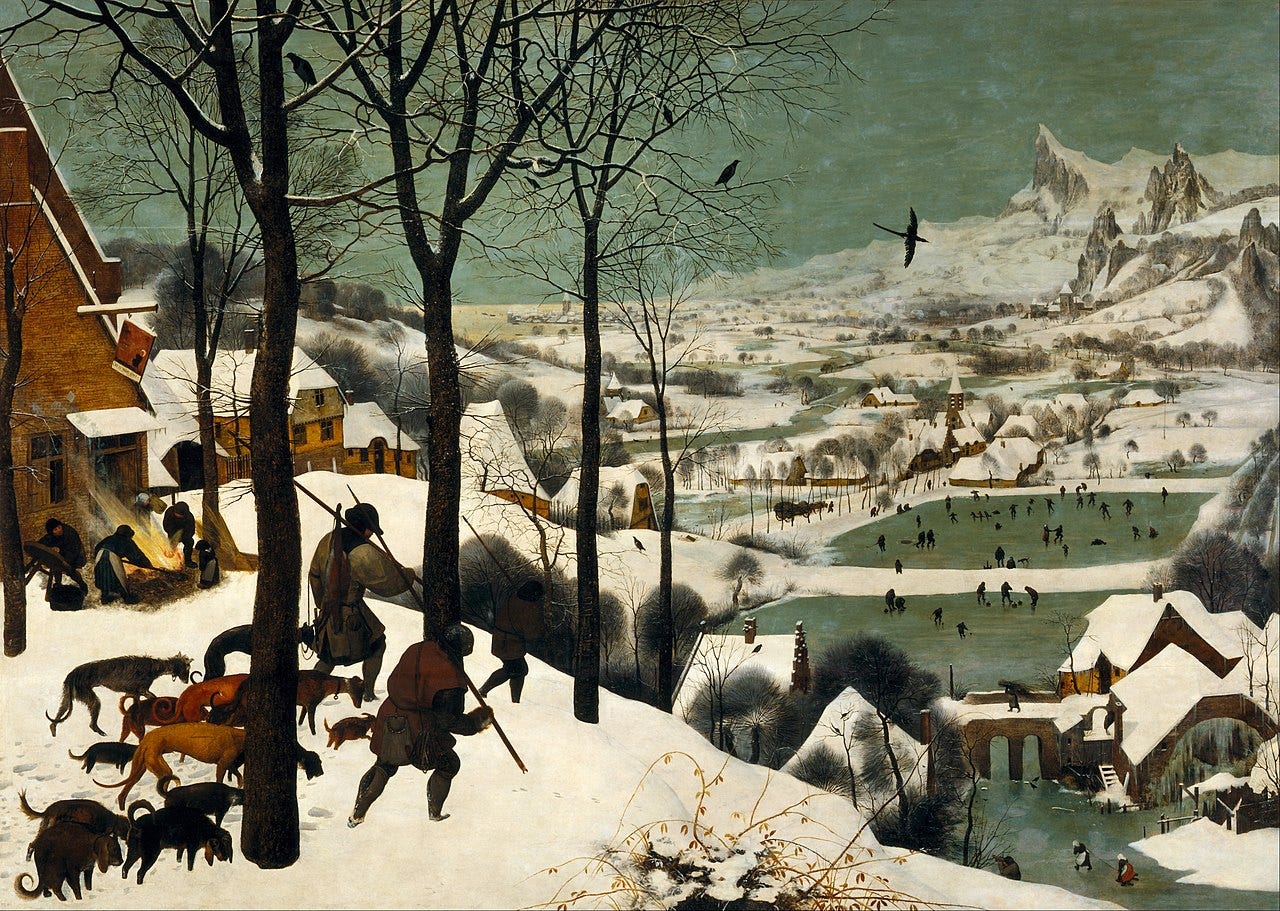
In 1565 Bruegel painted a set of panels showing the labors of the months, commissioned by the wealthy Antwerp collector Niclaes Jongelinck. Five survive, among them Hunters in the Snow, The Harvesters and The Gloomy Day.
Each panel takes in a whole landscape at a glance, with tiny figures at work under a wide sky. The mood changes with the season, from the frozen blue of winter to the gold heat of the harvest.
The Harvesters is now in New York at the Metropolitan Museum, while most of the others hang in Vienna. Together they are among the earliest paintings to treat the plain turning year as a subject worthy of a wall.
A world packed with proverbs and games
Some of Bruegel's pictures work like illustrated encyclopedias. Netherlandish Proverbs of 1559 crams more than a hundred Flemish sayings into a single village, each acted out by little figures.
The next year he painted Children's Games, a square filled with dozens of the games children played in the street. Battle between Carnival and Lent set feasting against fasting in the same crowded manner.
These are not simple scenes of fun. Behind the busy surface sits a dry, watchful comment on human habit, folly and appetite, offered without a raised voice.
Bible scenes in a time of fear
Bruegel's last years fell under harsh Spanish Habsburg rule in the Low Countries, when the Duke of Alba's soldiers hunted heretics and rebels. Several late paintings set biblical stories in snowbound Flemish villages.
In The Census at Bethlehem and The Massacre of the Innocents, soldiers move through a familiar northern winter. Many viewers have read these as veiled comments on the terror of their own day, though scholars remain cautious about how far Bruegel meant them as protest.
He died in Brussels in 1569. Whatever he intended, the paintings let a distant Bible story feel like something happening just down the road.
The two Towers of Babel
Bruegel painted the Tower of Babel more than once. The large version of 1563 hangs in Vienna, a spiraling mountain of a building that dwarfs the harbor and town around it.
He had seen the ruins of the Colosseum in Rome, and its stacked arches clearly fed the design. The tower leans slightly, already failing under its own ambition, with tiny workers swarming its ramps.
A smaller Tower, often called the Little Tower, is held in Rotterdam. Together the two panels turn a Bible story about pride into a study of engineering, labor and the limits of human reach.
The Icarus that may not be his
One of the most famous images tied to Bruegel is Landscape with the Fall of Icarus, in Brussels. A plowman works in the foreground while, almost unnoticed, two pale legs vanish into the sea at the edge of the scene.
The idea is unforgettable, that a great disaster can pass while ordinary life carries on. The poet W. H. Auden built a well known poem around it.
Here is the catch. Many scholars now doubt that the surviving painting is by Bruegel's own hand, and think it a later copy after a lost original. The invention is almost certainly his, even if the panel on the wall may not be.
Of all Bruegel's paintings, Hunters in the Snow is the one reproduced the most. Netherlandish Proverbs is the harder achievement: it packs more than a hundred sayings into a single village square, more invention per square inch than any other panel he painted.
Bosch died around 1516, before Bruegel was even born, so the two never worked side by side. Bruegel borrowed Bosch's demons and hybrid creatures early in his career, then dropped them for real villages and real weather, which is the bigger achievement: inventing monsters is easier than making ordinary peasants interesting.
Of his two painter sons, Jan Brueghel the Elder is the one who built an independent reputation, becoming a specialist in flower painting and a regular collaborator of Rubens. Pieter Brueghel the Younger ran more of a copying business, producing versions of his father's compositions for buyers who could not afford or find the originals. Between the three of them, the father remains the one art history remembers first, and for good reason: he invented the compositions the other two spent their careers repeating or refining.
The Pieter Bruegel the Elder questions that keep coming up
Who was Pieter Bruegel the Elder?
A Flemish painter of the 1500s, the leading artist of the Northern Renaissance, famous for peasant scenes and landscapes.
When and where was he born?
Around 1525 to 1530, somewhere in the Low Countries. The exact place is unknown.
How did he die?
He died in Brussels in 1569. The cause is not recorded, and he was still fairly young.
Why is he called the Elder?
To tell him apart from his son, Pieter Brueghel the Younger, also a painter.
Was he really a peasant?
No. He painted peasants but was an educated man in humanist company.
Where can you see his work?
Above all the Kunsthistorisches Museum in Vienna, which owns the largest single group of his paintings.
More secrets to unlock


Forty paintings, and a whole world
Only about forty paintings by Bruegel survive, and a third of them hang in one museum in Vienna. From that tiny body of work comes our whole mental picture of village weddings, hunters trudging through snow, and a busy, foolish, fully human world.
Few artists have done so much with so little left behind.