
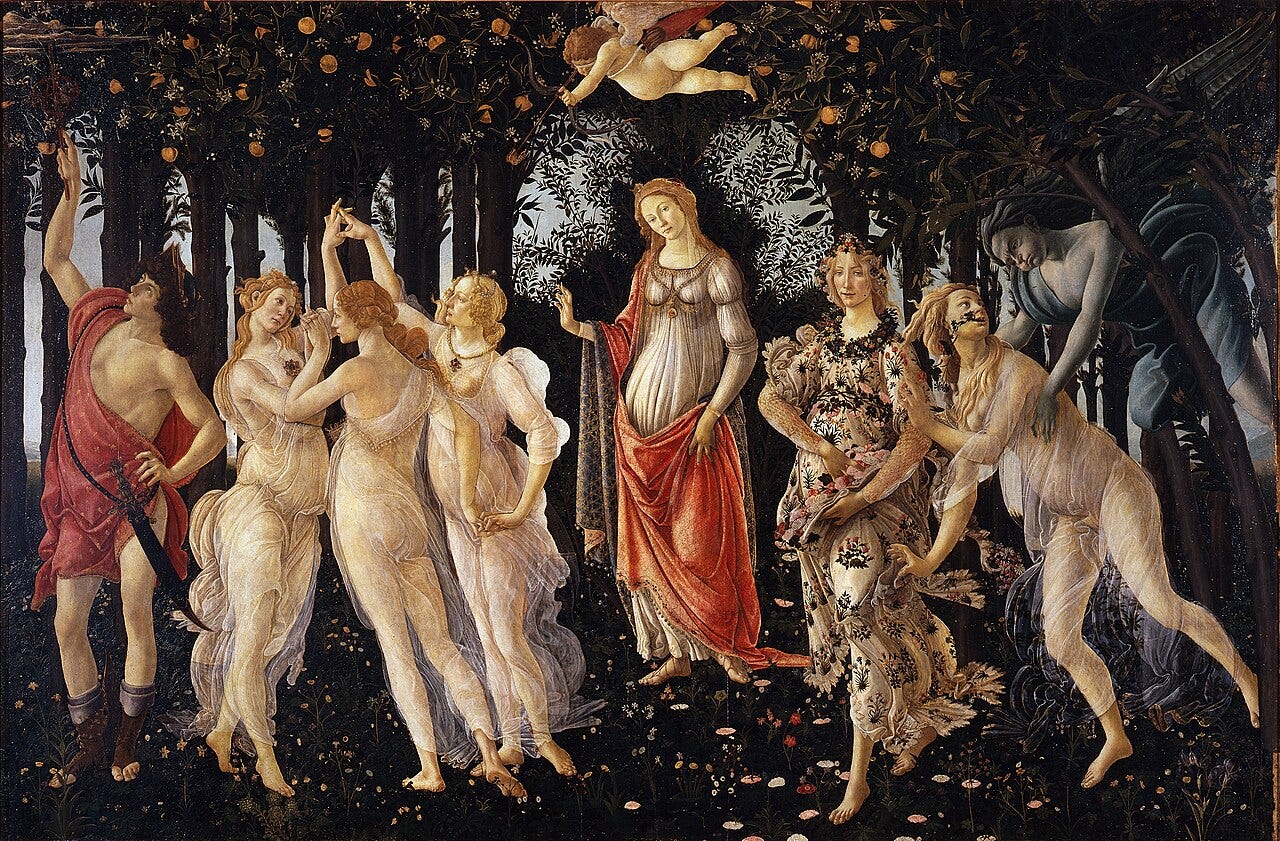
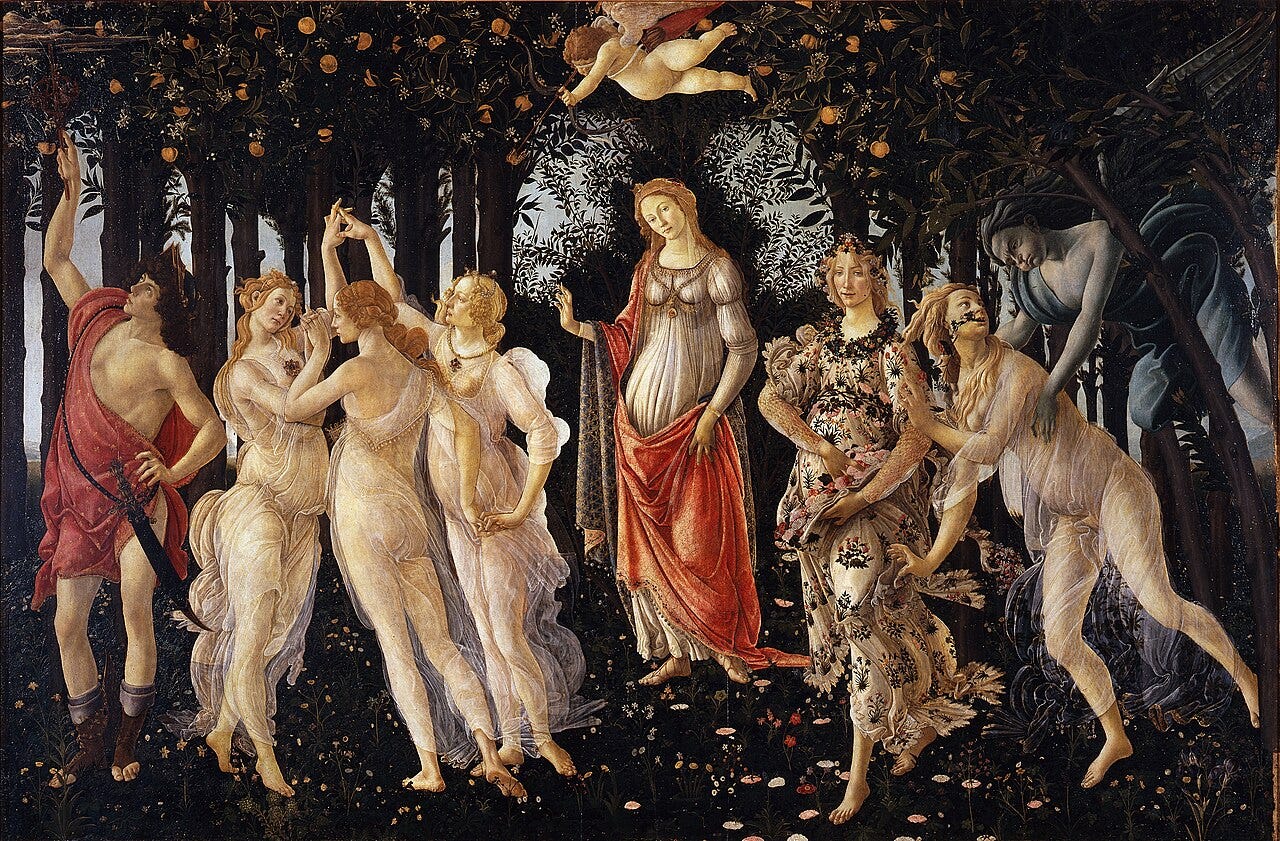
Primavera is an allegory of spring and love, and the trick is to read it from right to left: a wind god seizes a fleeing nymph, who transforms into the goddess of flowers, while Venus presides over a garden of love and the Three Graces dance.
It is one of the most analyzed and most debated paintings of the Renaissance.
Nobody agrees on every detail. But the spine of it is clear once you know where to start.
And you do not start where you would expect.
Read it backwards
Most paintings read left to right, like a sentence. This one runs the other way.
The story begins on the far right and moves left. So the first thing to find is the blue figure swooping in from the right edge, the wind. Follow what he sets in motion and the whole garden falls into order.
The chase that becomes spring
On the right, the blue wind god Zephyr lunges out of the trees and seizes a fleeing nymph named Chloris.
Watch what happens next, just to her left. Chloris transforms. Flowers spill from her mouth and she becomes Flora, the goddess of spring, draped in a gown covered with blossoms, scattering roses across the grass.
A violent gust of wind turns, in three figures, into the bloom of the season.
The court of Venus
At the center stands Venus, calmer and more clothed than in the Birth of Venus, the quiet ruler of this grove. Above her, a blindfolded Cupid aims his arrow.
To the left, the Three Graces dance in a ring of thin, transparent gowns, the picture of harmony and grace. At the far left edge, Mercury, the messenger god, reaches up with his staff to brush away a few clouds, keeping the garden in eternal spring.
A garden you could almost catalog
One detail astonishes botanists.
The meadow is not decorative filler. Researchers have identified around 200 species of plants in it, many shown so accurately you can name them, and most flower in spring near Florence.
That botanical precision is something no one asked a Renaissance painter to provide. The orange trees overhead, again, nod to the Medici, who almost certainly commissioned the work, possibly for a wedding.
Bigger, and older, than its famous sister
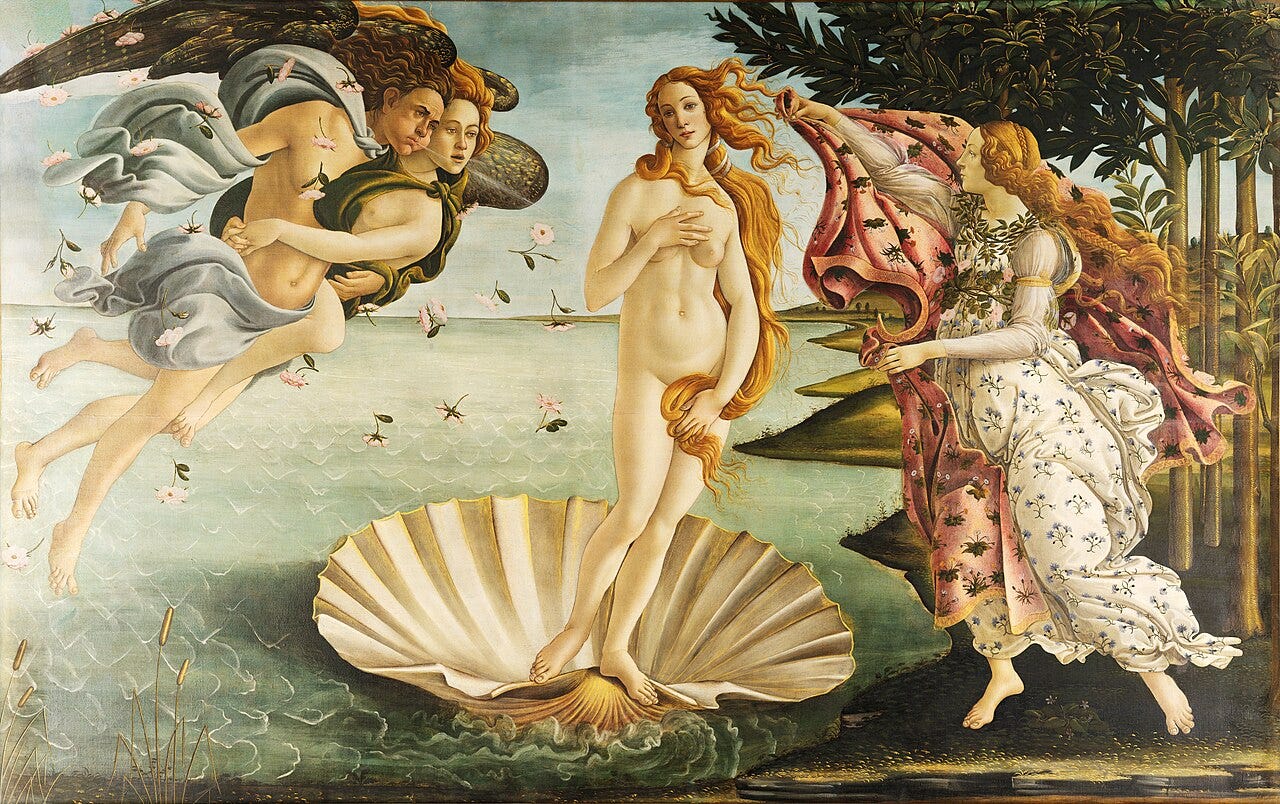
People assume Primavera and the Birth of Venus are a matching pair. They are not quite twins.
Primavera is the larger of the two, a wide panel painted in tempera on wood, and most scholars think it came first, a few years before the Birth of Venus, which was painted on canvas.
The two were not necessarily designed together. They probably hung in different Medici rooms, and only later did the world bolt them together as Botticelli's two great pagan visions.
Knowing that, Primavera stops looking like a companion piece and starts looking like the first time Botticelli dared to paint the old gods on this scale.
What it all means
Pull it together and Primavera reads as a meditation on love.
Raw desire, the wind seizing the nymph, is transformed into beauty and abundance, Flora and her flowers. Over it all rules Venus, love in its higher form, while the Graces show love turned into grace and the clouds are swept away.
In the Renaissance Neoplatonic mind, it is the same ladder as the Birth of Venus: physical love rising into something finer. The companion case: What Does Botticelli's Birth of Venus Mean?.
The three keys to the garden
Key: read it right to left, starting with the wind.
The transformation: Zephyr seizes Chloris, who becomes Flora, goddess of spring.
Still debated: the exact program and occasion, even after centuries of study.
Keep learning art the fun way


More secrets to unlock


The questions people ask about Primavera
What does Primavera mean? It means spring, and the painting is an allegory of love turning into beauty and abundance.
How do you read Primavera? From right to left, beginning with the wind god seizing the nymph.
Who is the woman scattering flowers? Flora, goddess of spring, who was the nymph Chloris transformed.
Who is in the center? Venus, with a blindfolded Cupid above and the Three Graces dancing nearby.
Where is it? In the Uffizi in Florence, near the Birth of Venus.
The puzzle that never closes
Scholars have written entire books decoding Primavera, and they still disagree about who some figures are and exactly what occasion it marked.
That is part of its strange power: it looks like a calm garden party and behaves like a riddle with no final answer, one people have puzzled over for five centuries. I follow the dramatic turn his own life took in Botticelli: The Complete Story.
I unpack the woman behind his faces in Botticelli's impossible love.

This painting is also part of our roundup of decoded paintings: Famous Paintings Explained: What They Really Mean.