
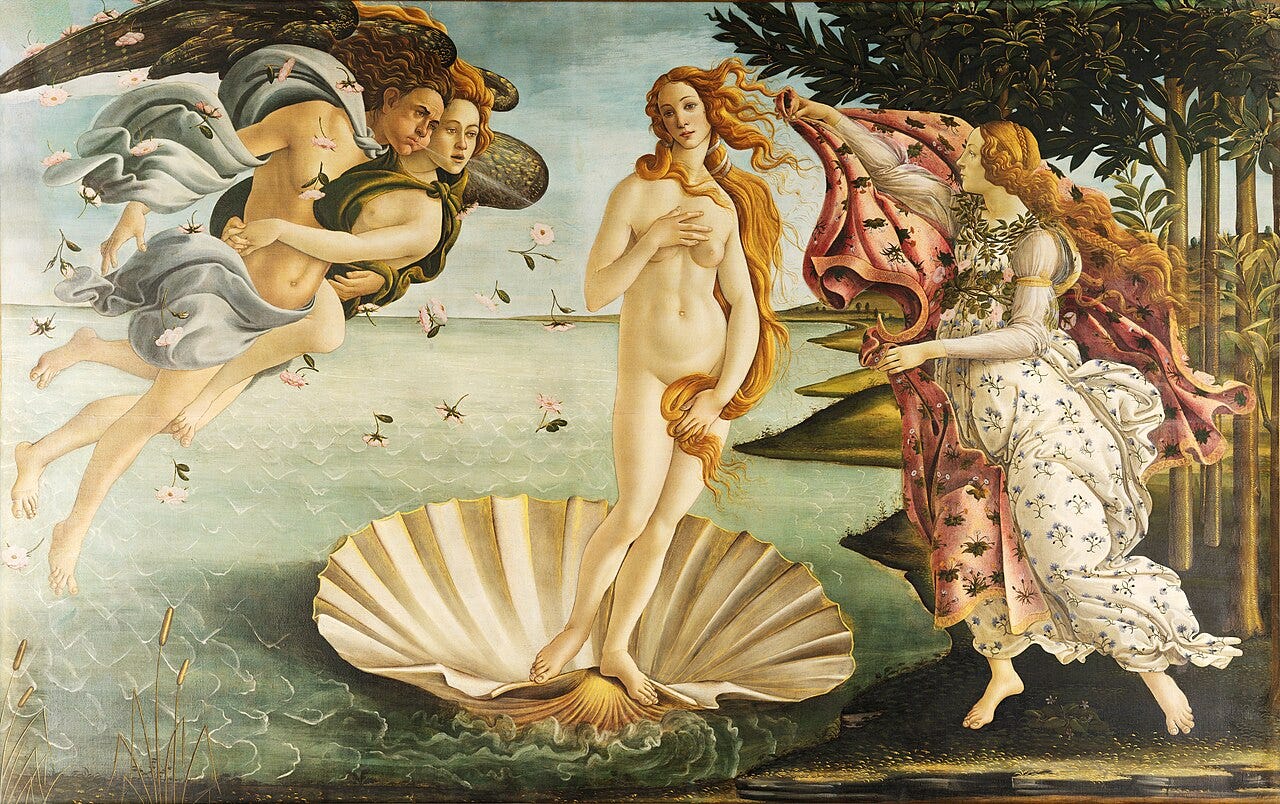
It shows Venus, the goddess of love and beauty, arriving on the shore of Cyprus on a giant shell, blown there by the winds and welcomed by a goddess of the seasons.
It is not really a birth scene. It is an allegory of divine beauty, built on the Renaissance idea that earthly beauty is a ladder the soul can climb toward the divine.
So the most famous nude in the world is really a piece of philosophy in disguise.
Let us read it from edge to edge.
What is actually happening
The picture tells a clear little story across its width.
On the left, two winged figures locked in an embrace blow the goddess toward land. They are the wind, Zephyr, and a breeze, with roses tumbling through the air around them.
In the center, Venus stands balanced on a giant scallop shell, covering herself with her hand and her long hair. On the right, a young woman, a Grace or a season goddess, rushes to wrap her in a flowered cloak.
Everyone is in motion, pushing the eye toward the still, calm goddess at the heart of it.
Not a birth, an arrival
The title fools people. We picture Venus being born here, but that is not the moment Botticelli paints.
In the myth Venus is born from the sea far offshore, sprung from the foam. What we see is the next scene: the grown goddess, fully formed, landing on the island of Cyprus, where she will be dressed and welcomed into the world.
It is a coming ashore, not a creation.
That small correction changes how you look at it. This is an entrance, a beauty stepping onto land.
The philosophy hidden in the beauty
Now the deeper layer, the reason a Christian city accepted a giant pagan nude.
Botticelli moved in the Medici circle, where the philosopher Marsilio Ficino was reviving Plato.
They believed that visible beauty, a face, a body, the sea, is a reflection of a higher, divine beauty, and that loving the first can lift the soul toward the second, an idea at the heart of the Renaissance Venus, in this reading, is not just desire.
She is the spark that starts that climb.
So her calm, almost sad expression makes sense. She is less a pin up than an idea made flesh.
A body borrowed from antiquity
Her pose is not invented. It is quoted.
Botticelli based her modest stance, one hand at her breast, the other lowering her hair, on ancient Roman statues of Venus known as the Venus Pudica, the modest Venus.
He even gilded strands of her hair with real gold so they catch the light. A fifteenth century painter rebuilding a classical goddess from marble into paint.
Clues to who ordered it
A few details point to the people who paid for it.
The painting was almost certainly made for the Medici, the rulers of Florence. The orange trees on the right were a quiet family emblem, and the subject may have been suggested by their court poet, Agnolo Poliziano.
What the title makes you assume
Myth: the painting shows Venus being born. Fact: it shows her arriving on shore, already grown.
Myth: it is simply a beautiful nude. Fact: it is a coded allegory of divine love and beauty.
Detail: her pose copies an ancient statue, and her hair is touched with real gold.
Keep learning art the fun way
More secrets to unlock
Painted for a villa, then half forgotten
For a picture this famous, its early life is oddly quiet.
Botticelli painted it on cheap canvas, not the costly wood panel of grand commissions, which points to a country villa rather than a church or palace.
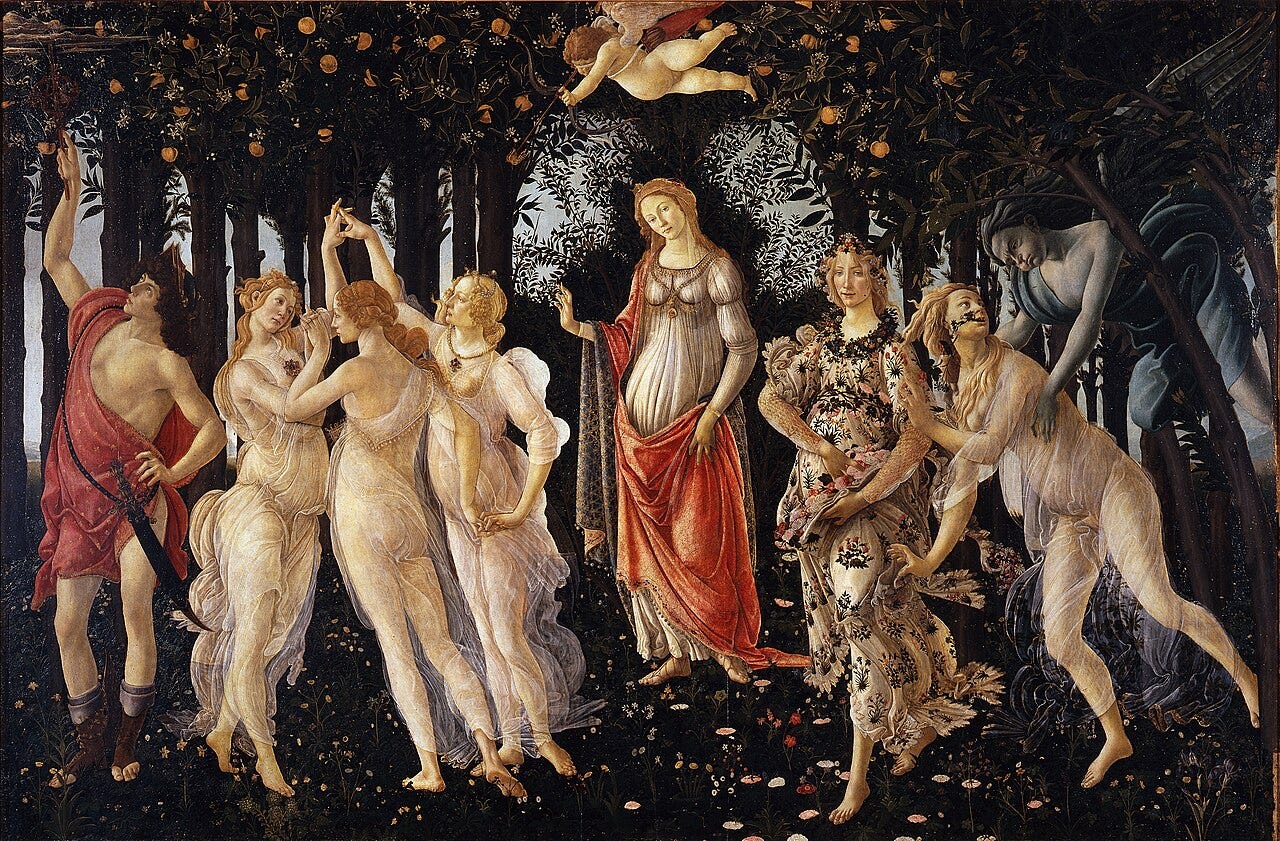
It hung in relative obscurity for centuries, until the 19th century rediscovered him and turned her into an icon. Today she rules a room in the Uffizi in Florence, beside his other great riddle, Primavera. This canvas escaped the flames a few years later, when Botticelli reportedly threw some of his own paintings onto Savonarola's bonfire.
The questions this painting keeps raising
What does the Birth of Venus mean? It is an allegory of divine beauty and love, showing Venus arriving on the shore of Cyprus.
Is Venus being born in the painting? No. She is landing fully grown, blown ashore by the winds.
Who are the other figures? The wind god Zephyr and a companion on the left, and a season goddess with a flowered cloak on the right.
Who commissioned it? Almost certainly the Medici family of Florence.
Where is it? In the Uffizi in Florence.
It was only centuries later, when Botticelli was rediscovered, that the goddess stepped onto the world's shore. Now she is one of the most reproduced images ever made. I trace the whole arc of his life in Botticelli: The Complete Story.
I tell the story of his model in Botticelli's impossible love.

This painting is also part of our roundup of decoded paintings: Famous Paintings Explained: What They Really Mean.