
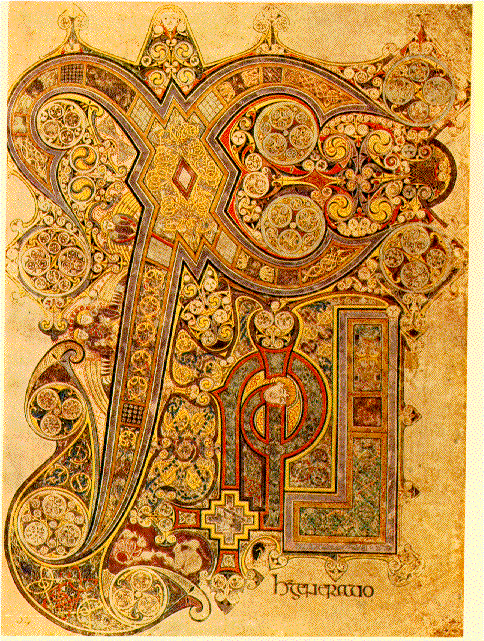
An illuminated manuscript is a handwritten book decorated by hand with gold, silver and bright color. The word illuminated comes from the gold leaf that catches the light and makes the page seem to glow.
Before printing, these were the most precious objects a culture could make, each one written and painted slowly, by hand, often over years.
Monks made the Book of Kells around the year 800, and twelve centuries later its pages still shine.
Tens of thousands survive in libraries today, the largest body of medieval painting still in existence.
Illuminated manuscript up close
What it is: a handwritten book decorated with gold and color.
The word: illuminated, from the gold that lights up the page.
The era: roughly 400 to 1600, peaking in the Middle Ages.
The makers: monks in monasteries, later professional workshops.
The cost: enormous, in time, skill and precious materials.
Keep learning art the fun way


Why the page glows
The gold is the whole point of the word.
Illuminators laid real gold leaf onto the page over a raised ground, then burnished it to a mirror shine, exactly the way panel painters gilded their gesso.
Tilt the book and the gold flashes in candlelight, so the holy figures seem lit from within. Silver leaf appeared too, though it has usually tarnished to black over the centuries while the gold still shines.
A great manuscript was a small fortune you could hold in two hands.
Made one page at a time
These books were the slowest art there is, and that is exactly why I rate them above almost anything painted on a panel.
A scribe first copied the text by hand onto prepared animal skin, called vellum or parchment. Then the illuminator added the decoration: large ornate initials, borders crawling with leaves and creatures, and small framed scenes called miniatures.
Pigments were often bound with egg, the same idea as tempera panel painting. A single luxury book could take a team years to finish.
Every copy was unique, because every copy was made by hand.
A whole world in the margins
The strangest joy of these books lives at the edges.
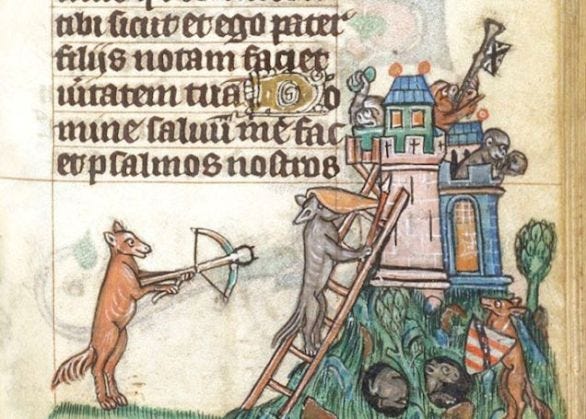
In the margins, illuminators painted a riot of invention: vines, flowers and saints, but also knights fighting snails, rabbits hunting dogs and grinning monsters, images with nothing to do with the holy text beside them.
This playful border world, called drollery, is medieval imagination off the leash. The sacred iconography held the center while comedy and chaos ran around the rim.
The most serious books in the world have jokes in the margins.
My favorite is the knight who keeps charging a snail. It turns up in manuscript after manuscript, and historians still cannot agree what it meant: cowardice, the resurrection, social climbers, even a jab at the Lombards.
Nobody scripted it, which is why I trust it as a glimpse of how these people thought.
The book that beat the printing press, for a while
Illumination did not die quietly when printing arrived.
After Gutenberg, early printed books were often left with blank spaces so an illuminator could still add initials and gold by hand. For decades the new machine and the old craft worked side by side.
Print was faster and cheaper, and the handmade glowing book slowly became a luxury of the past. What survives now sits in libraries and museums, still flashing gold when the light moves.
The press won on speed. The manuscripts won on beauty.
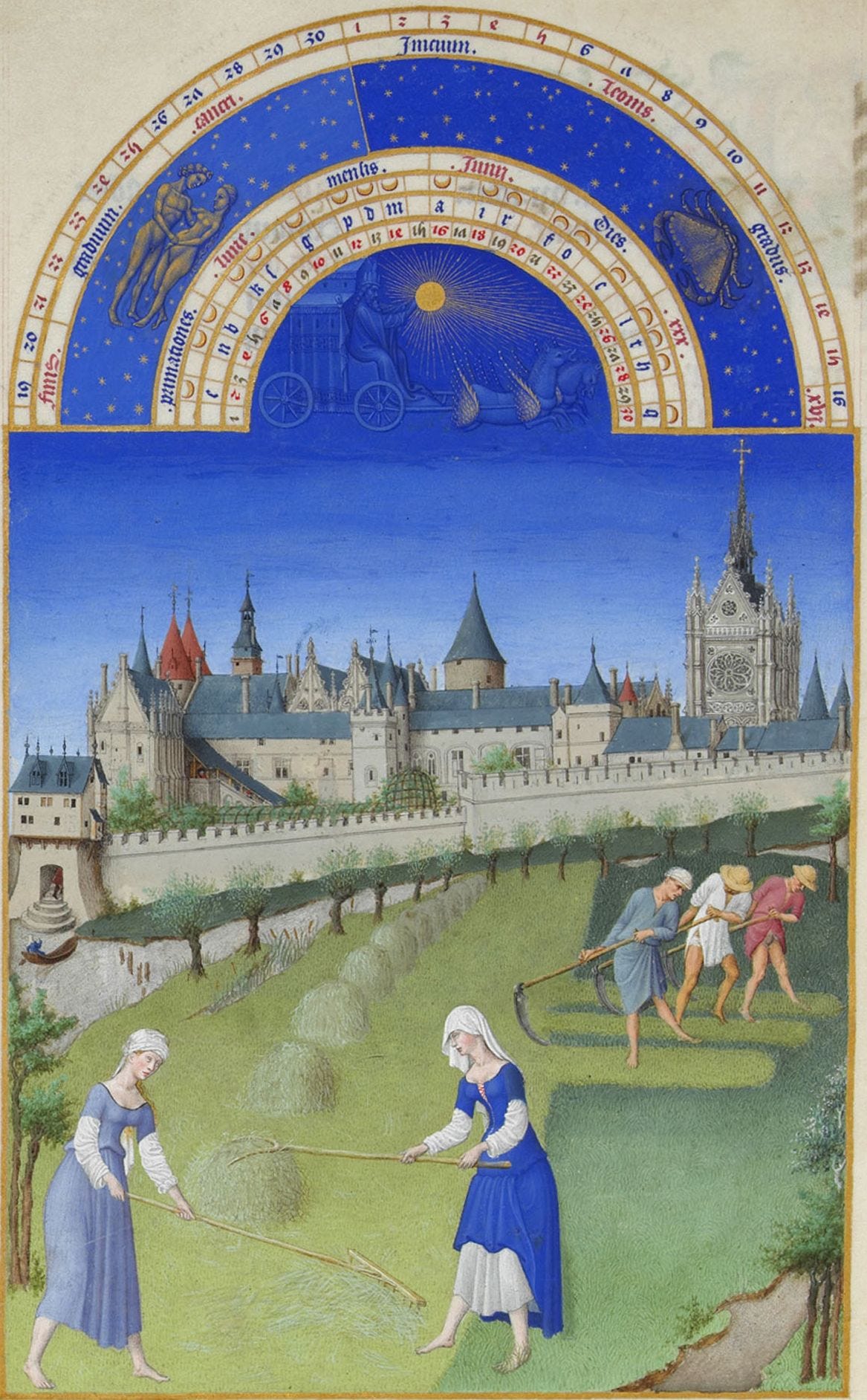
You can see the gold glow in person. The Met holds the Limbourg brothers’ Belles Heures, and the Morgan Library the Hours of Catherine of Cleves.
The most expensive blue in the world
The glow of these books came at staggering cost. The richest blue, ultramarine, was ground from lapis lazuli mined in what is now Afghanistan and carried thousands of miles, which made it more costly than gold.
Patrons sometimes wrote into the contract how much ultramarine and gold a manuscript must contain, the way you might specify carats today. A single luxury book of hours could cost as much as a house.
The brilliance on the page was a fortune in pigment as much as a feat of skill.
Books made of skin
Before paper was common in Europe, these books were written on prepared animal skin, parchment or the finer vellum, and the numbers are sobering. A large Bible could take the skins of an entire herd, sometimes more than a hundred animals.
Scribes worked for months or years on a single volume, and a slip of the knife or pen could ruin weeks of labor. The result was an object so costly in material, time and skill that it was often chained to the desk so no one could carry it off.
Illuminated manuscripts, your questions answered
What is an illuminated manuscript? A handwritten book decorated by hand with gold, silver and bright color, made before the printing press.
Why is it called illuminated? From the gold and silver leaf that catches the light and makes the page glow.
What is the most famous one? The Book of Kells, made around the year 800, now at Trinity College Dublin.
What were they written on? Prepared animal skin called vellum or parchment, before paper was common in Europe.
Why were they so costly? The gold leaf and the blue ultramarine, ground from lapis lazuli, made a single book a small fortune.
More secrets to unlock


Why I find them worth the squint
What stays with me is not the gold or the price. It is that every one of these books is a single human hand, working for years, that we can still read today.
Stand in front of the Book of Kells at Trinity College Dublin, or a page at the British Library, and you are looking at one person's patience made permanent. No two are alike, because no two hands are.
