
Camille Corot was the French painter who quietly built the bridge between formal classical landscape and Impressionism. His silvery, misty scenes of trees and water look soft and dreamlike, but the small, bright oil studies he made outdoors in Italy taught a whole generation, Monet's included, how to catch real light on the spot.
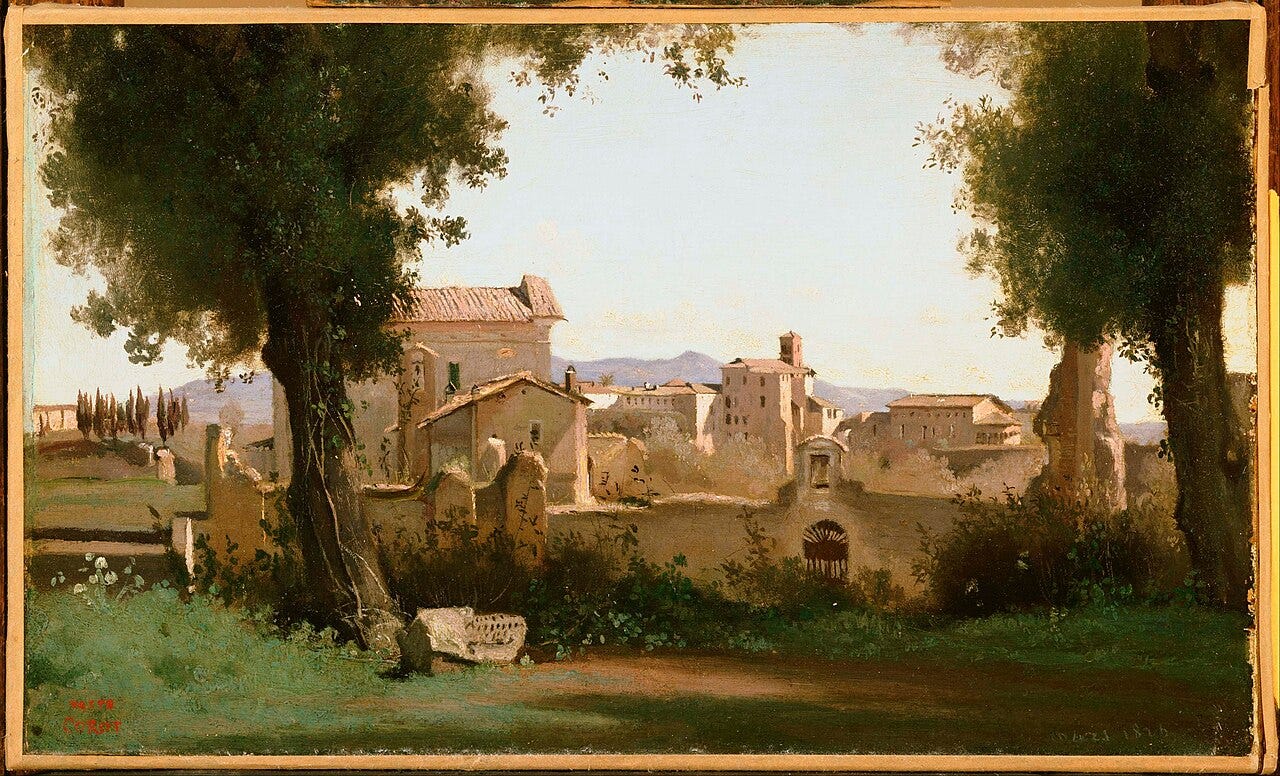
Adored in his own time and copied ever since, he is also, by a strange twist, the most forged painter in history.
Born: Paris, 1796
Known for: silvery landscapes, plein air oil studies, the link to Impressionism
Died: Paris, 1875
More incredible painter stories
If Camille Corot pulled you in, you will love these too:


Camille Corot at a glance
1796. Born in Paris above his parents’ fashion shop.
1822. His father finally granted him an allowance to paint. He was 26.
1825. First journey to Italy, three years of open air studies.
1846. Received the Legion of Honor, to his family’s astonishment.
1875. Died in Paris as père Corot. Forgers kept his brush going for another century.
The two Corots
There are really two of him. One painted the gauzy, poetic landscapes the public loved, feathery trees, soft light, a small figure, all in muted silver greens. These made his name and his fortune.
The other Corot, barely known in his day, made firm little studies outdoors, capturing a real hour and weather with startling freshness. See what is landscape painting.
The man who taught the open air
Those outdoor oil studies, many painted on trips to Italy in the 1820s, were a quiet turning point. Corot worked straight from nature, fast, decades before the Impressionists made it their banner. See what is en plein air.
Pissarro signed himself a pupil of Corot. Monet, Berthe Morisot and Degas all studied him. He is the calm hinge on which French landscape swings from the classical past into the modern.
Pere Corot, the generous one
Corot was famously warm, nicknamed Pere Corot, Father Corot, by younger artists. He gave money to the struggling, bought a house for the blind and broke Honore Daumier, and supported the widow of Jean Francois Millet.
That kindness, plus his fame, fed a problem that outlived him. His loose, easy to copy manner was so simple to fake that a joke still runs through the trade: Corot painted three thousand pictures, ten thousand of which are in America.
You can explore works by Camille Corot in the collection of the Metropolitan Museum of Art.
The draper's son who came to paint at twenty six
Corot was born in Paris on 17 July 1796, the son of a cloth merchant and a milliner. The family trade was fabric, and for years that was meant to be his life too.
He was schooled at Rouen and put through two apprenticeships with drapers, both of which failed to take. Only at the age of 26 did his father give him the money to devote himself to painting.
Almost no famous painter started so late, and he never lost the steady, unhurried habits of a tradesman.
The teachers who pointed him out the door
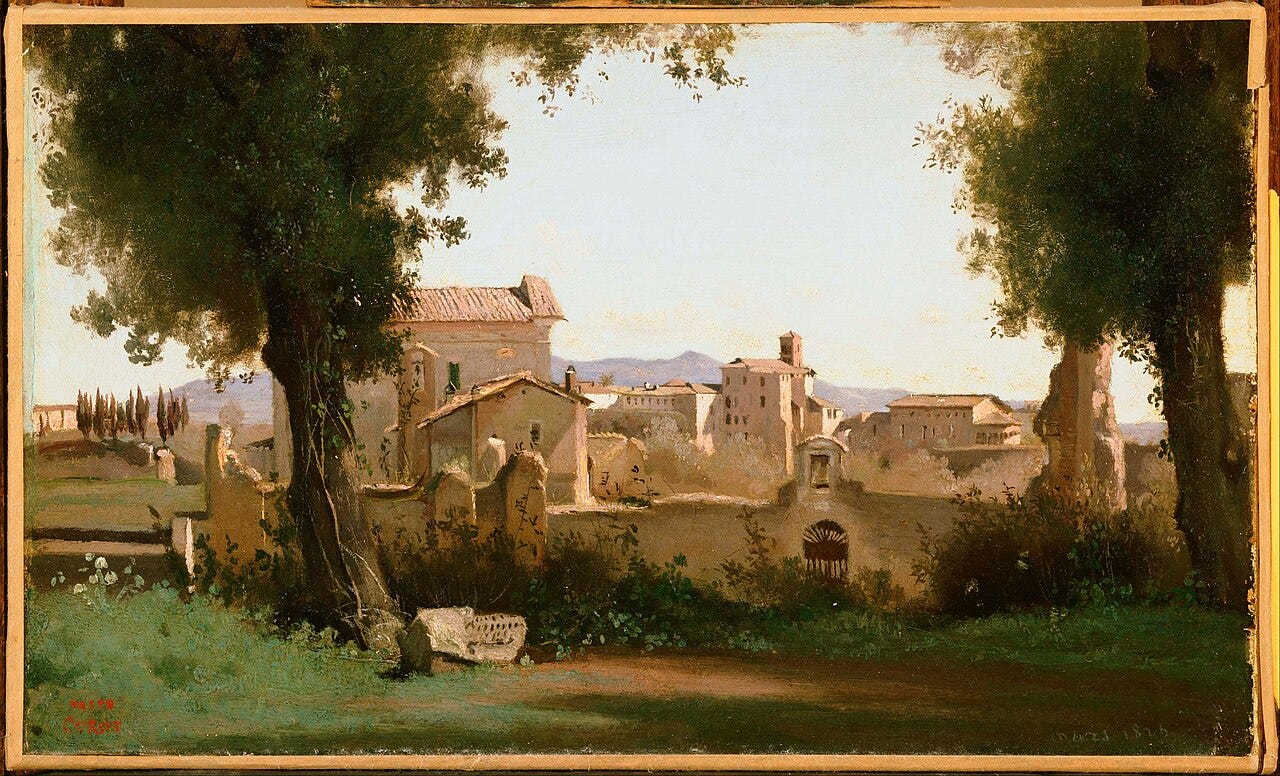
Corot first studied with the landscape painter Achille Etna Michallon, and after Michallon died young, with Jean Victor Bertin. Both men were pupils of Pierre Henri de Valenciennes, the theorist who told French artists to go outside and study real light before building a picture in the studio.
That lineage matters. Corot did not invent the outdoor oil study. He inherited a young French tradition of it and carried it further than anyone before him.
Three journeys to Italy
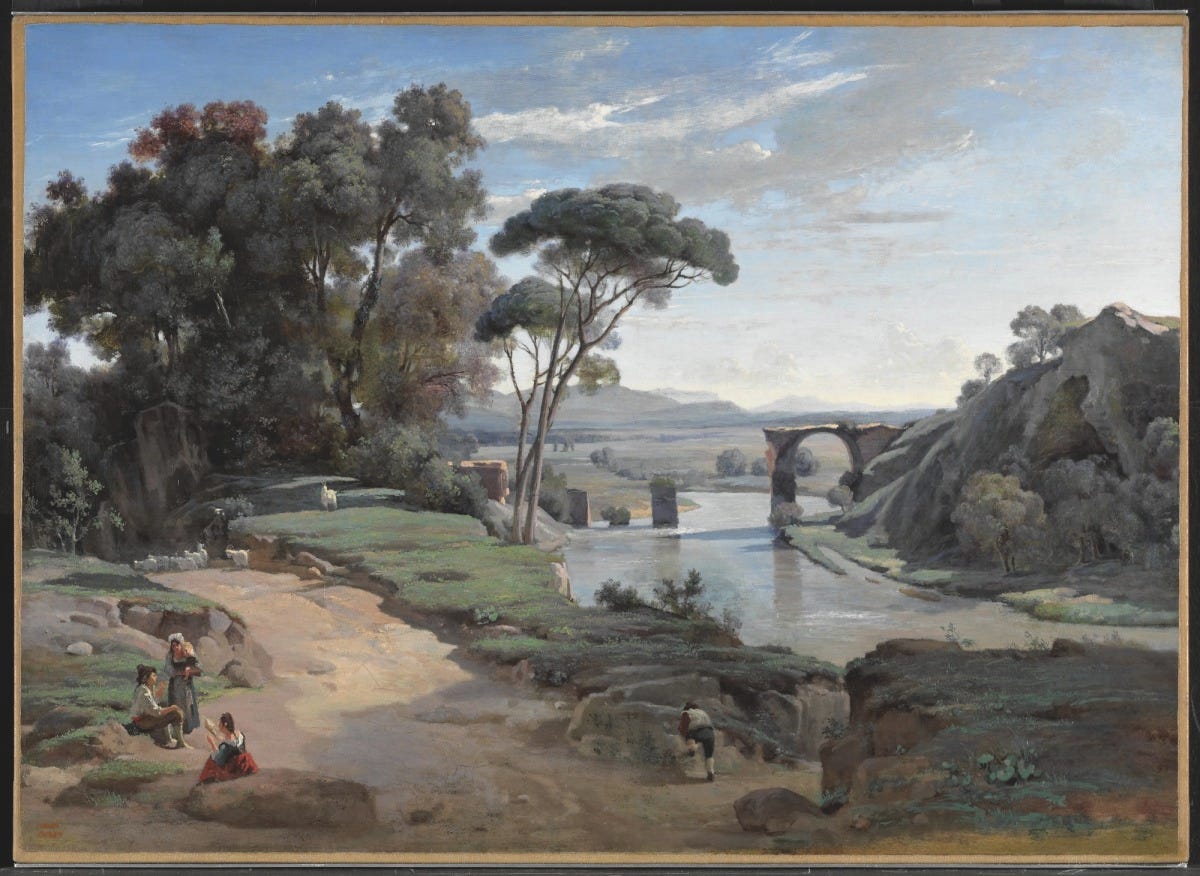
Corot went to Italy three times, in 1825 to 1828, again in 1834, and once more in 1843. The first stay was the one that made him. He left Paris at 29 and spent nearly three years in Rome and the surrounding Campagna, then travelled south to Naples.
By his own count that first trip produced around 200 drawings and 150 oil studies. In Rome he joined one of the earliest circles of open air landscape painters, Frenchmen who shared theories and painted the same sites side by side.
One small panel, painted in the spring of 1826, shows the Roman Campagna with the Claudian Aqueduct running across the distance. It is the whole early Corot in one sketch: quick, clear, sunlit, done on the spot.
He had made his Salon debut in 1827 with two Italian views, one of Narni and one of the Campagna.
Ville d'Avray, the pond he kept coming back to
Corot's family owned a house at Ville d'Avray, just west of Paris, with small lakes nearby. He painted those trees and that water again and again across his life.
The Leaning Tree Trunk, with its trees bending over a still lake, is one of a whole run of Ville d'Avray scenes. The place became less a location than a private motif, a set of shapes he could rearrange at will.
The Salon pictures history forgot
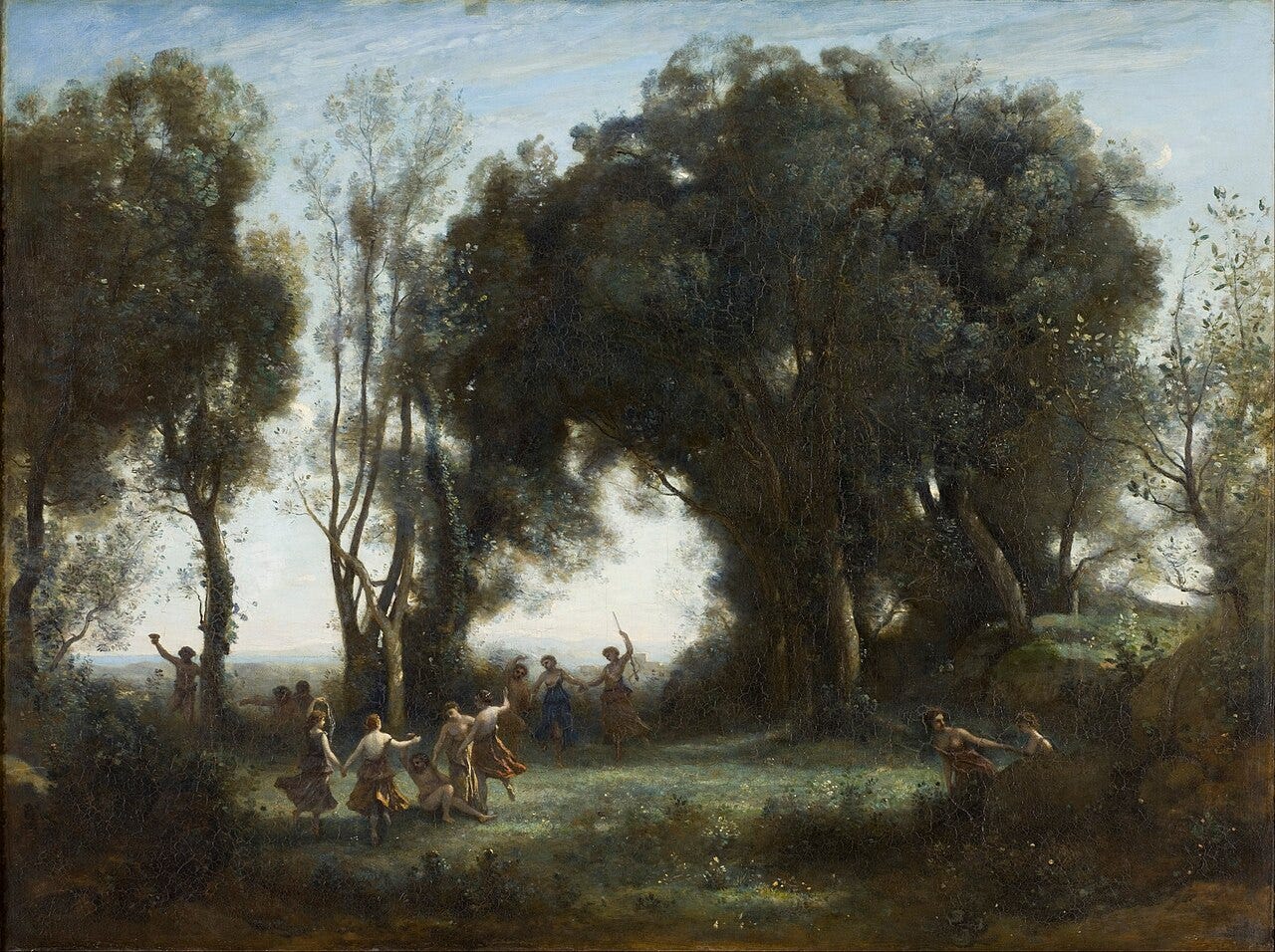
For much of his career Corot ran a double working life. In good weather he painted outdoors, fast and fresh. In winter he shut himself in the studio and built large canvases of myth and scripture aimed at the official Salon.
Those Salon pictures could be huge. Hagar in the Wilderness, shown in 1835, is a biblical desert scene more than two and a half metres wide, its tiny figures set in a landscape he had studied from nature in the French countryside.
In his day a pure landscape with no story was still thought too slight to matter, so the figures gave the view its excuse to exist.
Today those small outdoor studies are the works people cross a city to see, and the grand Salon machines are the ones they walk past.
The souvenirs, landscapes built from memory
In his later years Corot leaned into a form he called the souvenir, a landscape based not on a site in front of him but on the memory of one. Real topography was thinned away in favour of mood and a soft grey light.
Souvenir de Mortefontaine, painted in 1864 and now in the Louvre, is the type at its most loved: feathery trees, a pale sky, a lake, a small figure reaching up. These half remembered scenes are what made his fortune with collectors.
Fontainebleau and the Barbizon friends
Corot also worked in the forest of Fontainebleau, the wooded country south of Paris where a group of landscape painters had settled around the village of Barbizon.
He was close to that circle, above all to Jean Francois Millet, Theodore Rousseau and Charles Francois Daubigny.
What he kept out of his pictures is as telling as what he put in. France was being laced with railways and factories in his lifetime, and not one of them appears in his work.
The figures he kept for himself
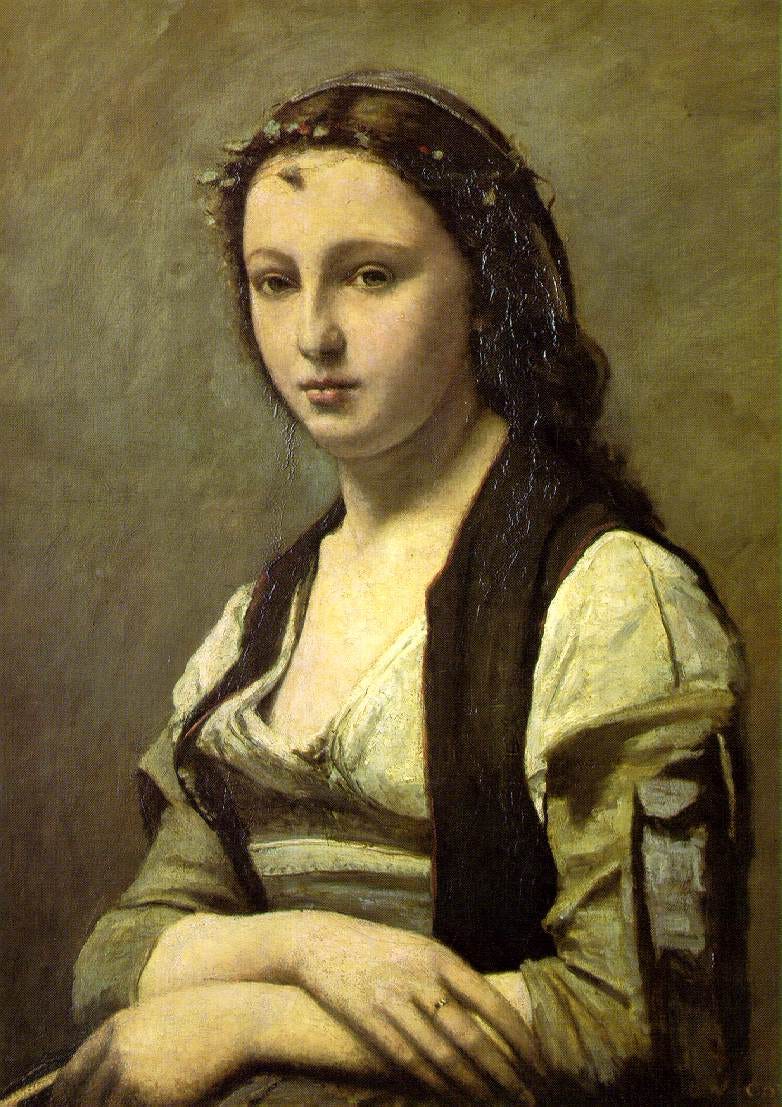
Away from the landscapes, Corot painted people, and he mostly kept them private. Across the last twenty years of his life he made quiet studio figures of women in costume, reading, dreaming or holding a mirror, works like Woman with a Pearl and Interrupted Reading of about 1870.
These were not commissions and rarely portraits of named sitters. They were something he did for himself, tuned to the same silvery harmonies as his landscapes.
The twentieth century rated them highly. Painters and critics came to see in these still, solid figures a modern seriousness that his own age had overlooked.
Why the fakes multiplied
Corot is often called the most forged painter in history, and the reason is not only that his soft late style was easy to copy. He helped cause it himself.
He was hugely productive, with more than 3,000 pictures to his name, and demand still outran supply. He also let younger artists copy his paintings as an exercise, then signed the copies.
His memory based souvenirs, with their vague places and generic trees, gave a forger very little hard detail to get wrong.
The result is a swamp of imitations and disputed attributions. Museums today hang works labelled follower of Corot, imitator of Corot and in the manner of Corot precisely because so many hands worked in his idiom.
Honours, the last burst, and death
Success came fully in the 1850s. At the 1855 Paris Universal Exposition Corot won a first class medal and the Emperor Napoleon III bought a picture from him. In 1867 he was made an officer of the Legion of Honour.
He kept working to the end. In 1871, to escape the Commune in Paris, he went to Douai in the north of France and painted a fresh group of clear, direct views, proof the outdoor eye of his youth never left him.
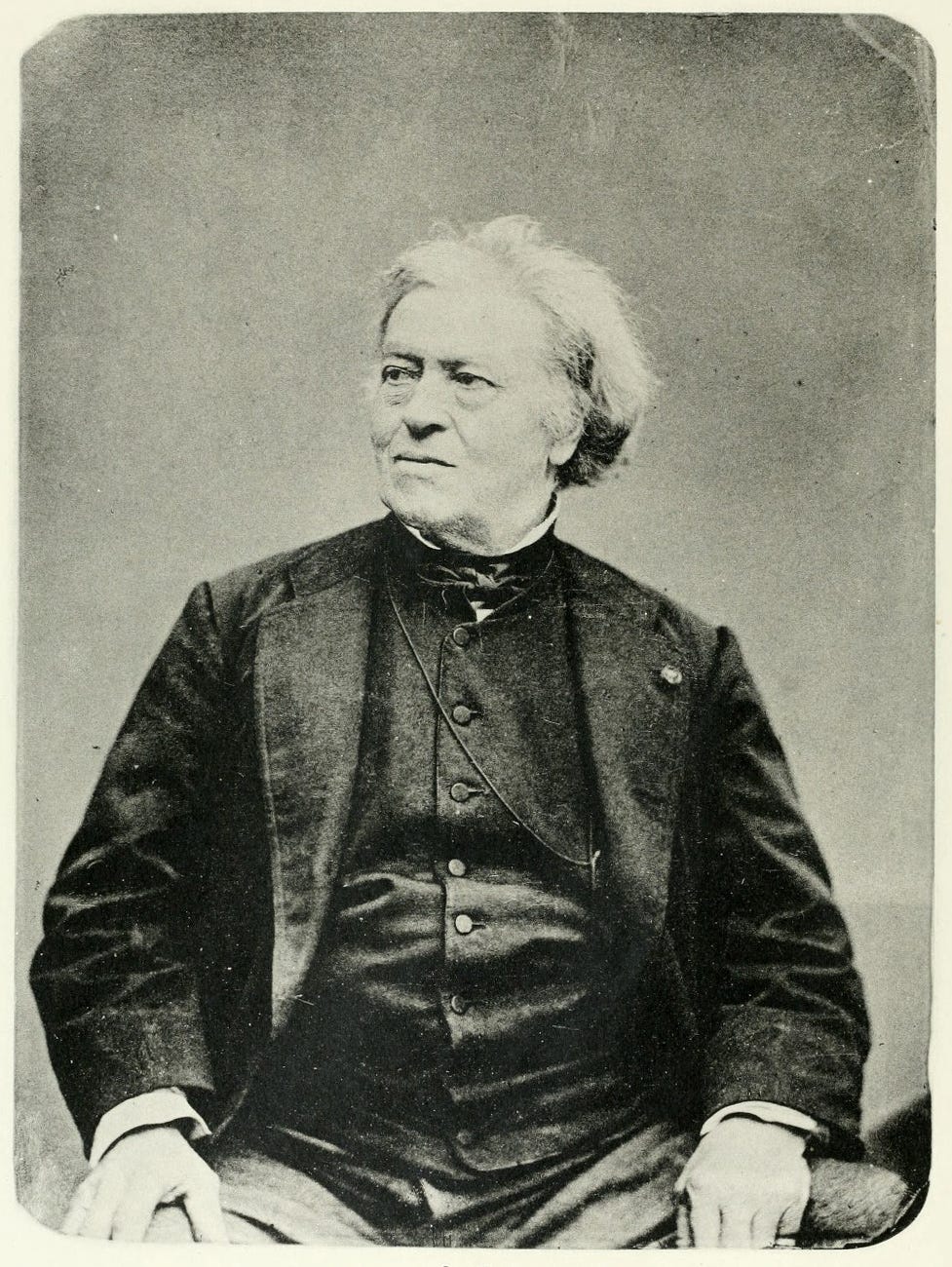
Corot died in Paris on 22 February 1875, aged 78, wealthy and widely mourned.
The Camille Corot questions that keep coming up
What is Camille Corot famous for?
Silvery poetic landscapes and the outdoor oil studies that fed Impressionism.
Did he influence the Impressionists?
Deeply. Pissarro and others called themselves his pupils.
Why are there so many fakes?
His soft, much copied style is notoriously easy to forge, so countless fakes carry his name.
What is a Corot souvenir? The silvery memory-landscapes of his last decades, painted from recollection rather than on site, feathery trees against pearl skies, the pictures that made him rich and beloved.
How much does a Corot cost? Top canvases bring several million dollars, modest for his stature partly because of the flood of fakes: the old joke says Corot painted 3,000 works, of which 10,000 are in America.
Where can I see Corot? The Louvre holds the greatest collection, with strong rooms at the National Gallery in London, the Met, and Reims, which he loved.
More secrets to unlock


The quiet hinge of modern landscape
Corot is easy to skip past because he is gentle. Pull him out, though, and modern landscape loses its bridge. Every Impressionist sunrise owes something to a man patiently painting Italian light in the 1820s.
One last detail. Late in life he turned to quiet studio figures of women reading or dreaming, like Woman with a Pearl. Ignored then, those portraits are now counted among his most modern and moving work.