
Edouard Manet was a French painter often called the father of modern art. He bridged the old world of the Salon and the new world of Impressionism, and twice set off the biggest scandals in 19th century Paris.
Born in Paris in 1832 to a wealthy family, he built his name on two paintings, Le Dejeuner sur l’herbe and Olympia, and died in 1883 at just 51.
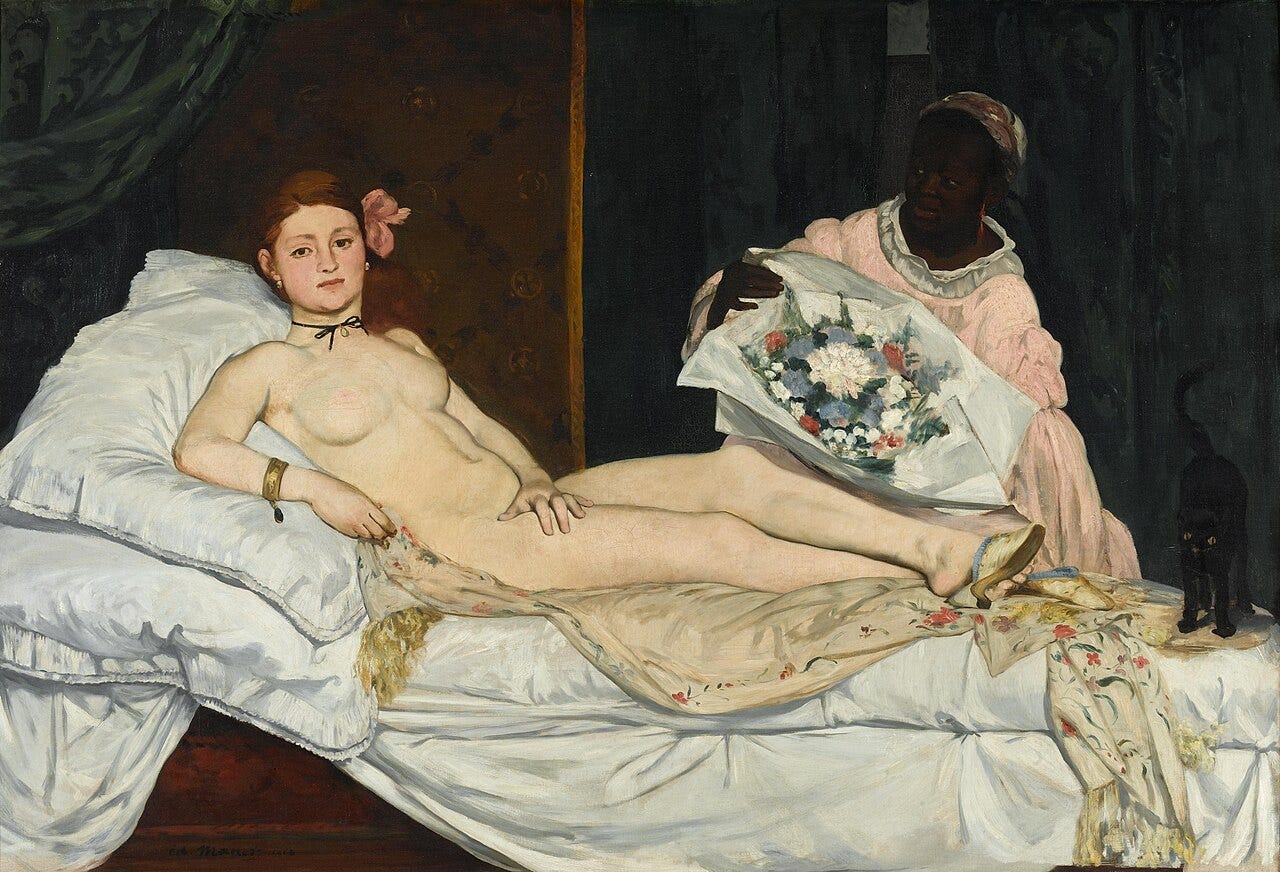
He wanted respectable fame, not rebellion, yet he could not stop painting modern Paris as it really was, including a confident naked woman staring straight back at the viewer. The public was outraged. Younger artists were electrified.
More incredible painter stories
If Édouard Manet pulled you in, you will love these too:


He inspired the Impressionists without ever joining their shows. Here is the whole story.
Édouard Manet at a glance
1832. Born in Paris into a family of magistrates and diplomats.
1863. Le Déjeuner sur l’herbe scandalized the Salon des Refusés.
1865. Olympia needed guards to protect it from the Salon crowd.
1874. Declined to show with the Impressionists, then spent the summer painting beside Monet at Argenteuil.
1883. Died at 51, days after the amputation of his left leg.
The bridge to modern art
Manet stands at the hinge between tradition and the modern. He took the techniques of the old masters and turned them on contemporary life, cafes, streets, bars and bedrooms.
His flat, frank handling and his focus on the here and now broke the spell of polished academic painting. Almost every modern movement traces back through him, which is why he, not Monet, often gets called the first modern painter.
The two scandals
In 1863 his Le Dejeuner sur l’herbe showed a nude woman picnicking with two clothed, modern men. Shown at the Salon des Refuses, it caused an uproar.
Two years later Olympia went further: a naked courtesan reclining and staring coolly at the viewer, unashamed. It scandalized Paris and put Manet at the center of the long, contested story of the nude.
How to spot a Manet
A Manet looks startlingly direct.
Flat lighting. Forms lit head on, with few middle shadows, so figures feel close and frank.
Loose, confident brush. Quick, visible strokes, especially in still life and clothing.
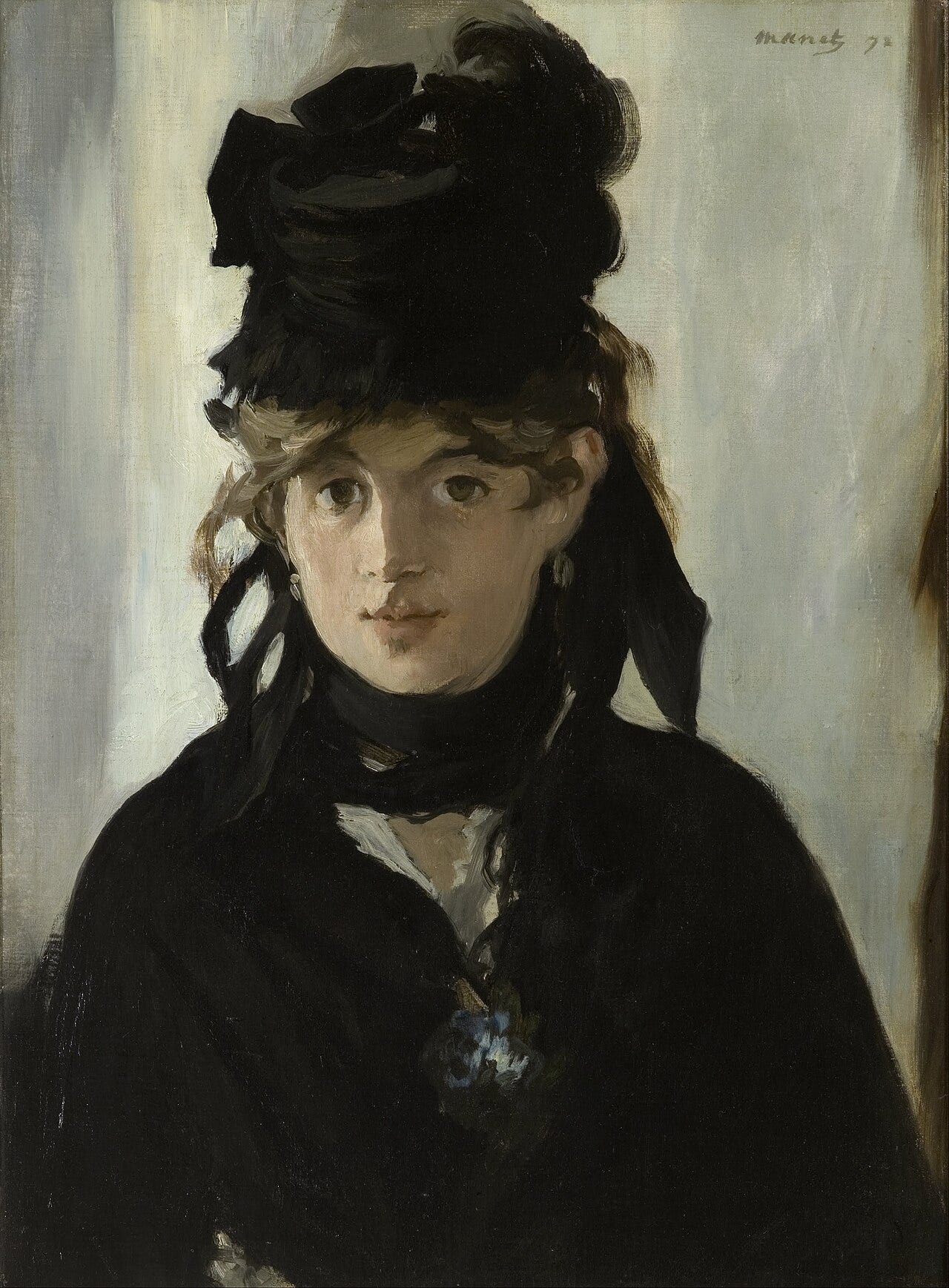
That black. He was a master of deep, living blacks, learned from Spanish painting.
The direct gaze. His subjects often look straight out at you, refusing to be a passive picture.
He grew out of Realism, the movement that insisted on painting ordinary modern life.
The Salon, not the rebels
Here is the paradox of Manet, and for me the most human thing about him. The Impressionists, Monet, Renoir, Degas, looked up to him as a leader, yet he never once exhibited in their independent shows.
He craved official recognition and kept submitting to the establishment Salon, chasing approval from the very institution he had scandalized. He led an upheaval he did not quite want to join.
What he took from Velazquez and Goya
Manet’s modern eye was built on old foundations, above all Spanish painting.
He adored Velazquez, whom he called the painter of painters, and Goya, taking from them his strong blacks, frank realism and loose brush. From his younger friends, the Impressionists, he later picked up lighter color and outdoor painting.
Manet and Berthe Morisot
One relationship marked his life and art: the painter Berthe Morisot, herself a major Impressionist.
She modeled for some of his most haunting portraits, and eventually married his brother, keeping her in the family. Their charged connection is one of the great stories of the era.
The leg that killed him
Manet’s final years were painful. He suffered from a disease, likely linked to syphilis, that attacked his nervous system and legs.
Even as walking became agony, he kept painting, completing his last great work, A Bar at the Folies Bergere. His leg was amputated, and he died days later in 1883, at just 51.
Where to stand in front of a Manet
Paris and London lead the way.
The Musee d’Orsay, Paris. Home to Olympia and Le Dejeuner sur l’herbe.
The Courtauld Gallery, London. Home of A Bar at the Folies Bergere.
Outside France, the Metropolitan Museum of Art in New York holds more of his work, including studies for A Bar at the Folies Bergere.
Born into the establishment he unsettled
Edouard Manet was born in Paris on 23 January 1832, into money and respectability. His father, Auguste Manet, was a senior official at the Ministry of Justice, a man of the law who expected his eldest son to follow him into a courtroom or a government post.
The plan was simple. Study hard, pass the exams, take a respectable position. Manet had other ideas. He filled his school notebooks with drawings and showed little interest in anything else.
An uncle on his mother's side took him to the Louvre as a boy and paid for a drawing course. That early refusal to become a lawyer set the shape of his whole life. The son of the establishment would spend thirty years quietly unsettling it.
The boy who failed the navy twice
Barred from art by his father, Manet tried the next respectable path. The navy.
He sat the entrance exam for the naval training school and failed. In December 1848, aged sixteen, he shipped out as a trainee pilot on a transport vessel bound for Rio de Janeiro. He crossed the Atlantic, saw Brazil, and came home in June 1849.
Then he sat the naval exam a second time. He failed again. Two rejections were enough for everyone, and his parents finally relented and allowed him to train as a painter.
The sea voyage stayed with him. Water, boats and open air would return again and again in his work.
Six years under Thomas Couture
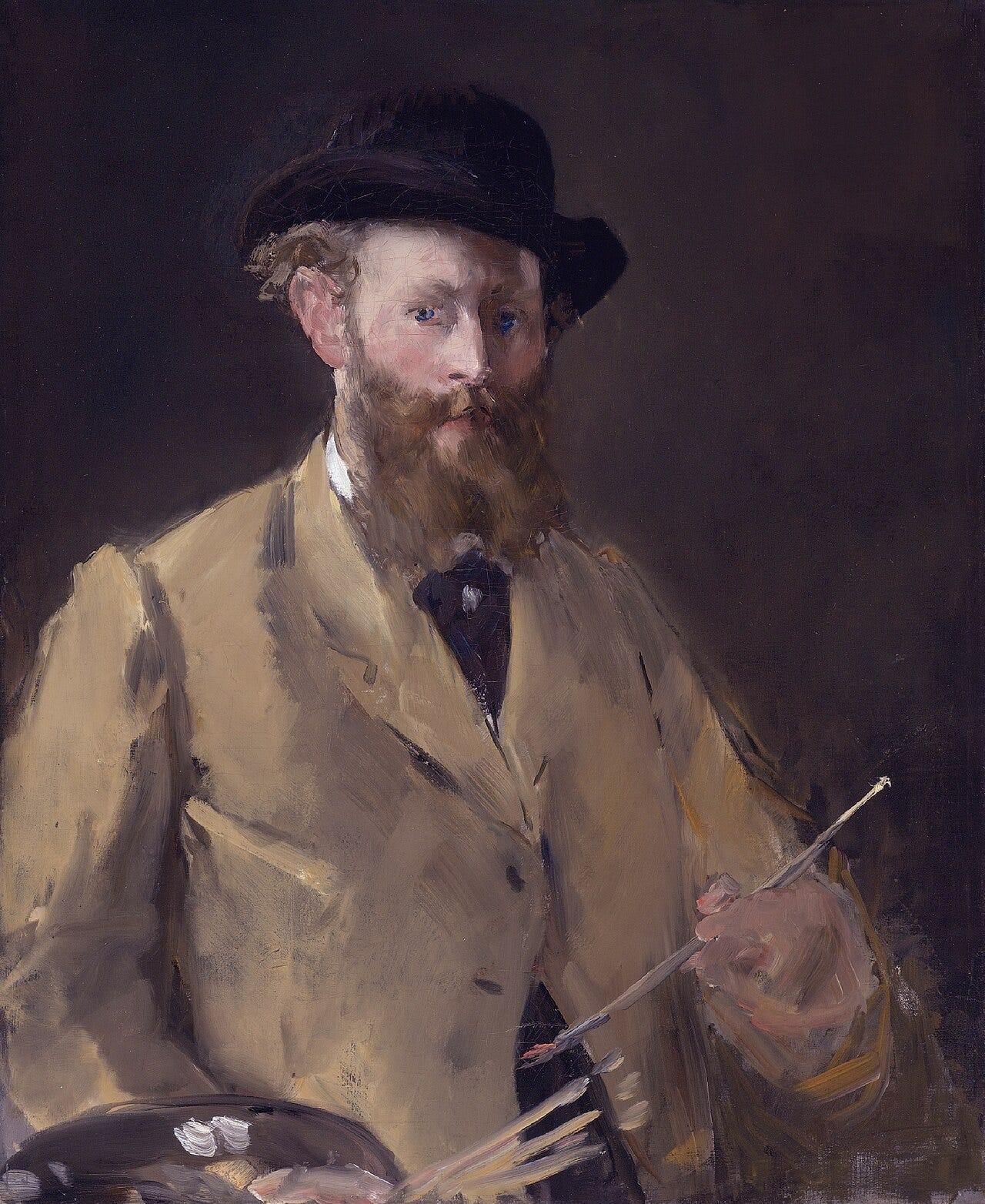
In 1850 Manet entered the studio of Thomas Couture, a successful academic painter. He stayed six years, and it was not a happy fit.
Couture taught idealized figures, smooth finish and grand historical subjects. Manet wanted the people and the clothes he saw in the street. They argued constantly, and Manet complained that the studio poses and props felt lifeless and false.
What he did value was the Louvre. He spent hours there copying Titian and Velazquez, learning by hand rather than by lecture. He left Couture in 1856 and set up his own studio. The training gave him technique. The friction gave him a subject.
The Absinthe Drinker and the first rejection
Manet's first major independent painting was The Absinthe Drinker, finished around 1859.
Its subject was a shock in itself. Not a god or a hero, but a ragpicker Manet had noticed near the Louvre, a shabby man with a glass of absinthe at his feet.
He submitted it to the Salon of 1859, the official exhibition that could make or break a career. The jury rejected it, and even Couture, his own teacher, disliked it.
A modern drunk painted at life size, with none of the polish the Salon expected, was not what juries wanted to reward. The picture set the pattern for the next decade.
The Salon des Refuses of 1863
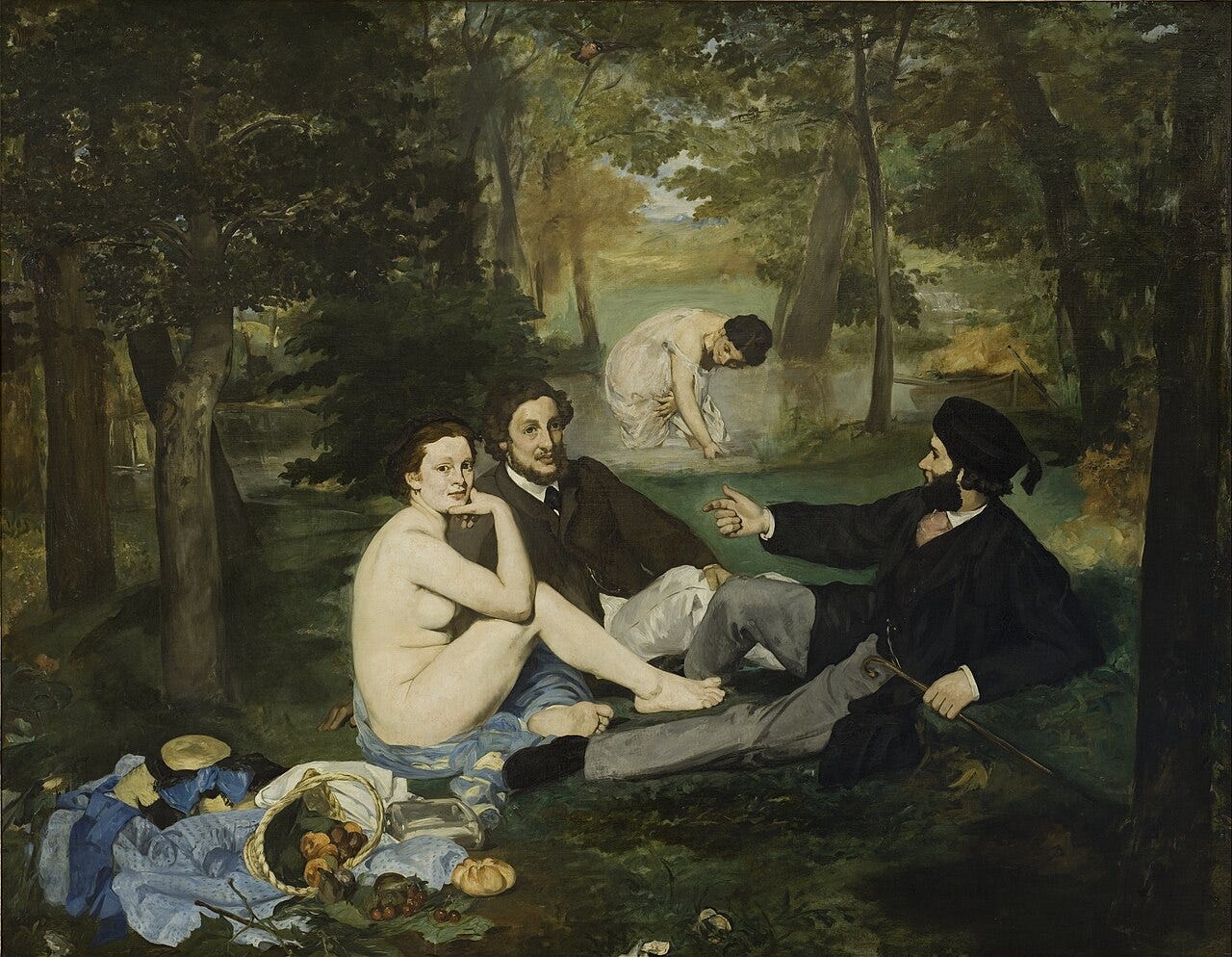
In 1863 the official Salon jury rejected more than half of everything submitted, thousands of paintings, and the anger boiled over.
To calm it, Emperor Napoleon III ordered a second show for the rejected works. It was called the Salon des Refuses. Manet sent three canvases, including Le Dejeuner sur l'herbe.
Crowds poured in, many of them to laugh. Manet's picnic of a nude woman seated beside two dressed men became the thing everyone talked about.
The exhibition mattered beyond one painting. For the first time, the public could see for itself what the jury had thrown out, and that crack in the Salon's authority never fully closed.
Victorine Meurent, the model everyone misread
The red haired woman who stares out of both Le Dejeuner and Olympia is often assumed to be a Paris prostitute Manet hired off the street. She was not.
Her name was Victorine Meurent, and she was a professional artist's model who sat for several painters through the 1860s. She was also an artist in her own right.
Meurent studied painting and exhibited her own work at the Salon, including in 1876, a year the same jury refused Manet's submissions.
Olympia was built from a studied studio pose, not a snapshot of a real courtesan. The scandal was never really about one woman's morals. It was about a working Parisian model looking straight back at the respectable men who came to stare at her.
Baudelaire pushed him, Zola defended him
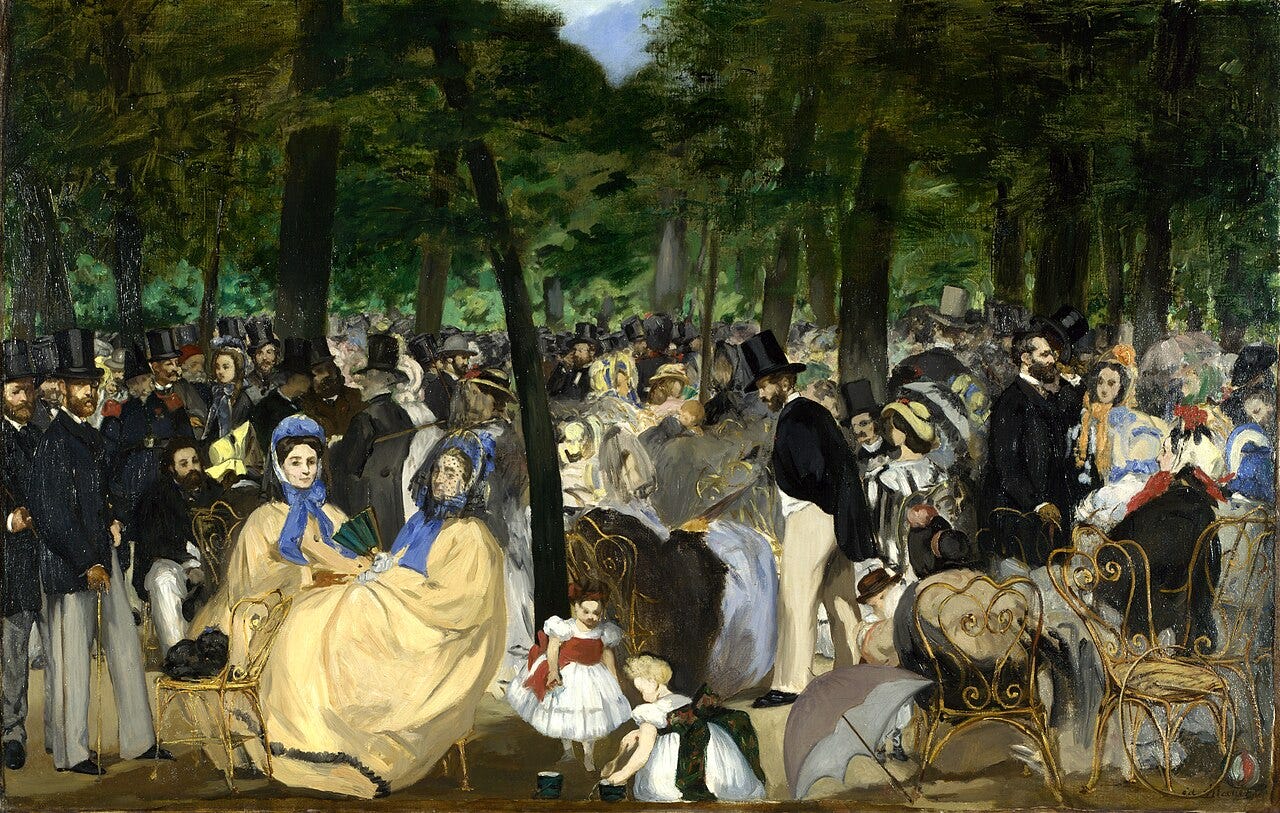
Manet was never alone. Writers saw what the juries missed. The poet Charles Baudelaire became a close friend and urged him forward.
It was Baudelaire's world of modern Paris that lay behind Music in the Tuileries Gardens, which Manet painted outdoors in 1862, a crowd of real fashionable Parisians.
After Baudelaire died in 1867, a younger writer took up the cause. Emile Zola published a long defence of Manet on 1 January 1867, and declared that the future belonged to him. Manet thanked him by painting his portrait for the Salon of 1868.
Zola made one prediction that sounded absurd at the time. He said Le Dejeuner would one day hang in the Louvre. It did, entering the national collection in 1934.
Suzanne Leenhoff and the boy called Leon
The most private puzzle of Manet's life sat at his own dinner table. In 1863 he married Suzanne Leenhoff, a Dutch piano teacher who had given lessons to him and his brothers in the family home.
Suzanne already had a son, Leon, born in 1852, long before the wedding. The boy was raised as Suzanne's younger brother and introduced to the world as Manet's godson, never as his child.
Manet painted him often, once with a sword, once carrying fruit.
Whether Leon was Manet's own son, or the son of Manet's father, was never settled. The family kept the secret to the grave. Manet gave the boy his care and his canvases, but never, in public, his name.
The Cafe Guerbois circle he led but never joined
By the late 1860s Manet had become the center of a circle without ever setting out to lead one. The meeting place was the Cafe Guerbois, in the Batignolles quarter of Paris.
On certain evenings the younger painters gathered there. Claude Monet, Pierre Auguste Renoir, Edgar Degas and Frederic Bazille came to argue about art over drinks, and Manet held court.
They admired him, since his years of refusals had made him a figurehead for the new painting.
Henri Fantin-Latour painted that circle in 1870, showing Manet at his easel surrounded by Renoir, Monet, Bazille and Zola in A Studio at Les Batignolles.
Yet when this same group launched their own independent exhibition in 1874, Manet said no. He said no again to all eight of their shows. He wanted the Salon, not a breakaway club, even as those painters kept calling him their example.
A republican through the siege, honoured too late
Manet was a committed republican who had little love for the empire of Napoleon III.
When France went to war against Prussia in 1870, he sent his family to safety and stayed to defend the capital. He served as a staff lieutenant in the National Guard and lived through the long siege of Paris, a winter of hunger and shelling.
Official honour came late. In 1881 the state finally named him a Chevalier of the Legion of Honour. By then his health was failing.
His last great painting, A Bar at the Folies Bergere, went to the Salon in 1882, its barmaid meeting our eyes while the mirror behind her shows a reflection that cannot quite line up.
Recognition and decline arrived together.
More secrets to unlock


The Édouard Manet questions that keep coming up
What is he known for? Scandalous modern paintings like Olympia, and bridging to Impressionism.
When did he live? Born in 1832, died in 1883.
Was he an Impressionist? He inspired them but never exhibited in their shows, aiming for the Salon.
Why was Olympia shocking? A nude courtesan stared coolly at the viewer, refusing to be idealized.
Where was he from? Paris, born into an upper middle class family.
Did Manet actually want to be a painter, or was he pushed into it? He chose it against strong resistance. His father, a senior official at the Ministry of Justice, wanted him in law. Manet failed the naval entrance exam twice, partly because his heart was never in it, and only then did his parents allow him to train as an artist under Thomas Couture in 1850. Painting was his own stubborn choice.
Was Leon Leenhoff really Manet's son? No one knows for certain. Leon, born in 1852, was raised as the younger brother of Manet's wife Suzanne and described in public as Manet's godson. Manet painted him repeatedly and provided for him. Historians have argued that Leon was either Manet's own child or the child of Manet's father, but the family never confirmed it.
Manet shocked Paris with black paint and posed figures while his near namesake chased outdoor light instead, a contrast laid out in our piece comparing Monet and Manet.