
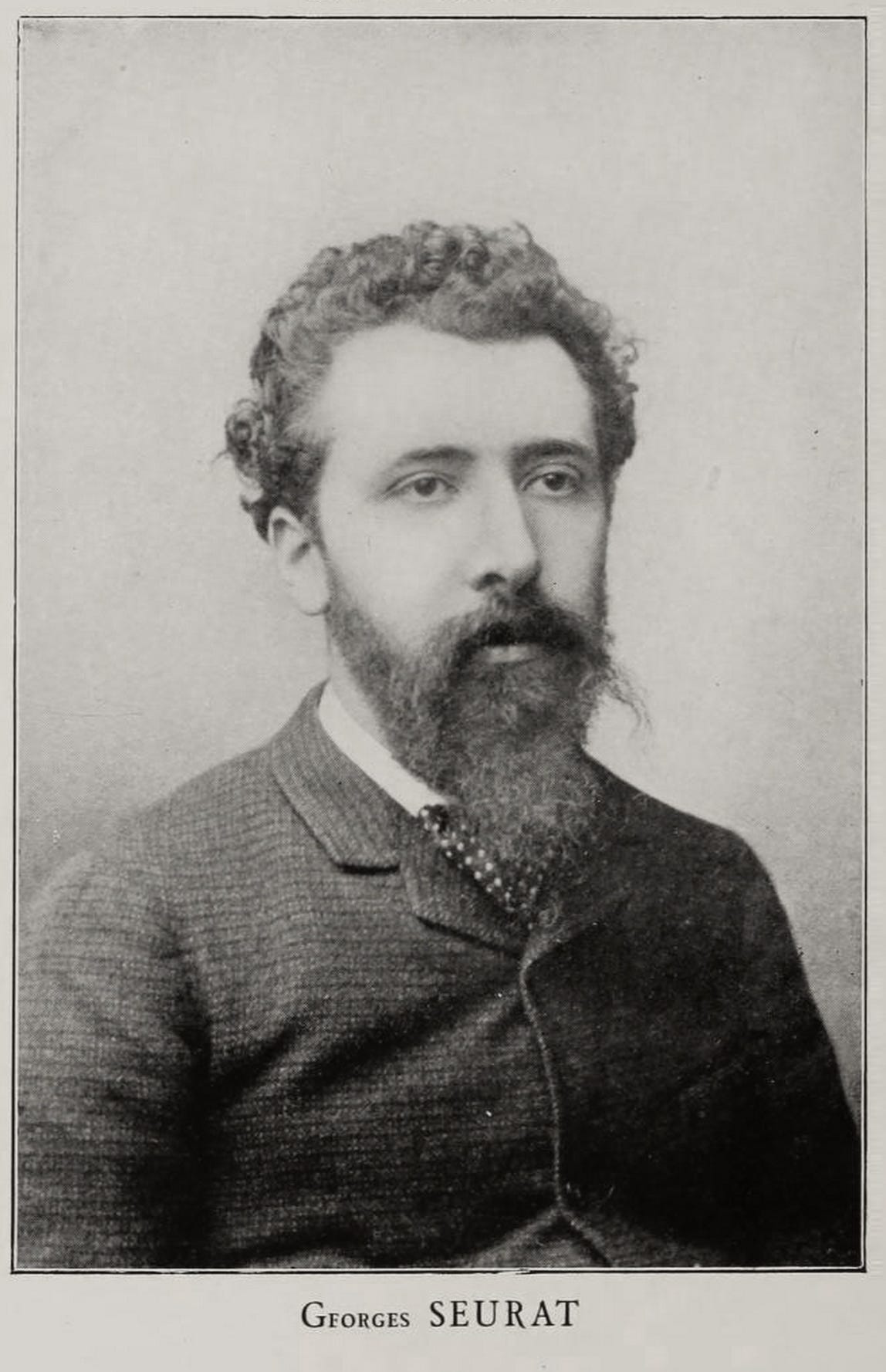
Georges Seurat was the painter who turned dots into a science. He built A Sunday on La Grande Jatte out of millions of tiny touches of pure color, invented Pointillism, and died at just thirty one, leaving only a handful of monumental works.
In barely a decade of work he rewired how a picture could be built, then died at the height of it, leaving a reputation far larger than his tiny surviving output.
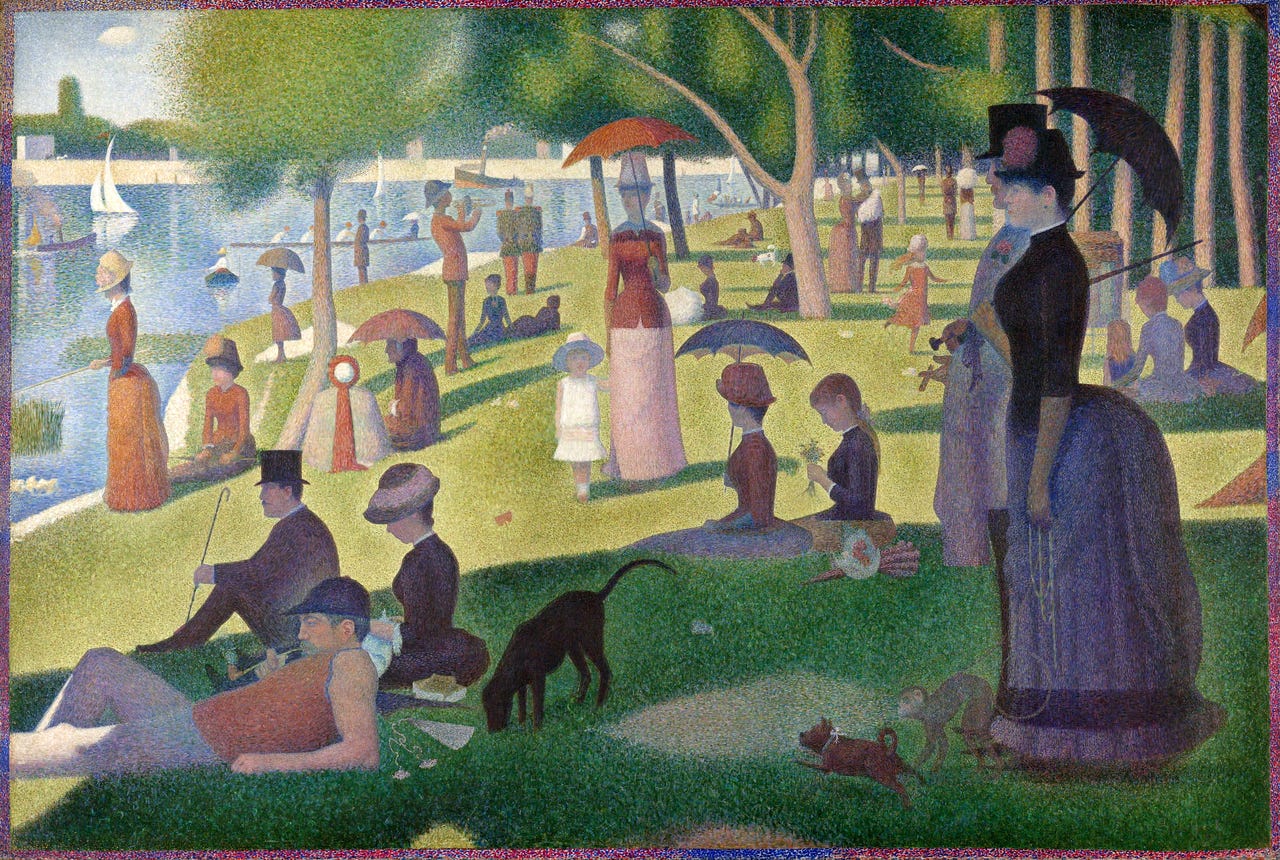
Where the Impressionists worked fast and by instinct, Seurat slowed everything down and turned painting into a method. The calm of his pictures hides an enormous amount of control.
More incredible painter stories
If Georges Seurat pulled you in, you will love these too:


Georges Seurat at a glance
1859. Born in Paris to a comfortable, quiet family.
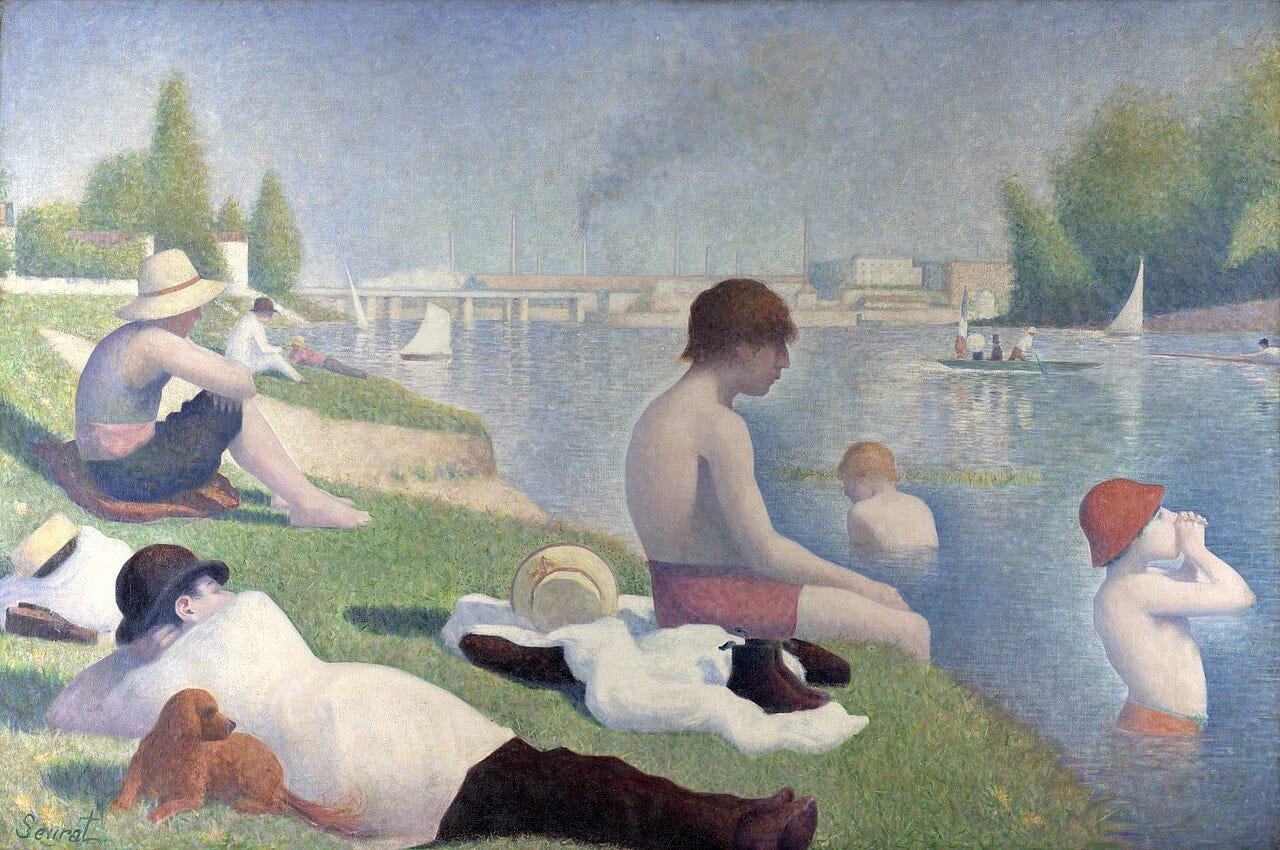
1884. Bathers at Asnières was refused by the Salon. He helped found the jury free Indépendants instead.
1886. A Sunday on La Grande Jatte crowned the last Impressionist exhibition.
1890. A secret family: his companion Madeleine and a son almost nobody knew about.
1891. Died suddenly at 31. Signac spent years securing the legacy.
Painting one dot at a time
Seurat covered his canvases in small, separate dots of pure color, trusting the eye to blend them at a distance into glowing light.
He called it Divisionism; we call it Pointillism. It grew out of the new science of how colors affect one another, and it took him months of patient, almost machine like work. Other painters picked up the method too, enough to fill a whole list of famous pointillist paintings. Seurat himself preferred the more technical name, and what divisionism actually means is worth spelling out on its own.
A Sunday on La Grande Jatte
Seurat first drew notice with Bathers at Asnieres in 1884, a calm scene of working men by the Seine that the official Salon rejected. He answered by helping found an independent exhibition.
Then he spent two years building the huge canvas, finishing it in 1886. Parisians stroll, sit and fish on an island in the Seine, every figure still as a statue, a modern crowd frozen in dots of light. It became the face of Post Impressionism.
When science met art
Seurat read books on optics and color and tried to give Impressionism the method it lacked. He even painted dotted borders around his canvases and chose frames to control how the colors read.
For him a painting was as much a careful experiment as an act of feeling.
Dead at thirty one
In the spring of 1891 Seurat fell suddenly ill, probably with an infection, and died within days, aged only thirty one. His young partner and their baby son fell ill at the same time, and the child died too.
He left perhaps seven major paintings, a tiny output for a giant reputation.
Brick by colored brick, straight to modern art
Seurat proved that a painting could be built like a structure, brick by colored brick, and still glow with life. His dots fed straight into modern art, from the color experiments of the next generation to the pixels on the screen you are reading this on.
Where the two big canvases hang
A Sunday on La Grande Jatte is the pride of the Art Institute of Chicago. Bathers at Asnieres, the picture the Salon turned away, now hangs in the National Gallery in London.
The quiet son of a comfortable Paris family
Georges Seurat was born in Paris on 2 December 1859, into money and reserve. His father was a property owner and former bailiff from the Champagne region, who kept a cottage and garden outside the city where he spent most of his time.
Georges grew up mainly with his mother, along with a brother and a sister. During the Paris Commune of 1871 the cautious family slipped away to Fontainebleau to wait out the unrest.
The comfort mattered. A private income meant Seurat never had to sell a canvas to eat, so he could chase a slow, exacting method with no market pressure.
He stayed intensely private, and friends described a man who guarded his personal life to the very end.
Learning to draw under a pupil of Ingres
Seurat trained the official way. In 1875 he took a course with a local teacher, and in 1878 he entered the Ecole des Beaux Arts in Paris. His teacher there was Henri Lehmann, a follower of Ingres, the great champion of line over color.
That schooling stuck. Seurat came out of it devoted to drawing above almost everything, treating a clean contour and careful tone as the backbone of a picture.
In November 1879, aged twenty, he left for military service at Brest on the Atlantic coast, and filled sketchbooks with the sea, the beaches and the boats. Back in Paris the next year he kept reading, pulled toward books that tied art to science.
The conte crayon drawings that came first
Before the dots, there were the drawings, and they rank among the finest of the century.
Seurat worked in conte crayon, a greasy black chalk, on rough textured paper. He pressed and eased the crayon so the grain of the paper broke the black into soft grades of shadow.
The results glow without a single hard line, and figures rise out of the dark like shapes half seen at dusk.
The Metropolitan Museum of Art holds two from 1882 and 1883, a portrait of his friend Aman Jean and a tender study of his mother sewing.
He left around five hundred drawings in all, and the painter Bridget Riley later treated them as art fully equal to the paintings.
Bathers at Asnieres, the canvas the Salon refused
His first large statement was not the park scene most people know. It was Bathers at Asnieres, painted in 1883 and 1884.
The canvas is huge, about two meters by three. It shows working men and boys resting by the Seine on a hot day, across the water from the factories of a Paris suburb.
Seurat sent it to the official Salon in 1884, and the jury turned it down. Rather than retreat, he treated the rejection as a starting gun.
The painting hangs today in the National Gallery in London, and if you look closely you find small dabs of orange and blue that Seurat added later, testing his new color method on a picture he had already finished.
A show that answered to no jury
The Salon rejection pushed Seurat into history a second way. In 1884 he helped found a new exhibiting body with a plain promise: no jury and no prizes. Any artist could pay a fee and show.
It settled into the Societe des Artistes Independants, which then ran the yearly Salon des Independants. Seurat showed his refused Bathers there in 1884.
The idea outlived him by generations. Freed from a jury's taste, young painters could put radical work straight in front of the public. The Independants became one of the doorways through which modern art walked in.
Pointillism was not the word he wanted
Here is a myth worth clearing up. Seurat did not call his method pointillism. Critics coined that word, and it stuck to the dots.
Seurat and his circle preferred divisionism, the splitting of a tone into its separate colors, or the grander term chromoluminarism.
The difference mattered to him. Pointillism names a texture, all those points of paint. Divisionism names the whole idea, dividing color to build light.
There is a second, quieter myth. The science was never as tidy as Seurat hoped. Modern study shows the dots do not truly fuse into fresh colors in the eye the way he expected.
The effect we admire is real, but it owes as much to his own eye as to the optics he trusted.
The painted borders, the white frames, and the later canvases
Seurat kept pushing after La Grande Jatte, and he even painted the edges. Around 1888 and 1889 he added borders of small colored dots to several works, then set them in plain white frames, so nothing warm or gilded would fight his color.
The large pictures kept coming. Les Poseuses, or Models, now at the Barnes Foundation in Philadelphia, showed nude models in his own studio.
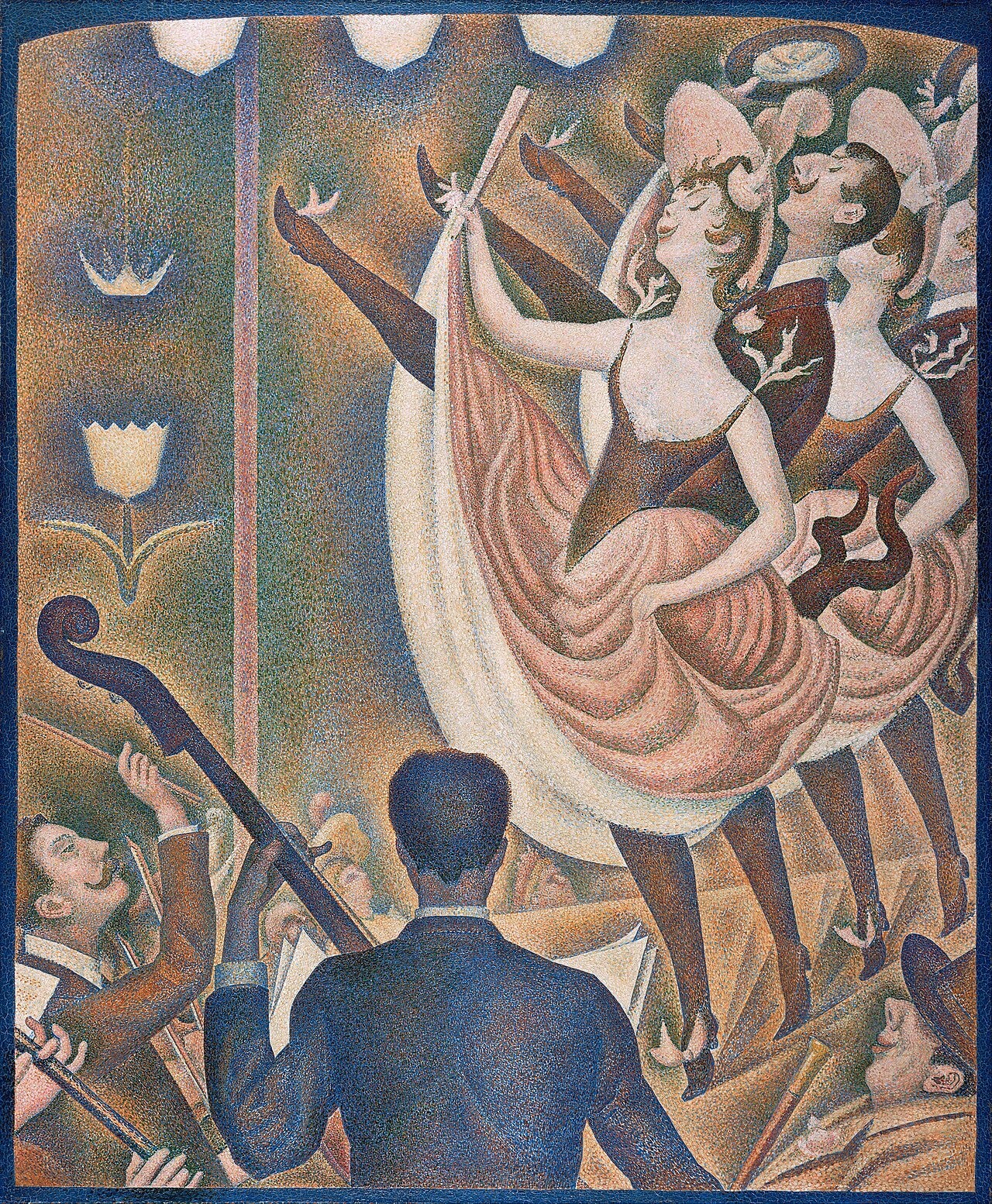
He turned to popular entertainment in Parade de cirque at the Metropolitan Museum of Art, and the cabaret kick line of Le Chahut, now at the Kroller Muller Museum. In 1888 he also painted calm harbor views at Port en Bessin on the Normandy coast.
The hidden family, the sudden death, and Signac

Seurat kept one secret to the end. He lived in the Pigalle district with Madeleine Knobloch, and in February 1890 she bore him a son he registered as Pierre Georges. He hid the little family even from close friends.
In March 1891 he wore himself out hanging the Salon des Independants, where his unfinished Le Cirque was on show. He fell ill within days and died in Paris on 29 March 1891, aged thirty one.
The likely cause was an infectious illness such as diphtheria.
Paul Signac, his closest ally, spent the following decades keeping Neo Impressionism alive and wrote its founding manifesto in 1899.
His baby son caught the same sickness and died two weeks later. Le Cirque now hangs in the Musee d'Orsay, still unfinished, and Paul Signac spent the rest of his life carrying Neo Impressionism forward.
More secrets to unlock


The Georges Seurat questions that keep coming up
Who was Georges Seurat? The French painter who invented Pointillism.
When was he born? In Paris, in 1859.
How did he die? In Paris, in 1891, of a sudden illness, at the age of 31.
What is he famous for? A Sunday on La Grande Jatte.
What technique did he create? Pointillism, painting in dots of pure color.
Where can I see his most famous work? The Art Institute of Chicago holds A Sunday on La Grande Jatte.
Did Seurat invent pointillism by himself? Not alone. Seurat led the method, but his friend Paul Signac worked it out alongside him and became its main champion after Seurat died in 1891. Even the older painter Camille Pissarro tried it for a while. And Seurat himself preferred the name divisionism to pointillism.
How many paintings did Seurat leave behind? Very few for so famous an artist. He died at thirty one, so his output is small: about seven large canvases, roughly forty smaller paintings and panels, and around five hundred drawings. It was quality, not quantity, that made his name.
A Sunday on La Grande Jatte now anchors the Art Institute of Chicago, where visitors lean in to see the dots, then step back to watch them dissolve into summer light.
For me that is the quiet magic of Seurat: a picture engineered like a machine that somehow still breathes.