
Henri Matisse was the French master of color who led the Fauves, spent a lifetime as Picasso's friendly rival, and reinvented his own art at the very end, cutting shapes from painted paper with scissors when he could no longer stand.
More than any painter of the twentieth century, he made joy itself his subject. He was born in a weaving town in northern France in 1869 and did not pick up a brush until he was 20, recovering from appendicitis.
Matisse at a glance:
Born at Le Cateau-Cambrésis in 1869; discovered painting at 20, recovering from appendicitis.
Set off the Fauve scandal at the 1905 Salon d'Automne.
Spent his last decade making the cut-outs from bed and wheelchair.
Designed the entire Vence chapel between 1948 and 1951.
Picasso, his lifelong rival, collected his paintings and mourned him openly.
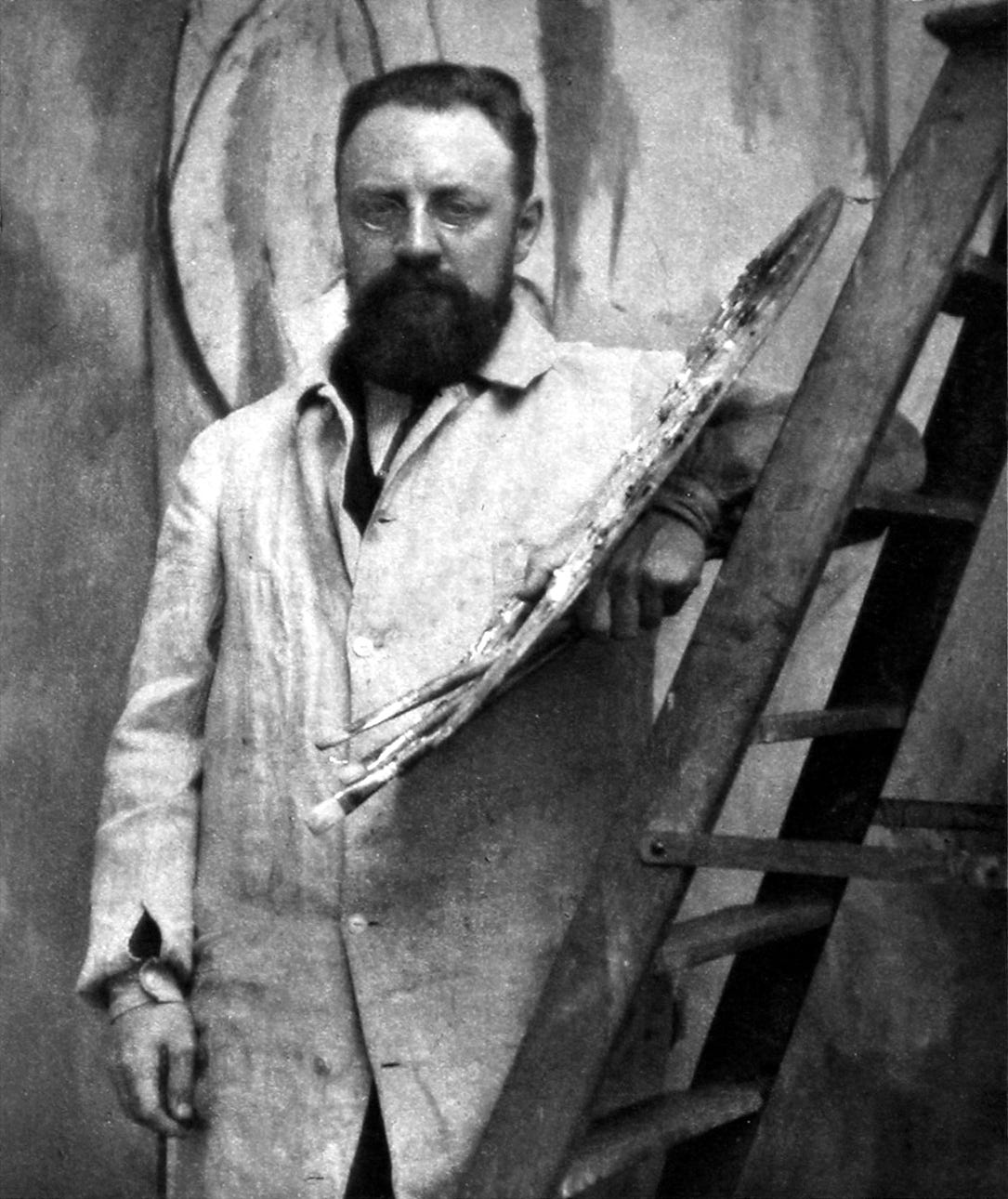
He wanted his pictures to calm you down, not shake you up. That sounds simple. It took him fifty years of work to get there.
More incredible painter stories
If Henri Matisse pulled you in, you will love these too:


Color as the whole point
Matisse cut color loose from description. A face could be green, a shadow could be pink, if that is what the picture needed to feel right.
He once said he dreamed of an art as restful as a good armchair for a tired mind. You can see that calm in Goldfish, in the flat red of The Red Studio, and in the dancers who circle across his canvases.
The bright years grew from dark ones
The joyful cut outs came out of a grim time. Matisse spent the Second World War in the south of France, too ill to flee, while his estranged wife and his daughter Marguerite worked for the Resistance.
Marguerite was arrested and tortured by the Gestapo and barely survived. Out of those years of fear and sickness came some of the most life affirming images he ever made, color cut clean from the page.
The calm in his art was a decision, not an accident.
The door he opened for the century
The Art Institute of Chicago holds Bathers by a River, one of the five works he called pivotal.
Matisse came out of Post Impressionism and an early flirtation with pointillism, then blew the door open with Fauvism, the first great shock of the new century. Cubism and abstraction walked through the door he opened.
Six pictures that made Matisse famous
A few works carry his fame: The Dance, Woman with a Hat, The Red Studio, Goldfish, the cut paper Blue Nudes, and the book Jazz. Each one is a lesson in how far color alone can carry a picture.
The law clerk who found paint at twenty
Matisse was not a child prodigy. He was born in 1869 and grew up in the textile country of northern France, and his family pointed him toward a safe career.
He studied law in Paris, passed his exams, and took a job as a clerk in a solicitor's office near Saint Quentin.
Then, around 1889, appendicitis put him in bed for weeks. To pass the time, his mother brought him a box of paints. He was twenty years old. He later said the moment felt like finding a kind of paradise, and he soon gave up the law for good.
Moreau's studio and the long days at the Louvre
In Paris he entered the studio of Gustave Moreau at the Ecole des Beaux Arts. Moreau was a Symbolist painter and a generous teacher, and he told his students to trust their own eye rather than copy a formula.
Matisse spent hours in the Louvre making careful copies of old masters. He studied Chardin, Poussin, and the Dutch painters, learning how color and light hold a picture together.
That slow schooling under Moreau and in the museum gave him a base he would push against for the rest of his life.
The 1905 room they called a cage of wild beasts
In the autumn of 1905, Matisse and a few friends hung their new work together at the Salon d'Automne. The canvases used pure color straight from the tube, laid down in loose patches that did not always match real life.
The critic Louis Vauxcelles looked at the room and joked that it was like finding a Renaissance sculpture among wild beasts, or fauves in French.
The name stuck, and Fauvism was born. The picture that drew the loudest scorn was Woman with a Hat, a portrait of his wife Amelie with green and violet across her face.
Viewers were shocked. One American couple, though, saw something in it and bought it.
Picasso, the rival he could not do without
Matisse and Pablo Picasso met around 1906 in Paris, and they circled each other for the next fifty years. Matisse was the elder by twelve years, calm and orderly. Picasso was younger and restless. Each watched the other closely.
They traded paintings and studied what the other was doing. The push went both ways, color against structure, the north against the south.
Picasso later said that no one had ever looked at his work as carefully as Matisse, and that when Matisse died there was no one left to talk to in quite the same way.
The Steins and Shchukin, the buyers who believed
Matisse might have struggled far longer without a handful of early buyers. Leo and Gertrude Stein, Americans living in Paris, bought Woman with a Hat and hung it in their apartment where the whole avant garde could see it.
Their support gave him standing at a fragile moment.
The Russian textile merchant Sergei Shchukin went further. He commissioned two large panels, Dance and Music, finished around 1910 for the staircase of his Moscow mansion.
Those commissions let Matisse work at grand scale, and both panels are now held in Russian museums.
Why he chased the light down to Nice
Around 1917 Matisse began spending winters in Nice, on the Mediterranean coast, and he eventually settled there. He said the clear southern light was what kept him. The change showed at once in the work.
For much of the 1920s he painted interiors full of patterned fabrics, open windows, and models posed as odalisques against screens and cushions.
The mood is warm and unhurried. Some later critics found these years soft, but the pictures were a patient study of color, light, and the female figure at rest.
The wall in Pennsylvania he had to paint twice
In the early 1930s the collector Albert Barnes asked Matisse to paint a large mural for the Barnes Foundation near Philadelphia. The subject was again the dance, a ring of leaping figures set into three arched panels high above the galleries.
Matisse worked from measurements he had been given for the wall, and the numbers were wrong. When the finished canvas did not fit, he started over and painted the whole thing again to the correct size.
The corrected version has been at the Barnes Foundation in Pennsylvania ever since, and the first attempt survives in a Paris museum.
1941, surgery, a bed, and a second life of work
In 1941 Matisse underwent major surgery for abdominal cancer. He survived, but the operation and its aftermath left him weak and often confined to a bed or a wheelchair for the rest of his life.
He treated the reprieve as a gift and called the years that followed a second life. Assistants pinned papers to the walls, fetched materials, and moved shapes where he pointed.
Unable to stand for long at an easel, he found a new way to make art that his body could still manage.
Drawing with scissors
In his final decade Matisse turned to paper. Assistants painted sheets in flat color, and he cut shapes from them with a pair of scissors, then arranged and pinned them into large compositions.
He described the method as drawing with scissors, cutting straight into color.
The results include the 1947 book Jazz and the series of Blue Nudes from 1952, along with room sized works of leaves, birds, and swimmers.
The cut outs are simple in means and joyful in effect, and many people now count them among the finest work of his whole career.
The chapel at Vence, the work he loved most
Between 1948 and 1951 Matisse designed a small chapel for a community of Dominican nuns at Vence, in the hills above Nice. He took on the entire building, not just a picture for the wall.
He drew the stained glass windows, the black and white tile murals, the altar, the priests' vestments, and even the door handles.
Inside, colored light from the windows falls across plain white walls drawn with a few thin lines. Matisse, who was not conventionally religious, poured his last strength into it.
He called the Chapel of the Rosary the crowning achievement of his life. He died in Nice in 1954.
The paint box that started everything
At 20, a law clerk recovering from appendicitis, Matisse was given a paint box by his mother to pass the time.
He later said that from the moment he held it he knew this was his life. The father predicted ruin; the son moved to Paris within the year.
Scissors as a drawing instrument
After 1941 surgery left him bedridden, Matisse had assistants paint sheets with gouache and carved them with tailor's shears, directing placement from bed with a long bamboo pointer.
He called it drawing with scissors, cutting into color itself. The Snail and the Blue Nudes came from a man who could barely stand.
The rivalry that ran on respect
Matisse and Picasso traded paintings all their lives, choosing difficult ones on purpose, and inspected each other like chess players.
After Matisse died in 1954, Picasso refused to attend the funeral but painted his answer for years: the studios and odalisques of the late 1950s are one long conversation with the dead man.
The Henri Matisse questions that keep coming up
Why is Matisse called the king of color? From the Fauve scandal of 1905 onward he treated color as structure rather than description, and Picasso, his lifelong rival, conceded that in the end there is only Matisse.
What are the cut-outs? The painted-paper compositions of his last decade, cut with scissors from his bed and wheelchair after surgery in 1941, ending in The Snail and the Blue Nudes, an old man's most radical work.
What is the Vence chapel? The Chapelle du Rosaire, designed entirely by Matisse between 1948 and 1951, walls, windows, vestments, for the Dominican nun who had once nursed him. He called it his masterwork despite being an unbeliever.
How did Matisse and Picasso get along? As wary rivals who collected each other's paintings, traded barbs for forty years, and admitted the other was the only one who mattered. Picasso: no one has ever looked at Matisse's painting more carefully than I.
How much does a Matisse cost? Odalisque couchée aux magnolias brought 80.8 million dollars in 2018, and the great cut-outs are effectively priceless inside museum walls.
Where can I see Matisse? The Musée Matisse in Nice, the chapel at Vence, the Pompidou, MoMA, the Barnes Foundation, and the Hermitage's Dance and Music.
What are the Fauves? The wild beasts, the name a critic threw at the room where Matisse and friends showed pure-color canvases in 1905. The insult named the century's first avant-garde movement.
Why is the Vence chapel special? Matisse designed everything, architecture, stained glass, murals, vestments, between 1948 and 1951, for the Dominican nun who had nursed him. He called it his best work.
More secrets to unlock


The Matisse questions people keep asking
Who was Henri Matisse? The French painter who led Fauvism and reshaped modern color.
When was he born? In Le Cateau Cambresis, in 1869.
How did he die? In Nice, in 1954, at the age of 84.
What is he known for? Bright color, Fauvism, and the late cut outs.
What are the cut outs? Shapes cut from painted paper with scissors, his final great body of work.
What movement did he belong to? Fauvism, which he founded.
Where can I see his work? MoMA in New York, the Matisse Museum in Nice, and the Centre Pompidou in Paris.
Did Matisse really train as a lawyer? Yes. He studied law in Paris and worked as a legal clerk in northern France. He only started to paint at twenty, while recovering from appendicitis, after his mother gave him a box of paints. He came to art late rather than as a young prodigy.