
Hilma af Klint was a Swedish painter who made fully abstract art around 1906, years before Kandinsky, Mondrian or Malevich, the men the textbooks still credit with inventing it.
Then she hid almost all of it, and the world only caught up a century later. Her huge canvases are coded diagrams, blue for the feminine, yellow for the masculine, swans for union, painted to make invisible spiritual forces visible on the wall.
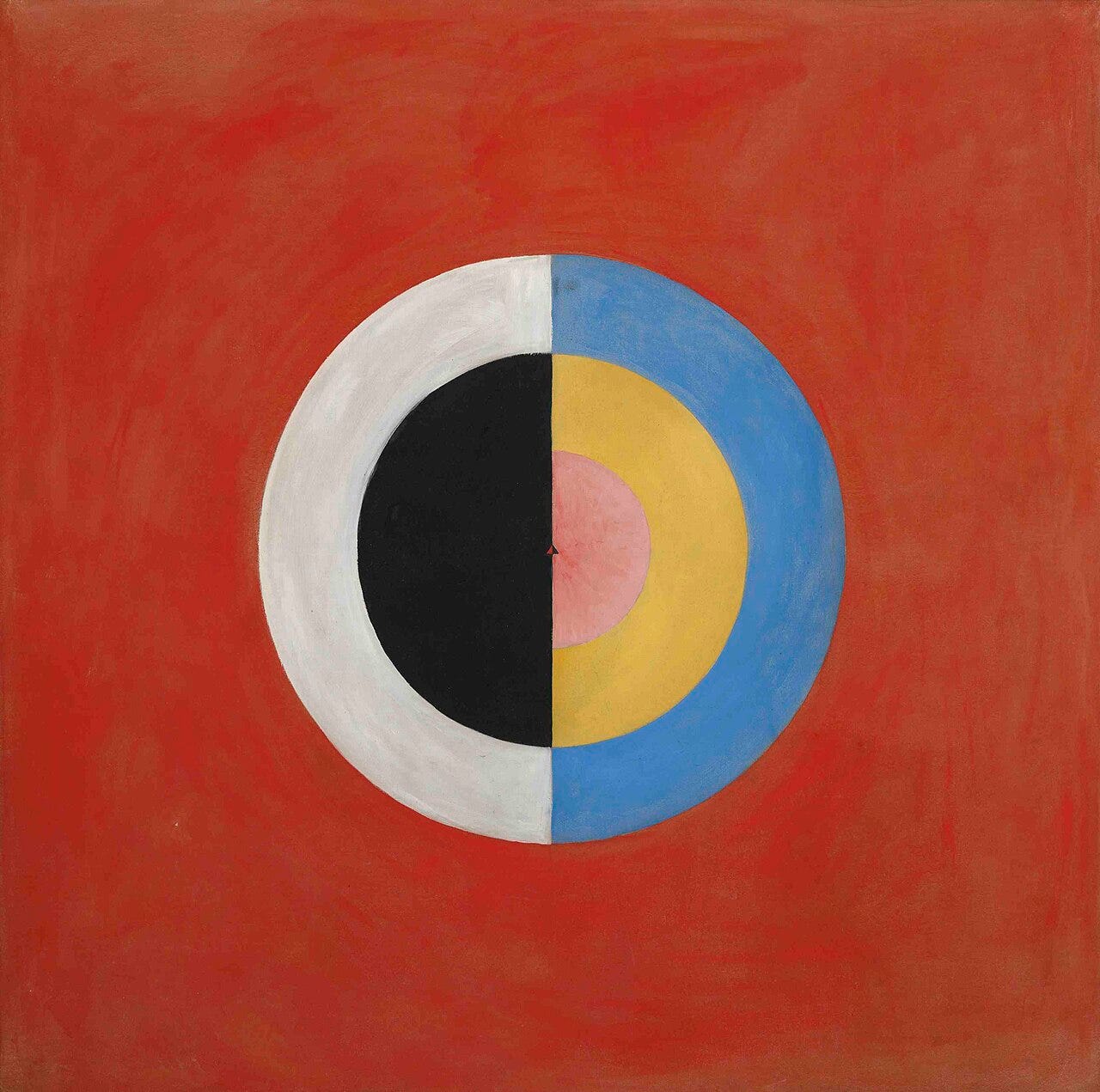
Her canvases look like nothing else from their time: large fields of spirals, circles, soft pinks and yellows, letters and flowers, made to put invisible spiritual forces on the wall. She believed they were guided by powers beyond herself.
More incredible painter stories
If Hilma af Klint pulled you in, you will love these too:


Her story is part art history scandal, part séance, part the most startling rediscovery of our age. It also asks an uncomfortable question: how do you lose the inventor of abstract art for seventy years? Here is the whole story.
Hilma af Klint at a glance
1862. Born at the Karlberg naval academy palace outside Stockholm.
1896. Formed The Five, women who met to pray, meditate, and draw with closed eyes.
1906. Began the Paintings for the Temple, years before Kandinsky’s abstractions.
1932. Willed that the work stay sealed for at least twenty years after her death.
1944. Died at 81 after a tram accident. The crates stayed shut for decades.
The claim that rewrites art history
Open almost any textbook and it will tell you abstract art began around 1910 with Wassily Kandinsky. Af Klint was painting pictures of no real object as early as 1906.
That makes her a serious candidate for the first abstract artist in Western art. She got there first, working in near total privacy in Stockholm while the famous men were still painting recognizable things.
This is the heart of why she matters, and why her rediscovery has forced museums to rewrite part of the story of abstract art.
Why she was written out
For most of the 20th century, the official story of abstraction was clean and male. Kandinsky, Mondrian and Malevich were sold as rational pioneers, stripping art down to pure form through pure logic.
Af Klint fit none of that. She was a woman, working alone, who said her pictures were dictated by spirits. That was easy to file under eccentric rather than serious.
Her own choice to hide the work for decades sealed it. By the time it surfaced, the canon was already written, and museums were slow to reopen the question.
So here is the blunt version. She was not overlooked by accident. Abstraction had been packaged as a male, rational breakthrough, and a mystic woman who spoke to spirits simply did not fit the sales pitch.
The séances and The Five
Af Klint did not think of herself as inventing anything. She thought she was receiving it.
From 1896 she met regularly with four other women in a group they called The Five. They prayed, held séances and made automatic drawings, letting the hand move as if guided, convinced they were in contact with spiritual teachers.
She said her greatest works were commissioned by these unseen guides, and that she sometimes began with no idea what would appear.
Whatever you make of that, it freed her hand. Believing the images were not hers to judge let her paint things no trained artist of 1906 would dare.
Her method, and the notebooks she left behind
Here is a detail that turns a curiosity into a serious body of work. Af Klint wrote almost everything down.
She left more than 150 notebooks, running to tens of thousands of pages, recording her symbols, her instructions and what each sign was meant to carry. She was effectively leaving a decoder ring for a future reader she trusted would arrive.
Very few artists in history have documented their own intentions so completely. It is the reason we can read her work at all, instead of just guessing.
Her private code
Her abstraction is not improvised. It runs on a system, and thanks to those notebooks we know roughly what the recurring signs mean.
Blue stands for the feminine, yellow for the masculine, and their meeting is one of her constant themes. Spirals and snail shells signal growth and evolution.
The swan stands for union, two opposites becoming one. Letters such as the W carry ideas of matter and spirit.
That places her close to Symbolism, the movement that painted ideas and the soul rather than the visible world. She simply carried it all the way into pure shape and color.
The temple she imagined
Her major project was never meant for an ordinary gallery wall. Af Klint imagined a spiral temple, a building you would climb, with the work leading you upward toward higher knowledge as you rose.
The temple was never built. But the plan tells you how seriously she took all this. It was not decoration. It was meant to be a path for the soul.
Here, the point is the scale of the ambition.
Theosophy, Steiner and the new physics
Af Klint was not painting in a vacuum. Two huge currents fed her work.
The first was spiritual: theosophy, and later the ideas of Rudolf Steiner, which held that a hidden order lies behind the visible world. She once showed her work to Steiner, who reportedly told her the world was not ready for it.
The second was science. This was the age of X rays, radio waves and the splitting of the atom, the first hard proof that powerful, real forces exist beyond human sight. Af Klint wanted to paint exactly those unseen forces.
The conventional painter underneath
Here is what surprises people. Af Klint could paint in a completely traditional way, and did.
She trained at the Royal Academy of Fine Arts in Stockholm, among the first generation of women allowed in, and graduated with honors. To earn a living she made careful botanical studies, portraits and landscapes, often in watercolor.
That respectable public career was the cover. Behind it, in private, she made the radical work she showed almost no one.
The mapmaker’s daughter who never married
She was born in 1862 at a naval academy outside Stockholm, into a family of mapmakers and officers. The precision of charts and diagrams never left her work.
The death of her younger sister in 1880 turned her toward spiritualism and the hope of contact beyond death. She never married. Her closest companion for years was a woman named Thomasine Andersson, and she spent long stretches painting on a quiet island in Lake Malaren.
She lived simply and privately, pouring everything into a body of work she assumed would only be understood long after she was gone.
How Hilma af Klint died
She kept working into her seventies, sorting and annotating her enormous archive so a future audience could find its way in.
In 1944 she was hurt in a tram accident and died soon after, at 81. She left more than a thousand paintings and works on paper, the mountain of notebooks, and a will telling the world to wait twenty years before looking.
The rediscovery
The comeback is almost as remarkable as the work. Her abstractions stayed largely unseen until a 1986 exhibition in Los Angeles on spiritual art.
A major show at the Moderna Museet in Stockholm in 2013 began the real reappraisal. Then, in 2018, a survey at the Guggenheim in New York drew around 600,000 visitors and became the most attended exhibition in that museum's history.
Suddenly everyone was asking the obvious thing. How had we never heard of her, and was the tidy story of who invented abstraction simply wrong?
Why her work is so hard to find
Fair warning, she is harder to find than most masters. Almost all of her work is held together by the Hilma af Klint Foundation, and she has no permanent room of her own.
The Moderna Museet in Stockholm is the closest thing to a home, and the museum that led her revival. The surest way to stand in front of the major work is to catch one of the touring shows that travel the world, from the Guggenheim in New York to London and across Asia.
A naval daughter born inside a palace
Hilma af Klint was born on 26 October 1862 at Karlberg Palace outside Stockholm. The palace served as Sweden's royal war academy, and her father Victor af Klint was a naval officer and teacher there.
Behind the family stood generations of seamen, with a feel for maps, mathematics and careful looking. As a child Hilma spent summers on the island of Adelso in Lake Malaren, where she grew close to plants, water and sky.
One of the first women let into the Academy
From 1882 to 1887 she trained at the Royal Academy of Fine Arts in Stockholm. She belonged to the first generations of women the school allowed in, and she finished with honors.
The Academy even granted her a studio in the center of the city. For a woman painter of that era, that kind of recognition was rare. On paper she looked like a promising and very proper young artist.
The careful painter everyone knew
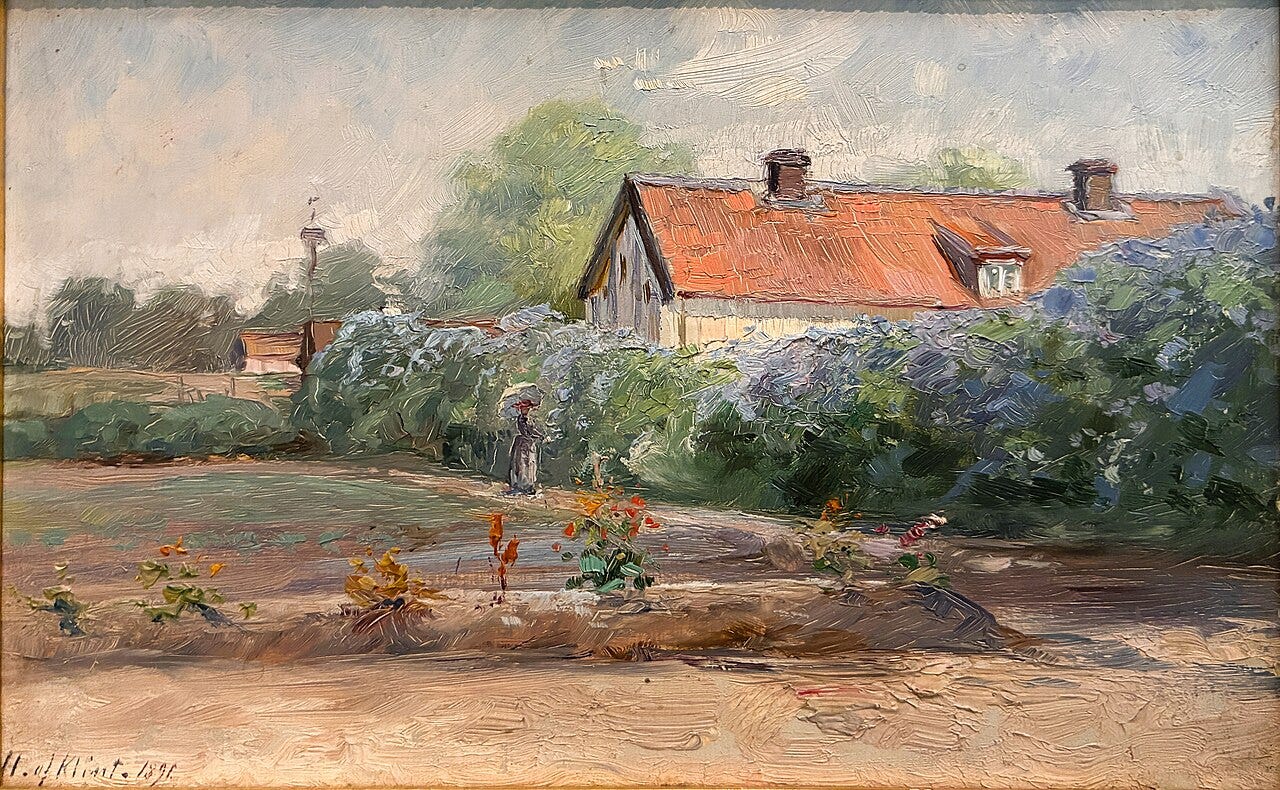
For years af Klint earned her living from work that troubled no one. She painted landscapes and portraits. She drew plants, flowers and animals with scientific care.
Some of that output was botanical and veterinary illustration, made to be exact. This public face was skilled and conventional. Almost no one guessed what she was making in private.
A sister's death and a door to the unseen
When Hilma was still young her sister Hermina died, in 1880. The loss stayed with her. It drew her toward spiritualism, a movement of the time that claimed the living could reach the dead.
Seances were popular then across Europe and America. Af Klint began to sit in on them. She came to believe that messages could arrive from beyond the visible world.
The five women who drew with their eyes closed
In 1896 af Klint joined four other women in a group they called De Fem, or The Five. They met regularly to hold seances and write down what seemed to come through.
They practiced automatic drawing. The idea was to let the hand move on its own, guided by what they described as higher spirits. These sessions ran for years and became a quiet rehearsal for the art that followed.
A commission that came from the spirits
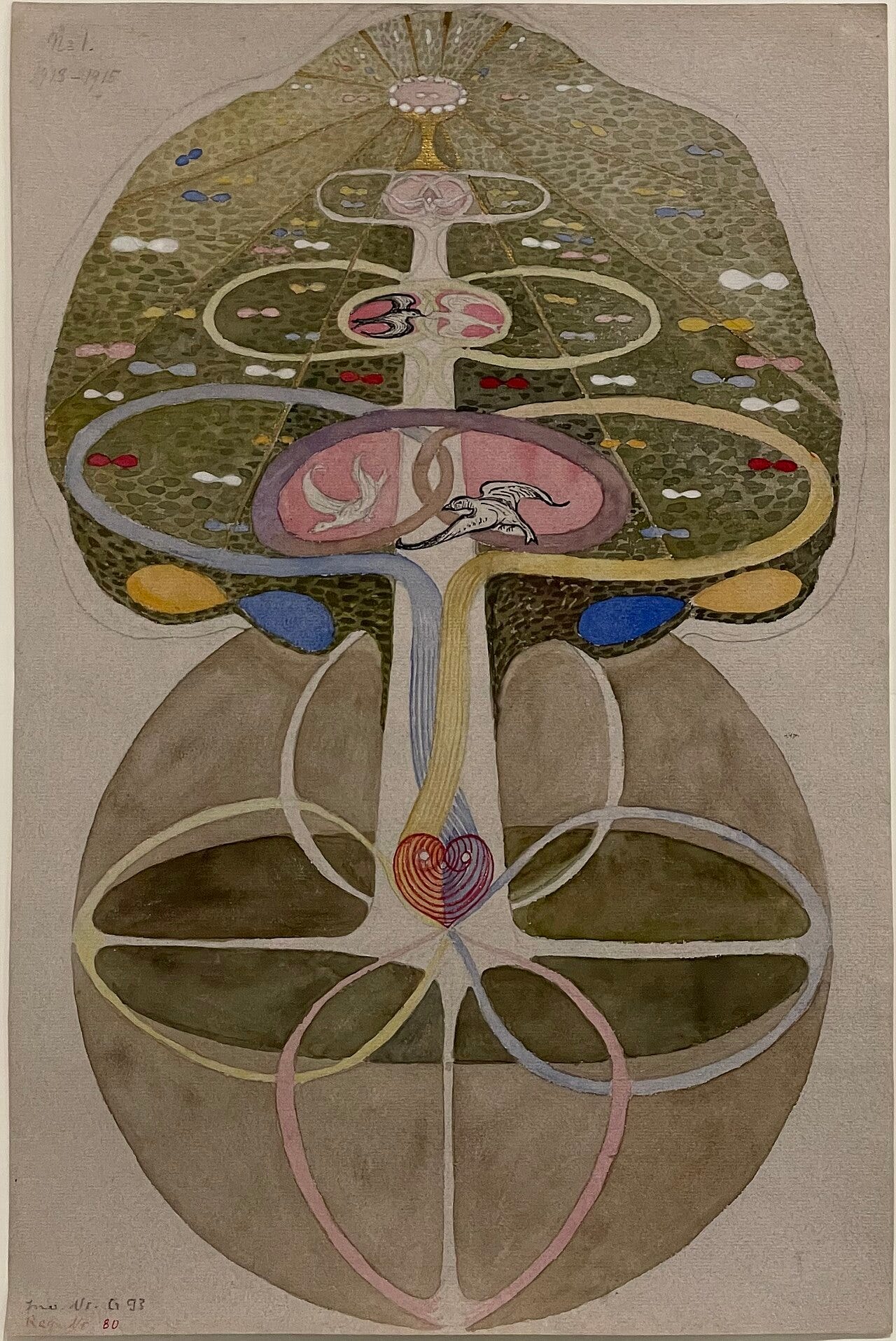
In 1906, af Klint said she received a commission from a spirit she named Amaliel. The task was large. She was to make paintings for a temple.
She called the result The Paintings for the Temple. Between 1906 and 1915 she produced 193 works in the series. They are filled with spirals, letters, flowers and geometric shapes that she read as a spiritual language.
Canvases as tall as a room
Some of these pictures are enormous. The group known as The Ten Largest, painted in 1907, rises more than three meters, roughly ten feet.
Each of the ten stands for a stage of human life, from childhood to old age. She worked on paper spread on the floor, moving quickly with tempera. The color is soft and the size is immense.
Rudolf Steiner and the science of the spirit
In 1908 af Klint met Rudolf Steiner, a leading figure in Theosophy who later founded his own spiritual philosophy, anthroposophy. His thinking mattered to her for the rest of her life.
By most accounts Steiner was guarded about her paintings and did not fully embrace them. After their meeting she slowed her large output for several years.
When she returned to the work, anthroposophy shaped how she thought about color, form and meaning.
The twenty year silence she chose
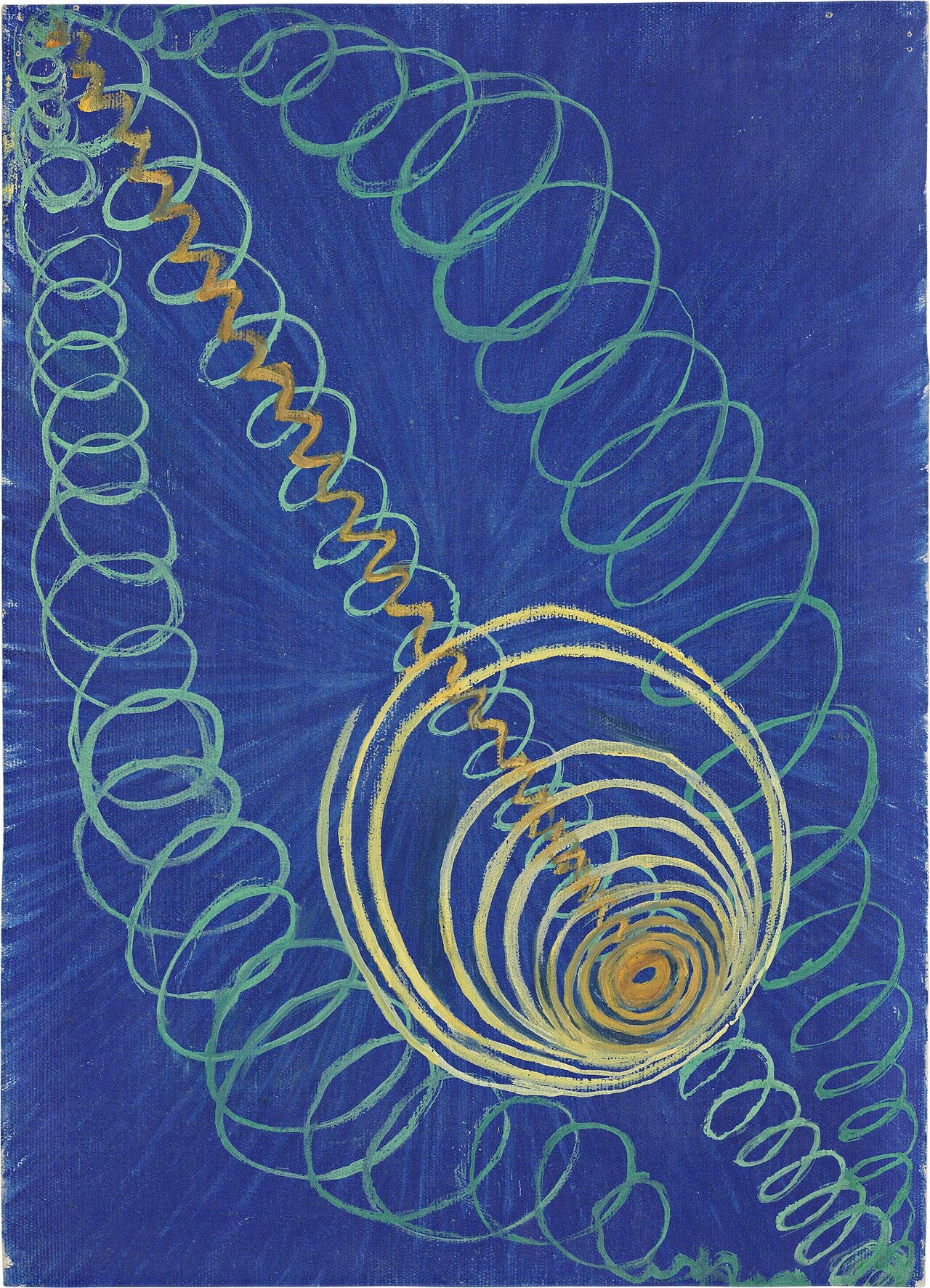
Af Klint died in 1944, after injuries from a tram accident. Her will asked that her abstract work stay out of sight for twenty years, because she felt the world was not ready to understand it.
The work stayed largely unseen for far longer than that. It surfaced in a 1986 group exhibition in Los Angeles, then slowly drew notice.
In 2018 the Guggenheim in New York gave her a full show, Paintings for the Future, which became one of the most visited exhibitions in the museum's history.
That show forced a rethink. Many scholars now argue that af Klint made purely abstract pictures around 1906, years before Wassily Kandinsky, Kazimir Malevich and Piet Mondrian, the men long credited as the first abstract artists.
More secrets to unlock


Where she stands next to Kandinsky and Kupka
On the calendar, af Klint wins outright. Her Paintings for the Temple started in 1906, at least four years before the abstract watercolor traditionally credited to Kandinsky and six years before Kupka's Amorpha, Fugue in Two Colors in 1912. Mondrian did not drop recognizable objects from his canvases until well into the 1910s.
Kandinsky published his theory in Concerning the Spiritual in Art in 1911 and exhibited his work, while af Klint's canvases stayed in crates under her own instructions. A painting nobody sees cannot found a movement, whatever its date.
The Ten Largest, finished in 1907, rise over three meters high, made for a temple that was never built. Nothing Kandinsky, Kupka or Mondrian attempted in that decade matched that ambition.
The Hilma af Klint questions that keep coming up
What is she known for? Pioneering abstract painting around 1906, before Kandinsky.
Who were The Five? A group of five women who held séances and made spirit guided art together.
Why was her work hidden? Her will asked that it stay unseen for 20 years after her death.
What did she paint with? Mostly oil and tempera, plus watercolor for her nature studies.
How did she die? From injuries after a tram accident in 1944, aged 81.
Where can I see her? Mainly through the Hilma af Klint Foundation, the Moderna Museet and touring shows.
What does the af in her name mean? It is a Swedish noble particle meaning of, like the German von. Her family were minor aristocracy.
How do you say her name? Roughly HILL ma ahf KLINT.
Did Hilma af Klint paint abstraction before Kandinsky? Many scholars now say yes. Her abstract Paintings for the Temple began around 1906, a few years before Kandinsky, Malevich and Mondrian made their own first abstract works. The claim is widely argued rather than fully settled, but her early dates are well documented.
Why was her work hidden for so long? Her will asked that it be kept out of view for twenty years after her death. She believed people were not yet ready for it, so it stayed largely unseen until the 1980s and only reached a wide public in the 2010s.