
John Constable was the English painter who made the ordinary countryside worth a great painting. His Hay Wain, a hay cart crossing a shallow river, is one of the most loved landscapes ever made.
A miller's son from Suffolk, he spent his life painting the fields, mills and skies of his own small corner of England, and it was France, not Britain, that crowned him first.
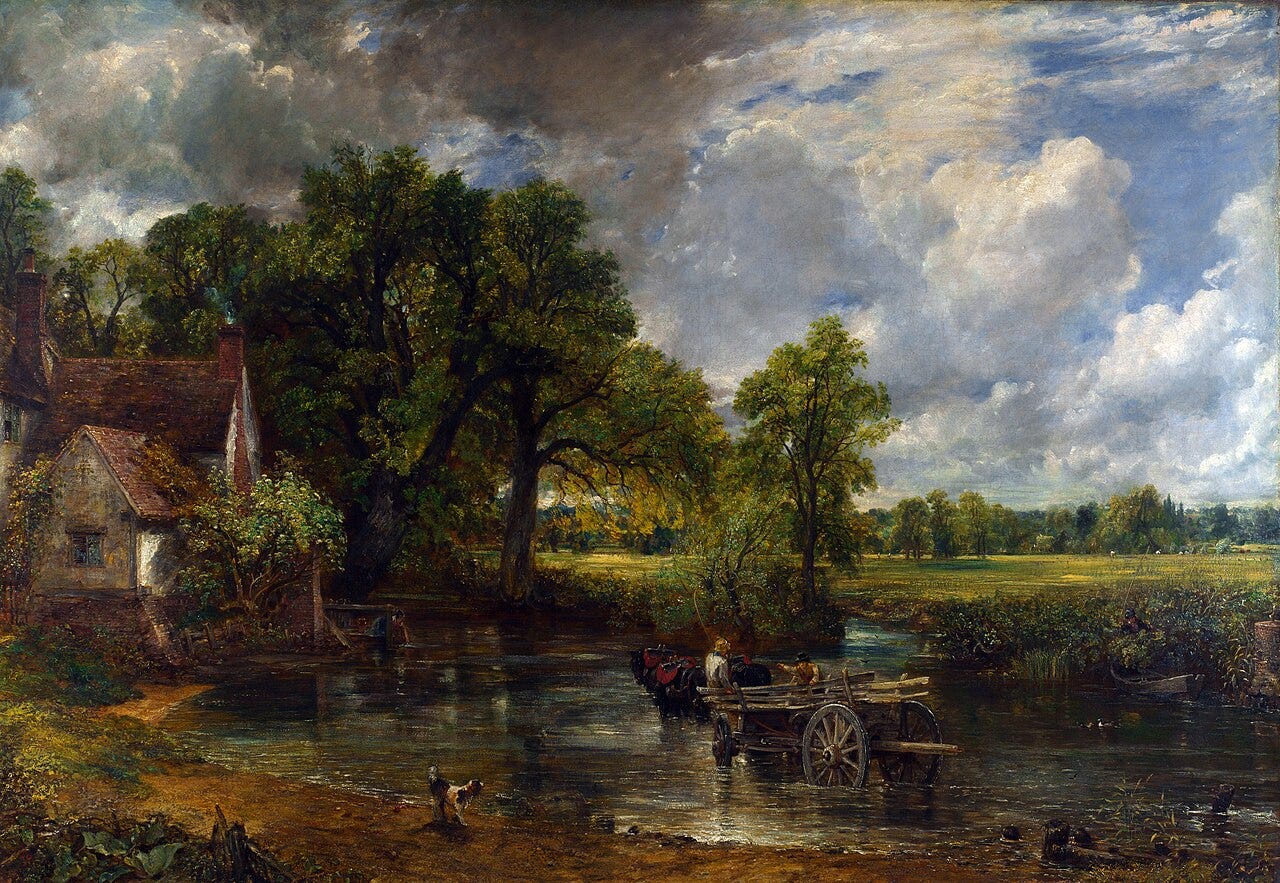
He did not chase mountains or ruins or famous views. He painted the fields, mills and skies of home, again and again, and turned them into something monumental.
Born: East Bergholt, Suffolk, 1776
Known for: The Hay Wain, English landscapes, cloud studies
Died: London, 1837
More incredible painter stories
If John Constable pulled you in, you will love these too:


John Constable at a glance
1776. Born in East Bergholt, Suffolk, a mill owner’s son.
1816. Married Maria Bicknell after a seven year wait.
1821. The Hay Wain. Paris gave it a gold medal three years later.
1829. Elected a full Royal Academician at 52, by a single vote.
1837. Died suddenly in London, having sold barely twenty paintings in England.
Constable Country
Constable was a miller's son and grew up in the Stour valley on the Suffolk and Essex border. That small patch of land, now nicknamed Constable Country, gave him nearly every subject he ever wanted. He said its scenery made him a painter.
He worked slowly and locally while rivals painted grand foreign scenes. His ambition was to make a true, unposed English landscape feel as important as any history painting.
The Hay Wain and the six footers
To force critics to take landscape seriously, Constable painted a series of huge canvases, the size usually reserved for grand subjects. They are nicknamed the six footers. The Hay Wain, from 1821, is the most famous of them.
At first British buyers were lukewarm. It looked too rough, too real. Then it crossed the Channel.
More loved in France than at home
When The Hay Wain was shown in Paris in 1824 it caused a sensation and won a gold medal from the French king. Young French painters, including Delacroix, were struck by its fresh color and loose handling.
Constable helped point the way to the Barbizon school and, later, the Impressionists, even as his own country was slow to honor him. He was elected to the Royal Academy only at 52.
The man who painted the sky
Constable studied clouds like a scientist. He made dozens of rapid oil sketches of the sky alone, working en plein air, and noting the date, time and weather on the back. He called the sky the chief organ of sentiment in a landscape.
Those cloud sketches, done outdoors and fast, are for me the freshest things he ever made. They still feel astonishingly modern.
The wife he waited seven years for
Constable fell in love with Maria Bicknell, but her family opposed a match with a country miller's son. They waited nearly seven years and married only in 1816, once he came into a small inheritance.
Maria died of tuberculosis in 1828, leaving him with seven young children. He wore black for the rest of his life, and his later skies turned darker and wilder with grief.
Where his skies still hang
The National Gallery in London holds The Hay Wain, the picture that stunned Paris in 1824. The Victoria and Albert Museum keeps his cloud studies and the full size sketch for the Hay Wain.
A Suffolk mill owner's son
John Constable was born on 11 June 1776 in East Bergholt, a village in Suffolk. His father, Golding Constable, was a prosperous mill owner and corn merchant.
Thomas Gainsborough came from the same county a generation earlier, born in Sudbury, less than ten miles from Constable's Stour valley.
He owned watermills at Flatford and Dedham, windmills, farmland, and barges that carried grain down the River Stour.
The family was comfortable, even well off. Young John grew up among the mills, locks, and meadows he would paint for the rest of his life. He was a practical boy, and for a time he worked in the family business, tending one of his father's windmills.
Everyone assumed he would take it over. Painting was a hobby, not a career. Turning that hobby into a life would take years of patient argument with a doubtful father.
The long road to the Royal Academy
Constable came to art late and slowly. In 1795 he met the collector Sir George Beaumont, whose small Claude landscape helped fire his ambition.
Four years later, in 1799, he won his father's reluctant blessing and entered the Royal Academy Schools in London. He became a full student in 1800, aged twenty four.
Most students trained from boyhood. Constable was starting in his twenties, largely self taught, and progress was hard.
He first showed at the Academy in 1802. When an early landscape was rejected, the Academy's president Benjamin West encouraged him, saying he must have loved nature before he could paint it.
That same year Constable turned down a safe post as a drawing master. He had chosen landscape, and there was no going back.
Painting straight from nature
Constable wanted to paint the countryside exactly as he saw it. That set him against fashion. The academies prized the ideal landscape, the calm classical scenery of painters like Claude, composed in the studio.
Constable preferred a real Suffolk lane, a working mill, a passing cloud.
From about 1808 he sketched outdoors in oil, working fast to catch the light and weather of a single hour. For his big pictures he even made full size oil sketches, rough and vigorous, to plan the finished work.
Here is a common myth worth correcting. People often assume his famous exhibition landscapes were painted outdoors, in front of the view.
They were not. Pictures like The Hay Wain were built in his London studio, from years of drawings and open air studies.
Making landscape as serious as history painting
In Constable's day, art had a strict pecking order. Grand history paintings, scenes from the Bible, myth, and classical history, sat at the top. Landscape ranked far below, treated as decoration.
Constable set out to change that. Starting in 1819 he painted a run of enormous canvases, each roughly six foot wide, and sent them to the Royal Academy's crowded summer shows.
The size was deliberate. A humble Suffolk river scene painted on the scale of a history picture demanded to be taken seriously.
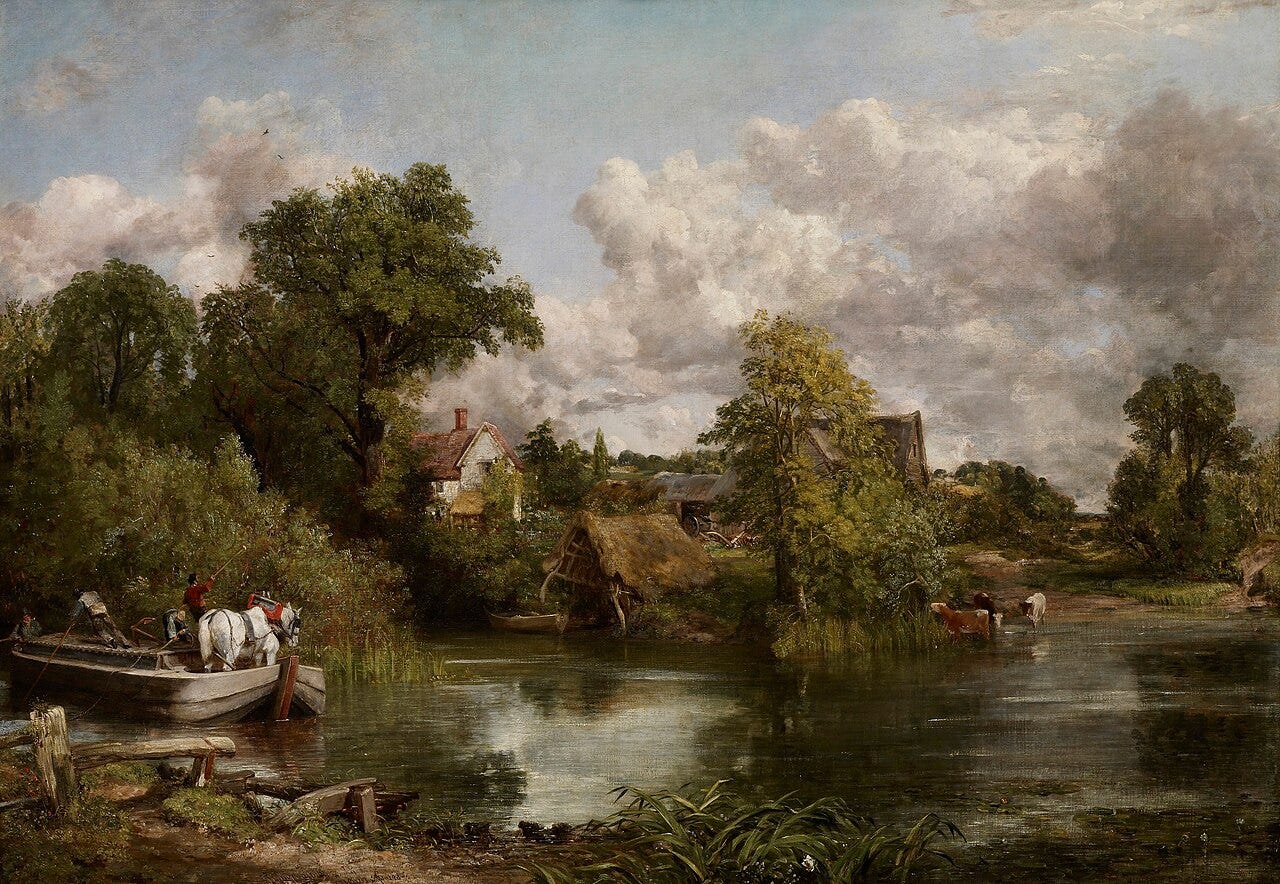
These were his six footers, among them The White Horse, Stratford Mill, and The Hay Wain. They did not always sell. But they made one clear claim, that everyday English country could carry a great painting.
Skying on Hampstead Heath
After moving his family to Hampstead, north of London, Constable began a project all his own. Through 1821 and 1822 he climbed onto Hampstead Heath and painted the sky, again and again. He called it skying.
He made dozens of quick oil studies of clouds alone, no land, no buildings, just weather. On the back of many he wrote the date, the time of day, the wind direction, and the conditions, like a scientist logging an experiment.
The timing fits a wider moment. The naming of clouds was new. Luke Howard had classified them, as cumulus, stratus, cirrus, and the rest, only in 1803.
Constable never exhibited these cloud studies. They were training for the hand and eye, yet today they are among his most admired works.
The gold medal from a French king
Constable's plain Suffolk scenes struggled to sell in England. In France they caused a stir. In 1824 the dealer John Arrowsmith took The Hay Wain and two other works to the Paris Salon.
French painters were amazed by the fresh, flickering light and loose touch.
Charles X, the king of France, awarded Constable a gold medal, mainly for The Hay Wain. Young French artists took note. Theodore Gericault had already gone home from London quite shaken by the picture.
Eugene Delacroix is said to have reworked the background of his own Salon painting, Scenes from the Massacre at Chios, after seeing Constable's handling of colour and light. An English farm scene had helped push French painting toward nature.
A Royal Academician at last
Recognition from his peers came late and grudgingly. Constable was elected an Associate of the Royal Academy in 1819, a first step. Then he waited.
Year after year the Academy passed him over for full membership, often preferring lesser talents whose grander subjects fit the fashion.
He was finally elected a Royal Academician on 10 February 1829, aged fifty two. By then Maria had died, and the recognition felt hollow.
After nearly thirty years of proving that landscape deserved a seat at the table, he took little joy in the honour. The thing he had wanted for so long arrived just as life had emptied of the person he most wanted to share it with.
Grief and the darkening skies
In November 1828 Constable's wife Maria died, soon after the birth of their seventh child. She had long been frail, and tuberculosis took her. Constable was shattered. He wore black for the rest of his life and never remarried.
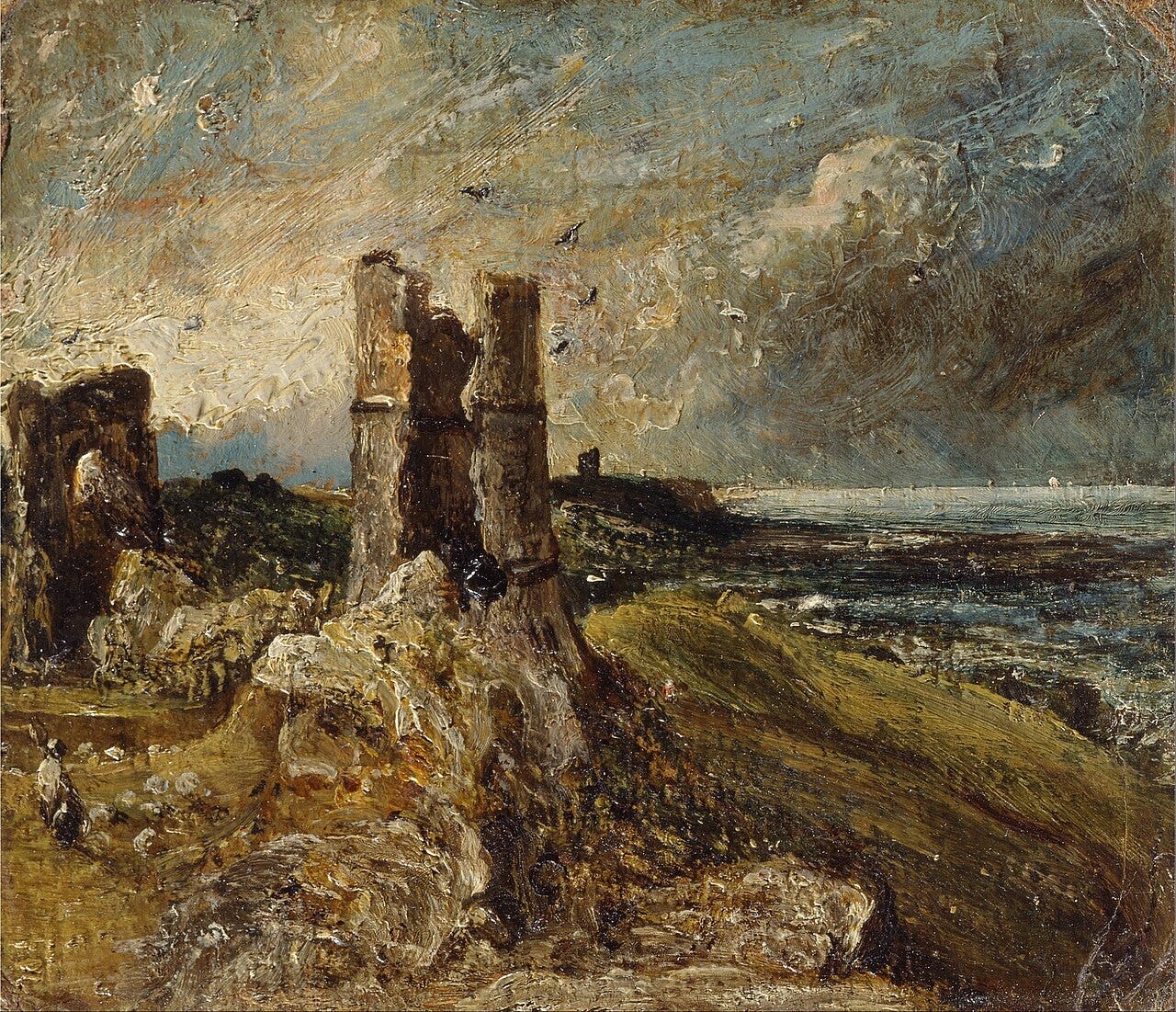
The grief seeped into his painting. His skies grew heavier and more troubled, the light more broken. Hadleigh Castle, painted in 1828 and 1829, shows a ruined tower above a grey estuary under a vast, restless sky.
It is a picture of loss as much as of place.
Where his earlier scenes glowed with calm noon warmth, the late work carries storm and shadow. The weather he had studied so coolly now did his mourning for him.
Last years, few patrons, and a sudden end
Even near the end, buyers stayed scarce. Constable leaned on a small circle of loyal friends. Chief among them was Archdeacon John Fisher, who gave the picture its nickname The Hay Wain, championed his work, and steadied him through his grief.
In his final years Constable also turned teacher, giving lectures on landscape painting and tracing its history and rise as an art. He kept painting Suffolk and Salisbury to the last.
Then, on the night of 31 March 1837, he died suddenly in London, aged sixty. The cause was never certain. He left a studio crowded with unsold canvases. The fame that had eluded him in life arrived soon after, and has never left.
The John Constable questions that keep coming up
What is John Constable famous for? English landscapes, above all The Hay Wain.
Where did he paint? Mostly his native Stour valley in Suffolk, now called Constable Country.
Why did France matter to him? French painters embraced his work years before the British did.
Why is Constable important? He raised the English landscape to serious art, painting the ordinary countryside of Suffolk with a truth to weather and light that later inspired the French Romantics and Impressionists.
Did Constable paint his big landscapes outdoors? No. He sketched outdoors and made full size oil studies in the open air, but the large finished exhibition pictures, like The Hay Wain, were built in his London studio from those studies over many months.
When and how did Constable die? He died suddenly in London on the night of 31 March 1837, aged sixty. The cause was never certain. He left a studio full of unsold canvases, and the wide fame that had escaped him in life arrived soon after his death.
More secrets to unlock


What Constable did to the sky
Constable insisted that home, weather and a working river were worthy of great art, and in doing so he helped free landscape and feed Impressionism. His skies still set the standard for painting the English weather.
His Hay Wain now anchors a wider list of the twelve landscape paintings that changed art, next to Turner's blazing skies and Hokusai's Great Wave.
One last fact. He sold far more paintings in France than in Britain during his lifetime, yet refused to travel abroad, saying he would rather be a poor man at home than a rich one away.