
Salvador Dali (1904 to 1989) was the Spanish Surrealist who painted melting clocks, waxed his moustache into two upward spikes, and turned his own life into the strangest performance in modern art.
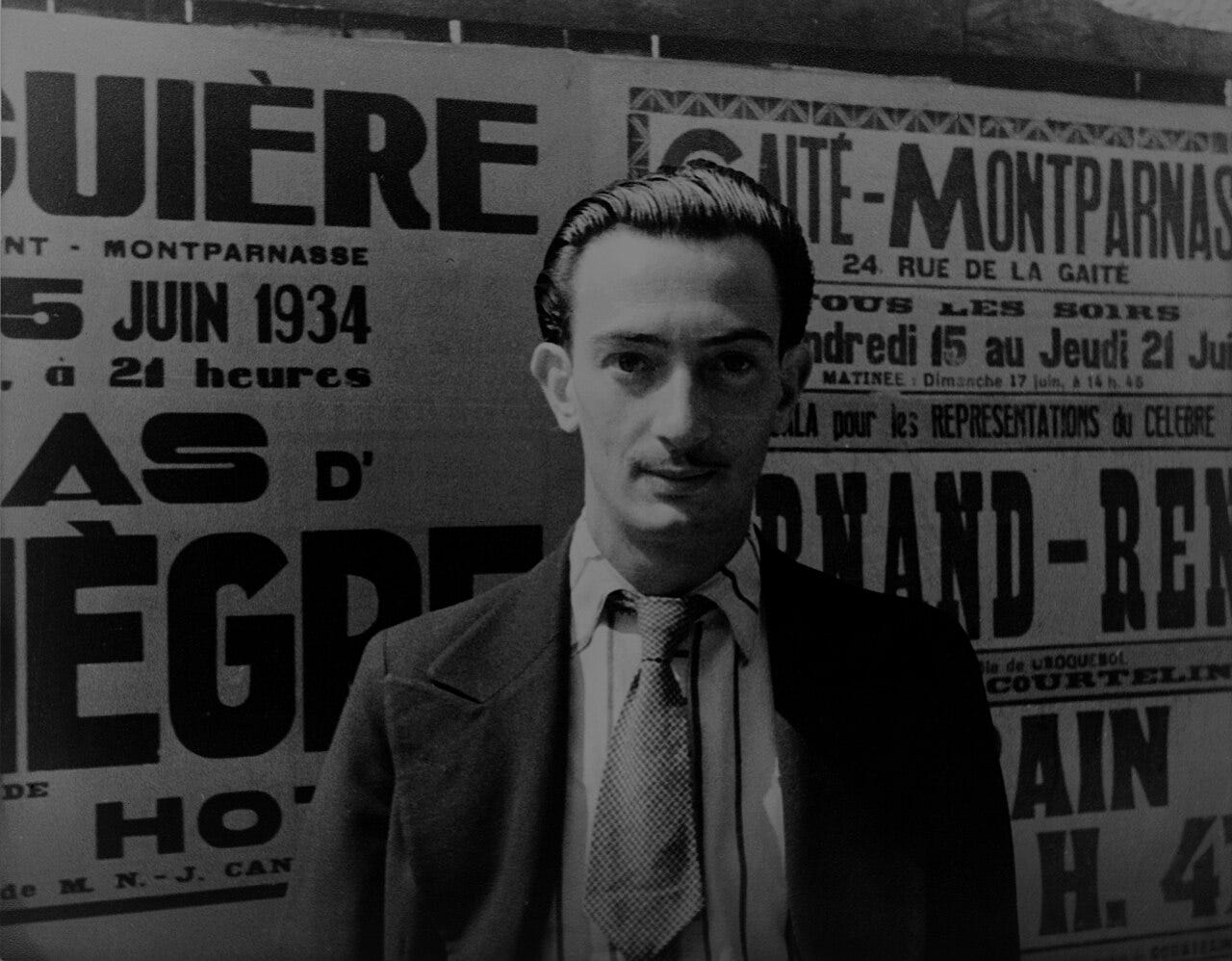
He believed he was his dead brother reborn, worshipped a wife he could only visit by invitation, got thrown out of Surrealism for loving money, and ended up buried under the floor of his own museum.
Behind the circus was a serious painter. Here is the whole, very odd story.
Dali in sixty seconds
Lived: 1904 to 1989, born and died in Figueres, Catalonia, Spain.
Famous for: The Persistence of Memory and its melting clocks.
Movement: Surrealism, until he was expelled from it.
His muse: Gala, his wife and manager.
The brand: the moustache, the stunts, the showmanship.
More incredible painter stories
If Salvador Dali pulled you in, you will love these too:


The boy named after a dead brother
Dali was named Salvador after an older brother who had died as a baby, nine months before Dali was born.
When he was five, his parents took him to the grave and told him he was his brother reborn. He believed it, and he spent his life convinced he was a kind of double, a replacement haunted by the first Salvador.
That strangeness was there from the start.
Madrid, Lorca and a sliced eyeball
As a student in Madrid he fell in with the poet Federico Garcia Lorca and the filmmaker Luis Bunuel.
With Bunuel he made the short film Un Chien Andalou, which opens with a razor slicing a woman's eye. It announced a new kind of art that wanted to shock the rational mind awake. He was expelled from his art academy not long after.
Surrealism and the paranoiac method
Dali joined the Surrealists and became their most famous member. He painted dreams with the crisp realism of an old master, so the impossible looked photographic.
He called his technique the paranoiac critical method, a way of inducing his own hallucinations and painting what he saw. The movement he supercharged is explained in what Surrealism is. Why he became its face is here: why Salvador Dali is famous.
The melting clocks
In 1931 he painted The Persistence of Memory, the small canvas of soft watches drooping over a dead landscape.
It became the single most famous image of Surrealism. Dali claimed the limp clocks came to him while staring at a runny camembert cheese melting in the sun.
Gala, the wife he worshipped
In 1929 Dali met Gala, a Russian woman then married to the poet Paul Eluard. She became his wife, model, business manager and obsession.
He signed some works with both their names and credited her with keeping him alive and sane. Late on he bought her a castle at Pubol, and agreed he could only visit her there with her written permission. It was love as devotion and contract at once.
Avida Dollars, thrown out of Surrealism
Dali loved money and fame, and it cost him his movement.
The Surrealist leader Andre Breton, disgusted by his greed and his flirtation with Franco's Spain, expelled him and coined a cruel anagram of his name: Avida Dollars, eager for dollars. Dali shrugged it off, declaring that he himself was Surrealism.
The greatest showman in art
Dali understood publicity better than any artist of his century.
He waxed his moustache into two cosmic spikes, walked an anteater through Paris on a leash, gave interviews from a diving suit, designed the Chupa Chups lollipop logo and dreamed up a sequence for a Hitchcock film.
The moustache alone has its own story: Salvador Dali's mustache More oddities are in surprising facts about Dali.
The fire, and the crypt beneath his museum
Gala's death in 1982 broke him. He moved into the castle at Pubol and stopped eating well.
In 1984 a fire in his bedroom left him badly burned. He died in Figueres in 1989, and was buried in a crypt under the stage of his own Theatre Museum, where visitors walk over him every day. The full story is here: how Salvador Dali died.
Figueres, Florida and New York
The Persistence of Memory is at MoMA in New York. The largest collections are the Dali Theatre Museum in Figueres and the Dali Museum in Florida, and the Metropolitan Museum of Art holds his work too.
Born on the Emporda plain
Salvador Dali was born in Figueres, a market town in Catalonia, on 11 May 1904. Figueres sits on the Emporda, a wide flat plain in the northeast corner of Spain, swept by a dry wind called the tramontana.
A short drive east lies the coast at Cadaques and the rocky headland of Cap de Creus, where wind and sea have worn the stone into odd shapes. Dali spent childhood summers there and later built a home at nearby Port Lligat.
That coastline never left his work. The empty golden plain, the still bay and the twisted rocks of Cap de Creus appear as the background of painting after painting, from the soft watches to his religious canvases.
He once said he needed Port Lligat the way Raphael needed Urbino.
The exam he refused to sit
Dali studied at the San Fernando art academy in Madrid, and he clashed with it almost at once. He was suspended in 1923 after a dispute over a teaching appointment.
He returned, but in 1926, days before his final examinations, he told the panel that no one on the faculty was competent to judge him. He was expelled for good.
A common myth says he was thrown out for some obscene prank or for his later films. In fact the expulsion came in 1926, three years before his first film reached screens.
Dali treated the loss as freedom. Cut off from a safe career as a drawing teacher, he committed fully to painting, and within a few years he was in Paris among the Surrealists.
The films he made with Luis Bunuel
At the student residence in Madrid, Dali became close to the film director Luis Bunuel. In 1929 the two made a short film together, Un Chien Andalou.
Its images came partly from their own dreams, and it made both men known in the Paris avant garde. A year later they began a longer film, L'Age d'Or, released in 1930.
This time they argued, and Bunuel took control of the shoot. Dali's part shrank to the early script.
It was their last film together. Their politics pulled them apart, and the friendship cooled for decades. People sometimes call Un Chien Andalou Dali's film.
It was truly a partnership, and Bunuel sat in the director's chair while Dali supplied ideas and images.
A photographer's eye for the old masters
For all his wild reputation, Dali trained hard and admired the old masters. He studied Vermeer, Velazquez and Raphael, and he prized slow, patient, exact painting.
He built his dream pictures with the same care. Soft watches, burning giraffes and floating figures are painted in sharp focus, with real light and deep space, so the impossible looks solid.
Dali called these works hand painted dream photographs. The aim was to make the viewer believe an image that could never exist.
He kept a fine brush and a light touch even in his largest canvases. This is why his best paintings feel so precise. The method is old and careful, even when the subject is a melting clock or a face built out of fruit.
Atoms, DNA and a return to God
After the Second World War, Dali's work changed. The atomic bomb and new science pulled his attention, and so did the Catholic faith of his childhood.
He called the new direction nuclear mysticism, and tried to join religion, physics and mathematics in single images.
In 1951 he painted Christ of Saint John of the Cross, a view of the crucifixion seen from above, now held in Glasgow. He said the figure stood for the nucleus of the atom.
In 1955 he finished The Sacrament of the Last Supper, now in the National Gallery of Art in Washington. He later grew fascinated by DNA, the newly mapped code of life, and worked its spiral into his pictures.
Faith and science became one subject for him.
The lollipop logo and other paid work
Dali was happy to work for money, and his design jobs are among his most seen images. In 1969 the Spanish sweet maker Enric Bernat asked him for a logo, and Dali drew the daisy shaped mark still used on Chupa Chups lollipops today.
He also made objects and fashion. For the collector Edward James he created the Lobster Telephone in 1936 and the Mae West Lips Sofa in 1937.
He designed jewelry, shop windows and prints, and worked with the couturier Elsa Schiaparelli. In 1945 he built the dream sequence for Alfred Hitchcock's film Spellbound.
One myth is worth clearing up. Dali did not invent the Chupa Chups lollipop. He designed only its logo, though he did suggest placing it on top so it always shows.
The diving suit and the anteater
Dali turned public appearances into events. In 1936, at the International Surrealist Exhibition in London, he gave a lecture wearing a deep sea diving suit and helmet, meant to show a plunge into the unconscious.
The helmet was sealed too tightly and he began to suffocate. The audience thought his struggling was part of the act. Someone finally unscrewed the helmet and freed him.
He kept staging such scenes for the rest of his life. In 1969 he was photographed in Paris leading a live anteater on a leash down the street.
The stunts were planned, not random. Dali understood cameras and headlines long before most artists did, and he used them to keep his name in the news.
The praise for Franco that cost him friends
Dali's politics set him against many old allies. As Spain fell into civil war and then dictatorship, he sided with the winners.
He praised General Francisco Franco, the ruler of Spain, and sent him warm messages. In 1956 Franco received him in a private audience.
This appalled the political left and his former Surrealist friends. Many of them had raised money for the Spanish Republic. Bunuel went into exile, and their mutual friend the poet Federico Garcia Lorca was killed by fascist forces in 1936.
Dali's support for the regime, and his open love of money, made him an outcast in progressive art circles for years. He seemed to enjoy the outrage almost as much as the painting.
Andy Warhol and the St Regis years
From the 1930s onward Dali spent long stretches in New York, and for years he kept a suite at the St Regis Hotel each winter.
There he held court, surrounded by models, writers and hangers on. The suite became a small stage for the city's artists.
In 1965 he met the young Andy Warhol at the St Regis. The two admired each other across a gap of about thirty years. Warhol, who was building Pop art and his own fame machine, saw in Dali an early model for the artist as public figure.
Dali, in turn, enjoyed the attention of a new generation. New York gave him the audience Europe once had, and he played to it happily.
Dali chased fame in New York and Hollywood and signed his name to a line of perfume bottles; Remedios Varo left Spain for Mexico City instead, where she spent her days painting alchemists and clockwork machines for a small circle of friends rather than the press.
The Salvador Dali questions that keep coming up
What is Dali most famous for? The Persistence of Memory and its melting clocks.
Where was Dali from? Figueres, in Catalonia, Spain, born in 1904.
How did Dali die? Heart failure in 1989, aged 84.
Was Dali a Surrealist? Yes, its most famous one, until he was expelled.
Did Dali do drugs? He claimed not to, with the line, I do not do drugs, I am drugs.
Did Dali have children? No. He and Gala had none.
Was Dali religious? Later in life, yes, he embraced Catholicism.
Where is the Dali museum? His Theatre Museum is in Figueres, and another major one is in Florida.
Why was Salvador Dali expelled from art school? He was expelled from the San Fernando academy in Madrid in 1926, shortly before his final exams. He told the examining panel that none of its professors was competent to judge his work, and refused to be tested. He had already been suspended once, in 1923.
Did Salvador Dali really design the Chupa Chups logo? Yes. In 1969 the founder of Chupa Chups, Enric Bernat, asked Dali for a new design, and Dali drew the daisy shaped logo still used today. He did not invent the lollipop itself, only the mark, and he advised placing it on the top of the wrapper.
More secrets to unlock


Genius or the greatest act ever
People still argue whether Dali was a true visionary or the most brilliant self promoter who ever lived.
For me the honest answer is both at once. He could paint like a Renaissance master and sell like a circus, and he never let anyone decide where the art stopped and the act began.
His sharpest lines are in Dali quotes. Spain made the legend official near the end: in 1982 the king created him Marquis of Dali de Pubol, a title invented for the son of a Figueres notary, and he died seven years later beneath the dome of his own museum.
His reach outlived him by decades. The Swiss artist HR Giger counted Dali's paranoiac imagery among the influences behind the biomechanical creature he designed for Alien.