
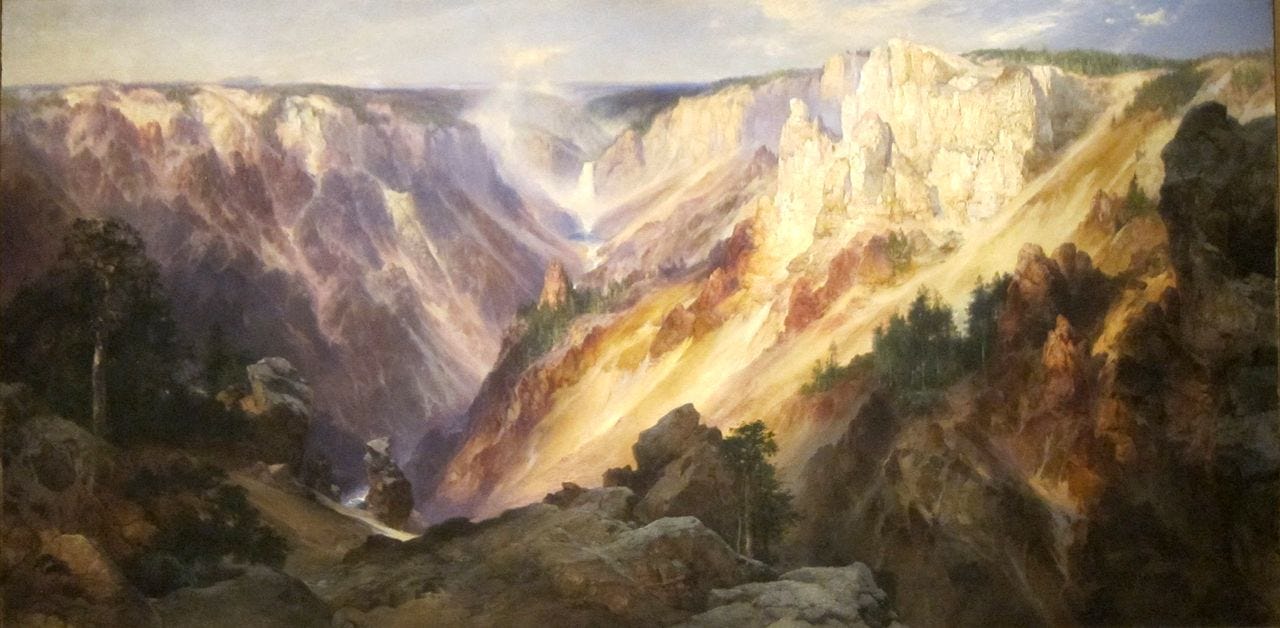
Thomas Moran was an English born American landscape painter, 1837 to 1926, whose enormous canvases of Yellowstone helped convince Congress to create the first national park in 1872, cascading falls included among the Famous Waterfall Paintings that inspired the trip.
Congress paid 10,000 dollars for one of his paintings and hung it in the Capitol.
Few painters can say their art changed the map of a country. Moran can. Here is how a brush helped protect a wilderness. Emily Carr painted that same untamed wilderness a continent away, on Canada's Pacific coast, a story told in the Emily Carr complete story.
More incredible painter stories
If Thomas Moran pulled you in, you will love these too:


Thomas Moran at a glance
1837. Born in Bolton, a Lancashire mill town. The family sailed for Philadelphia when he was a boy.
1871. Joined the Hayden expedition into Yellowstone as its artist.
1872. Congress bought The Grand Canyon of the Yellowstone for ten thousand dollars, months after creating the first national park.
1884. Built a studio in East Hampton with his wife, the etcher Mary Nimmo Moran.
1926. Died in Santa Barbara at 89, still signing canvases TYM.
The painter who helped invent the national park
In 1871, Moran joined the Hayden Geological Survey, the first official expedition into the Yellowstone region. He went west having never seen it, sketching the geysers and canyons in color.
Back in his studio he produced The Grand Canyon of the Yellowstone, a canvas over two metres wide. In 1872 Congress bought it for 10,000 dollars.
That same year, Yellowstone became the first national park in the world. Moran's paintings gave lawmakers what words could not: proof that the place was worth saving.
The men who made the expedition
Moran did not travel alone. The survey was led by the geologist Ferdinand Hayden, who needed images to take to Washington.
Alongside Moran rode the photographer William Henry Jackson. Painter and photographer worked the same cliffs, and their two kinds of proof would soon land on the same desks in Congress.
Why his West looks like a vision
Moran adored Turner, and it shows. He painted the West not as a flat record but as landscape painting full of light, mist and scale.
He sketched outdoors, working en plein air to catch real color, then built the grand final versions indoors. The result sits between fact and Romanticism.
He bent details when it helped the drama. The cliffs are real. The glow is Moran.
The middle initial that became a nickname
After Yellowstone, Moran signed his work with a joined monogram, T Y M. The Y stood for a nickname he embraced: Thomas Yellowstone Moran.
It is rare for a place to brand a painter. The park he helped save became part of his own name.
The Yellowstone, the Chasm, and the river he kept repainting
First, The Grand Canyon of the Yellowstone of 1872, the one Congress bought. It is the painting that started a movement to protect wild land.
Second, The Chasm of the Colorado of 1873 to 1874, its giant companion, also bought by Congress for the Capitol.
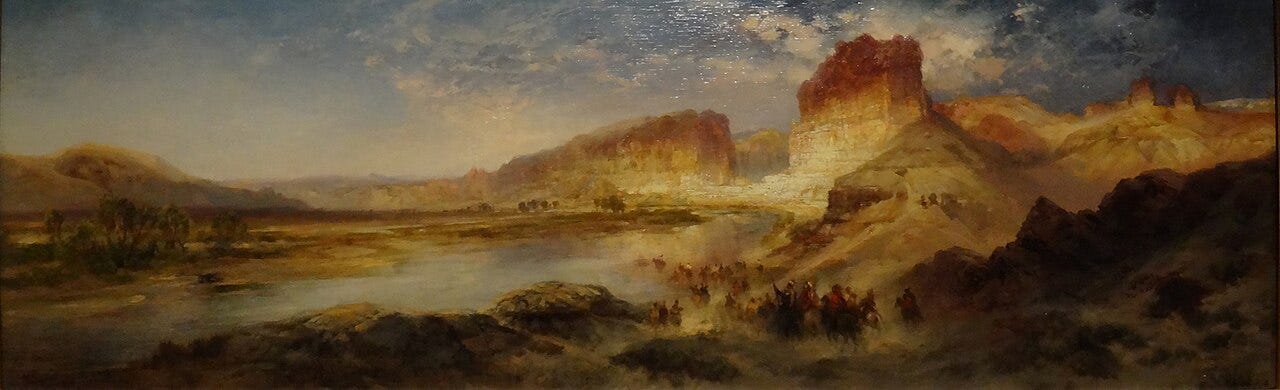
Third, his Green River of Wyoming scenes, a quiet cliff and river view he returned to and repainted for decades.
The myth of the photograph
People often say photographs alone saved Yellowstone. Jackson's prints were vital, but black and white could not show the sulphur yellows and rust reds of the canyon.
It took Moran's color to make Congress see the place. Photo and painting worked together, not one against the other.
A long life as the painter of the parks
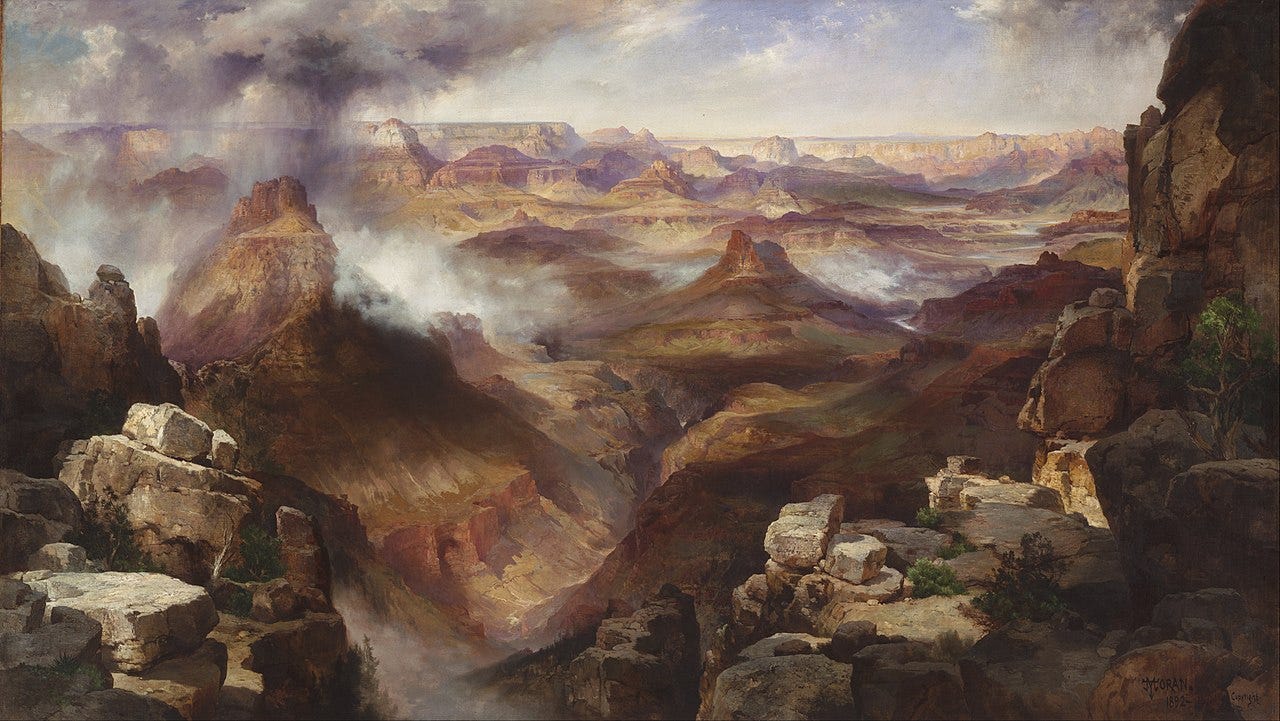
Moran settled for years in East Hampton on Long Island, then later moved west again. In his old age he painted the Grand Canyon of Arizona, returning to the giant spaces that made him.
He died in 1926 in Santa Barbara, by then known across America as the man who painted the national parks into being.
Where to stand before his West
The Smithsonian American Art Museum holds his great Yellowstone canvas. The National Gallery of Art in Washington owns more of his Western views.
From a Lancashire mill town to Philadelphia
Thomas Moran was born in 1837 in Bolton, a cotton mill town in Lancashire, England. When the trade slumped, the family sailed for the United States in 1844 and settled in the Philadelphia area.
He was one of several brothers who all became painters, Edward and Peter among them. Art was the family trade as much as any craft.
The boy who would come to stand for the American West thus began as an English immigrant. He did not see the western landscape that made his name until he was well into his thirties.
An apprentice among the wood engravers
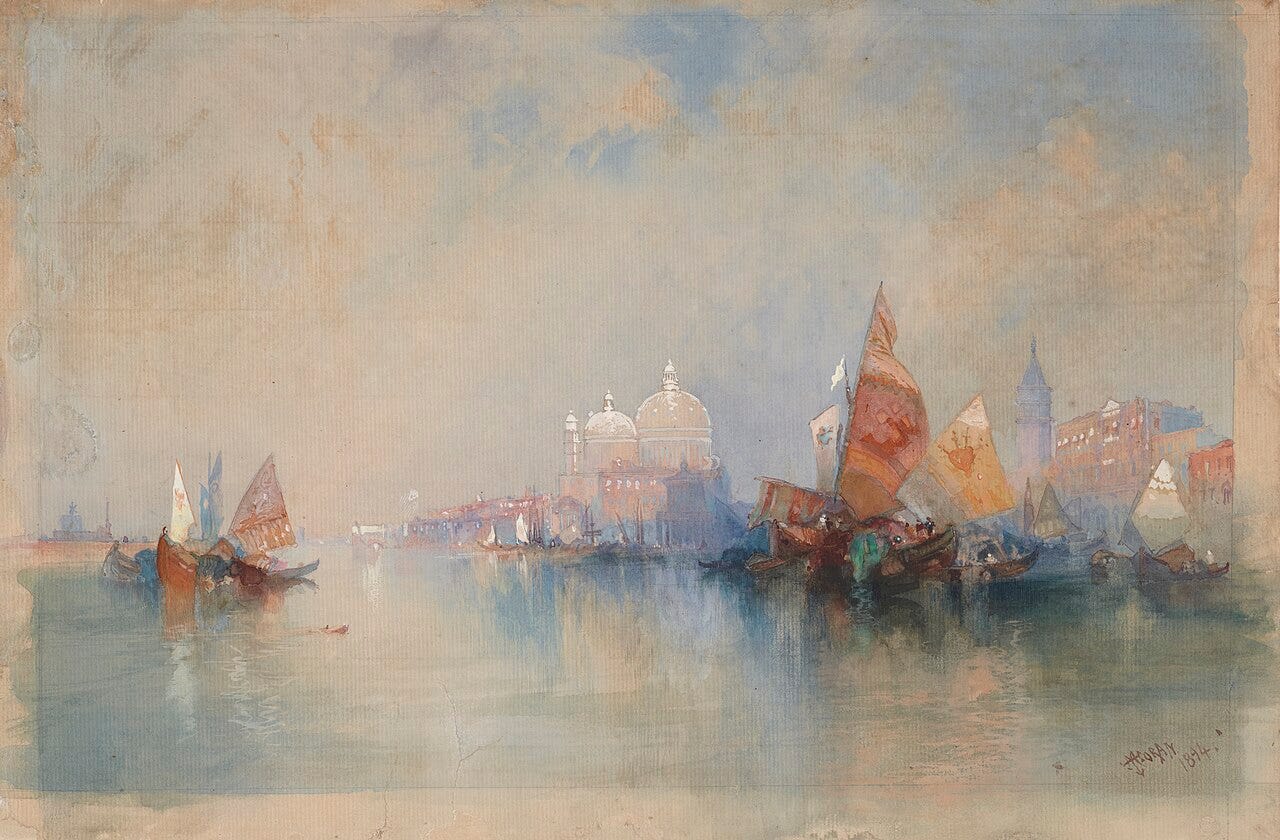
As a teenager Moran was apprenticed to a Philadelphia firm of wood engravers. He learned to cut images into blocks for printing, close and exacting work.
The training taught him to build a picture from clear line and strong contrast, and it gave him a lifelong second career in illustration.
Magazines such as Scribner's Monthly later carried his views of the West to readers who would never travel there.
He soon wanted color and scale that a printing block could not give. He turned to watercolor and oil, but the engraver's eye for structure never left his painting.
The lessons he took from Turner
In 1861 Moran traveled to London, where he studied the work of the English painter J. M. W. Turner. He copied Turner's canvases at the National Gallery and absorbed the older man's way with light, mist and glowing color.
Turner became his measure for what landscape could do. From him Moran learned to push a real place toward feeling, letting sun and haze carry the emotion of a scene.
That debt stayed visible for the rest of his life. When Moran painted a western canyon flooded with gold light, he was answering Turner across an ocean and a generation.
The painting Congress bought
In 1871 Moran joined Ferdinand Hayden's government survey into the Yellowstone country, sketching the geysers and canyons alongside the photographer William Henry Jackson.
The pictures they brought back helped persuade Congress to make Yellowstone the first national park in 1872.
That same year Moran finished a huge canvas, The Grand Canyon of the Yellowstone, about seven feet by twelve. The United States Congress bought it for ten thousand dollars, a large sum then, and hung it in the Capitol.
It was a rare thing, a landscape painting turned into public property and a tool of national policy. Moran had helped invent both a park and a way of selling the West to the nation.
Mary Nimmo Moran, the etcher he married
In 1862 Moran married Mary Nimmo, herself a gifted printmaker. She became one of the most respected etchers of her day and was elected to the Royal Society of Painter Etchers in London.
The two worked side by side, and Moran took up etching seriously in part through her. Their home was a working studio shared by two artists rather than one.
Mary died in 1899, a heavy loss. Her reputation as an etcher has grown again in recent years, and she is now studied as a notable American printmaker in her own right.
East Hampton, Santa Barbara, and the last years
For much of his life Moran was based in East Hampton, on the eastern end of Long Island, where he and Mary kept a house and studio near the sea.
He returned to the West on many trips, painting the Grand Canyon of Arizona and the Green River of Wyoming again and again.
A second federal purchase soon followed, sealing his role as the official painter of the American West.
Moran died there in 1926, near ninety years old. He had lived long enough to see the wild places he painted become protected land visited by millions.
The Mountain of the Holy Cross
In 1874 Moran traveled into the Colorado Rockies to find a peak that carried a natural cross of snow in a pair of crossing ravines. The next year he turned it into a large painting, The Mountain of the Holy Cross.
The subject struck a deep chord in a religious age. Many Americans read the snowy cross as a sign that the western wilderness was blessed, and reproductions spread widely.
The picture won a medal at the 1876 Centennial Exhibition in Philadelphia. It showed that Moran could give the West not just grandeur but a sense of the sacred.
The Grand Canyon of Arizona
Yellowstone made Moran's name, but the Grand Canyon of Arizona became his great late subject. He first saw it in the 1870s and returned across the decades, drawn back to its shifting light and vast drop.
The Santa Fe Railway understood his value and gave him free passage in exchange for paintings, using his images to lure tourists west. His canyon views hung in stations and appeared on calendars and brochures.
In 1874 the federal government bought a second enormous canyon canvas from him, this time of the Grand Canyon. Once again a Moran landscape passed into public hands as a portrait of the nation itself.
More secrets to unlock


The Thomas Moran questions that keep coming up
When was Thomas Moran born? In 1837 in Bolton, England. His family emigrated to the United States in 1844.
How did Thomas Moran die? Of natural causes in 1926, in Santa Barbara, California, aged 89.
What is he famous for? His Yellowstone paintings that helped create the first national park in 1872.
Where do his paintings hang in Washington? In the Smithsonian, the National Gallery, and historically in the Capitol.
What did his TYM signature mean? Thomas Yellowstone Moran, the nickname he took after the survey.