
Tintoretto was the Venetian painter who turned the calm Renaissance scene into a storm. Working at furious speed, he filled enormous canvases with plunging perspectives, flashes of light and figures hurtling through space.
They called him Il Furioso, the furious one, for the energy of both his brush and his ambition.
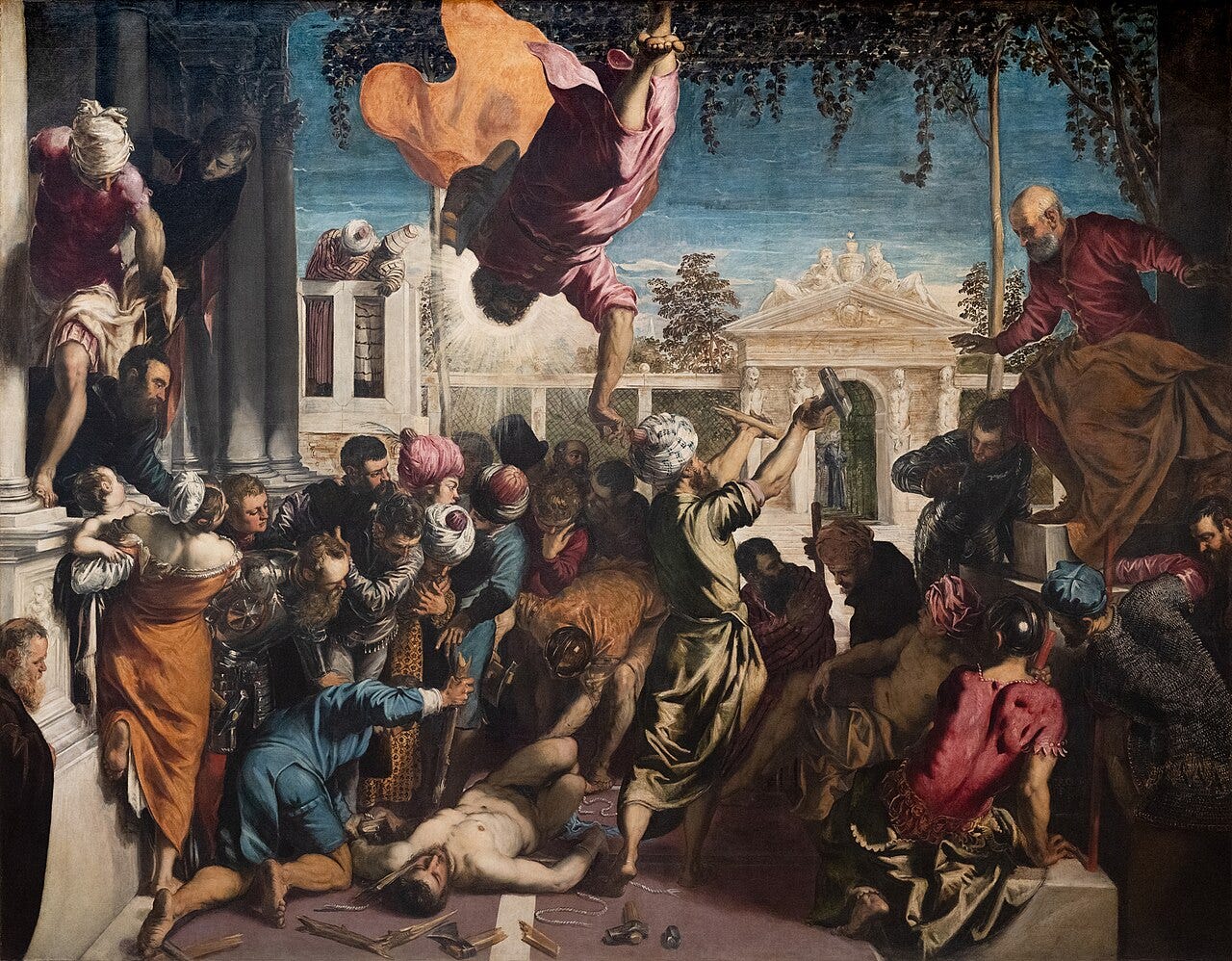
Where Titian glowed and Veronese charmed, Tintoretto dramatized. He wanted movement, depth and theater, and he got it by working faster and cheaper than anyone in Venice.
Born: Venice, around 1518
Known for: dramatic Mannerist scenes, the Scuola di San Rocco
Died: Venice, 1594
More incredible painter stories
If Tintoretto pulled you in, you will love these too:


Michelangelo's drawing, Titian's color
Legend says Tintoretto pinned a motto in his studio: the drawing of Michelangelo and the color of Titian. He wanted to fuse the muscular Florentine line with the rich Venetian palette into a single overwhelming style.
He used small wax models in boxes, lit by candles, to plan his dramatic lighting and steep angles before he painted. That stagecraft gives his work its cinematic feel. See what is Mannerism.
Tintoretto at a glance
1518. Born Jacopo Robusti in Venice, a dyer’s son.
1548. The Miracle of the Slave made his name overnight.
1564. Won the San Rocco commission by installing a finished painting where others brought sketches.
1588. Began Paradise for the Doge’s Palace, among the largest canvases ever painted.
1594. Died in Venice. He is buried in the Madonna dell’Orto, his parish church.
The man who won by working fast
Tintoretto was ferociously competitive. To win the commission to decorate the Scuola di San Rocco, instead of submitting a sketch like his rivals, he secretly painted a finished canvas and installed it in place, then offered it as a gift the charity could not refuse.
He often quoted low prices and worked at speed to take work from older masters, which made him both prolific and resented.
The Scuola di San Rocco, his life’s work
Over more than two decades he covered the walls and ceilings of the Scuola di San Rocco with a vast cycle of biblical scenes, now seen as his finest work, sometimes called Tintoretto's Sistine Chapel.
His version of the Last Supper throws the table at a wild diagonal, fills the air with smoky angels and lights the room from a glowing lamp, a world away from Leonardo's calm symmetry.
You can explore works by Tintoretto in the collection of the Metropolitan Museum of Art.
The dyer's son who never left Venice
His real name was Jacopo Robusti. Almost nobody called him that.
The world knew him as Tintoretto, which means little dyer in Italian. His father was a tintore, a dyer of silk cloth, and the nickname stuck to the son for life.
He was born in Venice around 1518 and barely left it. The National Gallery notes only one recorded trip outside the city, to Mantua in 1580.
Otherwise the canals, the churches and the guild halls of Venice were his whole world until he died there in 1594.
The Titian story everyone repeats
Here is the myth. The young Tintoretto entered Titian's workshop, showed frightening talent, and the older master threw him out within days out of jealousy.
It is a good story. It is also unproven. The tale comes from later biographers, and historians treat the timeline and the motive with caution.
What is solid is the influence itself. He wanted to fuse Titian's color with the muscular figures of Michelangelo, and he reportedly pinned a motto to his studio wall spelling out exactly that goal.
The little wax figures in a box
Tintoretto planned his crowded scenes like a set designer. He built small models of his figures in wax and clay, then arranged them inside little boxes, like miniature stages.
He hung some figures on threads from above to work out bodies seen from odd angles. He moved candles around the box to study how light and shadow would fall.
This let him plan dramatic lighting and steep foreshortening before he touched the canvas. It is a strange, almost cinematic habit for the 1500s. He was lighting a scene the way a film crew lights a set, four centuries early.
How he stole the San Rocco commission
In 1564 the Scuola Grande di San Rocco, a wealthy Venetian charity, held a contest to decorate its ceiling. The rules were simple. Each artist would submit a sketch, and the members would vote.
Tintoretto ignored the rules. While rivals like Paolo Veronese prepared drawings, he had a finished canvas secretly installed in the actual ceiling.
When the panel was unveiled, some members were furious. Then he played his best card and offered the painting as a free gift, and the confraternity's own statutes made it hard to refuse a donation.
He won, and that trick opened the door to decades of work in the building.
The painting that made his name
Before San Rocco, one canvas launched him. In 1548 he unveiled The Miracle of the Slave, also called Saint Mark Rescuing a Slave. It now hangs in the Gallerie dell'Accademia in Venice.
The story is grim. A servant is about to be tortured for praying at Saint Mark's tomb. Then the saint plunges headfirst out of the sky, and the torturers' tools shatter.
That plunging saint is the whole picture, a body falling fast through space. Tintoretto was about thirty. Overnight, Venice knew his name.
Paradise, one of the largest paintings on canvas ever made
Fire gutted parts of the Doge's Palace in the 1570s, and Venice needed a giant new picture for the Great Council Hall.
Tintoretto got the job late in life. The result, Il Paradiso, stretches roughly 22 meters wide, about 74 feet. That makes it one of the largest old paintings ever done on canvas, holding hundreds of figures spiraling toward Christ and the Virgin.
He was around seventy when the work went up, near 1592. His son Domenico and the family workshop helped carry the load. Stand in that hall today and the painting fills an entire wall.
The Last Supper where smoke becomes angels
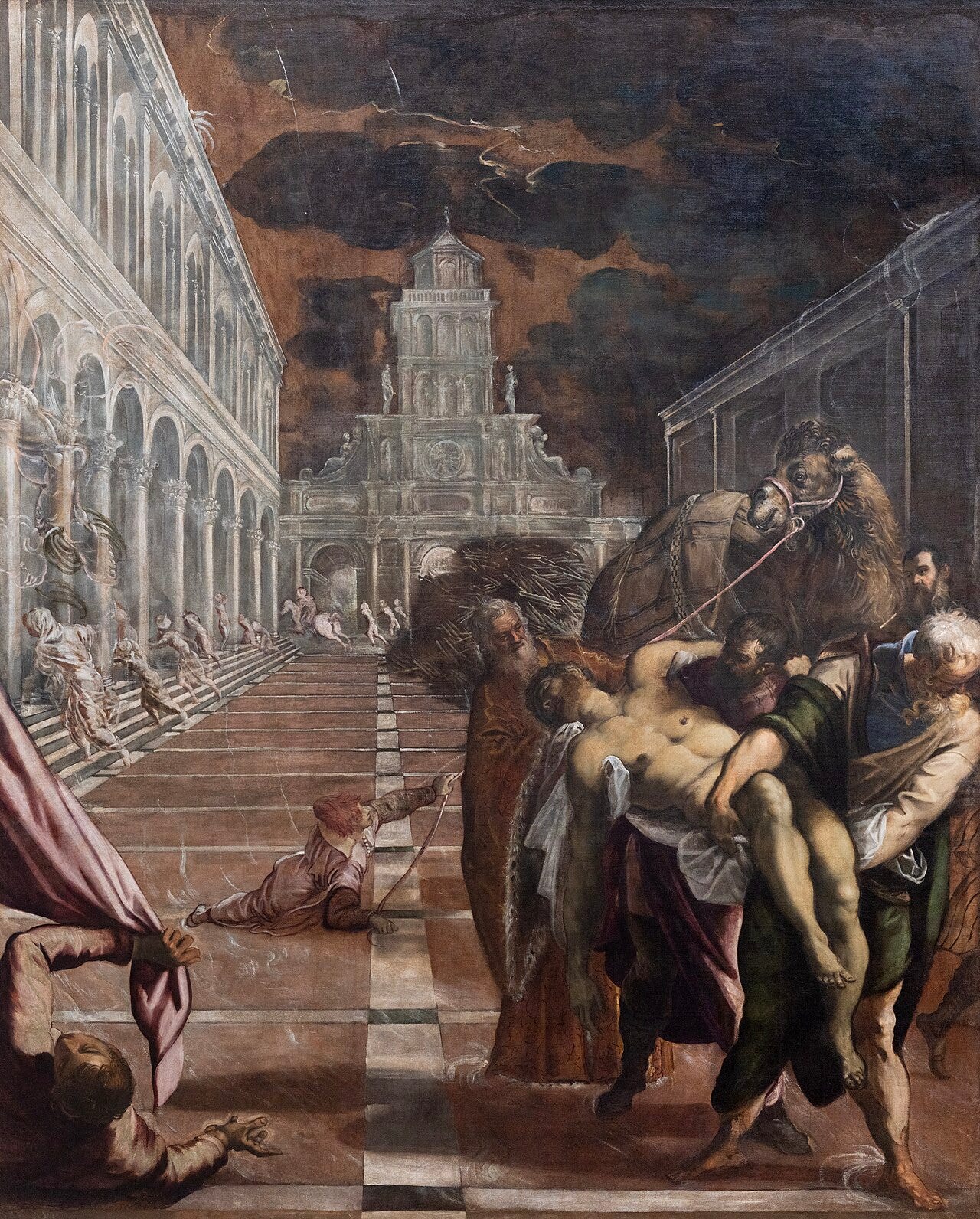
Most painters put the Last Supper table flat across the picture. Leonardo did. Tintoretto swung it.
In his late version for the church of San Giorgio Maggiore, finished around 1594, the table shoots off at a steep diagonal into the dark.
The room is a dim tavern lit by one hanging oil lamp, and servants clear dishes in the shadows while the miracle happens.
Look at the smoke rising from the lamp. It thickens and turns into ghostly angels hovering over the disciples. It was one of the last things he ever painted.
The family firm, and the daughter he adored
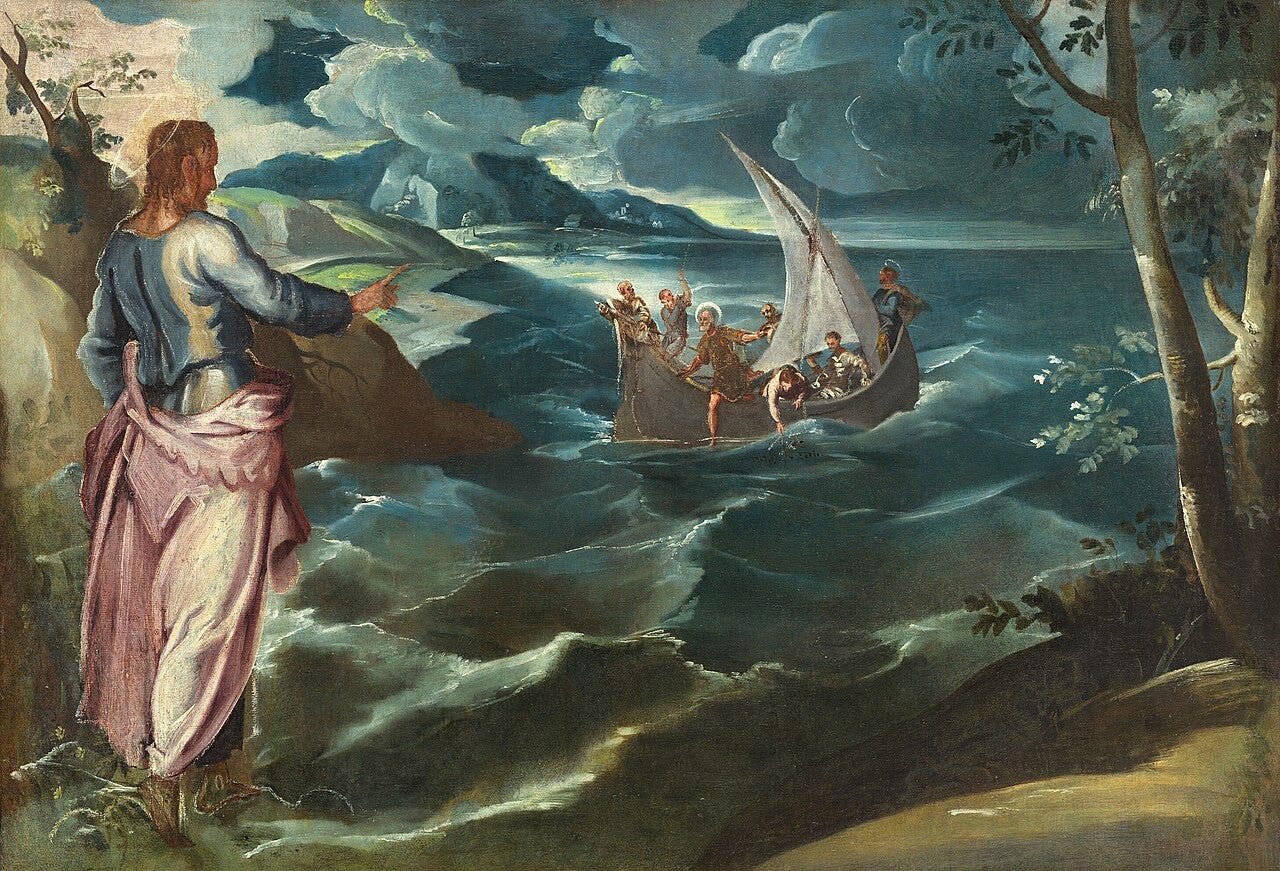
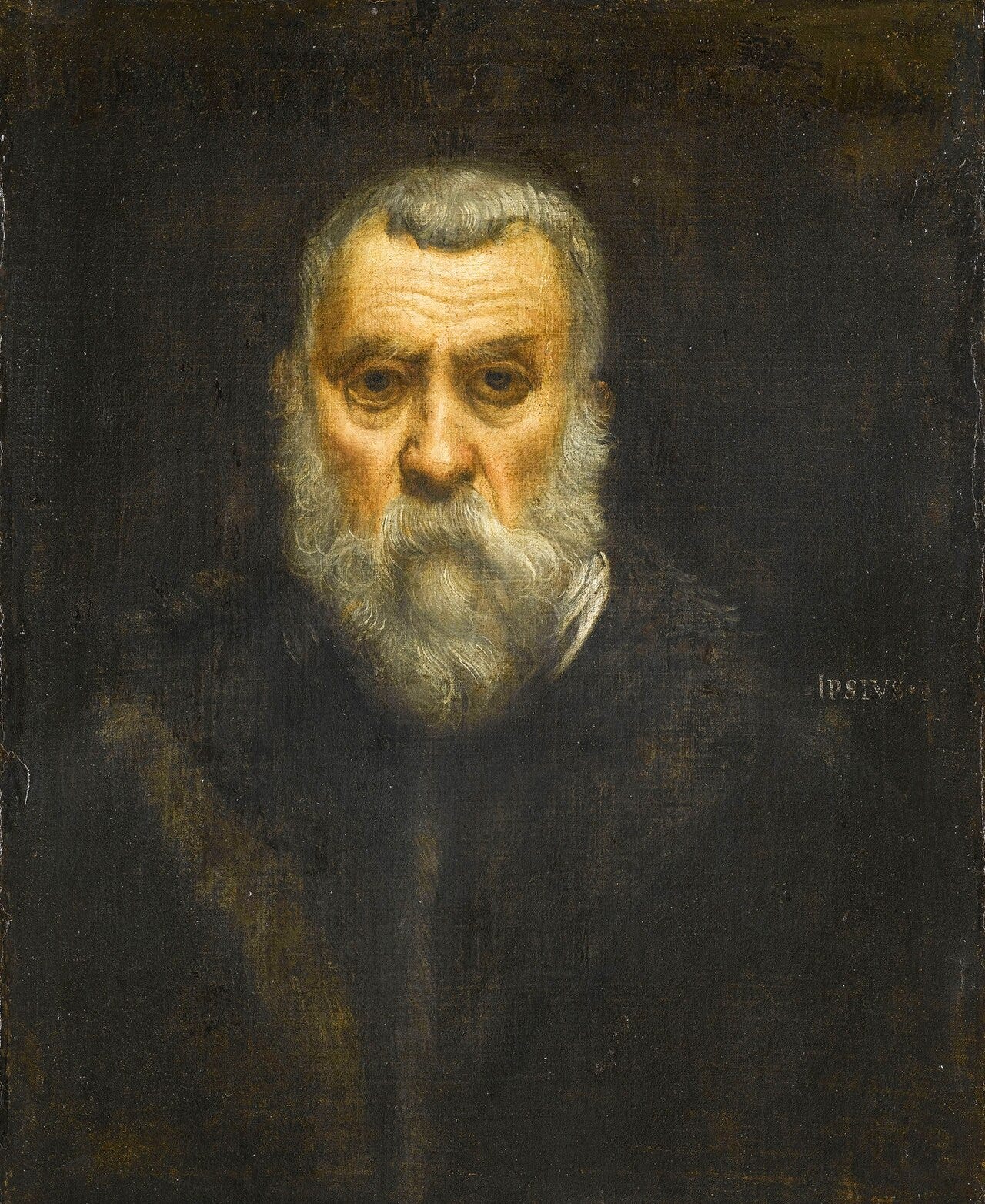
Tintoretto ran his studio like a family business. His daughter Marietta, known as La Tintoretta, painted at his side and built a reputation as a portraitist.
He is said to have dressed her as a boy when she was small so she could come everywhere with him.
Her death around 1590 crushed him. She was only in her thirties.
His sons Domenico and Marco also trained in the workshop. Domenico carried the name forward, finishing commissions and running the shop after his father was gone. Many canvases signed Tintoretto were team efforts.
Il Furioso, the painter who worked at a run
Rivals mocked his speed. His fans made it a legend. They called him Il Furioso, the furious one, for the pace and intensity of his brush. He could rough out a huge scene while others were still stretching their canvas.
That speed fed a rumor that he was careless. It was not true. The wax models and the lighting boxes prove how carefully he planned.
He also undercut competitors on price and sometimes worked for cost, which is partly how he grabbed so many commissions from Titian and Veronese.
The bridge to El Greco and the Baroque
Tintoretto did not stay a local Venetian story. A young Cretan painter named Domenikos Theotokopoulos spent time in Venice in the 1560s. The world would later call him El Greco.
He absorbed Tintoretto's stretched figures, dark grounds and flashes of unearthly light, then carried that charge to Spain.
The bigger inheritance came later. The drama, the deep shadow and the diagonal energy that Venice found excessive became the language of the Baroque.
For a while critics found him too much, then the writer John Ruskin championed him, and his standing recovered.
The Tintoretto questions that keep coming up
What is Tintoretto famous for?
Huge, dramatic Mannerist paintings and the Scuola di San Rocco cycle in Venice.
Why was he called Il Furioso?
For the speed and energy of his brush. He painted enormous canvases at a furious pace, aiming, as the motto on his studio wall had it, for the drawing of Michelangelo and the colour of Titian.
How did he get his light effects?
He built little lit models in boxes. See the dramatic dark and light of tenebrism.
More secrets to unlock


Why the storm still pulls you in
Tintoretto pushed painting toward drama, motion and deep space, pointing ahead to the Baroque. Stand in the Scuola di San Rocco and you are inside the mind of the most restless painter in Venice.
See how his rich oils build that glow in what is oil painting.
His daughter Marietta, known as La Tintoretta, was a gifted painter in his workshop, but he reportedly refused to let her leave Venice for foreign courts, keeping her close until her early death.