
Monet painted the grainstacks near his home around twenty five times because the stacks were never really the point. His subject was the light, color and weather that changed across them by the hour and the season.
The pile of grain was just a fixed thing to hang the changing light on.
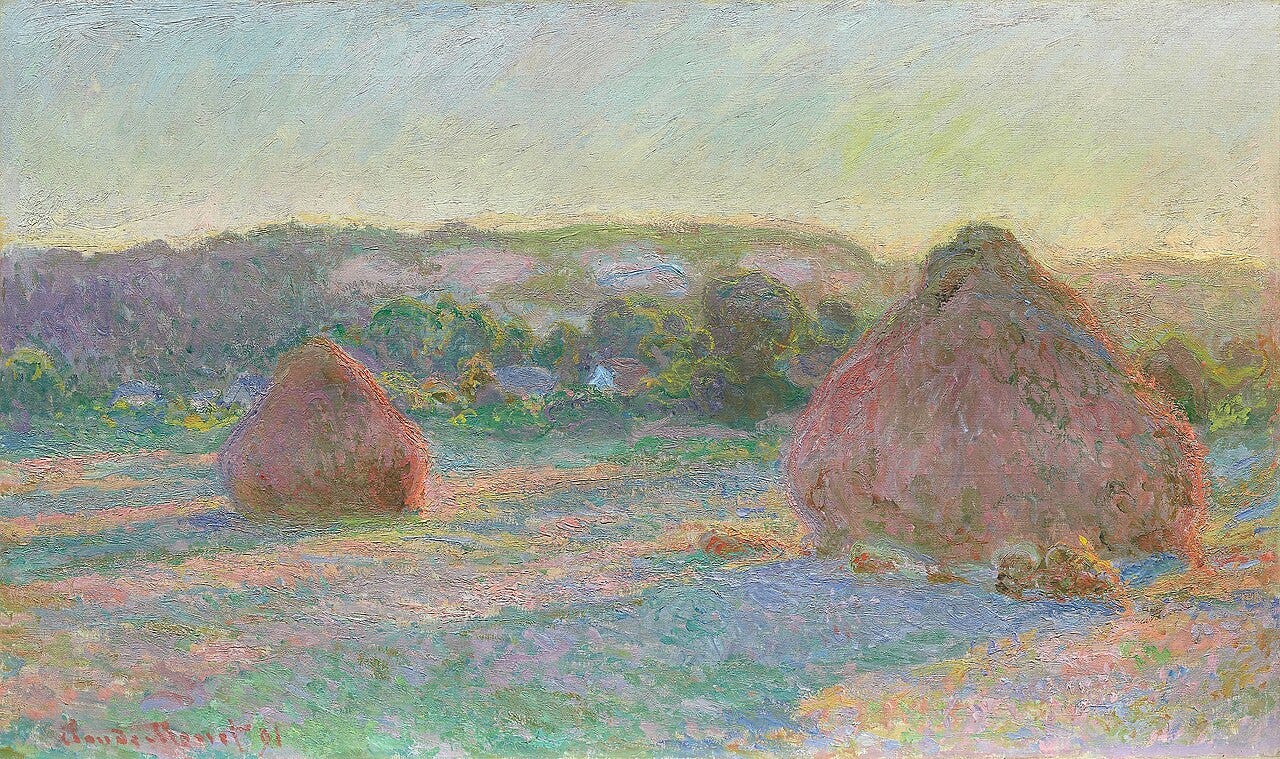
It sounds simple. It quietly changed what a painting could be.
This is why one of the most famous artists in the world spent a year staring at the same lumps of straw.
Why a haystack, of all things
Monet did not paint haystacks because he loved haystacks. He painted them because they stood still.
He needed a plain, unchanging shape, right outside his door, that he could return to in every kind of weather. Against that fixed shape, the only thing moving was the light. And the light was what he was after.
Keep learning art the fun way


What he was really looking at
In the fields around Giverny stood tall stacks of harvested grain, left out to wait for threshing.
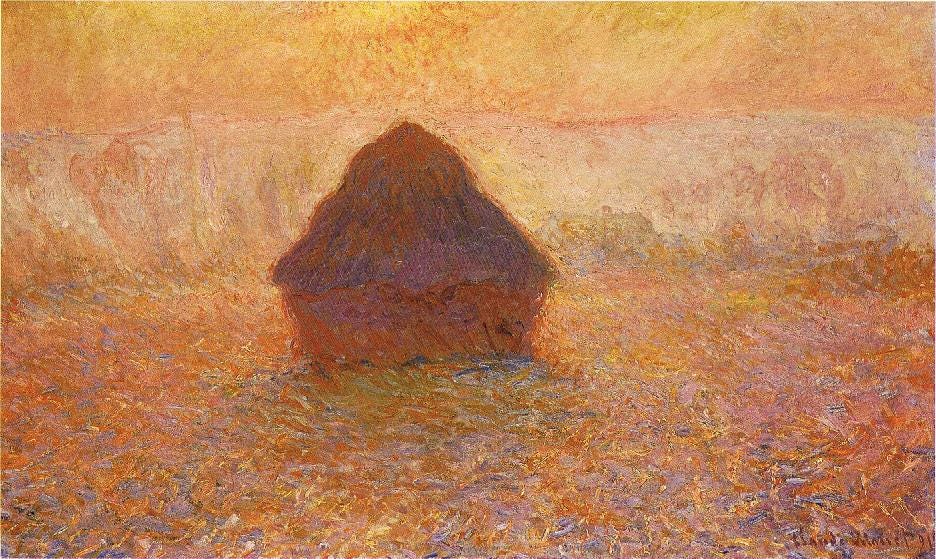
Monet watched how they looked at dawn, at noon, at sunset, under snow, in mist, in the orange light of a winter afternoon. The same stack could glow pink, then blue, then almost black, within a single day.
He set out to record those states, one by one.
Painting against the clock
The urgency in the paint comes from a hard limit.
A given effect of light might last ten or fifteen minutes before the sun moved and the colors changed. So Monet worked on many canvases at the same time, lined up beside him.
As the light shifted, he dropped one stack painting and picked up the next that matched the new moment.
He was not finishing one picture. He was chasing a dozen moments at once, across days and weeks, returning each time the light came back around.
He had a word for what he wanted: instantaneity. Not the stack, but the precise envelope of light and air around it in one passing instant.
From frost to fire
The range he caught from a single subject is the real marvel.
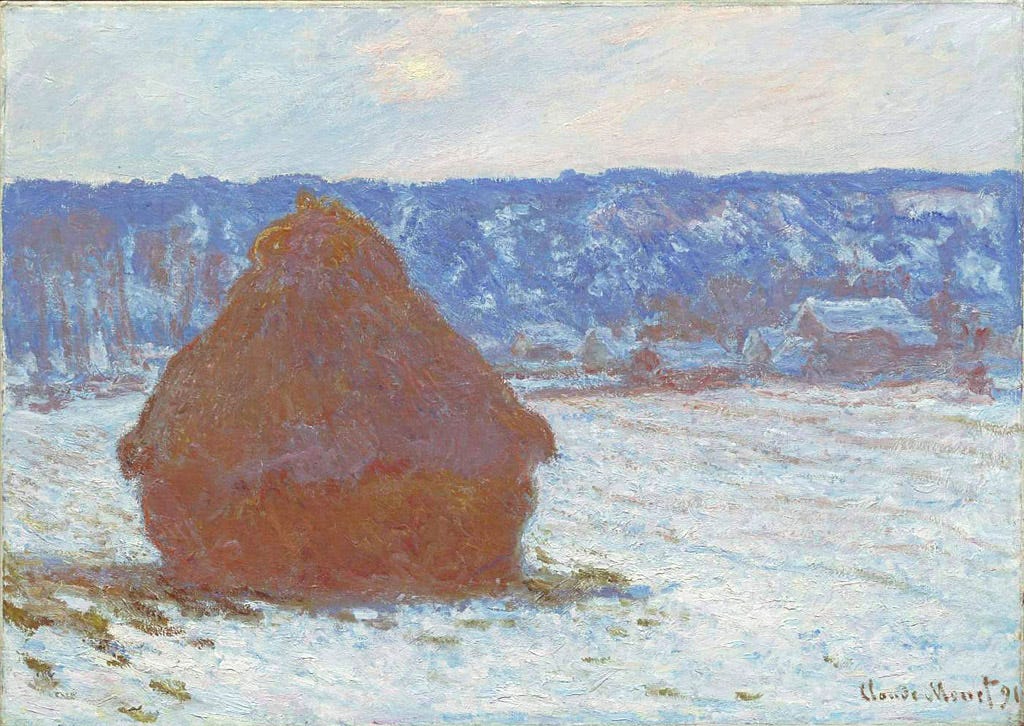
There are stacks in blue morning frost, their shadows long and cold. Stacks blazing orange against a winter sunset, almost on fire.
Stacks half buried in snow, in haze, in flat grey afternoon. Same straw, same field, wildly different worlds, because the light was different.
Set side by side, the series turns a dull farm object into a calendar of a year’s light. That, to me, is the trick that changed painting.
Why it was a quiet turning point
The grainstacks turned a habit into an idea: the series.
By painting one motif many times, Monet made the changing light the true subject and the object almost an excuse.
That notion, that you could build a body of work around time and perception rather than a story or a place, runs through the rest of his life, into the poplars, the Rouen Cathedral fronts and finally the water lilies.
It is pure Impressionism, pushed to its logical end.
The show that made him rich
In 1891 his dealer hung fifteen of the grainstack paintings together in Paris.
Seeing them as a group, viewers could read the light traveling across the stacks like a slow film. The show was a sensation. Most of the canvases sold within days, at strong prices, and the long years of poverty were finally over.
The stacks did not just change his art. They secured his life. Camille, his first wife, had lived through the hardest of those poor years and never saw the turn in his fortune.
A small thing people get wrong
They are usually called haystacks, but that is not quite right.
What Monet painted were stacks of harvested grain, wheat and similar crops, not dried grass. In French he called the series Les Meules. The English nickname stuck anyway, which is why you will see the same paintings labeled both ways.
The haystack questions people ask
Why did Monet paint haystacks so many times? To capture how light and color changed the same stacks across hours, seasons and weather.
How many haystack paintings did Monet make? Around twenty five in the main series of 1890 and 1891.
Are they really haystacks? They are stacks of harvested grain, not hay, though the name haystacks stuck in English.
Where are Monet’s haystacks now? Spread across museums worldwide, including the Musée d’Orsay, the Art Institute of Chicago and the Museum of Fine Arts in Boston.
Why do the haystacks matter? They launched the idea of the painted series and made light itself the subject.
More secrets to unlock


The viewer who saw only color
There is a famous afterlife to these paintings.
A young Russian painter named Wassily Kandinsky saw one of Monet’s grainstacks at a show and, by his own account, could not even tell what it showed.
He only felt the color, glowing and alive without a clear subject. That shock helped push him toward pure abstraction years later.
A stack of grain in a French field helped crack open the door to abstract art. That same hunger for shifting light soon filled his water lily pond, and it is why he is the painter who defined Impressionism. I tell the whole life, from the hungry years to Giverny, in Monet: The Complete Story.
