
Monet: The Complete Story
Claude Monet spent sixty years chasing one impossible thing: the exact look of light at a single moment. He painted the same haystack and the same cathedral over and over, then dug a pond so he could paint water and sky for the rest of his life.
He also gave a movement its name, by accident, with a painting a critic meant to mock.
The soft, pretty reputation hides a hard life. Monet starved for years, lost his first wife at 32, nearly went blind, and turned a private garden into one of the most ambitious projects in the history of painting.
Pretty was never the point. Light was.
Monet at a glance:
He lived from 1840 to 1926, mostly in France, and died at 86 in his own garden.
His real subject was never the haystack or the lily. It was the light falling on them.
He often painted the same scene many times, working several canvases at once as the sun moved.
The word Impressionism comes from one of his paintings, used as an insult in 1874.
His last great work, the water lilies, points straight toward abstract art.
Everything he made circles one obsession with light, and that is the thread this guide follows.
He did not paint things, he painted light
Stand back from a Monet and a field appears. Lean in and it falls apart into dabs and streaks of pure color.
That is the whole method. Monet cared less about the haystack than about the blue of its shadow at four o'clock, the pink the sun threw on it at six.
He worked fast, en plein air, trying to pin down a moment of light before the sky shifted and ruined it.
This is why his paintings can look unfinished. He was recording an atmosphere, the way the air and the light sat on a thing for a few minutes before it was gone.
The same scene, again and again
Once you grasp that, his strangest habit makes sense. He painted the same motif over and over.
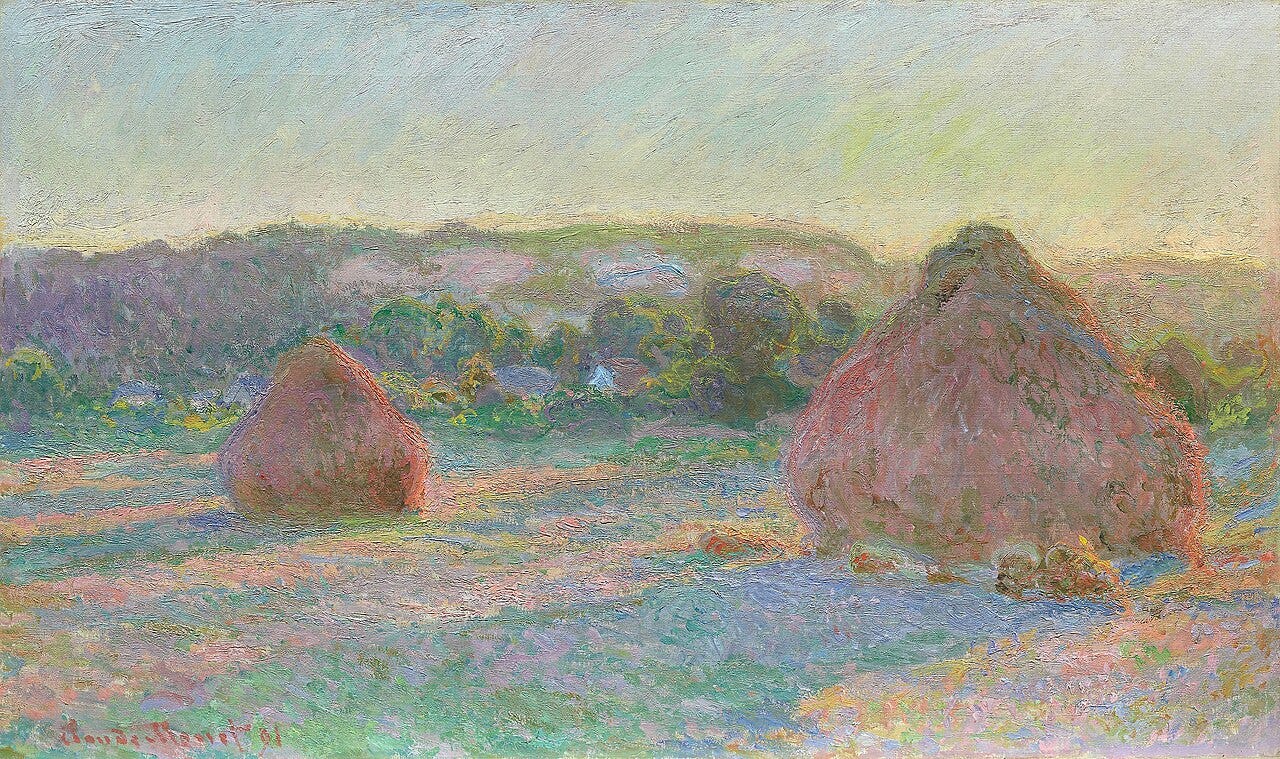
Around 1890 he set up in a field and painted the grainstacks near his house perhaps twenty five times, in different seasons, weathers and hours.
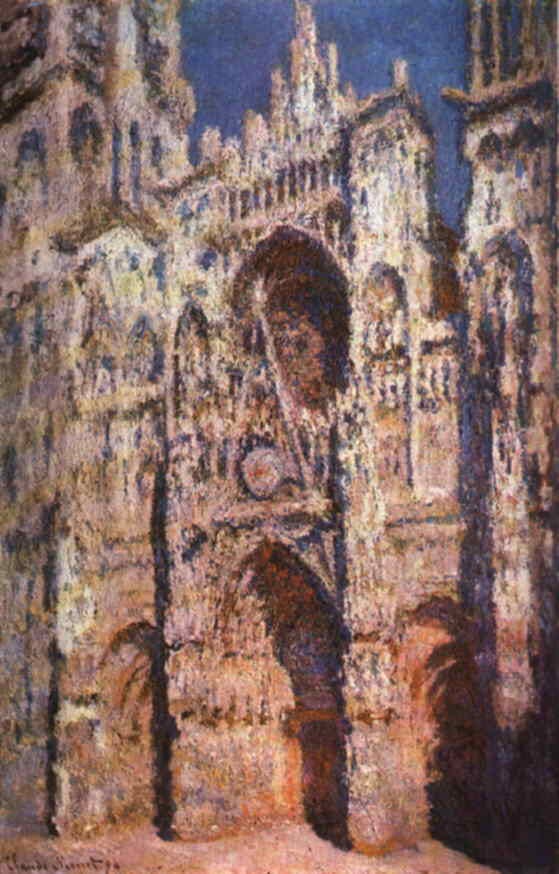
Then the poplars along a river. Then the front of Rouen Cathedral, more than thirty times, as the stone changed from grey dawn to gold noon.
He often had several canvases going at once, switching from one to the next as the light moved on. The subject barely mattered; the light was the real series. I dig into why he did this in Why Did Monet Paint Haystacks.
He took the idea abroad too. Around 1900 he painted the Houses of Parliament in London again and again, dissolving the building into the city's thick fog until the fog itself became the subject.
The word that began as an insult
In 1874 Monet and his friends, shut out of the official salon, held their own show.
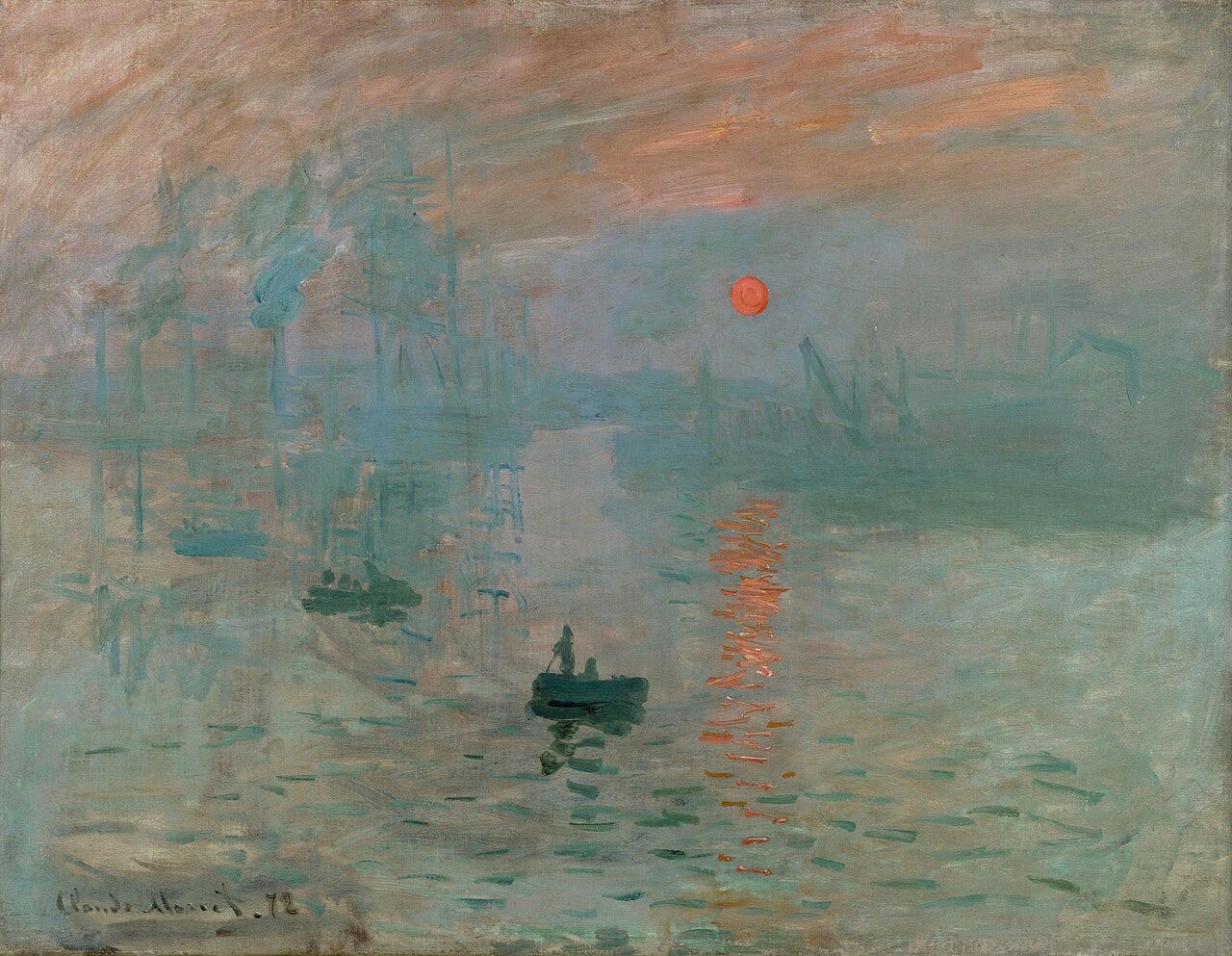
He hung a loose, smoky harbor scene called Impression, Sunrise. A critic named Louis Leroy seized on the title and sneered that the whole room was just a set of unfinished impressions.
The insult stuck, and the group took the name Impressionism for themselves.
Whether Monet truly deserves the title of first Impressionist is its own argument, which I settle in Was Monet Really the First Impressionist.
Look closely at Impression, Sunrise
The painting that named everything hides a clever trick.
The little orange sun looks like it burns and pulses against the cool grey harbor. There is a reason. A neuroscientist later measured it and found the sun and the sky around it almost exactly equal in brightness, even though their colors differ.
Your eye can lock onto color but not onto that missing difference in light, so the sun seems to throb and will not sit still.
Photograph the painting in black and white and the sun nearly vanishes into the sky. Monet, with no science at all, had painted the way human sight actually works.
That instinct, color over outline, light over fact, is the whole movement in one small canvas.
The years of hunger
Behind the garden and the fame lies a long stretch of real poverty.
As a young man in Le Havre, Monet drew caricatures for pocket money until the painter Eugène Boudin pushed him outdoors to paint the sea and sky directly.
He moved to Paris, fell in with Renoir, Bazille, Sisley and Pissarro, and spent the 1860s and 1870s mostly broke.
His model and first love, Camille Doncieux, posed for his early breakthrough pictures and bore him two sons. There were stretches when he could not pay rent or buy paint, and at least one moment of such despair that he is said to have tried to drown himself.
The war, London, and a boat for a studio
Two events in these years quietly shaped everything that followed.
When the Franco Prussian War broke out in 1870, Monet fled to London. There he studied the misty light of Turner and Constable, and met the dealer who would later save his career.
His friend Bazille, who had often paid his bills, was killed in the fighting.
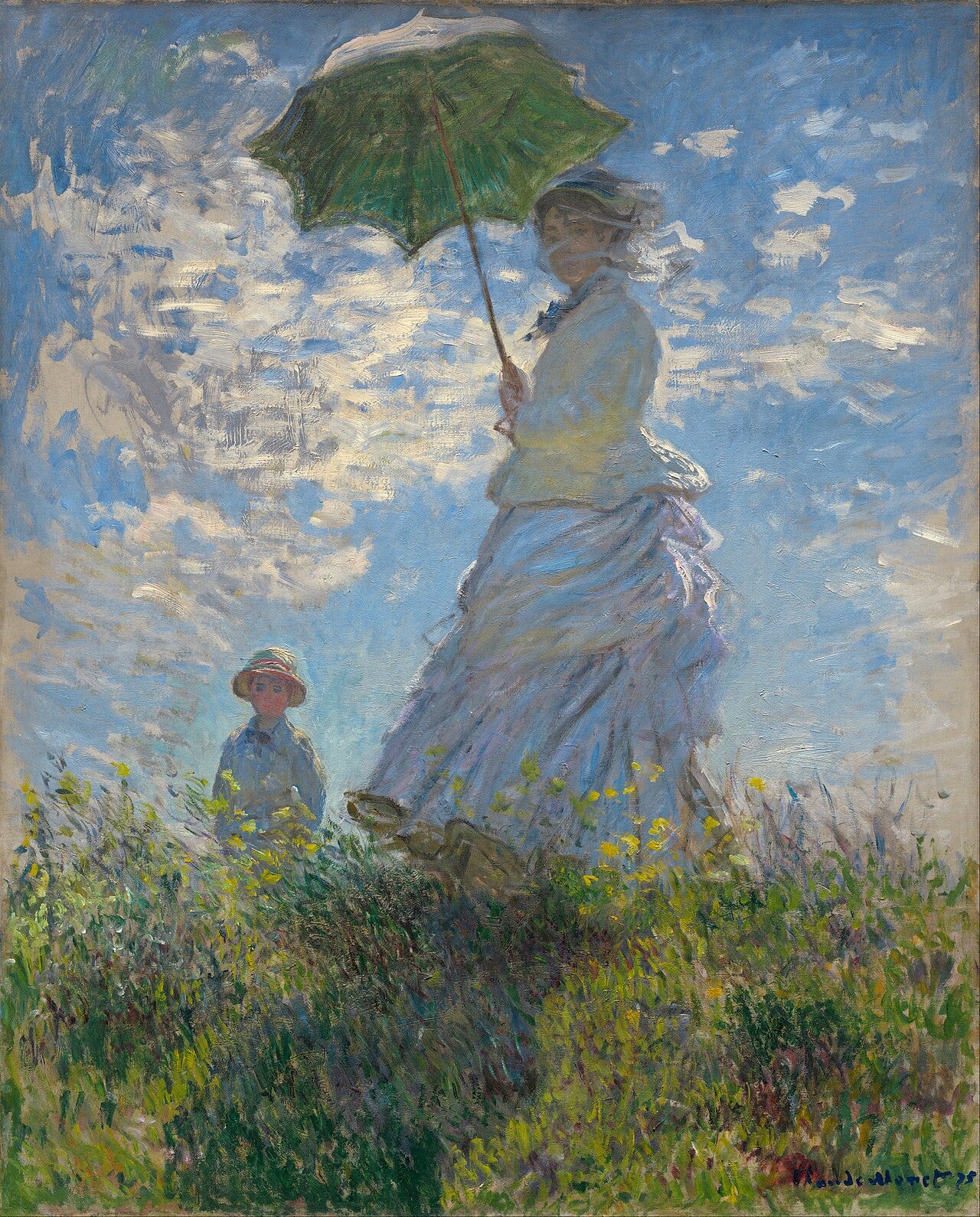
Back in France he settled at Argenteuil on the Seine and built a floating studio, a boat he could paint from out on the water.
A year earlier, working beside Renoir at a riverside resort called La Grenouillere, he had already found the quick, broken brushwork that became the heart of Impressionism.
The dabs that puzzled critics were born on a river, chasing sunlight on moving water.
The wife he painted as she died
In 1879 Camille died of illness at just 32, and Monet did something that haunted him for the rest of his life.
At her deathbed, he painted her. Later he confessed to a friend that even in his grief, he caught his own eye coldly registering the blues and yellows the approaching death laid across her face. The painter in him would not switch off, even there.
I tell the full story in Why Did Monet Paint His Dying Wife.
After Camille, his life slowly turned from struggle to success, helped by the dealer who finally found buyers for his work.
The garden he built to paint
In 1883 Monet settled in the village of Giverny, and in time the garden became his greatest work.
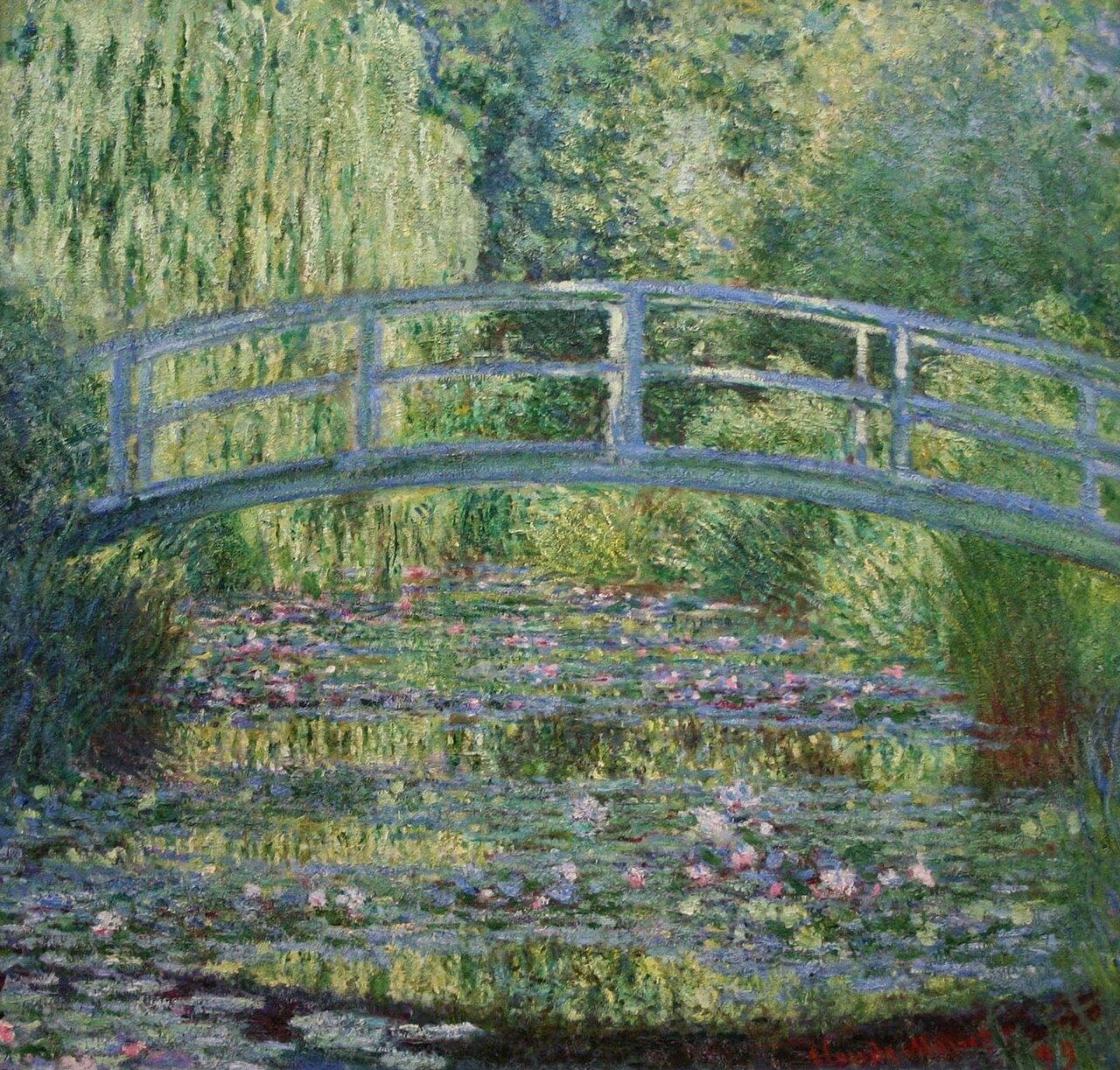
He bought the land, diverted a small river, and built a water garden with a Japanese style bridge and a pond stocked with lilies. It was a subject he designed and grew on purpose, a painting he could walk into and tend.
I walk through the whole house and garden in Inside Monet's House: Giverny Room by Room.
The water lilies, and a gift to a wounded country
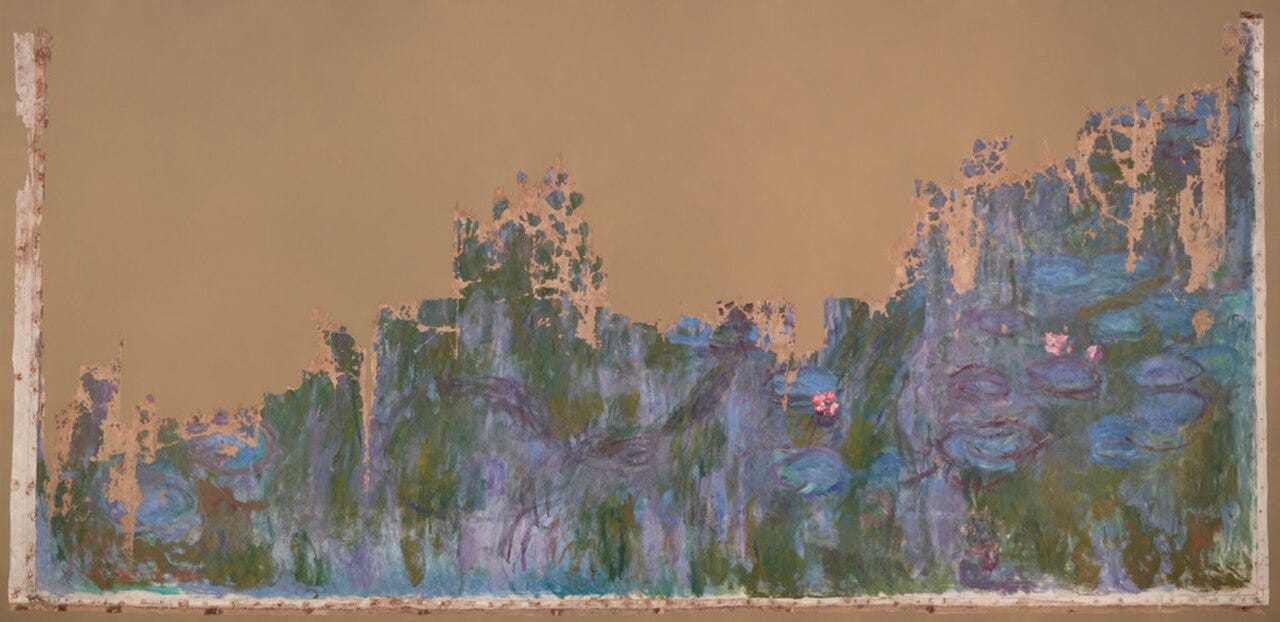
From about 1899 to his death, Monet painted that pond more than 250 times.
He zoomed in until the banks vanished. No horizon, no shore, just water, lilies and the sky reflected upside down on the surface. Late in life he scaled them up into vast wall sized panels, the Grandes Décorations.
He gave those great panels to France, signed the gift the day after the 1918 armistice, as a peace memorial for a country bled white by the First World War.
They were installed in the Orangerie in Paris, a quiet oval room that feels like stepping inside the pond.
Why water became his only subject is its own story: Why Did Monet Paint Water Lilies.
When his eyes failed
There is a cruel twist in the painter of light losing his sight.
From around 1912 Monet developed cataracts. Colors muddied and yellowed for him, and for a while his canvases turned thick and reddish brown. He raged, scraped pictures, despaired, and finally had surgery in 1923 that changed his vision again.
What that damage did to his final works is in How Monet's Cataracts Changed Modern Art.
How to see a Monet
What sets Monet apart from the other Impressionists is mostly what he left out.
Little by little he dropped the human figure almost entirely. Where Renoir painted people and Degas painted dancers, Monet emptied his world down to light, water, air and a few stacks of grain.
People shrink to specks, or vanish from the canvas altogether.
He chased what he called the envelope: the veil of colored light and atmosphere that wraps a scene for one passing moment. Not the cathedral, but the air standing in front of the cathedral.
Up close his method is plain nerve. He laid strokes of pure, unmixed color side by side and let your eye blend them, a green and a yellow reading as sunlit grass.
He nearly banished black from his shadows, painting them in blue and violet, because that is what shadow really looks like outdoors. And no one chased water and reflection as hard as he did, because nothing else changes light so fast.
The result is paint that behaves like weather. A screen flattens it. In person it almost breathes.
The friends and the dealer who saved him
Monet did not rise alone, and for years he would not have eaten without help.
Renoir, Pissarro, Sisley and Bazille were his fellow rebels in the early Impressionist fight. The dealer Paul Durand Ruel gambled on the whole group for decades and kept Monet afloat with advances.
His biggest gamble paid off in 1886, when he shipped a huge show of Impressionist paintings to New York. America loved them, and the money from across the Atlantic turned Monet from a struggling painter into a wealthy one.
His old friend the statesman Georges Clemenceau pushed him to finish the water lily panels and pressed France to accept them.
The shrewd businessman behind the dreamer
The picture of Monet as a gentle soul in a straw hat misses half of him.
He was a sharp operator. He played his dealers against each other, held paintings back to push prices up, and refused to sell the grainstacks except as a set, knowing they were worth far more together.
He staged his series exhibitions for maximum effect and courted wealthy American collectors. By the end he was rich, employed a staff of gardeners, and ran Giverny like a small estate.
The dreamy surfaces were made by a man who knew exactly what they were worth.
Where Monet leads
He is the central figure of Impressionism, the man who pushed its core idea furthest and lived longest to develop it.
But his ending points past his own movement. Those last water lilies, all surface and color and no clear edge, look forward to a kind of painting that would not arrive for decades.
For years after his death the late panels were seen as the ramblings of a half blind old man. Then, in the 1950s, the Museum of Modern Art in New York bought his water lilies, and a generation of American abstract painters claimed him as an ancestor.
Stand in front of the late panels and you can see the door opening toward painters like Rothko, who built whole canvases out of pure floating color.
The man who started Impressionism quietly helped end it, and opened what came next.
Three Monets to begin with
Impression, Sunrise, 1872. The smoky harbor that named a movement.
Grainstacks, 1890 to 1891. The same field, painted into a study of light and time.
The Water Lilies, around 1916 to 1926. A pond turned into the edge of abstraction.
See them in person
Monet rewards travel, because the scale and the surface only exist in the room.
The Musee d'Orsay and the Musee de l'Orangerie in Paris hold his Impressionist works and the giant water lily panels. The Art Institute of Chicago owns the largest group of his Stacks of Wheat, and the Metropolitan Museum of Art in New York has a deep group too.
The deeper Monet stories
The full dives, with the reporting and the details that change how you see him.
Inside Monet house at Giverny, room by room, including his own bedroom
Was Monet really the first Impressionist, the painting that may have got there first
Six women, one monster, what Picasso did to the women who loved him
The Monet questions that keep coming up
What did Monet paint? Landscapes and light: harbors, fields, cathedrals, gardens, and above all the water lilies of his own pond.
Why are Monet's paintings blurry? He painted the fleeting effect of light and air on a scene, not its sharp outlines.
Why did Monet paint the same thing many times? To capture how light changed it across hours, seasons and weather.
Where is Monet's garden? At Giverny in Normandy, where you can still visit the pond and the Japanese bridge.
Did Monet go blind? No, but cataracts badly clouded his sight late in life, until surgery in 1923.
When was Claude Monet born? On 14 November 1840, in Paris, France.
When did Monet die? On 5 December 1926, aged 86, at his home in Giverny.
Why is Monet called the father of Impressionism? His 1872 canvas Impression, Sunrise gave the whole movement its name.
How many paintings did Monet make? Around 2,500, many of them in long series of the same subject.
What was his style? Impressionism, the movement his work helped name.
He spent a fortune to paint a pond
Forget the gift shop version of Monet, the easy, pretty wallpaper. The real man was relentless.
He moved a river, fought the local council for the right to build his pond, planted a garden as a painting, then chased its reflections for a quarter of a century while his eyes slowly failed.
The water lily rooms of the Orangerie opened to the public in 1927, a few months after he died. He never saw crowds stand inside the work he gave his country, in the silence he built for it.
