
El Greco, who lived from 1541 to 1614, was the Greek icon painter who became one of Spain’s greatest artists. His stretched, flame like figures and acid colors looked so strange that he was dismissed for centuries.
Around 1900 the modern painters who cared about feeling over accuracy rediscovered him, and today he is seen as a bridge from Byzantine icons to the emotion of modern art.
He shares that adopted country with the other painters covered in Famous Spanish Paintings: 12 From El Greco to Sorolla, a list that includes his own work.
Five fast facts about El Greco
Born in Crete in 1541, his real name was Domenikos Theotokopoulos.
Trained first as a Byzantine icon painter.
Studied in Venice and Rome before moving to Spain.
Settled in Toledo, where he did his greatest work.
Forgotten for 250 years, then rediscovered around 1900.
More incredible painter stories
If El Greco pulled you in, you will love these too:


The Greek who learned to paint icons
He was born on the island of Crete, then ruled by Venice, in 1541. His real name was Domenikos Theotokopoulos. El Greco, the Greek, was just a nickname the Spanish gave him later.
He trained in the old Byzantine tradition, painting flat, golden religious icons. That spiritual, unworldly look never fully left him, even when he learned to paint like a Westerner.
He passed through Venice and Rome
Around 1567 he moved to Venice and absorbed the rich color and loose brushwork of Titian's city. In Rome he also became a sharp portrait painter, but his pride got him into trouble.
By one famous account he offered to repaint Michelangelo's Last Judgment, which he found indecent, and to do it better. That kind of arrogance made him enemies and few patrons.
Toledo made him, the king rejected him
In 1577 he came to Spain hoping to win royal commissions from Philip II. The king tried him once, disliked the result, and never hired him again.
So El Greco settled in the old city of Toledo and became its painter. There, free of court taste, he developed the strange, soaring Mannerist style that is unmistakably his, lit with the dramatic darkness of tenebrism.
Why his figures stretch toward heaven
El Greco's people are impossibly tall and thin, their bodies pulled upward like flames. For a long time some doctors guessed he had an eye defect, an astigmatism, that made him see the world stretched.
That theory has been thrown out. Any eye problem would have distorted his copying too. The elongation was a deliberate choice, a way to make flesh look weightless and reaching for God.
He lived grandly and died in debt
In Toledo he lived like a lord, renting a grand house and, the story goes, hiring musicians to play while he ate. He never married his companion Jeronima, but had a son, Jorge Manuel, who worked in his studio.
Despite steady commissions he was often in debt, and he died in Toledo in 1614.
Forgotten for centuries, then reborn
For about 250 years El Greco was dismissed as a bizarre oddity. Then, around 1900, artists looking for emotion over realism rediscovered him.
Cezanne and the Expressionists studied him, and Picasso drew directly on his work for the figures of Les Demoiselles d'Avignon. The rejected Greek had become a forerunner of modern art.
The Prado and Toledo
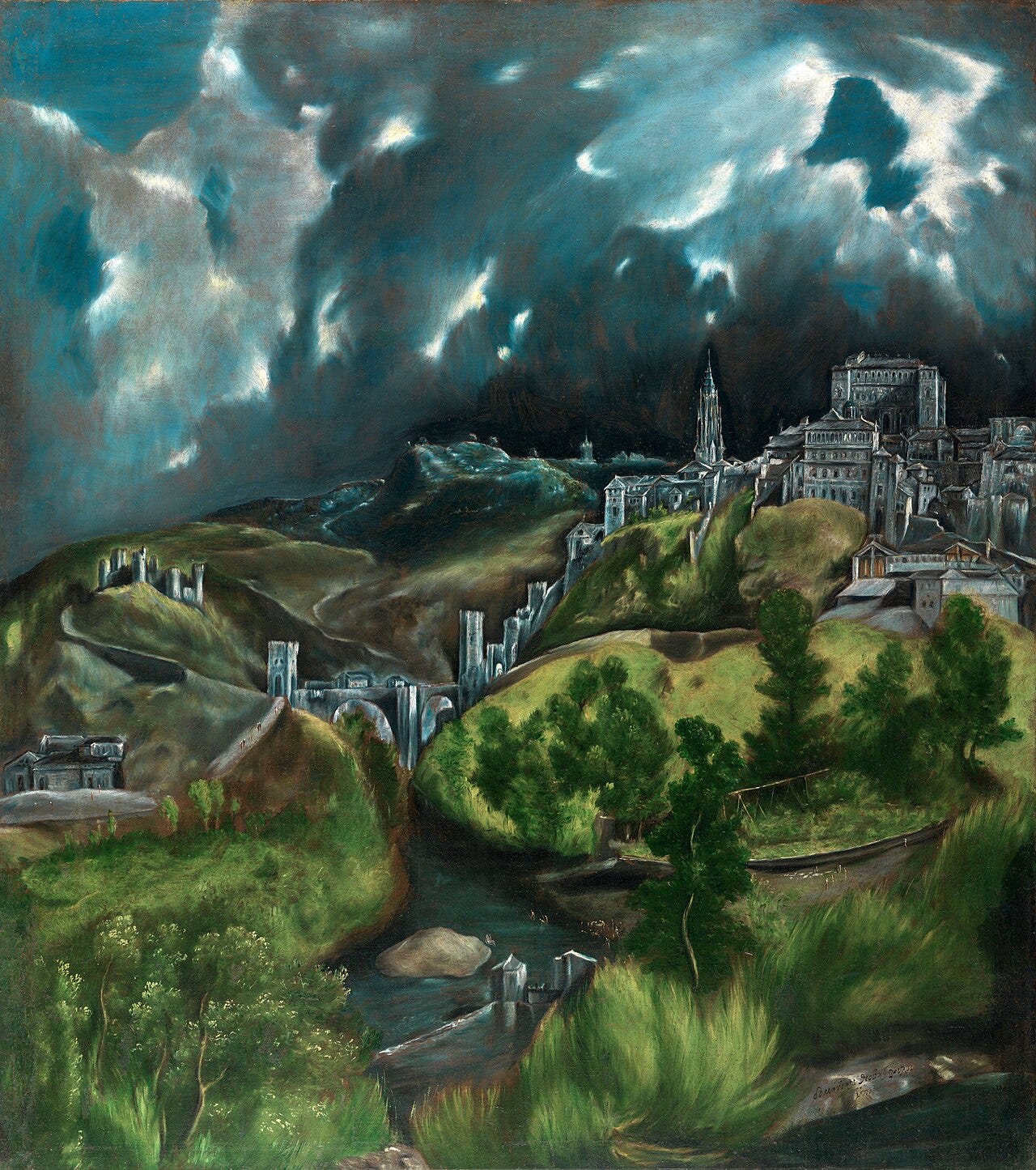
The Prado in Madrid holds the largest group of his work. The Metropolitan Museum of Art in New York owns his haunted View of Toledo.
Born a Venetian subject on the island of Crete
He was born in 1541 in Candia, the walled capital of Crete that is now called Heraklion. Crete at that time was not Greek in any political sense. It was a colony of the Republic of Venice, and had been for centuries.
So the boy who would sign his work Domenikos Theotokopoulos grew up a Venetian subject who spoke Greek. That double identity shaped everything that came next.
The nickname El Greco, meaning the Greek, came later in Italy, where people were often labeled by their homeland. He never forgot his roots.
For the rest of his life he signed his paintings in Greek letters, with his full birth name, even while living in Spain.
A recorded master painter before he ever left the island
Before Venice, before Rome, before Spain, he was already a professional.
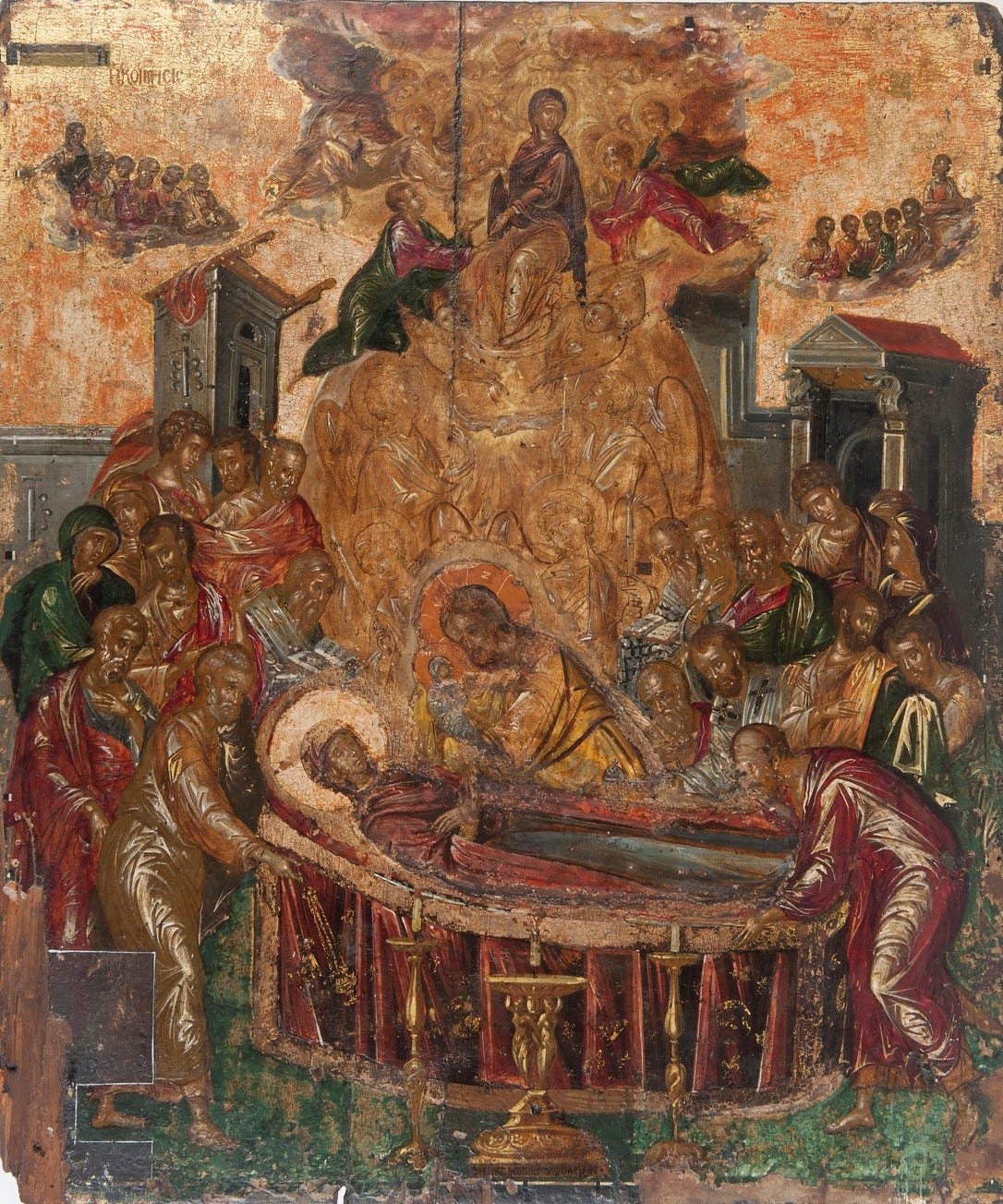
In 1566, records in Candia list him as a master painter. He was only about twenty five, and he was working in the old Byzantine icon tradition, painting sacred images on wood panels in the flat, gold ground manner passed down for centuries.
Only two icons that scholars accept as certainly his have survived from these years. They are worth pausing on, because they show the starting point of a very long journey.
No other major Western painter traveled so far in his own mind, from the flat symbolic world of icons to Renaissance realism and then past it.
That road began on Crete.
Venice, and the myth of studying under Titian
Around 1567 he crossed to Venice, the capital of the republic that ruled his island. He is documented there by 1568.
Venice hit him like a new language. He studied the deep color and loose brushwork of Titian, then the drama of Tintoretto, the grand staging of Veronese, and the earthy scenes of Jacopo Bassano.
Here is the myth worth correcting. It is often repeated that El Greco was Titian's personal pupil or apprentice. The National Gallery of Art states there is no evidence for that tradition.
A 1570 letter does call him a young man from Candia and a pupil of Titian, but scholars read that loosely. He absorbed Titian's example.
A formal apprenticeship in the master's studio is not proven.
Rome, the Farnese palace, and a fatal insult
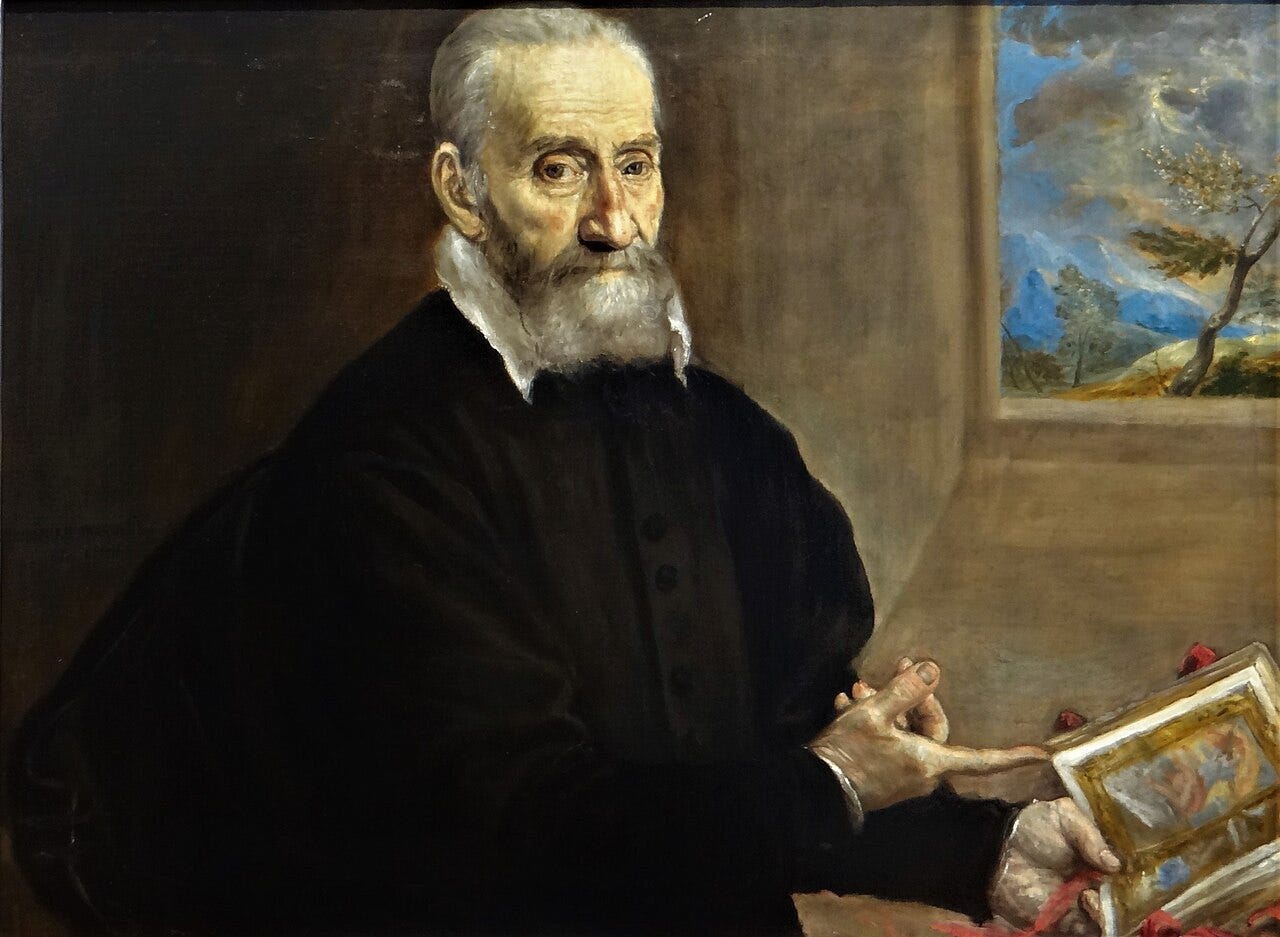
In the autumn of 1570 he moved to Rome, carrying a letter from the miniaturist Giulio Clovio.
That letter opened a golden door. It won him lodging inside the Palazzo Farnese, home of Cardinal Alessandro Farnese, one of the richest patrons in the city.
There he met the scholar and librarian Fulvio Orsini. In 1572 he joined the painters guild, the Academy of Saint Luke.
Then he talked himself into trouble. He criticized Michelangelo's ability as a painter, in the very city that revered him. Michelangelo had died in 1564, but his prestige was untouched.
A repeated story goes further, claiming El Greco offered to repaint the Last Judgment, which he found indecent. Whatever he actually said, Rome gave him no altarpiece in six years.
The Espolio, his loud arrival in Toledo
He reached Spain in 1576 and Toledo by July 1577. He came with work already lined up.
Diego de Castilla, dean of Toledo Cathedral, had arranged for him to paint altarpieces for the church of Santo Domingo el Antiguo.
By September 1579 he had finished nine paintings there, including the great Assumption of the Virgin for the high altar.
At the same time he painted the Espolio, or The Disrobing of Christ, for the cathedral vestiary. He packed the crowd of tormentors tight around Christ, heads stacked row on row, to press home the sense of a man surrounded and abused.
These works announced him at once as the finest painter in the city.
The lawsuit that soured him with the cathedral
The Espolio should have been a triumph. Instead it became a fight over money.
El Greco named a high price for the finished painting. The cathedral authorities balked, and the disagreement went to formal arbitration and litigation.
It left a lasting mark on his career in Toledo. He never again received a comparable commission from the cathedral. From then on his patrons were private individuals, parish churches, and convents rather than the great cathedral chapter.
This is a pattern worth noticing in his life. He knew his own worth and demanded to be paid for it, and that confidence dragged him into courtrooms more than once.
Philip II and the altarpiece the king sent back
One prize kept El Greco in Spain in the first place. King Philip II was building the vast monastery palace of El Escorial, and royal work there could make a painter for life.
El Greco got his chance. He painted the Martyrdom of Saint Maurice, finishing it in 1582.
The king did not like it. Philip promptly ordered another artist to paint the same subject to replace it. Some think the near shocking brightness of the yellows against the deep blue unsettled him.
That was the end of it. The great door to royal patronage closed for good, and El Greco settled permanently into the life of Toledo instead.
The Burial of the Count of Orgaz, his single greatest work
In 1586 the parish priest of Santo Tome in Toledo gave him the commission that would define him.
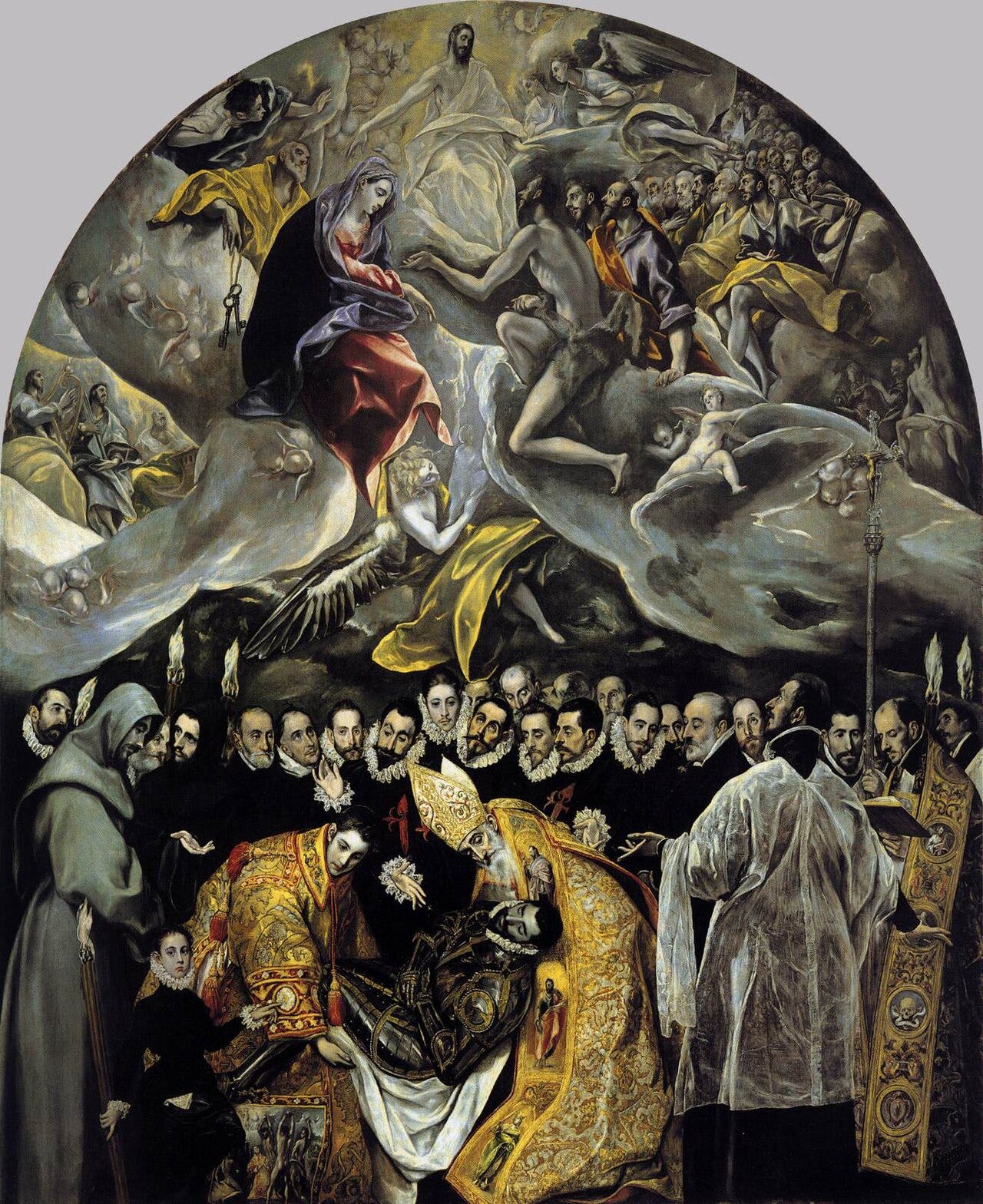
The Burial of the Count of Orgaz, painted between 1586 and 1588, honors a local legend. A generous medieval benefactor was said to have been laid in his tomb by Saints Stephen and Augustine, who appeared in person to bury him.
El Greco split the canvas in two worlds. Below, the funeral is solid, earthly, filled with recognizable Toledo gentlemen. Above, heaven opens in cold swirling clouds where the figures stretch tall and ghostly.
It still hangs in Santo Tome, where it was made, and seen there it has the force of a vision opening in the wall.
Jeronima de las Cuevas and the son who signed the Burial
El Greco never married in Spain, but he was not alone.
His companion was Dona Jeronima de las Cuevas. In 1578, in Toledo, she gave birth to his only child, a son named Jorge Manuel. El Greco acknowledged both mother and son openly in his documents, including his final will, yet he never married her, and no one has fully explained why.
Jorge Manuel grew up inside the workshop. He became his father's assistant and later worked as a painter and architect in his own right.
The boy is hiding in plain sight in the Burial of the Count of Orgaz. The child at the lower left is Jorge Manuel, and his handkerchief carries El Greco's signature and the date 1578, the year of his birth.
His books, his margin notes, and the picture that reached Picasso
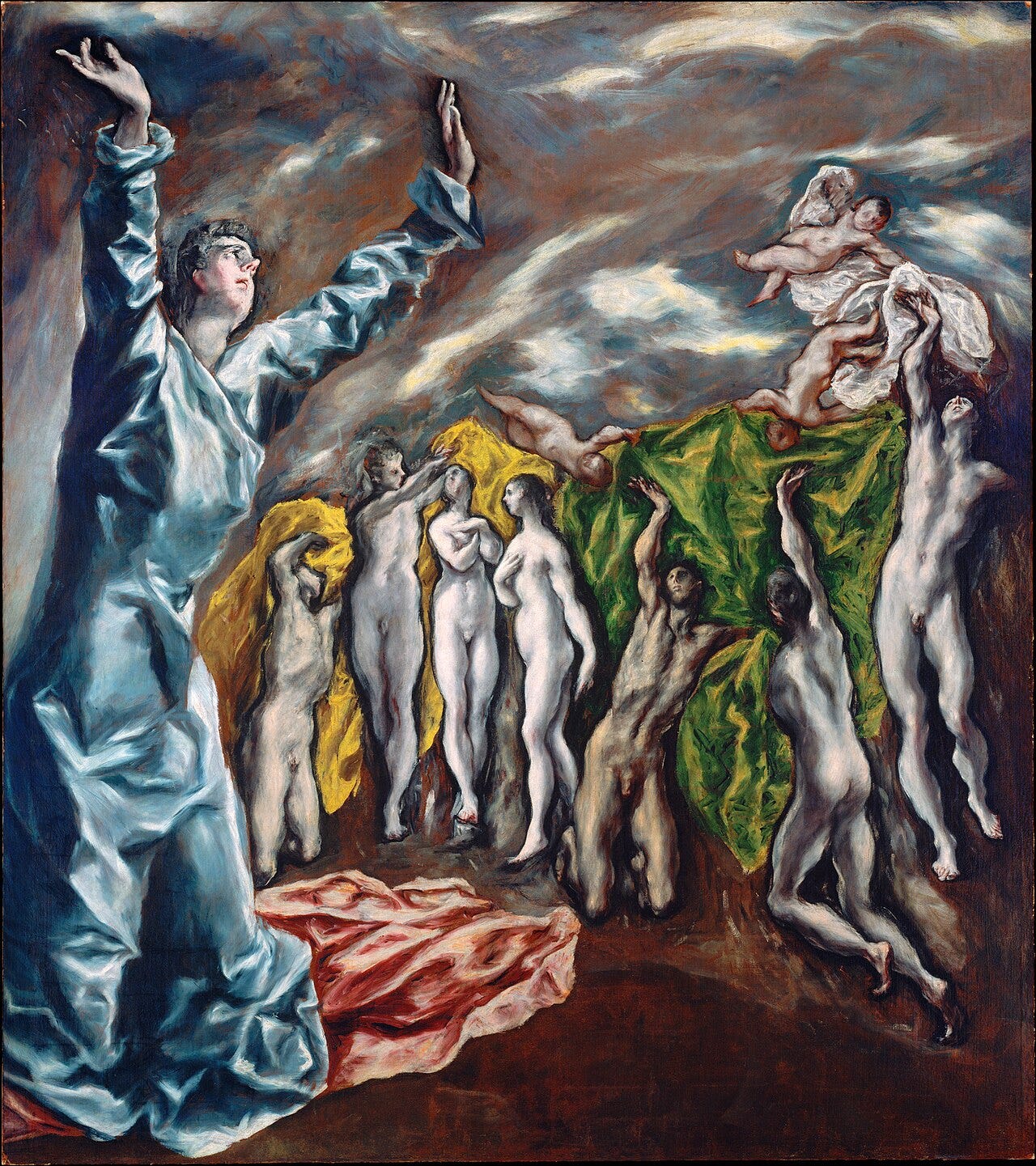
El Greco was a reader as much as a painter. The inventory taken after his death shows a large library, with Greek authors in Greek, Latin classics, Vitruvius on architecture, and Vasari's Lives of the artists.
He argued with his books. His surviving copies of Vitruvius and Vasari carry his own notes scribbled in the margins, and in them he keeps attacking Michelangelo.
From about 1585 he rented grand apartments in the palace of the Marques de Villena, with room for a full workshop. One early account even claims he kept musicians playing while he dined.
He died in Toledo on 7 April 1614, at the age of 73. Centuries later Picasso studied his stretched, spectral figures, and his Vision of Saint John fed straight into Les Demoiselles d'Avignon.
The El Greco questions that keep coming up
Who was El Greco? A painter born in Greek Crete who became a master of the Spanish Renaissance, working mostly in Toledo.
What was his real name? Domenikos Theotokopoulos. El Greco simply means the Greek.
When and where was he born? On the island of Crete in 1541.
How did he die? Of illness in Toledo, Spain, in 1614.
Why are his figures so stretched? By choice, for spiritual effect. The old idea that it came from an eye defect has been rejected.
Where can you see his work? In the Prado in Madrid, and across the city of Toledo, where many pieces still hang.
Was El Greco actually Greek or Spanish? He was Greek by birth and ancestry, born on Crete in 1541, but Crete was a Venetian colony, so he was legally a Venetian subject. He spent his mature career in Spain and is counted among the great Spanish painters.
Did El Greco study with Titian? There is no solid evidence that he was Titian's apprentice, despite a long tradition saying so. He clearly learned from Titian's paintings and the wider Venetian school after arriving around 1567, but the National Gallery of Art notes the pupil story is unproven.
More secrets to unlock


How a reject became modern
A Greek who annoyed Rome and was turned away by the king of Spain spent his life in a provincial Spanish town, then vanished from the story for 250 years.
When he came back, around 1907, his stretched saints suddenly looked modern. For me he is the great time traveler of art.
The modern rediscovery has a paper trail.
In 1897 Picasso's friend, the painter Ignacio Zuloaga, bought El Greco's Vision of Saint John in Paris for a thousand pesetas and hung it in his studio, where the young Picasso studied it.
Scholars have read Les Demoiselles d'Avignon against that canvas ever since; it hangs today in the Metropolitan Museum.
A shorter round of El Greco trivia covers the Crete years, the birth name Domenikos Theotokopoulos, and the quarter century he spent forgotten before Picasso rediscovered him.