
JMW Turner was the British master of light, the painter who melted ships, storms and sunsets into pure color decades before the Impressionists were born.
Secretive, restless and fiercely ambitious, he pushed landscape so far that it edged toward abstraction, and he left thousands of works and a fortune to his country.
Today his name marks Britain's most talked about art prize, yet the man himself stayed a mystery to the end.
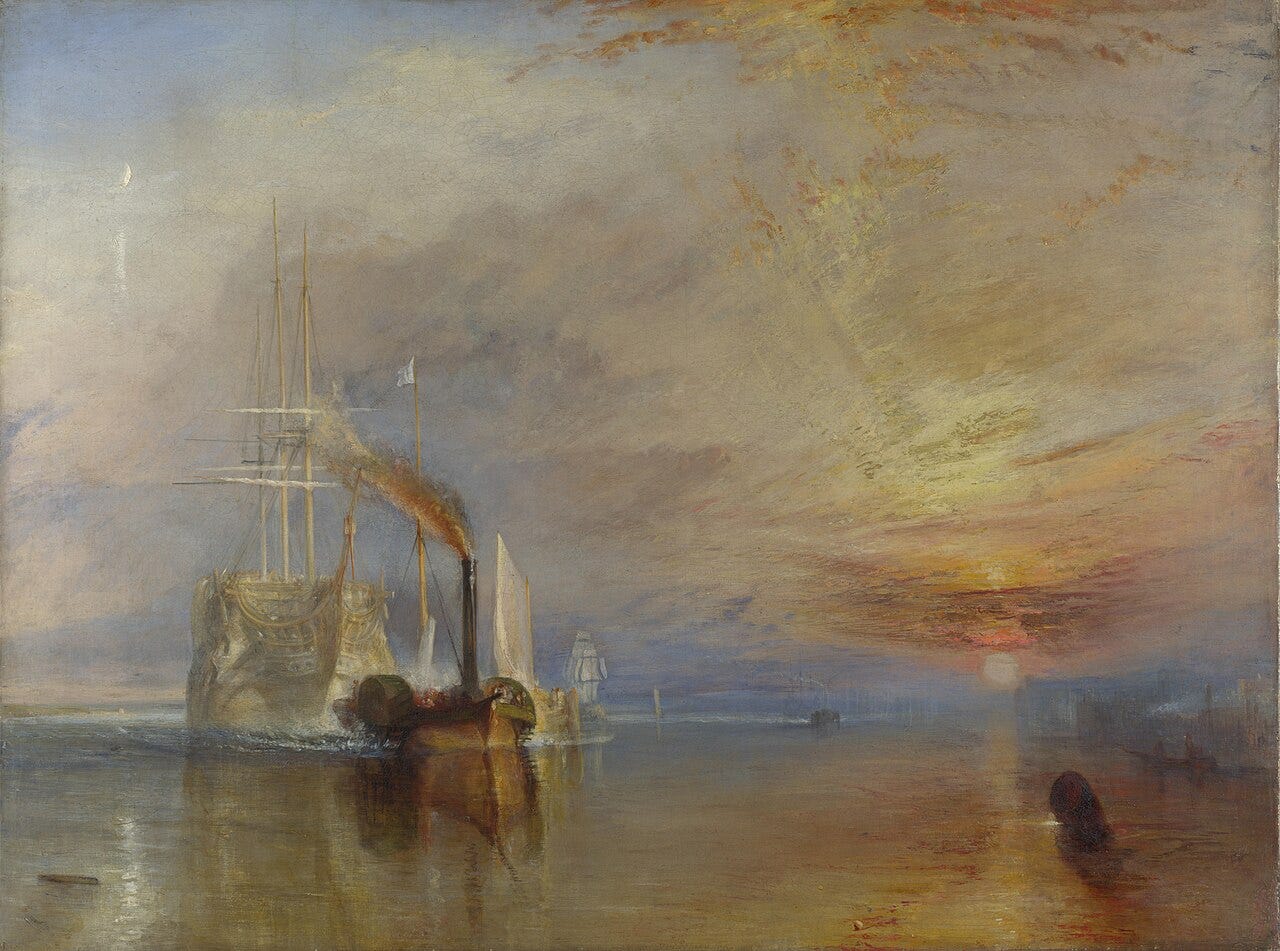
People who only know calm English watercolors are not ready for late Turner, where the world almost disappears into light.
More incredible painter stories
If JMW Turner pulled you in, you will love these too:


JMW Turner at a glance
1775. Born above a barber shop in Covent Garden.
1802. Elected a full Royal Academician at 26, as young as the rules allowed.
1839. The Fighting Temeraire, a tug’s eye view of a dying age.
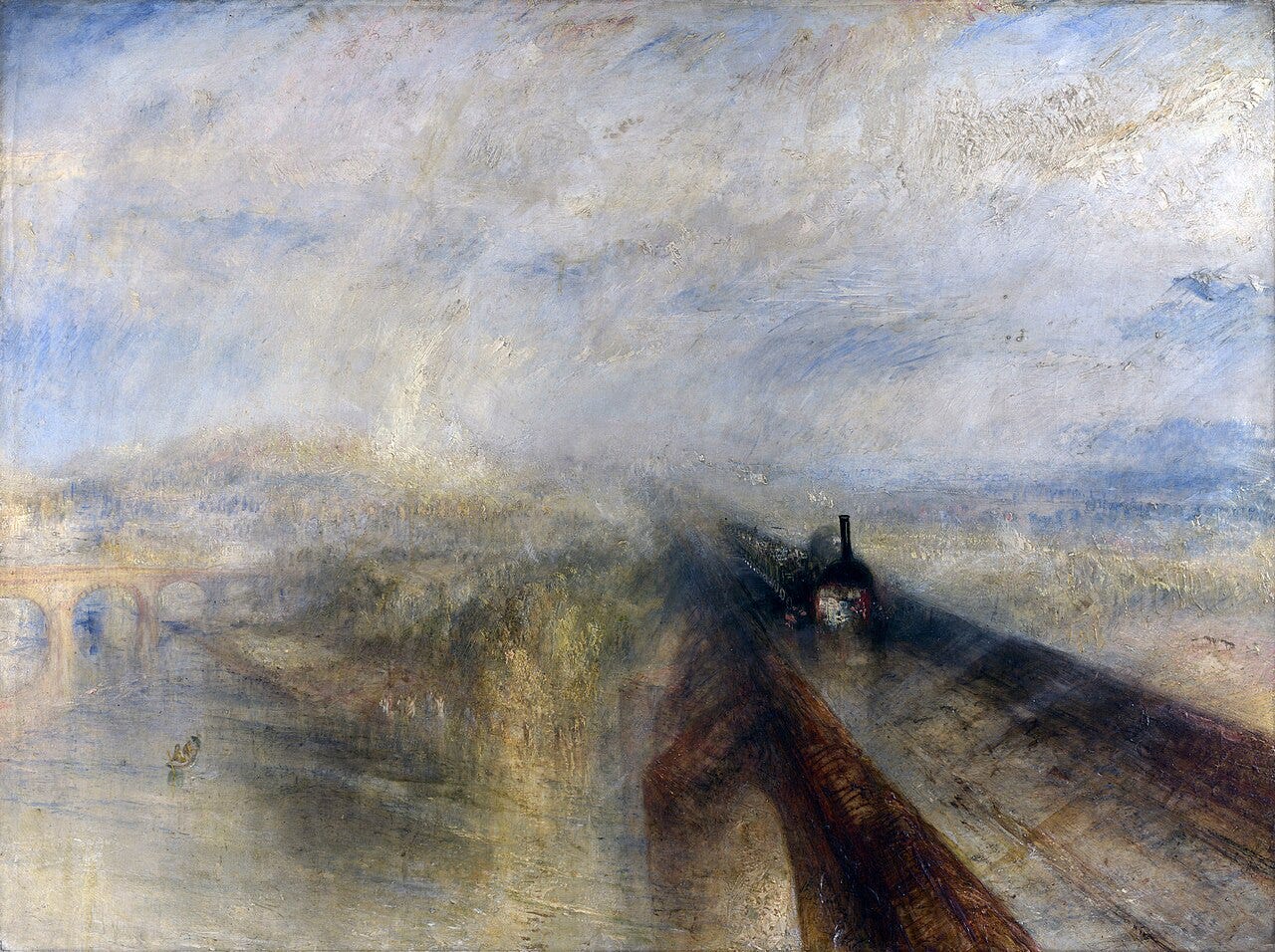
1844. Rain, Steam and Speed brought the railway into painting.
1851. Died in Chelsea under the assumed name Booth. He is buried in St Paul’s.
The painter of light
Turner was obsessed with light and weather. Early on he could paint a precise harbor or ruin, but year by year the solid world dissolved in his hands until his late canvases became storms of gold, white and grey.
He pushed Romantic landscape somewhere nobody had taken it before.
The Slave Ship and the Fighting Temeraire
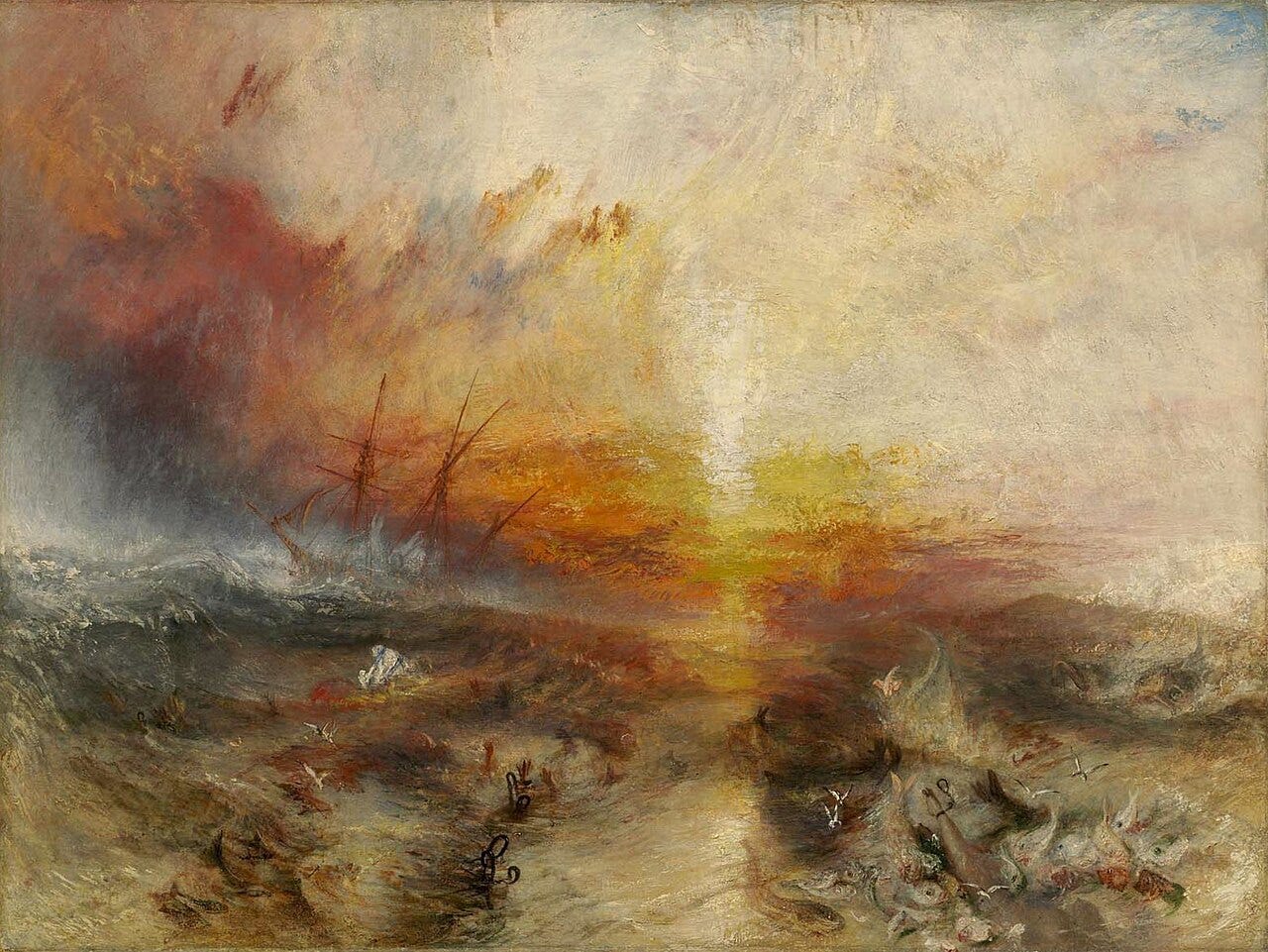
Two paintings sum up his range. The Slave Ship of 1840 turns a real atrocity, drowned captives thrown overboard, into a furnace of red sea and sky, a piece of moral fury.
The Fighting Temeraire, an old warship towed away to be broken up, became so loved that Britain later voted it the nation's favorite painting.
The man who tied himself to a mast
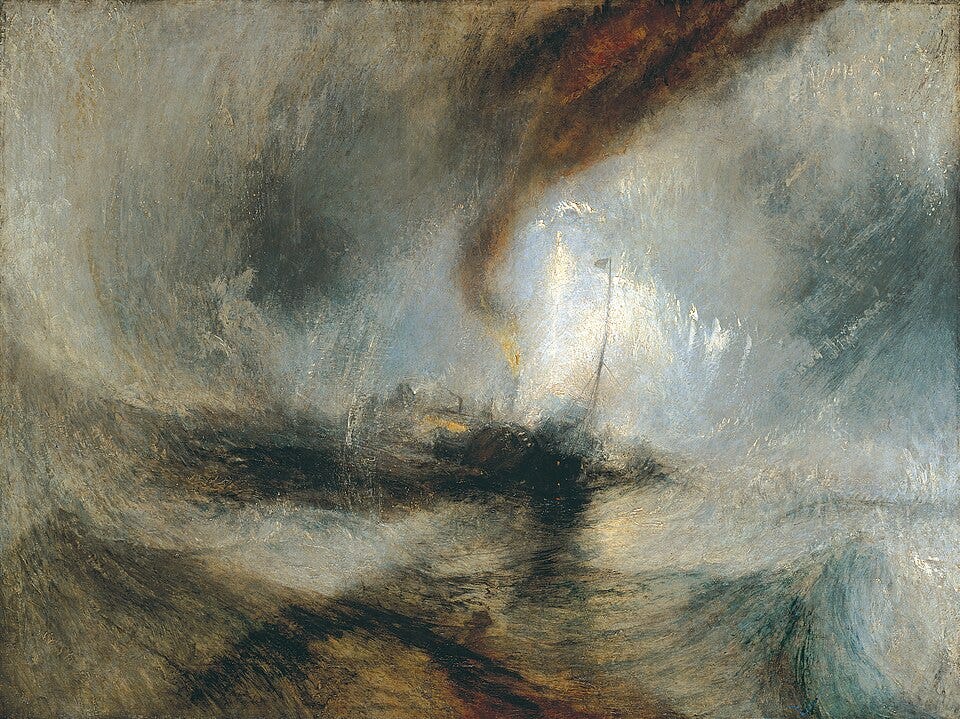
Turner wanted to paint a storm from the inside. The story goes that he had himself lashed to a ship's mast for four hours in a blizzard to feel it, then painted Snow Storm from memory. The steamboat all but disappears into the weather, which is why we count Snow Storm among the seascape paintings where sea and sky, not any ship, carry the picture.
True or not, it is exactly the kind of risk his pictures feel like.
Watercolor and endless travel
He was one of the greatest watercolor painters who ever lived, travelling across Britain and Europe with a sketchbook, chasing light through the Alps and along the Rhine. He made tens of thousands of works on paper.
The secret life
For all his fame, Turner guarded his private world. In his last years he lived quietly in Chelsea under a false name, Mr Booth, with his companion Sophia Booth, and let almost no one in.
He shaped the young Claude Monet, who studied his work in London and never forgot it.
The showman of varnishing day
Turner loved to win. On the varnishing days before a show opened, when painters could touch up their work on the gallery wall, he would finish a canvas in public to upstage his rivals.
In one famous moment he dropped a single dab of bright red into a grey seascape hanging next to a quiet Constable, pulling every eye to his own picture.
Constable grumbled that Turner had been in and fired a gun. He guarded his methods and let the legends grow around him.
What he left behind
When he died in 1851 he left the bulk of his work to the British nation: around three hundred paintings and tens of thousands of drawings and watercolors, the Turner Bequest. The country is still unpacking it.
Born above a barber shop in Covent Garden
Joseph Mallord William Turner was born on 23 April 1775 in Maiden Lane, in the Covent Garden district of London. His father, William Turner, ran a barber shop and made wigs, and the family had little money.
His father saw the boy's gift early. He pinned young William's drawings to the shop wall and sold them to customers for a few shillings each. That shop was Turner's first gallery, and it taught him that pictures could pay.
He never lost the plain London accent of that street. Even when he was rich and celebrated, he stayed careful with money and wary of strangers, a habit that started in a working barber's shop where every coin counted.
The mother sent to Bedlam
Turner's home life carried a heavy shadow. His mother, Mary Marshall, suffered from severe mental illness that grew worse through his teenage years.
In 1799 she was admitted to St Luke's Hospital, then moved to the Bethlem Hospital in Moorfields, the asylum Londoners called Bedlam. She died there on 15 April 1804.
As a boy, Turner was often sent away to relatives, including an uncle in Brentford, west of London. He learned to keep to himself.
He almost never spoke of his mother in later life. Some scholars believe the long shadow of her illness helped push him toward the sea and sky, subjects far from the family rooms he left behind.
A prodigy at the Royal Academy
Turner entered the Royal Academy Schools on 11 December 1789, aged just 14. A year later, at 15, he showed his first watercolor at the Academy's summer exhibition.
He worked as an architectural draftsman while he trained, and his first oil painting appeared at the Academy in 1796.
Here is a myth worth correcting. People often picture Turner as a rough, untaught outsider who painted on instinct. In truth he was academy trained from childhood and knew the rules better than most.
He was elected an Associate of the Royal Academy in 1799, and a full Royal Academician on 10 February 1802, aged 26, among the youngest ever chosen. From 1807 to 1837 he also served as the Academy's Professor of Perspective.
Chasing Claude Lorrain
Turner measured himself against the dead as much as the living. His great model was the seventeenth century French painter Claude Lorrain, whose golden harbor scenes he studied for a lifetime.
He was competitive with rivals too, above all the landscape painter John Constable. But it was Claude he wanted to be ranked beside forever.
He arranged it in his will. Turner left two of his own paintings, Dido Building Carthage and Sun Rising through Vapour, to the National Gallery in London.
His condition was exact. They had to hang between two named Claudes, Seaport with the Embarkation of the Queen of Sheba and The Mill. The gallery agreed, and the four paintings still hang together today, a rivalry frozen on the wall.
The Liber Studiorum
Turner wanted to prove that landscape could carry as much weight as grand history painting, so he built a printed argument for it. The project was called the Liber Studiorum, meaning book of studies. He began it in 1807 and worked on it until 1824.
He sorted the prints into six kinds of landscape: historical, pastoral, epic pastoral, mountainous, architectural, and marine. Around seventy plates appeared.
The idea came straight from Claude, whose own Liber Veritatis recorded his compositions. Turner etched the outlines himself and worked closely with engravers on the tone.
The series showed that landscape could hold drama, history and feeling, and it spread his name to buyers who could not afford an oil painting.
The Alps and Venice remade his light
In 1802, during a brief peace with France, Turner crossed the Channel and reached the Alps, stepping into the Val d'Aosta on the edge of Italy. The scale of the mountains changed what he thought a landscape could do.
Italy pulled him back for the rest of his life. He made three trips to Venice, in 1819, 1833 and 1840. Venice did something to his eye that nothing else had.
The city sits on water, and its light bounces off canals and pale stone until solid buildings seem to melt.
His late Venetian scenes dissolve stone into color and reflection. Form gives way to atmosphere. The trips did not just add subjects to his sketchbooks. They loosened his whole way of seeing.
Skies born from a volcano
Some of Turner's most intense sunsets may owe a debt to a disaster on the far side of the world. In April 1815, Mount Tambora in Indonesia erupted, the largest eruption in recorded history, and threw huge amounts of ash and sulfur into the upper atmosphere.
Those particles spread around the globe over months. For several years, skies across Europe turned strange colors at dawn and dusk, deep reds, oranges and yellows.
Turner was painting exactly then, and his skies from the period glow with that heavy, colored haze. Scientists have since studied paintings from these years to estimate how much volcanic dust hung in the air.
Turner's canvases became, by accident, a record of the sky science can still read.
Rain, Steam and Speed and the railway age
Turner did not turn away from the machines that were changing Britain. He ran toward them.
In 1844 he exhibited Rain, Steam and Speed, the Great Western Railway at the Royal Academy. It shows a steam train racing across the Maidenhead bridge over the River Thames, wrapped in rain and light.
The engine looks half dissolved by weather and motion, and many viewers even claim to spot a hare running ahead of the train on the tracks.
The painting hangs in the National Gallery in London today. It captures the moment steam power was remaking travel. Where other painters saw ugliness in the railway, Turner saw a new kind of speed and force worth painting.
Soapsuds, whitewash and Ruskin's defense
As Turner aged, his paint grew looser and his forms thinner, until some canvases were almost pure color and light. Not everyone approved.
When he showed Snow Storm in 1842, one critic dismissed it as nothing but soapsuds and whitewash. Turner, who claimed he had watched a real storm lashed to a ship, snapped back that he wondered what the critics thought the sea was like.
Then came his champion. The young writer John Ruskin published the first volume of Modern Painters in 1843, built largely to defend Turner and rank him above every landscape painter before him.
Ruskin called the same late work grand where others called it a mess, and his long campaign lifted Turner's reputation through the second half of the century.
Admiral Booth and a grave in St Paul's

In his last years Turner all but vanished. By 1846 he was living quietly in a house by the river in Chelsea with a widow named Sophia Caroline Booth.
He took her surname to hide. Neighbors, who had no idea he was Britain's most famous painter, knew him only as Admiral Booth and assumed he was a retired sailor.
Turner never married. He died in that Chelsea house on 19 December 1851, aged 76. He was buried in St Paul's Cathedral in London, close to the painters Joshua Reynolds and Thomas Lawrence.
That was his own wish. He had asked to lie among his brothers in art, and the Academy he joined at 14 laid him among its greatest names.
More secrets to unlock


Quick answers about JMW Turner
Who was JMW Turner? The leading British Romantic landscape painter, a master of light.
When was he born? In London, in 1775.
How did he die? In Chelsea, London, in 1851.
What is he famous for? The Fighting Temeraire and the Slave Ship.
What movement did he belong to? Romanticism, pointing ahead to Impressionism.
Where can I see his work? Tate Britain in London holds the great Turner Bequest.
Where was JMW Turner born? He was born on 23 April 1775 in Maiden Lane, in the Covent Garden district of London, where his father worked as a barber and wig maker.
Why is the Turner Prize named after him? Tate created the Turner Prize in 1984 and named it after Turner, partly in answer to his own unfulfilled wish to set up an award to help younger artists.
The Turner Prize, the most famous and most argued over art award in Britain, is named after him. A painter who hid his own life now lends his name to the loudest debate in art each year.
Turner and John Constable were rivals at the Royal Academy for decades, exhibiting in the same rooms while pursuing opposite ideas of landscape. Constable's career is covered in John Constable, The Complete Story.