
Otto Dix was the German painter who refused to let the world look away from the First World War. He volunteered, fought in the trenches as a machine gunner, and spent the rest of his life painting what he had seen: shattered soldiers, ruined faces, the rot and waste of battle.
Dix at a glance:
Born near Gera in 1891, a foundry worker's son.
Volunteered in 1914 and served as a machine-gunner through the worst of the Western Front.
The 1924 print cycle Der Krieg is the century's harshest war reporting in art.
The Nazis fired him in 1933 and hung his work in the Degenerate Art show.
Died in 1969, having painted both Weimar's glitter and its wounds.
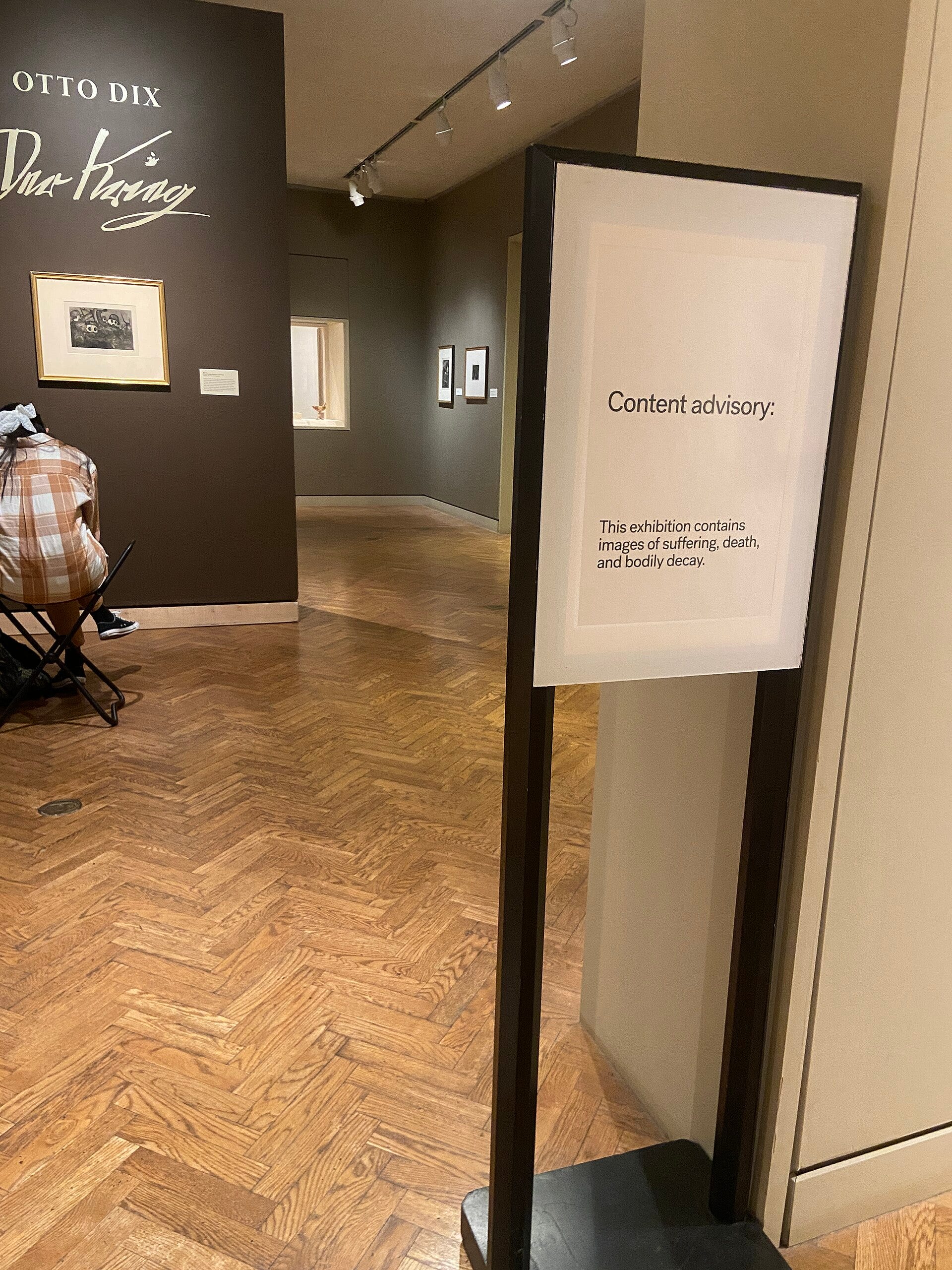
His unflinching honesty made him a target of the Nazis.
He once said he had to see it all for himself, the depths of human suffering.
Born: Gera, Germany, 1891
Known for: brutal war paintings, New Objectivity, savage Weimar portraits
Died: Singen, Germany, 1969
More incredible painter stories
If Otto Dix pulled you in, you will love these too:


The war he could not unsee
Dix carried the trenches home in his head. His print cycle The War and his great triptych of the same theme show corpses in the wire, gas masked figures and blasted ground, with a clarity that is hard to bear. See what is etching.
He did not paint glory or grief in the abstract. He painted the exact, physical truth of what shells do to bodies, as a warning carved in detail. See what is history painting.
The cold eye of New Objectivity
After the war Dix became a leader of New Objectivity, a movement that answered chaos with brutal, clear eyed realism. He painted Weimar Germany without mercy: profiteers, wounded veterans begging on the street, the journalist Sylvia von Harden at her cafe table.
See what is realism.
The portraits are sharp to the point of cruelty, yet strangely tender toward the broken and the overlooked.
Branded degenerate
When the Nazis took power, Dix was an obvious enemy. They threw him out of his teaching post, seized and displayed his work as degenerate art, and burned or sold what they could.
He retreated to the countryside and painted quieter landscapes to survive, then was conscripted again in the Second World War, old now, and briefly held as a prisoner. See what is expressionism.
You can explore works by Otto Dix in the collection of the Metropolitan Museum of Art.
From an iron foundry to a Dresden classroom
Dix was born on 2 December 1891 in Untermhaus, a small place beside Gera in Thuringia. His full name was Wilhelm Heinrich Otto Dix, and the household was working class.
His father Franz worked in an iron foundry and his mother Pauline earned money as a seamstress.
The pull toward art came early. At the age of ten he posed for a local painter named Fritz Amann, and the hours in that studio settled the question of what he would do.
A schoolteacher arranged support on the condition that the boy also learn a trade, so Dix spent four years apprenticed to a decorative painter.
In 1909 he entered the School of Applied Arts in Dresden. The teaching there leaned toward craft rather than academic painting, which left him largely self taught.
He copied the old Dutch, Italian and German masters to learn how they built luminous surfaces, and a Van Gogh exhibition he saw in 1913 pushed him toward stronger colour.
The war he asked to see
When the First World War broke out, Dix did not wait to be called. He volunteered, and he later explained the impulse without flinching. He said he had to experience the depths of life for himself, and that this was the reason he went.
The army trained him behind the guns as a machine gunner. By 1915 he was at the front in France, and he lived through some of the worst fighting of the war, including the Somme. He was wounded more than once.
The years did not turn him into a platform speaker. They turned him into a witness who could not look away, and what he saw supplied his subjects for the next four decades.
Fifty plates and a war altarpiece
In 1924 Dix published Der Krieg, a portfolio of fifty etchings that moved through the war in close detail, from the march to the front to the rotting dead.
The set stands in the line of Goya and his prints of the disasters of war, made to be turned page by page rather than hung on a wall.
He returned to the theme on a grand scale between 1929 and 1932 with the triptych The War, painted in oil and tempera on wood. It now hangs in Dresden.
The shape is deliberate. Dix built it like a German Renaissance altarpiece, with a central panel, two wings and a narrow strip below.
The dead soldier stretched across that lower panel recalls Mantegna and old images of the entombed Christ, so a scene of mass killing takes a form once reserved for sacred painting.
The technique he borrowed from the old masters
Around 1920 Dix turned his back on the Expressionist manner of his youth. In its place he adopted the methods of fifteenth and sixteenth century German painting.
He worked on wood panels, laying thin glazes of oil and tempera one over another to build a hard, glassy depth. The finish recalls Cranach, Baldung Grien and Grunewald, the painters he studied most closely.
The old method served a modern aim. He wanted to depict things as they really are, and the patient, exact surface of Renaissance painting let him render a face or a wound with almost clinical precision.
The faces of Weimar
Dix became the great portraitist of the Weimar years. In 1926 he painted the journalist Sylvia von Harden at a cafe table, all angles and nerves, a cigarette in her hand.
He said he had stopped her in the street and told her she represented an entire epoch. The picture later shaped the look of the 1972 film Cabaret.
His sitters were doctors, lawyers and dealers as often as performers. He showed the throat specialist Mayer Hermann as a mass of circles, from the round face to the round lamp on his brow, a portrait that edges into satire.
He looked at the city itself as well. The triptych Metropolis, painted in 1927 and 1928, lays the nightclub and the pavement side by side, the dancers above and the beggars below.
The cripples at the card table
Some of the hardest pictures Dix made were of the men the war sent home. In Skat Players of 1920 he sat three disfigured veterans around a game of cards, each rebuilt from prosthetic jaws, glass eyes and mechanical limbs, still playing on as if nothing had happened.
He returned to the theme in War Cripples, a procession of maimed former soldiers begging on a Dresden street. The Nazis later seized the painting as degenerate, and it has been missing since, known now only from photographs and a related print.
Dix refused to make any of it noble. He showed the wounded as the state preferred not to see them, which is exactly why the work still carries a charge.
Coded defiance in Seven Deadly Sins
After the Nazis stripped Dix of his teaching post, he answered on canvas. In 1933 he painted Seven Deadly Sins, a grim allegory in egg tempera on wood, now held in Stuttgart.
At its centre, Sloth is a skeleton whose outstretched arms and scythe fold into the shape of a swastika. Dix blamed exactly that passivity for letting Hitler climb to power.
On the skeleton rides Envy, wearing a mask with Hitler's face. He added the small moustache only after the war, once it was safe to do so.
Arrest, the home guard and a prison camp
The pressure kept rising. In 1939 Dix was jailed on a charge of complicity in a plot on Hitler's life. The charge was dropped and he was let go.
Near the end of the fighting, in 1945, the state drafted the painter into the Volkssturm home guard at the age of 53. He was captured by French forces and held as a prisoner of war until 1946. Inside the camp he painted a triptych for the chapel.
Singen, and where to find him now
The later Dix turned toward religion and allegory, painting biblical scenes such as Saul and David in 1945 and a Crucifixion in 1946.
In 1967, after a trip to Greece, he suffered a stroke that paralysed his left hand. He died at Singen, in southern Germany, on 25 July 1969, at the age of 77.
His work is now spread across major collections. The War triptych stays in Dresden, the portrait of Dr Mayer Hermann hangs at the Museum of Modern Art in New York, the Sylvia von Harden portrait is at the Pompidou in Paris, and Seven Deadly Sins is in Stuttgart.
The machine-gunner who kept sketching
Dix carried sketchbooks through Flanders and the Somme, drawing craters and corpses between attacks.
He later said he had to see everything with his own eyes, war included. The nightmares lasted decades; the drawings became Der Krieg.
Old master technique, modern horror
For the great Weimar portraits Dix revived the old masters' method: tempera underpainting, oil glazes, panel instead of canvas.
The result is Grosz's subject matter with Holbein's surface, and it is why his sitters, the dancer Anita Berber above all, look simultaneously embalmed and alive.
Inner exile on Lake Constance
Banned from exhibiting, Dix retreated to Hemmenhofen on Lake Constance in 1936 and painted landscapes that fooled the censors.
Conscripted into the Volkssturm at 53, captured by the French, he came home in 1946 and painted to the end, unfashionable under every regime and vindicated by all of them.
The Otto Dix questions that keep coming up
What is Otto Dix famous for?
What is Der Krieg? Fifty etchings from 1924 built from his trench sketchbooks and memories, published in portfolios that veterans' groups both praised and tried to suppress.
Why did the Nazis hate Dix? His war images contradicted heroic myth and his Weimar portraits documented everything the regime called degenerate. He was fired from his Dresden professorship in 1933, among the first.
Harrowing First World War paintings and prints, and his savage portraits of Weimar Germany.
Did he fight in the war?
Yes, he volunteered and served as a machine gunner, which shaped his whole career.
Why did the Nazis attack his work?
They branded it degenerate, removed it from museums and forced him from teaching.
When did he die?
In 1969, in southern Germany.
How much does an Otto Dix cost? Major paintings rarely surface, and when they do they bring seven figures; his watercolors and the Der Krieg print cycle of 1924 trade from five figures up, and museums hold the core.
Where can I see Otto Dix? The Gemäldegalerie Neue Meister in Dresden for the War triptych, the Stuttgart Kunstmuseum for the great Metropolis triptych, and Berlin's Neue Nationalgalerie for the portraits.
More secrets to unlock


Why the warning still holds
Dix made art that is genuinely difficult to look at, and that is the point. A century on, his trenches remain among the most honest images of war ever painted, a record made by a man who insisted the truth be seen.
One last detail. He kept a sketchbook in the trenches and drew constantly under fire, hundreds of studies made in the middle of the slaughter. The paintings that shook a nation grew from notes taken with shells falling around him.