
An allegory is a picture in which the figures and objects stand for something beyond themselves: abstract ideas like Justice, Time, Love or Death, made visible as people and symbols.
An allegorical painting is not just a scene to look at. It is a coded message to be read.
A blindfolded woman holding scales is not a woman. She is Justice. A winged old man with a scythe is Time.
Painters even worked from a handbook for it, Cesare Ripa's Iconologia of 1593, which spelled out how to picture Envy, Hope or Deceit.
Allegory, the short version
What it is: a painting where figures and objects represent ideas.
The aim: to make abstract concepts visible and readable.
The tools: personifications, attributes and symbols.
The relatives: iconography, emblem books and the vanitas.
The catch: you often need the key to read it fully.
No lectures, just stories


Ideas in human form
Allegory turns concepts into characters.
A blindfolded woman holding scales is not a person, she is Justice. An old man with wings and a scythe is Time. A skull is death, an hourglass is the passing hour.
By giving each idea a recognizable body and a set of objects, called attributes, the painter builds a sentence out of figures. Reading it depends on knowing the code, which is the work of iconography.
You do not just see the figures. You translate them.
A puzzle for the learned
For centuries, allegory was a game for educated viewers, and I love that it still rewards the effort.
Renaissance and Baroque patrons loved paintings that hid a clever moral or political message behind a beautiful surface.
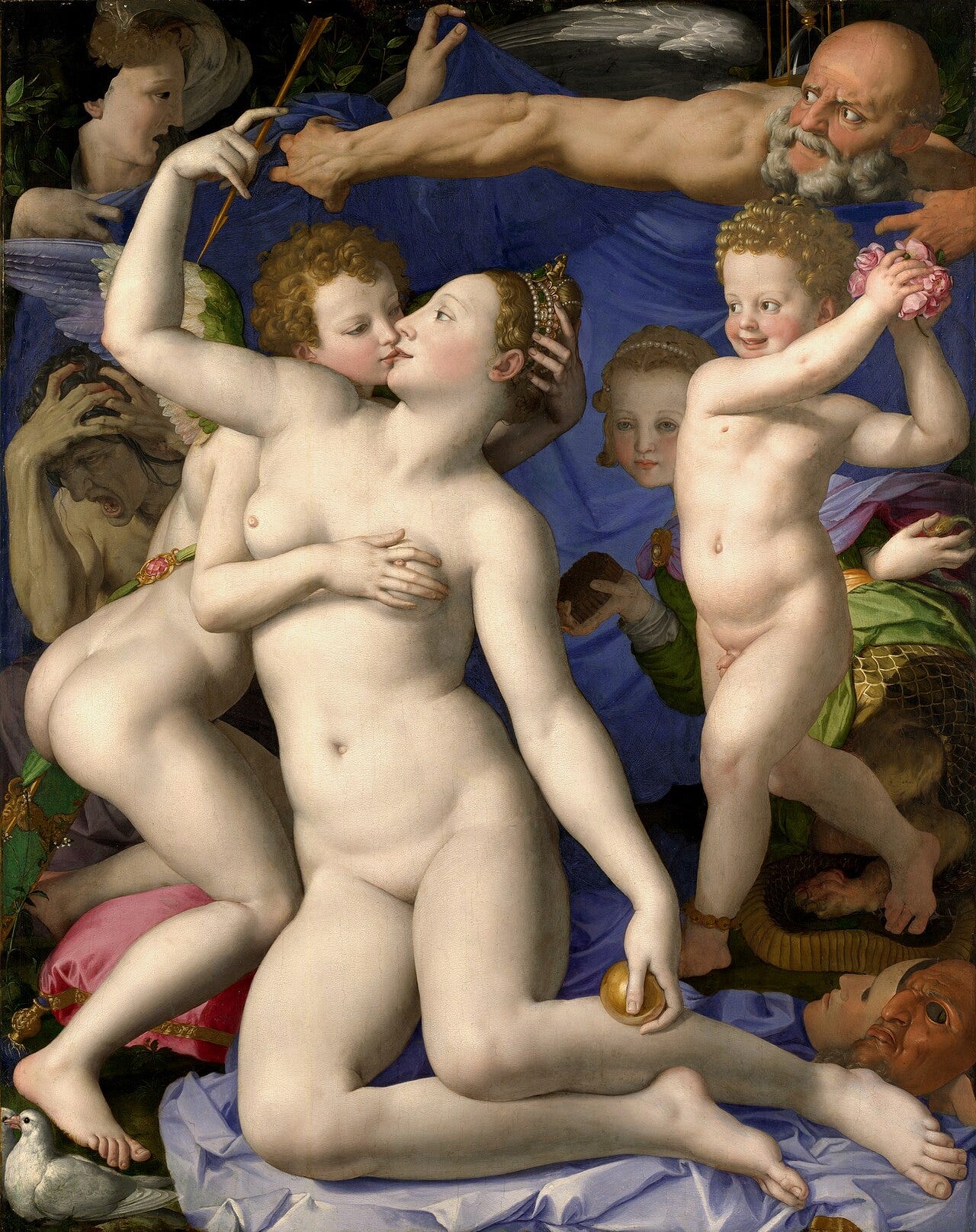
Bronzino's famous allegory of Venus and Cupid is a glittering, sensual tangle of figures that also encodes a warning about love, time and deceit, and scholars still argue over exactly what every figure means. Half the pleasure was decoding it.
The painting flattered you twice: once with its beauty, once with the riddle only you could solve.
More than a still life
Allegory often hides inside other kinds of picture.
A vanitas still life is really an allegory of mortality, its skulls and snuffed candles spelling out the shortness of life. A grand history painting might dress a real war as a triumph of Virtue over Vice.
The allegorical habit runs through the whole tradition: objects rarely mean only themselves.
Once you start reading for it, and I cannot stop now, allegory is everywhere.
When everyone could read it
Allegory was once a shared public language.
In an age before mass literacy, a figure of Justice on a courthouse or Charity on a tomb communicated instantly to people who could not read a word.
These personifications were a visual vocabulary everyone half knew. Today that fluency has faded, which is why so many old allegories now feel like locked rooms.
That everyday key has been lost.
The pictures did not get harder. The language was simply forgotten.
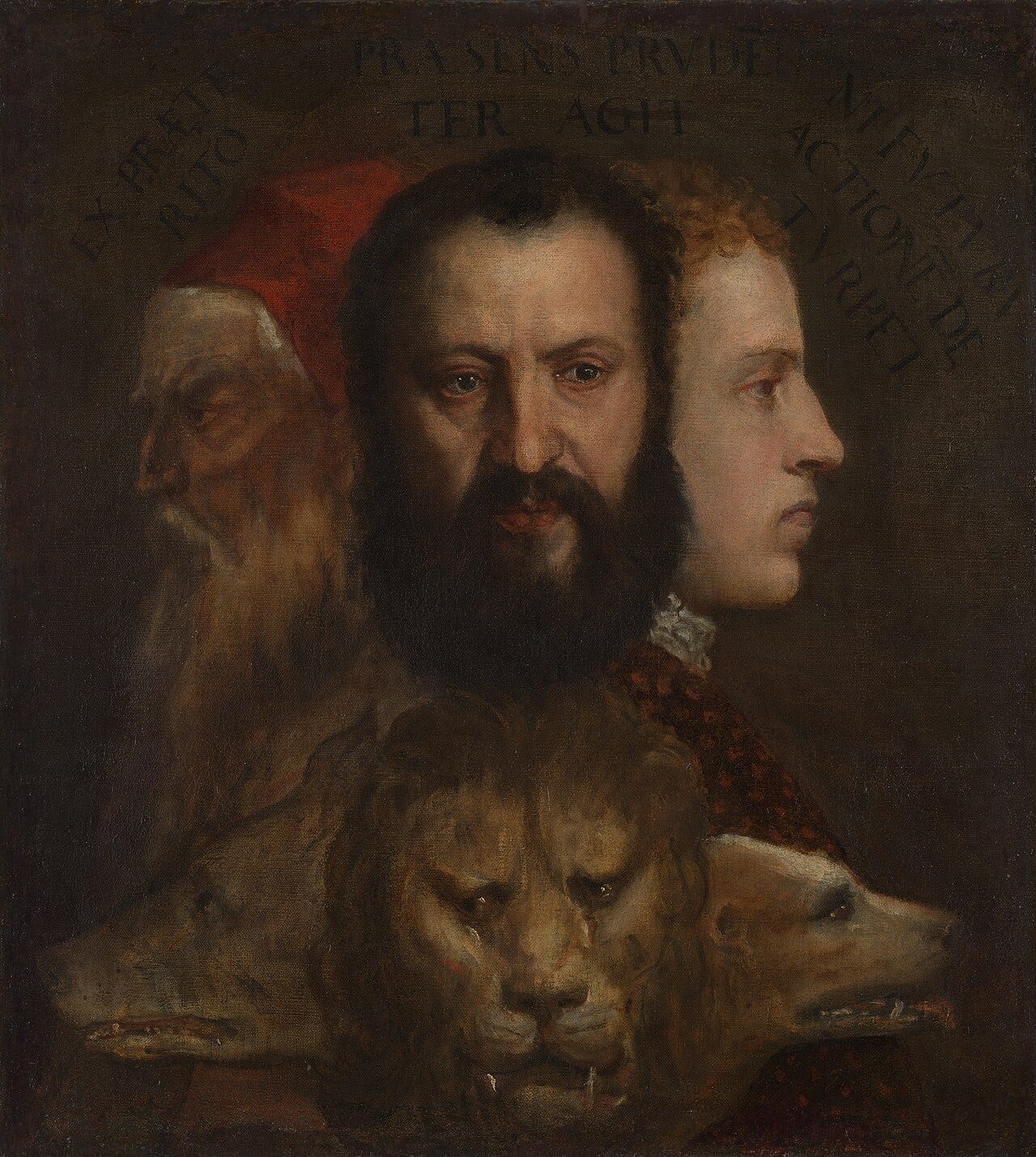
Two of the greatest hang in Europe. Bronzino’s Allegory with Venus and Cupid is in the National Gallery, and Vermeer’s Art of Painting in the Kunsthistorisches Museum, Vienna.
Decoding a picture is exactly the pleasure of 7 secrets hidden in famous paintings.
Allegory, what people ask me
What is allegory in art? A painting where figures and objects represent abstract ideas.
How is it different from a normal scene? The figures are not just themselves. They stand for concepts like Justice or Time.
What is an attribute? An object that identifies a personification, like the scales of Justice.
Is a vanitas an allegory? Yes. A vanitas still life is an allegory of mortality.
Why are old allegories hard to read? Their symbolic language was once common knowledge and has since faded.
What comes next


The painting you have to read
Most people are taught to look at paintings. Allegory asks you to read them, to find the argument about virtue, love, time or death spelled out in symbols behind the beautiful bodies.
Recovering that lost alphabet is, to me, one of the quiet joys of old art: the moment a gorgeous, puzzling scene suddenly clicks into meaning.
